Showing posts with label Topeka tourism. Show all posts

Tuesday, February 10, 2026

Ah Kansas!

 
If there's anything better than life - it's life in Kansas.
Kansas Chamber of Commerce, 1930
 
It's been awhile since Randy and I were in school. But we can still complete an assignment. This morning, we spent an hour with Mrs. Kylie Meyer's second grade class at Stafford Elementary School, Randy's alma mater. 
 
Mrs. Meyer gave us an assignment to compare the "then and now" of farming. The second graders are learning about comparison and contrast. Mrs. Meyer helps to illustrate the concept by inviting community members with different backgrounds to talk about their professions or interests and compare them, then and now. 
 
Another Then and Now comparison: When Randy was in second grade, there were two classes of 26 each. This year's class has 16. We also talked about the difference in the number of farms and the county population when comparing then and now.
 
We have gladly participated in this activity for several years now. I put together a PowerPoint slide show with historic photos from both of our families. We were both 5th generation farmers before retiring in 2022. Many of the photos are from books my mom compiled for our kids with memories of family members and farm equipment from my parents' farming legacy. (There are several photos from the slide show and links to family history posts HERE in a blog post from 2022.)


For this year's presentation, I added some information on the number of farms in the early 20th century compared to now. That information was from our visit to the Kansas Museum of History in Topeka on the day after Kansas Day. I suppose a Kansas Day visit on January 29 would have been more symbolic. But, after finding out that 800 people (mostly school children) had been at the museum on Kansas Day to celebrate the state's 165th birthday, we were happy we were able to visit on a quieter day!


What is Kansas? Kansas is a crossroads. The heartland. A geographic center. The birthplace of ideas that have shaped our nation. A site of adaptation, conflict and consensus. A home of people, ideas and dreams ... Why Kansas? People came to Kansas for many reasons: for the land, for its resources and for the promise of a better life. Some, regrettably, came by force. Kansans stayed to make a home, to make a living or to fight for a cause. While here, Kansans have experienced conflict and cooperation, engaged in innovation and adaptation and promoted celebrations and communities. 
From displays at the Kansas Museum of History

Randy had been to the museum with our Kansas Master Farm Family group four years ago. However, I was sick and didn't get to go on the tour.

Since Jill and crew live in Topeka, we're often looking for something to do when the girls are in school and Jill and Eric are working. The Kansas History Museum wasn't an option for several years. It had been shut down for three years, undergoing a $6 million renovation. It updated the 1980s-era displays to new, colorful, interactive exhibits. 

While we were mainly in Topeka to see the girls' sports activities and to enjoy some family time, we thought the Kansas Museum of History was a worthwhile diversion. The gallery shares personal stories of people who came for many reasons and became Kansans for many more. The new exhibits are broken into four main themes: Bleeding Kansas, Making Kansas, Connecting Kansas, and Changing Kansas:

Bleeding Kansas tells our formative story from the territorial period, tracing the political and violent events that led to our statehood and recounting Kansas' role in the Civil War.
Making Kansas shares stories of people building lives, developing industries and grappling with extreme weather - experiences rooted in the land and its rich resources. 
Connecting Kansas weaves accounts of trails, transportation and the railroad which shaped our towns and influenced immigration and settlement.
Changing Kansas explores efforts for civil rights and social reforms, examining why Kansas is often at the heart of issues with national implications. 

There was also information on Kansas' indigenous history, featuring contributions from all 36 tribes with historical ties to the area.

We have seen the actual mural of John Brown in the Kansas Capitol on another "tourist" day in Topeka. (Click HERE for that blog post.) The Capitol mural was painted by artist John Steuart Curry on the east and north walls of the east corridor of the Capitol's second floor. 

But a reproduction of the mural also helped tell the story of "Bleeding Kansas" in the museum. And I learned something new about the mural:

The famous mural depicts the moral complexities of war, featuring a heroic, yet fanatical, John Brown painted larger than life. Many Kansans opposed Curry's interpretation, saying it misrepresented their state's identify. Frustrated by the criticism and unable to fulfill his vision, Curry refused to sign his statehouse murals and left Kansas. He died of a heart attack in 1946 at the age of 48, never knowing how celebrated his work would become.  

As required by the new constitution, the first Kansas Legislature established the state seal and motto in a joint resolution on May 25, 1861:
 
The east is represented by a rising sun in the right hand corner of the seal; to the left of it, commerce is represented by a river and steamboat; in the foreground, agriculture is represented as the basis of the future prosperity of the state by a settler's cabin and a man plowing with a pair of horses; beyond this is a train of ox-wagons going west; in the background is a heard of buffalo, retreating, pursued by two Indians on horseback.
 
The motto, Ad astra per aspera, which means "to the stars through difficulties," is above 34 stars, representing Kansas' entry as the 34th state in the Union. 
 
What is Kansas? It is the promise of a better life - sometimes fulfilled, sometimes deferred. It is striving to reach the stars in the face of difficulties. It is the joy of belonging, the creation of community.

Kansas is the story of everyday people whose inspiring narratives reach far beyond the state's borders. Some Kansans served the noblest of goals. Some served their own self-interests. Most, just like the rest of us, acted with complicated and very human combination of both. Regardless of their intentions, they all helped shape the world we know today.  

The Emporia Gazette used this cylinder press from 1890 to 1906 to print daily and weekly issues, including William Allen White's influential 1896 editorial, "What's the Matter with Kansas?"

While I enjoyed all the exhibits, I especially liked the "power of the press" section. (I worked as a reporter and editor at The Hutchinson News for nine years and have done a daily M-F radio Central Kansas Report for KFRM 550AM radio since March 2008.) The exhibit featured Emporia journalist William Allen White's printing press and a projector showing Kansas headlines, even as recently as the police raid on The Marion County Record newspaper back in August 2023.

And, of course, both Randy and I were attracted to the displays featuring farming and agriculture.  

I took a photo of this because the windmill was from Clay Center, where my sister lives.

"All parts of Kansas grow good corn, but
in wheat, Kansas can beat the world."
-- Topeka Daily Capital, 1889 

Farming is a way of life in Kansas, impacting its politics, laws, innovations, social customs and traditions. The economy relies on many agricultural businesses, including those related to storing, transporting and processing farm products.

Most early Kansas farmers wanted to grow crops they could sell. The standard farm size of 160 acres was too large for subsistence farming but generally not large enough for commercial ventures, especially as farmers moved west. As technology advanced in the late 19th and early 20th centuries, farming became big business in Kansas. There were 178,000 farms in Kansas in 1910, with an average farm size of around 244 acres. That number dropped to 55,000 farms in 2023, with an average size of 807 acres. Changing - and more expensive - technology, fluctuating crop prices and efforts to make farming more efficient all contributed to the rise of larger farms and agribusiness. With its advancements in agriculture, Kansas came to be know as the Wheat State and the Breadbasket of the World.  


This just scratches the surface. There is also a 1914 biplane made in Topeka, an 1860s cabin, train cars and depot and lots more. Both Randy and I would recommend a visit if you're near Topeka. Hours are 9 AM to 5 PM Tuesday through Saturday and Sunday from 1 to 5 PM. It is closed on Mondays. 

***

And, just for my memories, we also got to experience several of the girls' activities. 


 We picked up Kinley from school and got to watch her tennis lesson.  


We saw Brooke's basketball game. 

And we got to see a couple of her volleyball games (and witness the coach's skills.)


Though I don't have photographic evidence, we shopped for Kinley's 14th birthday presents in Kansas City and ate lunch with the whole family - including Brent and Susan. 

Fun and a little education? It was another great stay.

Thursday, June 19, 2025

Topeka Tourist, Take Two

I may be asked to revoke my Kansas citizenship. Not really, but before a recent visit, I had toured the Iowa State Capitol more recently than the Kansas State Capitol in Topeka. However, we remedied that during a trip last month to Topeka. While the girls were in school and Jill and Eric were working, we did our own version of a staycation. We worked our tourist events around a week full of tennis, track, softball and music. 

Randy had toured the Capitol a few years ago on a Kansas Master Farm Families Discover Kansas trip. However, I was sick and missed out. At the Iowa Capitol, I did take the 97-step climb to the top of the dome. (Click HERE for a "tour" of that capitol building). But we opted not to take the 296 steps to the top on this trip to the Kansas Capitol.

While I wasn't attempting to take a photo of Randy's socks, I had to smile when I looked at the pictures again. Randy forgot his short socks at home. No worries: Kinley instructed him in the fine art of arranging your tube socks just so - like a junior high girl!
 

The Kansas State Capitol recently completed a 13-year, top-to bottom-renovation of the building that restored the original architect's vision by uncovering murals, preserving original features, renovating aging limestone and expanding work space.  

Randy is standing on a map of Kansas that's located on the floor near the Visitor Center entrance. He's standing on the County Line - just like home!

Construction of the central building began in 1886. The building was declared officially complete in 1903, after 37 years of construction. 

The Capitol's distinctive copper dome with Ad Astra statue is a prominent feature of the Topeka skyline, but the view inside the dome is just as spectacular.

The Ad Astra statue sits atop the Kansas State Capitol dome. It is a 22-foot tall statue of a Kaw warrior with a bow and arrow drawn. The statue's name, Ad Astra, is derived from the state motto, "Ad astra per aspera," which translates to "To the stars through difficulties." The statue was crafted by the late Richard Bergen from Salina and was installed in 2002.

Topeka Capitol Journal photo (from the web)

Ad Astra wasn't the first idea to crown the Capitol. In 1889, during the Capitol's construction, J.H. Mahoney won a design competition to select what would top the dome. He proposed a 16-foot bronze statue of Ceres, the Roman goddess of agriculture. However, some people balked at the price and others argued about her mythological morals. The idea was abandoned, and the dome remained unadorned for more than 100 years. In the Capitol's Visitor Center, this 3-foot plaster model shows the original artist's vision.

But murals have long been a part of the beauty of the Capitol.

In the 1930s, John Steuart Curry painted murals on the second floor including the building's most famous painting, Tragic Prelude, which depicts an oversize and raging John Brown wedged between the warring sides of the American Civil War flanked by flames and a tornado. Curry's depiction of Brown is believed to be the only instance of a person convicted of treason being featured in a state capitol (Wikipedia).

David Hicks Overmyer painted a series of murals in the first floor rotunda between 1951 and 1953.


These agriculture-themed murals were some of my favorites, but there are many others, too.

This ode to Kansas and its state flower was another favorite. It says:

Rich with fields of corn and wheat
Gleaned from Nature's richest dower
Peerless Kansas on the Plains
Even the sun has kissed our flower. 
 
The Kansas State Library is also located in the Capitol building. I will always spend time in a library, and this one was beautiful.
 
I loved the brass sunflowers adorning some of the railings. In the background was a shelf of books that had been named Kansas Notable Books. On those shelves, I saw The Amelia Six by Kristin Gray, a book for Grades 4-6 and I thought my mystery-loving granddaughter Brooke might like it. I picked it up for her at the Topeka and Shawnee County Library the next day; however, I could have checked it out from the state library. (In it, 11-year-old Amelia Ashford gets the opportunity to spend the night in Amelia Earhart’s childhood home in Atchison with five other girls and mystery ensues.) The Amelia Six was a Kansas Notable Book in 2021.

Of course, the true purpose of the Kansas State Capitol is the business of running the state. Those are beautiful spaces as well.

The House of Representatives:

And the Kansas Senate:
 

Newer additions to the art of the Capitol are stained glass panels added during the state's centennial:


I'm sure we didn't see everything. It's another great stop to add to a Kansas staycation idea this summer.

TED ENSLEY GARDENS

We took a brief detour to the Ted Ensley Gardens in Topeka one morning. We've been there when there was much more in bloom (click HERE). But this time, it was just after the large tulip festival and the summer plantings hadn't yet been done.


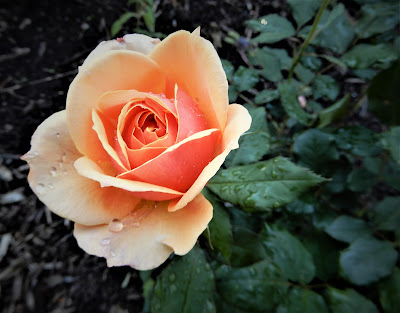
There had been moisture the night before, so the peonies and poppies were bejeweled with raindrops.  
 
The garden's purple martin houses were a lot more heavily populated than the house Randy installed by the corrals here at home a couple of years ago. (It's hard to see, but the flying bird is carrying twigs in its mouth.)
 
 
The flowers weren't the only things that were wet. Randy sat on a damp bench for me. He volunteered ... really. I'm sure we will return again when there are more summer blooms to enjoy.

LAKE SHAWNEE GOLF COURSE
 
Our real destination that morning was the nearby Lake Shawnee Golf Course.
 
This commemorates an eagle's nest that is at the course.
It's a beautiful course right along Lake Shawnee. Topeka had gotten rain, so Randy had to stick to the cart paths. He golfed with a father-son duo. When visiting with Bob Sands, the 88-year-old dad, I learned that he was retired journalist who co-wrote the book, From First to Worst: A History of Kansas City Major League Baseball 1955 - 1985. The authors wrote it following the Royals' World Series win. We commiserated about the demise of the daily newspaper as it was "back in the day" when I was a reporter/editor at The Hutchinson News and he worked at a number of papers, including The Topeka Capitol Journal.
 
Another day, Randy golfed at the Berkshire course in Topeka. As usual, I read my book.

OTHER TOPEKA TOURING

This winter, we'd also visited the Brown vs. Board of Education site in Topeka. It tells the story of Brown v. Board of Education, which ended legal segregation in public schools. The exhibits offer an understanding of the role this 1954 Supreme Court decision played in the Civil Rights Movement. It includes a free tour of the historic Monroe School building tour. This historic site is operated by the National Park Service and is open Tuesday through Saturday. Admission is free. 


When the girls were younger, we made several trips to the Kansas Children's Discovery Center. We also love the Topeka Zoo. We are looking forward to the renovations being complete at the Kansas State Historical Society museum.  For more of Topeka's attractions, you can visit www.visittopeka.com. 


Thursday, June 6, 2019

Kansas Staycation: Ted Ensley Gardens, Topeka

Flowers are the music of the ground.
 From earth’s lips, spoken without sound.
 – Edwin Curran

As I was sitting in the Topeka ExpoCentre arena last week for the church annual conference, I could hear the rain pounding on the roof. After nearly 12 inches of rain at home and flooding throughout Kansas and neighboring states, my first thought was, "Not again!"

But, by the time the afternoon session was over, the rain had stopped, so Randy and I visited the Ted Ensley Gardens near Topeka's Lake Shawnee. And the rain that I was bad-mouthing had decorated the flowers there like frosting on a cake.
It couldn't have been more beautiful. (And, bonus! It hadn't rained at home!)
 
The gardens comprise 37.5 acres on the west side of Lake Shawnee. The lake was built as a Work Progress Administration project and completed in September 1939. The gardens are named after Commissioner Ted Ensley, who formed the idea for a rose garden in 1978. From there, the rose garden expanded into waterfalls, fountains, streams, flower beds, a gazebo, a garden pergola, walkways and bridges.
We entered the garden via a 60-foot covered bridge over a rocky stream just north of SE 37th Street and West Edge road.
 The gardens feature a panoramic view of the lake...
  ... as well as plenty of places for sitting and enjoying the view and listening to the splash of the water in the fountain.
 
The pathways lead to tucked-away spots to find even more flowers and greenery.
The Shawnee County Extension Master Gardeners help maintain a Woodland (Shade) Garden as one of their demonstration gardens (below).
In May, staff and volunteers plant more than 90,000 annual flowers and plants. By the time we visited, those flowers were in full bloom.
 
The May planting comes after Tulip Time at the gardens, when horticulturists from the Shawnee County Parks and Recreation Department, with the assistance of volunteers, plant more than 80,000 tulips and daffodils. They are in full bloom in April during the city's Tulip Festival.
And speaking of flowers, the garden includes 1,200 varieties of perennials and 300 varieties of annuals, roses, trees and shrubs.
I loved the old-fashioned roses in all different colors. They are the most fragrant.
 
But there were also the more traditional "florist-shop-type" varieties, all glistening with raindrops.
There are also meditation gardens and water gardens throughout the complex.
The arboretum features 450 trees, including 87 varieties, some rare to Kansas, including a zelkova tree that will grow 100 feet tall and buckeyes, among others. But many of the trees enable visitors to see how a mature tree would look in their own home landscaping. It also demonstrates which trees grow best in that area of Kansas, which are most disease resistant and which have the best growth habits for withstanding wind, ice and snow.
In 2009, a statue was added to honor a little girl named Katie, who, upon seeing the gardens for the first time, exclaimed, “I’m so happy!” I understand the sentiment.
People aren't the only ones who like the flowers. So do the spiders, who left behind their handiwork in colorful settings.
Even in the carefully-manicured gardens, an interloper caught my eye ... and maybe reminded me a bit of the reality of home.
Weeds are flowers, too, 
once you get to know them.
--Winnie the Pooh

I know them all too well. Maybe that's why I can appreciate all the work that goes in to keeping the botanical gardens so manicured and beautiful. 

Topeka can be a great Kansas staycation destination. Besides the State Capitol, we also enjoy the Topeka Zoo and Discovery Center where we've been multiple times with Kinley and Brooke. While I was at church conference, Randy and Kinley spent the morning at the zoo and the afternoon at Sports Center, a family entertainment center, where they played 18 holes of Goony Golf and rode the go-karts. 

Now that the girls are getting older, our to-do list includes the Kansas Museum of History.

For casual dining, we like The Burger Stand. We tried The Pennant for the first time this trip, and I'm sure we'll be back, now that Jill & Eric and the girls are moving back to Topeka. The Blind Tiger Brewery and Restaurant is another local eatery. 

Find out more about Topeka eateries and attractions at Visit Topeka.