Showing posts with label community. Show all posts

Thursday, March 14, 2019

Ag Day 2019: Working Together

Today is Ag Day 2019. It's a day set aside to celebrate agriculture's role in American life.
Most of my blog posts tell about our efforts on The County Line to provide food, fuel and fiber for American families and consumers throughout the world. As I've said before, it's Ag Day every day around here.
Of course, we believe agriculture is important. We wouldn't be the fifth generation of farmers in our respective families if we didn't believe in agriculture.
As our society moves away from its agrarian roots, fewer people seem to recognize the value. Sadly, one of the members of a Facebook Farmers Wives group posted this message on Tuesday:
People never cease to amaze me! I was told today that we didn't need farmers!! So I am guessing that person doesn't need to eat either.
As organizers of Ag Day say:
We know that food and fiber doesn't just arrive at the grocery or clothing store or magically appear on the dinner table or in our closet. There's an entire industry dedicated to providing plentiful and safe food for consumption.
  • Each American farmer feeds about 165 people. Agriculture is America's No. 1 export.
  • New technology means farmers are more environmentally friendly than ever before. 
As the Ag Week hashtags and Facebook posts have been showing up on my social media feed this week, I've been thinking more about the importance of rural communities - actually being a community.

This week, a community matriarch and business owner in our small town died after a long illness. One of her grandsons posted a thank you for the expressions of sympathy given to their family - everything from cards to prayers to meals.

And, on the other end of the spectrum, two of our community's veterinarians had their first baby. He lived only two hours. A Meal Train is filling up quickly, and a fund to help them pay for medical and funeral expenses has already exceeded the original goal.

Helping out a neighbor is second nature to rural communities. It's demonstrated over and over and over again. Those are just two of latest examples. It wouldn't take me long to come up with a dozen.
 
For more than 100 years, each of our families has had pasture lands as part of our farming operations.We are caretakers for other pastures that have had a similar legacy in our landlords' families.
For grazing to be abundant, a pasture requires several different species of grass - from big bluestem to little bluestem to Indian grass to brome to Forbes (just to name a few).
These grasses all have different heights. Some mature early; others later. Those different species end up working together to keep the soil in place, reduce erosion and provide nourishment for grazing animals.
It's like that in a community, too. We're all different. We all have different abilities and interests and God-given talents. But it's that "hanging together" that makes a healthy environment.
 
That symbiosis is demonstrated day after day, week after week, year after year in a rural community: It may be helping an ailing neighbor harvest a crop. It might be baking a pan of cheesy potatoes for a funeral dinner. It could be working at the Food Bank. It might be serving on a church or community board.
That's not to say that rural life is idyllic. It can be just as stressful as that job in the downtown skyscraper - and probably not as profitable most years. Challenges come - no matter your address. As I've written this the past two days, the wind has been howling with 50-mile-per-hour-plus gusts, and we've had another 1.10 of rain we don't need. Believe me, there are challenges.

But those trials can strengthen us and our resolve, too. It's kind of like a Flint Hills pasture in the spring. It won't be long before "smoke signals" will drift into the Kansas skies from controlled burns on Kansas pasture lands, especially in the Flint Hills.

We think of fire as a destructive thing, and it certainly can be. But it can also be a vehicle of rebirth. One spring, I stopped at the Tallgrass Prairie National Preserve south of Council Grove - a detour as I came home from a convention. I could see the remnants of a prairie fire in the charred grasses and scorched branches.
But from the charred earth was green regrowth and vibrant prairie flowers lifting toward a vibrant blue sky.
It seems counter intuitive. Why would fire - which seems such a destructive force - bring this new life?
Yet as ranchers light fires to clear the dead grass and small brush, it makes way for a new carpet of green just weeks later.
And the cycle of life begins again. The Flint Hills are part of the tallgrass prairie, which stretches from Canada to Texas. Ranchers have a saying: Take care of the grass and it will take care of you. Burning pastures has been part of caring for the prairie even back to the days of the Indians. It's an age-old partnership with cattle, birds, wildflowers and the grasslands.
The same can be said of our rural communities. There are challenges and tragedies and things we must overcome.
But figuring out how to survive those things and come out on the other side stronger together is the true mark of community. And, in my experience, the ag community does that as well - or better - than any.
Happy Ag Day!

Wednesday, April 19, 2017

I Get By With A Little Help From My Friends

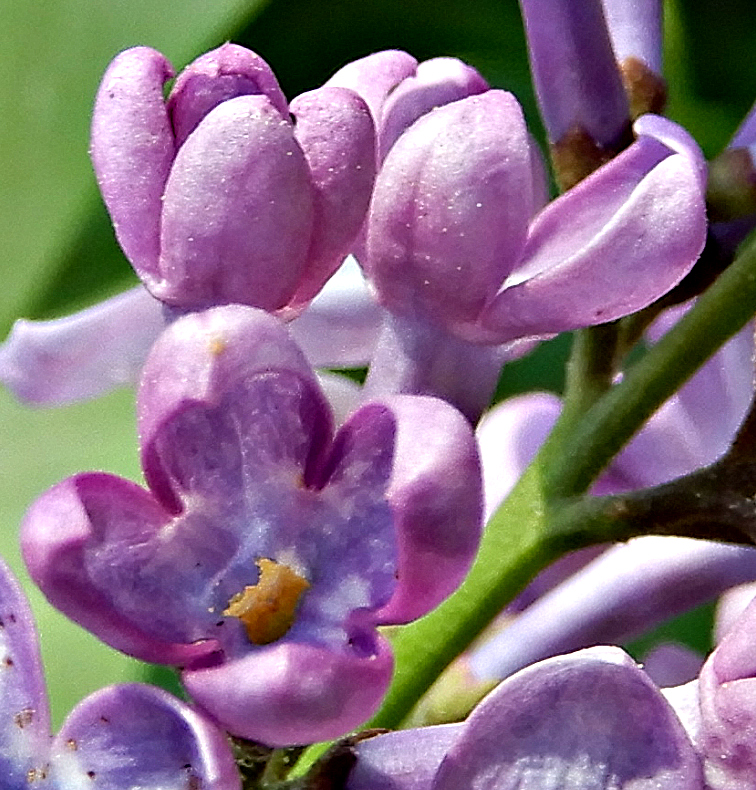
I walked into the church basement Monday morning, and I smelled the lilacs. The tiny blooms were decorating the tables for a dear friend's funeral dinner, stuffed into unlikely vases made from plastic K-State stadium cups.

That "purple pride" was just one common thread in our lives. So was farming and family and church and the Kansas City Chiefs. The list is long and the feelings are deep.
I looked at those intricate blossoms and marveled at the big fragrance from such tiny flowers. As I busied myself making tea and coffee, a Bible verse kept tickling my memory, but I wasn't coming up with it.

Yesterday, after I'd packed away two baskets of belongings I'd toted to the church for the dinner, I looked it up:
Our lives are a Christ-like fragrance
rising up to God.
2 Corinthians 2:15

All morning long on funeral day, people came to the church basement to leave pans of cheesy potatoes and to drop off plastic-wrap-covered salads. When I'd asked, not one person said, "No, I can't help." In fact, more food arrived than I knew was coming.  Filling the refrigerators was like a giant jigsaw puzzle, squeezing another salad in a bit of empty space.
Later, the fragrance of ham and potatoes displaced the delicate aroma from the lilacs. But through it all, I kept thinking about our lives as a "fragrance rising up to God."

Each little floret that makes up a lilac stem is beautiful individually. The intricate detail on each petal is kind of like a human fingerprint, different, yet similar.
A single lilac floret is beautiful, but alone, it can't make the aroma that permeates the room. We, as individuals, can be beautiful and strong and accomplish a great deal. But how much more can we do when we come together? It was Exhibit A at the funeral and dinner on Monday. Everyone contributing in big and small ways came together to honor a friend and his family with a "Christ-like fragrance."

Just counting quickly, I came up with 41 people (not counting immediate family) who came together to help celebrate a special life in behind-the-scenes work for the funeral, burial and dinner. Many, many others came to celebrate his life at the memorial service. Many gave memorial contributions or offered a tribute of flowers.
Church of the Resurrection UMC Pastor Adam Hamilton wrote a book called The Way: Walking in the Footsteps of Jesus. Among the Scripture readings is Mark 2: 1-12.

It's a familiar story told over and over again as children gather for Sunday School or Vacation Bible School. Jesus is preaching at Peter's home in Capernaum. Some men have a friend who is sick and paralyzed. They have heard that Jesus is a healer, so they carry their friend to the place where Jesus is preaching, believing He can help. When they find that the home is too crowded to enter through the door, they cut a hole in Peter's roof. They lower their friend, who is resting on a stretcher, through the hole and into Jesus' presence. And Jesus sees the friends' great faith and heals the paralyzed man.
There are several things we can take away from this story. The first is that all of us need stretcher-bearers. ... Who are the people who would pick you up, tear off the roof and lower you to Jesus? We all need friends like that, whose faith is strong even when ours is weak, who are friends not just in word, but in deed.

Who are our stretcher-bearers? Whose stretcher-bearer are you?

From Adam Hamilton's book, The Way: Walking in the Footsteps of Jesus
It's a good question. And I think I've had it answered over and over again in the past week. The possibilities to serve as Christ's hands and feet in this world today are plentiful:
Christ has no body now but yours. No hands, no feet on earth but yours. Yours are the eyes through which He looks compassion on this world. Yours are the feet with which He walks to do good. Yours are the hands through which He blesses all the world. Yours are the hands, yours are the feet, yours are the eyes, you are His body. Christ has no body now on earth but yours.
Teresa of Avila
And His is the fragrance through which we can honor God in our lives here on earth.