This image on a friend's Facebook page was one of the first things I saw when I unplugged my phone from the charger Monday morning. Irises are a favorite, so even though it's a flower more associated with May than November, it caught my eye.
And then there was the poem:
It doesn't have to be
the blue iris,
it could be weeds in a vacant lot,
or a few small stones;
just pay attention
then patch a few words together
and don't try to make them elaborate,
this isn't a contest but the doorway into thanks,
and a silence in which another voice may speak.
From Mary Oliver's book of poems, Thirst
It was a dreary, overcast, chilly morning to begin this week of Thanksgiving. And for many of us, Thanksgiving will look much different this year.
November 2018
From two years ago
Instead of gathering with family, I'll be making turkey and dressing for two. We canceled a trip to Topeka and Kansas City. The last few years, we've celebrated Thanksgiving on Friday at Jill's and then have done a little Black Friday shopping in the afternoon - long after the die-hard early bird fans were back home for an afternoon nap after being up at dark o'thirty.
The extended family Christmas Eve get-together at my parents has already been canceled for this year. And while it was definitely the thing to do, I am already dreading its absence. In my 63 years on earth, this will be my first time to miss this traditional family gathering that also celebrates my mom's birthday.
I've been furiously looking for silver linings.
"Well, I guess I'll get to go to my church's Christmas Eve service," I originally told myself in a pep talk. (For 40 years, it's been a challenge to gracefully decline participation in this special event - especially when Randy and I say "yes" to pretty much any church task.)
But then came the letter from the Great Plains UMC Bishop, recommending a move back to online worship services. Reading between the lines, it seemed the Bishop was recommending we celebrate Advent and Christmas at home - just like we did Lent and Easter eight months ago.
Last weekend, as worship chair, I canceled our annual Hanging of the Greens to decorate the church for the holidays.
I texted another faithful family to make sure they saw the email cancellation notice. And the "little girl" I used to direct in the Joyful Noise Choir who is now a mom with children of her own texted, "I understand, but it makes me sad."
I texted back an emphatic, "Me too!!" complete with too many exclamation points.
So for Thanksgiving Sunday, I wrapped Christmas presents and listened to the fabulous organist at Wichita's First UMC play "Now Thank We All Our God" and "We Gather Together" instead of playing them on piano myself. Now that I'm the regular pianist at our church, I'd ordered a seasonal book and was practicing solo arrangements for our Stafford UMC service.
Oh well, I sighed.
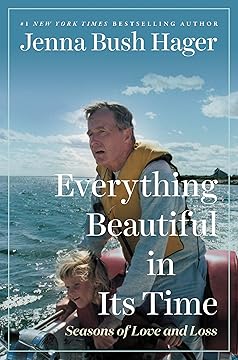
The Mary Oliver poem was just another "nudge" in my quest for silver linings. The night before, I'd finished the book Everything Beautiful in Its Time: Seasons of Love and Loss by Jenna Bush Hager. I told both Jill and my sister that it was the right read for this week of Thanksgiving.
I must admit I'm a little jealous of celebrities who seem to have a Willy-Wonka-like "golden ticket" to publishing books. I'm sure her celebrity got her foot in the door of William Morrow Publishing, but if I'm honest, she writes well, and I enjoyed the book. In fact, I'd recommend it.
The impetus for the book was losing three grandparents in just a year's span. That grief is different from what most of us are feeling right now. But the loss of these hallmarks of our family life - like Thanksgivings around a family table or Christmas in a farm shed - are grief, too.
In the book, Jenna Bush Hager detailed some of her grandparents' "rules for living." These are just a few from her grandpa, former President George H.W. Bush:
Don't get down when your life takes a bad turn.
Don't blame others for your setbacks.
When things go well, always give credit to others.
Don't be afraid to shed a tear when your heart is broken or because a friend is hurting.
And from her non-famous grandparents - her mom's parents Jenna and Harold Welch - this one stood out to me:
Get out of bed to go look at the stars - and always, always wish upon the first star you see.
So the poem about the blue iris - and most especially the weeds and the small stones - seemed to just continue to reiterate the message. It was a "God wink," as another friend calls it.
Even though I'd consciously thought about the words I was reading, it sometimes seems my perspective is as hazy as the view on an overcast day, with the drab days of fall reflected through a dirty feed truck window and fractured by a broken rearview mirror.
The way out of the pessimistic point of view can be as helter-skelter as a country road after a rainy weekend.
But it's all about perspective. That rainy, overcast sky dropped nearly 3/4-inch of rain over the weekend.
It gave the young wheat crop a small shot in the arm even if it made for a few mud puddles while feeding.
It's a lot easier to find the silver lining in migrating whooping cranes ...
... who "breakfasted" for a couple of weeks in a field not far from our house ...
... or in sunset skies
But in this week of Thanksgiving, I hope to notice them all - blue irises, mud and all.
Happy Thanksgiving to you and yours.
Handiwork by my late mother-in-law, Marie
For another look at how cloudy skies produce the best silver linings and sunrise skies, check out this Thanksgiving post from 2013.
"Here's a timely blog topic," Dr. Bruce said, as he put a medicine bottle down on the table.
And there it was: Coronavirus Vaccine.
No, Dr. Bruce didn't pirate a shipment of human coronavirus vaccine.
This was the bovine version. The entire label said "Bovine Rotovirus-Coronavirus Vaccine." Coronavirus in cattle causes diarrhea. Of course, that symptom appears on the ubiquitous internet Covid-19 charts for humans. (But let's get real: What symptoms aren't present on those charts?)
But this vaccine was administered to calves born last winter here on the County Line. The visit from Dr. Bruce was the cattleman's version of a "well-child check," during which the calves were vaccinated in a similar fashion as taking your infants to the pediatrician.
Early on in the pandemic, some enterprising(?) person posted a photo meme of a similar bottle. It suggested that news providers were being dishonest about the
coronavirus being new, in order to cause alarm and make the public
purchase protective equipment.
A coronavirus vaccine, you say?
In truth, the
bovine coronavirus, which has existed for years, is not the same as the
new strain of coronavirus behind this year's global outbreak in humans. The strain of the human coronavirus causing our human world to change so dramatically is called SARS-CoV-2.
I couldn't find when the bovine vaccine was first available, but even back in a 2003 report, the bovine version was being used in cattle operations.
(It kind of looks like this calf could use a vaccine for its runny nose, but, hopefully, that got covered, too, in all the shots given to each calf and cow that went through the working chute.)
So, no, I don't have breaking news on the human vaccine front here on the Stafford/Reno County line in rural Kansas. But after three separate visits from Dr. Bruce, our cattle herd is protected with a vaccine for their version of coronavirus.
Dr. Bruce did go high-tech with some of the preg-checks he did on our cows. The fall visit from the vet includes Dr. Bruce determining whether or not our cows will deliver 80-pound "bundles of joy" this coming winter.
During one of the visits, Dr. Bruce was testing out an ultrasound machine for bovines. Normally, he uses a manual exam to determine whether or not the cow is pregnant and estimate how "far along" she is.
At one visit, he used his newfangled machine, which he was testing to see if he wanted to purchase it for his veterinary practice.
He knows I'm interested in seeing things for myself. (I wasn't the only one: Randy wanted to look at the screen, too.)
Unfortunately, I didn't discover until later that my photo attempt of the screen instead revealed my windswept profile.
Blog fail! So, of course, I Googled to find an image.
Image from https://www.yourvet.co.nz
And just like the human version, I need labels to explain what I'm looking at. But Dr. Bruce knows what he's doing. He would tell me how "far along" the mama cow was - usually between 4 to 6 months - and I'd write it down on the chart.
For a couple of cows, he thought the ultrasound was inconclusive, so he reverted to the tried-and-true palpation method. That particular day, the manual exam revealed that they were all pregnant: The fetuses were just in a position making it difficult to see on the ultrasound screen.
So why is determining pregnancy in our beef cattle a management tool for the County Line and other beef producers?
The
identification of non-pregnant animals is essential if you wish to
decrease numbers and remove these animals from your herd. We took the open (non-pregnant) cows to the Pratt sale barn. That way, we're not spending money to feed and care for cows who are not building our herd.
Having Dr. Bruce estimate how far along each mother is in her pregnancy is also important. For first-time mothers (heifers), we try to synchronize their reproductive cycles so that calving of this group happens in a "condensed" time. When it's calving time, we check the heifers much more frequently, since they are more likely to have difficulty during labor.
One of the cows wasn't bred during her first cycle, so she was only 2 months along, rather than the 4-6 months we'd expect. That may mean the cow would calve after we move cattle back to summer pasture. Many times, Randy also culls those cows from the herd, too, preferring to have all the mothers calve in a similar time frame.
After the vet visits, we hauled the pregnant cows to stalks, where they will graze this fall. We'll move them closer to home after they eat "the leftovers" and as they approach calving time.
While the mamas have to dine on their own, we provide meal delivery of "take out" to the feeder calves, the babies who were born last winter.
I hear meal delivery is a big thing during the pandemic.
Out here in the boondocks, that only works if you're bovine or feline.
It could be a dust-provoked headache generated by old newspaper clips and a basement storage room that hadn't seen the business end of a dust rag for quite some time. Or it could just be from the seemingly never-ending task of deep cleaning and purging.
For those of you who weren't fortunate enough to be around when Tommy Roe released his song, "Dizzy," in 1969 (insert slight sarcasm here), it's a line from that hit, which occupied the No. 1 slot for four weeks.
I liked the song well enough that I forked over some cash for the album of the same name. As I've been sorting and cleaning in the office, I found the album occupying some real estate among the predominantly Barry Manilow and Carpenters discs:
I'm so dizzy, my head is spinning
Like a whirlpool it never ends
And it's you, girl, makin' it spin.
You're makin' me dizzy.
Of course, I have no turntable these days, so I had to pull it up on YouTube.
And the piles of paper (and other stuff) I've sorted and Randy has carried out of the house is "dizzying" in itself.
As I was going through yet more file cabinets and boxes crammed with dusty newspaper and newsletter clips, I texted my kids. In all honesty, I was feeling a little blue.
This is hard, I told them.
They didn't "know" me as a newspaper writer, and later, as an editor of the Focus (lifestyle) section, I told them. Brent was a baby when I quit the full-time commuting, and Jill was almost 3. I wrote a twice-a-month column, "At Home with Kim," for The News for several years when they were small. I also freelanced for a public relations firm in Hutchinson, writing copy for several quarterly newsletters. (These were in addition to the Stafford Main Street newsletter and The Messenger, the church newsletter which I am still doing when there's not a pandemic going on.)
But I hired a babysitter when I'd go for interviews for the newsletters, and I did most of my writing when the kids were in bed at naptime or the evening.
As I looked through story after story, I realized my kids just saw me as a Mom, and later, as a part-time school secretary and community volunteer.
I wouldn't change any of that. My most important job ever was being a Mom, and the other roles dovetailed nicely with that mission. But before I tossed all of the articles, I wanted them to know that I was pretty good at the newspaper/writing gig, too. I won plenty of state awards and even a few national awards for writing and editing.
Both of them acknowledged my difficulty in tossing things. (They both know I'm sentimental.) Here's what Jill had to say:
... Just because you're throwing away the physical reminders of your work at The News doesn't take away from the achievements you had and the hard work that went into it. ..."
Brent echoed:
... I agree that you should take pride in what you accomplished and the people and stories you amplified. It's good to know and remember. Throwing out a box of papers doesn't take away from that."
How'd they get so smart?
During one of our phone conversations, Brent asked me about what stories brought back the most memories.
One
was from the first fire I was ever sent to. It's not because it was an award-winning story, but because it was my first venture into "hard" news. I had been hired as a
lifestyle reporter. However, with a management change, all of us had to
cover breaking news, community meetings, etc. It was one of the first
times I had a front-page byline back when I was still Kim Moore. But I
would have gladly given that up to skip covering the fire. The homeowner
escaped, but her two dogs perished in the fire. I went to the car afterwards and cried.
Another front page article was a sidebar to a national story when the Shuttle Challenger exploded on January 28, 1986. With the afternoon paper still to go to press, I remember watching the TV and can still feel the intensity as the whole newsroom scrambled to write stories. The Hutchinson News was in a unique position because of the Cosmosphere, a museum on the Kansas Plains - an unlikely place for a Smithsonian-affiliated space museum.
I interviewed a Goddard science teacher who had been in the running for the Teacher in Space job that eventually went to Christa McAuliffe. I talked to both he and his wife by telephone about their impressions of McAuliffe during the workshops and pre-flight receptions. Even that day, he was ready to apply to be in the next teacher in space.
I uncovered a series of stories I did on the Amish and Mennonites in the area. I was invited into several of their homes and discovered a world much different from my own.
There were hundreds of colorful food pages and other food-related stories like Cook of the Week. I wrote the stories, but The News had a talented graphic designer at the time named Karen Scott. As the Focus editor, I enjoyed working with her to brainstorm ideas and produce quality pages every Wednesday.
For one of those food pages, I earned a runner-up finish in the national Golden Carnation Awards Program for nutrition writing. My managing editor told me I should go to the awards ceremony during the International Food Media Conference in New York City. I stayed in the hotel at the World Trade Center back in 1987, long before 9-11. It was quite an experience for a small-town girl from Kansas, and I later wrote about it for a column.
I met First Lady Nancy Reagan (and I have the picture to prove it) when I attended a American Press Institute seminar in Reston, Virginia, for lifestyle editors, shortly being named the Focus editor. (The managing editor at the time told me he wanted to move me from hourly as a reporter to salary as an editor so he didn't have to pay me overtime any longer. This was before kids, and I was still working on a work-life balance, I suppose.)
After I "retired" from The News, I did some freelance writing for a public relations firm in Hutchinson. I wrote the copy for Wesley Towers, a retirement community in Hutchinson from 1988 to 2014. (I remember Randy had to go with me to the first set of interviews because I was still breastfeeding, so I had to take some timeouts in the schedule. TMI?)
My favorite series for Wesley Towers was interviewing World War II veterans for a story that ended up spanning several issues. It required numerous interviews with our nation's heroes, as well as a lot of reading and research. I then wrote a series of stories, which became a living history lesson for me. So was a story about residents who had celebrated their 100th birthdays and a series about residents with Hutchinson businesses whose children had carried on the legacy and were still operating on Main Street and other storefronts in the community.
I wrote the Newton Medical Center Connection newsletter from 1989 to 1996 and for United Methodist Youthville's Crossroads from 1992-98, plus other articles assigned infrequently by the PR firm for AgTrax, the Kansas Area United Methodist Foundation, Training and Evaluation Center of Hutchinson and others.
As I was going through my piles of clips I'd entered in the Kansas Press Women contest through the years, I ran across this artwork:
So, yes, at the heart of it all, I was still a mom at the core.
And you know what? My kids are both pretty good writers, too.
(This post is more for me, so that there's some record - somewhere - of my writing career ... since I threw away most of this stuff - SIGH!) Maybe the soundtrack should have been "Memories" - not "Dizzy.")
We've lost count of all the trips to the trash pit, and I also sorted through some other tubs and boxes in the basement, plus did a long-overdue closet purge. Randy and I had dental hygiene appointments before harvest, and we ended up taking both the car and pickup to Hutchinson so that we could leave the car at the shop.
We filled both vehicles with goodies for Goodwill. I texted my family:
"Is it bad that my treasures filled up all the bins at Goodwill?"
I guess it was bad for the car in line behind me, but it's good for my basement storage area, and my kids are thrilled that I've gotten rid of some stuff. Thanks Covid-19? Hmmm ... I'm not sure I will go that far!
True confessions: I haven't done much (any?) sorting since harvest. Maybe posting this is my motivation to get started again.