Showing posts with label prairie fires. Show all posts

Thursday, April 18, 2013

Telling the Story ... The Whole Story

If you're telling the story,
 you have to tell the whole story. 

It may sound like something Paul Harvey would say. But, instead, it's wisdom from my favorite farmer philosopher (aka, my husband).

Last spring, when a "controlled" CRP burn ended up being far from controlled, my first inclination was to keep it to myself. However, it's not like people in Stafford weren't going to find out about it. After all, we had volunteer fire crews from Sterling, Alden, Raymond and the Quivira National Wildlife Refuge arrive to help us. News like that gets around faster in a small community than ... well, faster than a controlled burn can become uncontrolled.

But, Randy wanted me to share the story on Kim's County Line. His theory:
If you're telling the story,
 you have to tell the whole story.
This week, I had my own fire. My first inclination is to hide it. I hate making mistakes. I probably hate revealing my mistakes even more. (It's really silly, since most of my shortcomings are front and center anyway.)

This is about more than kitchen disasters. As a life-long perfectionist and overachiever, I like giving the impression that I have my life together, even if I sometimes feel like it's an illusion that rivals any of my husband's collection of magic tricks.  I want to smother "bad news" as assuredly as that box of baking soda smothered the flames dancing in the bottom of my oven Monday night. But Randy's matter-of-fact admission of less-than-stellar outcomes kept burning in my mind as high as those orange-yellow flames. So, here it is ... the whole story.

I was co-hostess this week for PEO, which means I was responsible for providing the dessert. (If you know women's meetings, you know that's an important job.) I have a reputation for being a good cook. (My birth family knows that my true misadventures in the kitchen date all the way back to Meatloaf Mush when I was 13 or so, but that's a story for another time. Or ask my brother about it.)

Anyway, in order to uphold that reputation for baking delicious and beautiful treats, I was making cheesecake in springform pans instead of regular 13- by 9-inch pans. I had two springform pans filled with butter-laden graham cracker crusts and topped with cheesecake made from five whole packages of cream cheese, fresh lemon zest, sugar and other goodies. 

Wanting to "look good" got me into trouble when the butter started dripping into the bottom of the oven. I added a layer of foil so that it wouldn't make such a mess. But, when the timer rang for the first check, I discovered flames. Yes, real flames, not just an acrid smell and burned-on residue. (Thank you, Lord, for that compulsion to check and double-check things and for the timing of that oven buzzer.)

I also discovered that I didn't have the fire extinguisher I thought I had above the stove. (If I used it for another cooking mishap, I have successfully developed amnesia about it.)

Thankfully, the half-full box of baking soda I had was enough to put out all but a little remnant of the flames.

I stay fairly level-headed in a crisis. I calmly pulled my cheesecakes from the oven. After the fire was out, I salvaged the ingredients. I ended up separating the cheesecake filling from the crust and baking the cheesecake in a sheetcake pan (along with a little extra that Randy got to taste test to make sure it didn't taste more like scorched earth than cheesecake.) To serve it Tuesday night, I fancied it up with fresh fruit and a dollop of whipped cream on top. It got rave reviews.

I could have not told anyone (and I didn't at PEO). And believe me, that's my first inclination. I want to believe I'm not telling the story now because Randy already told the tale to our friend at the local cafe and to the lumberyard proprietor when he ordered fire extinguishers for the house.

I hope it's because I truly want to be real. This space shouldn't be just about posting fun trips to the zoo with our granddaughter or farming tales or yummy treats accomplished without an oven fire.

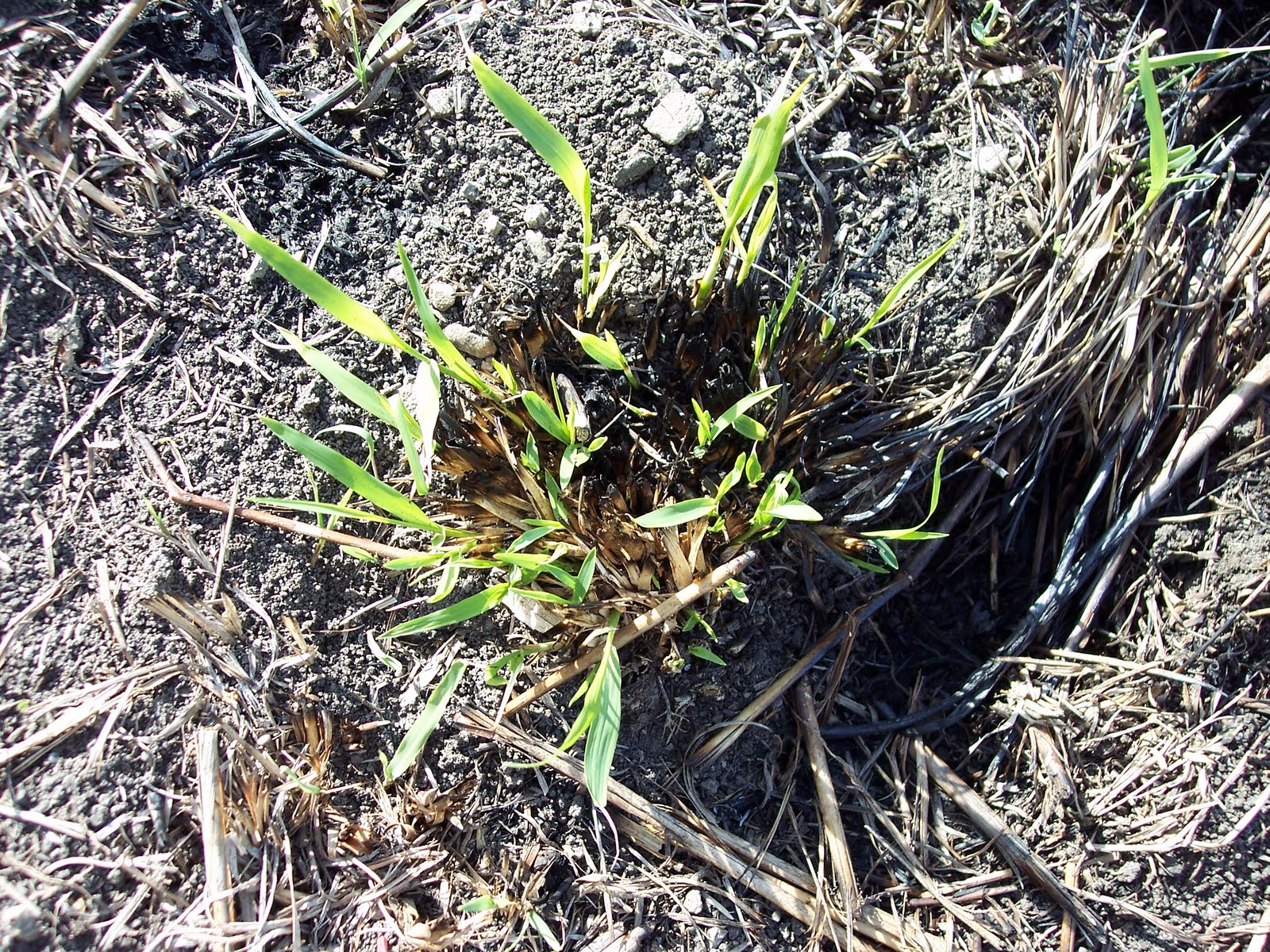
This is the same CRP field as at the top photo a couple of months after the fire.
Making mistakes is not a crime. (Repeat that to myself 10 times.) Experiencing unexpected consequences is part of life. A lesson in humility helps refine me. If I hadn't wanted to impress with a lovely springform pan dessert, I wouldn't be stuck revealing my failure.

I should be just as quick to share the fire (or any other shortcoming) because it's how people can truly know me - not just the image of me I'd like to portray.
I need to be more like a wildflower after a prairie fire.  We all have "fires" in our lives. We have times where the landscape feels as desolate as that blackened earth or the scorch in the bottom of my oven. We are lonely. We face health problems. We're concerned about our kids or our jobs or our community or a drought. The fires are different for all of us. But we all have them. We can get hot under the collar. We can feel like we're walking through flames.We can feel that all-consuming heat and wind surround us in a way where it's even hard to breathe.

But if we don't admit it to anyone else, it just might consume us:
If you're telling the story,
 you have to tell the whole story.

Monday, July 9, 2012

Refined

Three months ago, the landscape was barren. Fire had swallowed up dry prairie grasses like a voracious high school football team at an all-you-can-eat buffet.

But some 90 days later, the green grasses are dotted with prairie flowers in yellows and blues amid shoots of green.
What looked dead has new life. 

Today, please join me for the rest of the story over at Lovely Branches Ministries at my Food for Thought blog. While you're there, check out the blog posts by my other "buds" at Lovely Branches. There are a couple of recipe links over there, too.

Happy Monday!
***
And, today I am also linked to Michelle's Graceful: Faith in the Everyday and her Hear It on Sunday, Use It on Monday link. Check out what other bloggers had to say, too!

Thursday, April 5, 2012

Smoke Signals

Best laid plans can go up in smoke. Literally.

Last week, we attempted to burn off Conservation Reserve Program (CRP) grasses on some of our rented ground. Part of maintaining CRP ground requires caretakers to burn off or disc the native grasslands during every 15-year contract and replant with a Forbes mix of grasses.

This particular ground is located just adjacent to the Quivira National Wildlife Refuge and nestled among other parcels of land owned and used primarily by hunters. So instead of green wheat fields, it's a maze of dry prairie grasses, perfect for attracting deer and turkey.

It's also in a neverland of cell phone coverage at a point in which three counties converge - Stafford, Reno and Rice.

Case in point: When Randy called 911 to get permission for the burn, the call was answered by Rice County dispatchers. However, since the burn was technically in Reno County, they transferred the call there.

By the end of the evening, we'd also be talking to Stafford County emergency dispatchers. But I'm getting ahead of the story.

To prepare for the burn, Randy & Jake used a tractor and disc along the property line to form a fire break.

The evening of the burn, Randy discovered which direction the breeze was blowing by doing a highly scientific test using toilet paper.

Before we started, Randy drew out the plan for the burn on the ground.

I like having a plan, especially when I'm going to be driving a 4-wheeler in dry grasses with Randy lighting fire behind me.

He used this drip torch to light the grasses on fire.

We began on the north side of the field, and Jake followed behind on another 4-wheeler with a water tank on the back.

As we got to the northeast edge, I snapped this photo while we waited for Jake to catch up.

We thought we had the burn controlled, so I drove along the eastern and southern borders of the field, with Randy lighting the brush behind us.

As I drove and bounced along the uneven field, I said, "I really hate this."

And Randy said, "I know."

At the time, I didn't know exactly how much I would come to hate it by the end of the day.

We got to the southwest corner, where we knew the fire would be stopped by a wheat field.

Fire is quite a force. You can hear its roar. You can feel its heat. The tongues of orange and yellow flames devour the dry grasses faster than a group of teenage boys can plow through a bag of chips.

We watched awhile and then Randy took the 4-wheeler and went to check on Jake's progress.

I waited and took more photos.

Randy came back to get me and Jake went to check on the northern side of the burn again. And then we got THE phone call.

Embers had drifted onto the ground to our north. No little water tank on the back of a 4-wheeler was going to supply enough water to overtake the fire.

Randy & I raced back to get the pickup and bigger water tank. We started dialing 911. And dialed. And dialed. And dialed some more.

Remember: I told you this was in a never-never-land of cell phone coverage. Finally, a Stafford County dispatcher picked up. I've never been so glad to hear someone's voice on the other end of the line.

And the cavalry was dispatched. Sirens aren't usually something I want to hear, but I was awfully glad to hear them that evening. It seemed like it took hours, but it's really miraculous how quickly volunteer firefighters respond when they are called.

We had fire departments from Sterling, Alden, Raymond and the Quivira Refuge.

In all, about 80 acres were unintentionally burned.

But I didn't burn one of the dozens of cookies I baked to thank the firefighters for helping us out. We are so appreciative of the volunteers who give their time and effort to help others in an emergency.

Friday, April 30, 2010

Rebirth


Spring brings fire to the plains of Kansas. Yes, there are the vibrant yellows, reds and oranges of spring flowers and budding trees, the colors that remind us of flames.

But we also see the smoke signals that drift into the Kansas skies from controlled burns on Kansas pasture lands.

We think of fire as a destructive thing, and it certainly can be. But it can also be a vehicle of rebirth.

On my recent stop at the Tallgrass Prairie National Preserve south of Council Grove, I could see the remnants of a prairie fire in the charred grasses and scorched branches.


But from the charred earth was green regrowth lifting toward a vibrant blue sky.


It seems counter intuitive. Why would fire - which seems such a destructive force - bring this new life?

Yet as ranchers light fires to clear the dead grass and small brush, it makes way for a new carpet of green just weeks later.


And the cycle of life begins again. The Flint Hills are part of the tallgrass prairie, which stretches from Canada to Texas. Ranchers have a saying: Take care of the grass and it will take care of you. Burning pastures has been part of caring for the prairie even back to the days of the Indians. It's an age-old partnership with cattle, birds, wildflowers and the grasslands.

The prescribed burning mimics the seasonal fires that have shaped the tallgrass prairie for hundreds of years. Burning also reduces the chances of destructive wildfires such as those in California and other states. The practice helps ranchers control invasive species, such as eastern red cedars, that squeeze out native grasses.

As I drove home on that Saturday afternoon two weeks ago, there was a haze in the air as ranchers burned. That haze can be controversial. Congressman Jerry Moran introduced legislation this month that would protect the ability of Flint Hills landowners to use prescribed fire as a tool to maintain the tallgrass prairie ecosystem.

The Environmental Protection Agency is attempting to regulate how and when landowners can burn in the Flint Hills by asking Kansas to develop a smoke management plan. During recent years, a narrow window for grassland burning caused heightened air quality readings in Wichita and Kansas City. HR 5118 would recognize the multiple benefits of prescribed fires by exempting landowners and local governments from EPA's enforcement of Clean Air Act standards if it involves smoke from pasture burning in the Flint Hills.

And it's not just a rite of spring in the Flint Hills. Though it's not on as grand a scale, there is prairie burning in other parts of Kansas, including here on the County Line. We don't do a lot of burning, but we did burn a couple of pastures this spring.

Unfortunately, I wasn't around to capture the images. So, I'm sharing something I found on Youtube. This is just a short video that shows scenery from the Flint Hill and some burning. If you want a longer version about the history of the practice of burning - even back to the Indians - go to www.youtube.com and type in Meditation 3 - Prairie Fire (Warning: It's over 7 minutes long but it's more comprehensive.)

I've given you a few glimpses of still photography of the Flint Hills. But if you can find a National Geographic issue featuring the photography of Jim Richardson, I would recommend it. Richardson, who has a photography studio in Lindsborg, has traveled all over the world taking photos for National Geographic. His images of the region are breathtaking.