Showing posts with label wheat harvest. Show all posts

Tuesday, June 16, 2026

Pot of Gold? Wheat Harvest 2026

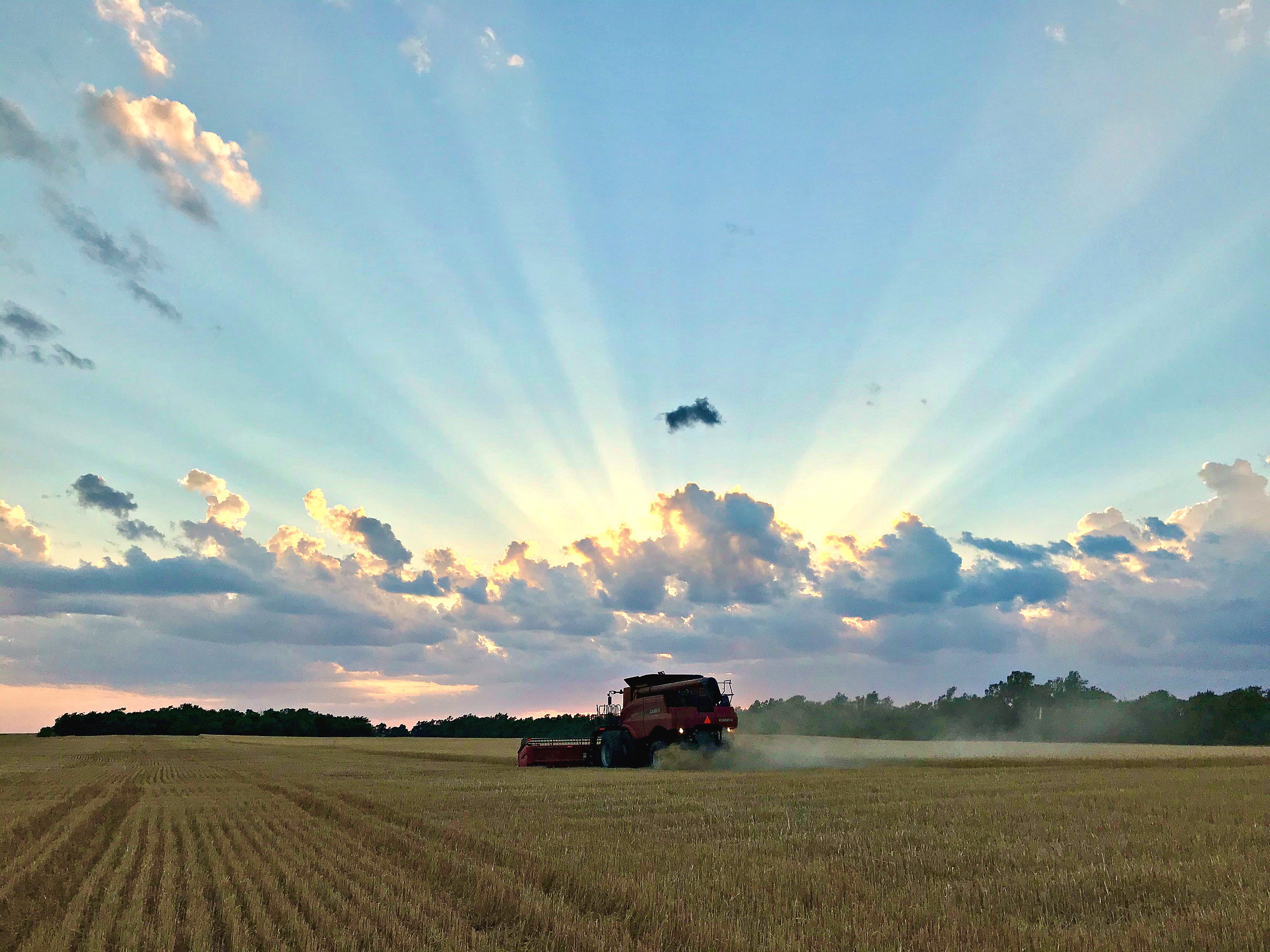
Photo taken Saturday night - June 13, 2026
 

It's not a year when the wheat crop is like a pot of gold at the end of the rainbow. But the sun has set on the 2026 wheat harvest. 

June 4, 2026

As my brother aptly described of his harvest in Pratt County, "Wheat 2026 is in the bin. Just didn’t fill the bin."

We don't have the final figures in. The Millers have the wheat custom cut by Frederick Harvesting out of Alden. They started cutting on us last Thursday and finished on Saturday. We are always amazed at how quickly it goes when a custom crew is involved. Back when we were farming full-time, it took a minimum of 10 days to get everything cut ourselves. It often stretched out further with weather delays and breakdowns.

You can barely see the third combine in the dust behind the grain cart.
 

But, when there are three combines in the field with 40-foot headers, things go quickly. (The one combine we owned at the end of our active farming (2022) was 35 feet. Randy says he thought that was big at the time.) 

With a custom crew racing on to the next customer's fields, you often don't get the scale tickets immediately, so we don't have the yield-per-acre numbers yet. 


But it was a year when we didn't get timely rains during the time when the wheat heads were filling, so we knew it wouldn't be a "pot of gold" year for our golden crop. It was a dry winter in our area. Until two weeks ago, we were in a swath of Central Kansas in extreme drought. Now, we're in an area classified as severe drought. 

Randy rode along with one of the combine operators a few times. Saturday morning, we spent quite awhile just watching the action.

Two combines were cutting during most of the time we were there, with a third broken down. 


But they eventually got it running, too, taking even bigger swaths through the fields. 

We were glad they got to our fields when they did. Weeds were starting to emerge, brought on by June rains. Those rains weren't beneficial to the wheat, but it was extremely helpful to alfalfa fields, pastures and fall crops. 


Still, we anticipate that the yields will be a little higher than we initially predicted. 

But time - and those scale tickets - will tell.

Speaking of pots of gold: Our neighbor Gary called us Saturday night and asked if we'd seen the double rainbow to the east. Our house is surrounded by trees, so we had not. But with his call, we hurriedly put on shoes and went down the road for a better view.

And what a view it was! 


 We had never seen a double rainbow that lasted so long and was so vivid. What a treat!


 We watched until the clouds swallowed up the rainbow.


 The photos don't do it justice. What a blessing to see an unobstructed view!

Tuesday, July 1, 2025

Wheat Harvest from the Sidelines

Notice that the grain cart tractor has tracks to make it easier to get through muddy conditions.

Randy hasn't been in the "pilot" seat of the combine for three years now. But he still finds a way to hitch a ride in the buddy seat. 

From our last harvest as active farmers - Taken June 13, 2022, on the first day of harvest that year.

You can take the farmer out of active farming. But you can't take away the interest ... even from the sidelines.


Our wheat was harvested by Frederick Harvesting based in Alden last Friday, June 27. Tye and Todd, who now farm our ground, contract with Frederick's to custom harvest their crop on their owned and rented farm ground. It didn't take long for two custom machines to get through our wheat acres, since Millers only planted 100 acres to wheat on us this year.

Randy had ridden with the harvesting crew earlier Friday afternoon as they worked on ground we had previously rented and farmed. During a ride on both the grain cart and the combine, he had learned that they would likely move to our ground later that afternoon and evening. 


It was my birthday, Randy had planned to take me Hutchinson for supper and a few errands. When we found out the timing, I volunteered to postpone my celebration. It certainly wouldn't be the first time my birthday and wheat harvest coincided. During my childhood and youth, harvest often overlapped with my birthday. As farm partners for the past 44 years, the harvest and birthday collision continued, though the start of harvest has seemed to creep earlier and earlier during our married life. However, I spent plenty of birthdays in the harvest truck, delivering meals, making parts runs or riding in the combine.

A long-ago harvest as the wheat truck driver at my parents' farm in Pratt County

However, Randy said we would continue with the birthday plans.  As we returned from Hutchinson near dusk, we saw two combines in the field on our ground. Randy went home and changed clothes and then went to the field to catch another ride. I told him to send me photos. Usually, that means I get a couple of hastily-snapped pictures. But I guess it was a birthday gift that he pulled through with a few more this time!

Kim's County Line photo From 2022

It's different for the family writer and photographer to be on the sidelines, too. I've literally taken  thousands of harvest photos during my lifetime. But I was glad to get a few photos from Randy anyway!


It's kind of an inside family joke that Randy was always glancing at the yield monitor while he harvested wheat. His attraction to the yield monitor has not faded, since that was one of the photos I received. 

I also got several showing the number of pounds that went into the grain cart. 


This harvest has been quite a marathon for Kansas farmers in our area. While farmers are reluctant to complain about summer rains, intermittent rain showers - and some gully washers - have made for a stop-and-start harvest. 


Frederick Harvesting used a tractor with tracks to help them traverse muddy fields.  


 Quality and yield have gone down for many - right along with downed wheat.  


Since I began blogging in 2010, I have kept track of the start date for wheat harvest. 

2010:  June 18
2011:  June 10
2012:  May 26 (an anomaly and the earliest harvest, by far, we've ever had)
2013:  June 21
2014:  June 17
2015:  June 20
2016:  June 15
2017:  June 12
2018: June 12
2019: June 26
2020: June 16
2021: June 17
2022: June 13
2023: June 28 
2024: June 12
2025: June 27 
 
From our last harvest as active farmers - June 2022

We don't have the yield totals for our wheat crop this year. Harvesting crews are more concerned about getting to the next farm and farmer's wheat crop than recapping yields from already harvested clients. And that's the way it should be. We will find out eventually. After watching the yield monitor, Randy thinks it was better than he expected after listening to other area farmers, so we'll see.  
 
A selfie - Harvest 2022


Tuesday, July 2, 2024

What? No Photos? Wheat Harvest 2024

All photos in this post are by Randy.

It seems like sacrilege, but I didn't take a single photo of our 2024 Wheat Harvest. We've been married (and farm partners) for 43 years. I know I was also around for the harvest before we got married. So, for 44 years, I'd documented wheat harvest on the County Line with photos. As a farm daughter and wheat truck driver growing up on a farm in Pratt County, I also took my share of wheat photos there.

Before retirement, I took dozens - maybe hundreds - each harvest. So it was definitely a weird feeling to know that I'd missed the whole thing. (I had a good excuse. My dad was in the hospital at the time. He's doing much better now.)

I told Randy that if he wanted photos of this year's harvest, he was going to have to pull the phone out of his pocket. He complied.


This year, the Millers opted to plant less wheat on our ground in an effort to combat rye. Only 15 percent of our owned ground was planted to wheat this year. In years past, it was closer to 50 percent. 

Plus, they hire their wheat cut by custom cutters, Frederick Harvesting and Trucking, based at Alden. So the whole process goes much more quickly than when we were combining and trucking the majority of it ourselves. Two combines and a grain cart pulled into the first field the afternoon of June 12. They moved locations and were totally done by about 10 PM that night. 

And there was another factor: The continuing drought certainly didn't produce a bumper crop. However, it was much better than we anticipated after an extremely dry fall, winter and early spring. 

We got the totals yesterday. As I said, we didn't have a lot of wheat planted on our ground this year. One field (which we refer to as Peace Creek) made 33 bushels to the acre. At our other field (Tretbar), the yield was 41 bu/acre. That gave an overall average of 37.8 bu/acre for this harvest. 


I got several texts from Randy that day as he rode in the combine with one of the custom harvesters. The newer John Deere combines had all the bells and whistles. The combine driver could even control the speed of the grain cart tractor from his machine. The grain cart showed how many pounds they were offloading from the combine. And, of course, Randy was watching the grain yield monitor about as closely as he did back when he was in the driver's seat. 

There are aspects of wheat harvest Randy misses. It was always his favorite time of the year. That is, UNTIL we had a breakdown. 


So when he sent this photo of the custom cutting crew making repairs, he said. "I don't miss this part." 

Nope, me neither. Though maybe I am missing my friends at the parts counter. On second thought, that's OK.


Tuesday, June 11, 2024

Happy Birthday, Turkey Red!

Photo note: This and all the other photos in this post - with the labeled exception - are from the Kim's County Line archive.
 

It may seem an archaic custom in 2024. But, back when I was a teenager in the 1970s, girls often received "hope chests" as gifts. Historically, it was a place to store linens and other household goods and the cedar-lined box kept away moths and pests.  I believe I got my hope chest when I graduated from high school. It still sits in our bedroom and has my kids' outfits they wore when they came home from the hospital, among other "treasures."

But it was a "hope chest" of another kind that continues to impact Kansas today. This chest delivered Turkey Red Wheat seed thousands of miles from the Ukraine to the United States, where Mennonites looking for religious freedom hoped to make a new life. And they did just that, planting the wheat kernels that helped transform Kansas' wheat industry. 

Seed chest exhibited at the Mennonite Heritage and Agricultural Museum, Goessel, KS. Photo from History.com

Bernhard Warkentin, the son of a Mennonite miller who is credited with setting up Ukraine’s prosperous wheat industry, came to the United States in 1871 to scout possible sites to do the same in America. Along with several of his fellow Mennonites, he traveled for two years by both horse and train covering a distance of over 10,000 miles in places like Canada, the Dakotas and Minnesota, looking for the ideal terrain.

In Kansas, he found what he was looking for: “The climate here is similar to that of the steppes in Ukraine,” says Fern Bartel, director of the Mennonite Heritage and Agricultural Museum in Goessel, Kansas. “Long winters. Dry in the summer, rainy in the fall and spring.”
From History Channel's "The Tools that Built a Nation"
 

In 1874, Warkentin settled in Halstead, Kansas, building a grist mill on the banks of the Little Arkansas River and encouraging other Mennonites to join him. Some 12,000 Mennonites moved to Kansas, mainly as a result of Warkentin's efforts. Many of them became wheat farmers. 

Wheat Harvest 2024 got under way in our area on Saturday, before being curtailed by a nice 1.70 inches of rain Saturday night into Sunday morning. (The rain was too late to help this year's wheat, but it certainly helped the spring-planted corn and soybean crops, alfalfa, pasture lands and farm ponds. Nobody around here was complaining about the delay to wheat harvest.)

Maybe the start and stop story of harvest is not so different from that of those immigrating farmers years ago. Certainly, the ultimate goal has not changed - using the land to produce food and fiber for the world while also providing for our own families. 

During Wheat Harvest 2024, we celebrate 150 years of Turkey Red Winter Wheat in Kansas. 


Before the Mennonites came to the region, many farmers who'd moved from the eastern regions of the U.S. were planting spring wheat, which was more acclimated for the Eastern seaboard. However, Kansas’s summers are hot, dry and windy, not ideal for wheat seedlings to thrive and produce a crop. On top of that, grasshopper swarms in the summer would completely devour what wheat did manage to survive.

But the influx of Turkey Red - a hardy winter wheat - was more suited to Kansas' climate. 


The Mennonite farmers arrived less than 10 years after the 34th State of the Union adopted the Homestead Act of 1862. It gave citizens or future citizens up to 160 acres of land if they lived on and improved it for five years. Many of those new immigrants from Ukraine took advantage of the Homestead Act to establish their own farms in Central Kansas. The first field of Turkey Red wheat was planted in Marion County in 1873 and harvested in the summer of 1874. The Mennonite farmers also brought new ideas to the region, Kansas Wheat reports. 
 
 
They also brought game-changing farming practices like leaving fields fallow in between planting cycles, applying fertilizer to fields and using large threshing stones to separate the wheat kernels from the stalks that enveloped them. Turkey Red was revolutionary, but it took time for the milling industry to adjust from milling soft wheat with lower protein and weaker gluten (think soft cookies) to the new hard red winter wheat, which had higher protein and stronger gluten (think of a loaf of bread that holds its shape). Just as the farmers discovered the hardiness of Turkey Red and the millers unlocked its better quality, the variety quickly spread and took over Kansas agriculture.
From a story from Kansas Wheat by Julia Debes, June 2024

At the same time, railroad lines expanded, communities were settled and giant elevators to store grain were built.

Turkey Red Wheat was one of the more popular varieties of wheat in Kansas until the 1940s, when higher–yield crops overtook it. But even today's varieties can trace their pedigrees back to foundations in Turkey Red hard winter wheat or other Crimean varieties. Kansas wheat accounts for nearly 20 percent of all wheat grown in the United States today.

[Turkey Red] genetic material is still the foundation of our varieties today. We’ve shortened them, we’ve given them stronger straw, we’ve improved drought tolerance and we’ve hopefully improved quality. But that’s really still the scaffolding on which everything is built.
Allan Fritz, Kansas State University wheat breeder 
Quote taken from a feature story by Jennifer Latzke in Kansas Farmer
 
Even today, visitors to the USDA Agricultural Research Service Southern Regional Performance Nursery in Lincoln, Neb., will see a check plot of Kharkov, a landrace similar to Turkey Red that is meant to show how the current wheat varieties stack up to the historic record. The world has come a long way from a 13-bushel per acre average in 1919 to the record 57-bushel average set in 2016 (also from the Kansas Farmer article)

Maybe the old farmers in the region looked at skepticism at those new farmers who brought different seeds and a different planting time table to the Kansas plains. However, Turkey Red winter wheat - and, ultimately, its descendants - were here to stay.

Just like the farmers of today, those long-ago farmers who'd carried those "hope chests" of seeds across the ocean didn't know what the planted seeds would yield until harvest time. Today, researchers continue to work on genetics that will improve yield and combat disease and drought. Manhattan, Kansas, is home to the Wheat Innovation Center at Kansas State University. K-State has a long history of sharing wheat germplasm with growers and farmers around the world, Fritz says,  even back to Ukraine, where Turkey Red first originated.
 
 
“There will only ever be one Turkey Red. That was really the foundation that we kind of built this whole industry and this whole region’s wheat production around."
Alan Fritz (quote from Kansas Farmer article)
Harvest 2021

Bernard Warkentin likely never dreamed that the seeds he and his Mennonite brethren were bringing to Kansas could one day lead to the state growing 244.2 million bushels of wheat in 2022, or 18 to 20 percent of the wheat crop of the United States. He may not have imagined that wheat production in the state would account for $4.3 billion of its economy and 15,245 jobs. Or that in 2023, half of every load of wheat that arrives at the local elevator would be destined for foreign buyers.

But, I'm sure glad he included Turkey Red wheat in his own "hope chest" as he left all he knew behind for a new adventure in a new land. 


***

For more information: The Goessel Museum is celebrating the 150th anniversary of Turkey Red wheat . Be sure to visit goesselmuseum.com, or stop by at 200 N. Poplar St., Goessel. Among the many exhibits you’ll see is the Wheat Straw Liberty Bell, a giant woven wheat art piece commissioned by the Smithsonian for display for the nation’s bicentennial in 1976.
 

And, to learn more about Turkey Red wheat’s influence in Kansas agriculture, listen to Kansas Wheat’s “Wheat’s on Your Mind: Thresher Nation” podcast episode, Wheat's on Your Mind, with Aaron Harries of Kansas Wheat and Glenn Ediger, author of “Leave No Threshing Stone Unturned,” a book about the Mennonites and Turkey Red wheat.


Thursday, June 29, 2023

Harvest from the Sidelines


I was an all-star bench sitter during my not-so-illustrious high school sports career. I wasn't known for my fabulous shooting or skillful ball handling. I was the girl who sang The Star Spangled Banner in my basketball uniform. That was the most action I got during a basketball game.

So I'm used to life on the sidelines - at least, in some things. But sideline sitting during wheat harvest is a foreign concept. From the time I was old enough to operate a stick shift and reach the pedals, I'd had some kind of job during wheat harvest. For Randy, it was the same. 


It is definitely a different feeling to sit and watch custom cutters chomp through the wheat on our ground. Four huge combines, a grain cart and a couple of semis can get things done quickly! Tye and Todd, who farm our ground, hired Frederick Harvesting out of Alden to cut our wheat, along with their own and that of other landlords. In about an hour, they had already cut one 65-acre patch and were moving onto the next field.

Later in the day, I was hoping for some sunset photos in our 80-acre field south of our house. But even with a quick supper break thrown in, they were in and out in a little more than an hour - well before the sun was starting to set.

"So, any regrets?" I asked Randy about our August 14, 2022, retirement as we sat there trying to watch the action through the heavy dust that's part of this sub-par, drought-impacted crop. 


"No," he said, admitting that the poor crop made it a little easier for the transition. (Not that either of us wished for a poor crop. That's just the card Mother Nature dealt this year in much of Kansas.)


We later drove by a combine stopped while its operator unplugged his header. Weeds in the thin wheat had likely plugged it up. 

"Well, I don't think I'll volunteer to help him with that," my farmer said as we drove by in our air-conditioned pickup with the windows closed tight to avoid the itchy dust.

Since I began blogging in 2010, I have kept track of the start date for wheat harvest. 

2010:  June 18
2011:  June 10
2012:  May 26 (an anomaly and the earliest harvest, by far, we've ever had)
2013:  June 21
2014:  June 17
2015:  June 20
2016:  June 15
2017:  June 12
2018: June 12
2019: June 26
2020: June 16
2021: June 17
2022: June 13
2023: June 28 

It was late this year. After months of no rain, we've had some moisture in the past few weeks. The rain was too late to help the yield very much. But it did give a boost to weeds which were able to thrive and make for an even more challenging harvest.  

We don't have information about yields or anything else at this point.

And even though Randy says he doesn't have any regrets about his decision to retire, he made multiple trips to the field to watch the progress. OK ... so did I.

And when they drove through the yard to get to their next field, Randy walked out to catch a ride.


Once a farmer, always a farmer.