Showing posts with label Kansas farm family. Show all posts

Tuesday, June 11, 2024

Happy Birthday, Turkey Red!

Photo note: This and all the other photos in this post - with the labeled exception - are from the Kim's County Line archive.
 

It may seem an archaic custom in 2024. But, back when I was a teenager in the 1970s, girls often received "hope chests" as gifts. Historically, it was a place to store linens and other household goods and the cedar-lined box kept away moths and pests.  I believe I got my hope chest when I graduated from high school. It still sits in our bedroom and has my kids' outfits they wore when they came home from the hospital, among other "treasures."

But it was a "hope chest" of another kind that continues to impact Kansas today. This chest delivered Turkey Red Wheat seed thousands of miles from the Ukraine to the United States, where Mennonites looking for religious freedom hoped to make a new life. And they did just that, planting the wheat kernels that helped transform Kansas' wheat industry. 

Seed chest exhibited at the Mennonite Heritage and Agricultural Museum, Goessel, KS. Photo from History.com

Bernhard Warkentin, the son of a Mennonite miller who is credited with setting up Ukraine’s prosperous wheat industry, came to the United States in 1871 to scout possible sites to do the same in America. Along with several of his fellow Mennonites, he traveled for two years by both horse and train covering a distance of over 10,000 miles in places like Canada, the Dakotas and Minnesota, looking for the ideal terrain.

In Kansas, he found what he was looking for: “The climate here is similar to that of the steppes in Ukraine,” says Fern Bartel, director of the Mennonite Heritage and Agricultural Museum in Goessel, Kansas. “Long winters. Dry in the summer, rainy in the fall and spring.”
From History Channel's "The Tools that Built a Nation"
 

In 1874, Warkentin settled in Halstead, Kansas, building a grist mill on the banks of the Little Arkansas River and encouraging other Mennonites to join him. Some 12,000 Mennonites moved to Kansas, mainly as a result of Warkentin's efforts. Many of them became wheat farmers. 

Wheat Harvest 2024 got under way in our area on Saturday, before being curtailed by a nice 1.70 inches of rain Saturday night into Sunday morning. (The rain was too late to help this year's wheat, but it certainly helped the spring-planted corn and soybean crops, alfalfa, pasture lands and farm ponds. Nobody around here was complaining about the delay to wheat harvest.)

Maybe the start and stop story of harvest is not so different from that of those immigrating farmers years ago. Certainly, the ultimate goal has not changed - using the land to produce food and fiber for the world while also providing for our own families. 

During Wheat Harvest 2024, we celebrate 150 years of Turkey Red Winter Wheat in Kansas. 


Before the Mennonites came to the region, many farmers who'd moved from the eastern regions of the U.S. were planting spring wheat, which was more acclimated for the Eastern seaboard. However, Kansas’s summers are hot, dry and windy, not ideal for wheat seedlings to thrive and produce a crop. On top of that, grasshopper swarms in the summer would completely devour what wheat did manage to survive.

But the influx of Turkey Red - a hardy winter wheat - was more suited to Kansas' climate. 


The Mennonite farmers arrived less than 10 years after the 34th State of the Union adopted the Homestead Act of 1862. It gave citizens or future citizens up to 160 acres of land if they lived on and improved it for five years. Many of those new immigrants from Ukraine took advantage of the Homestead Act to establish their own farms in Central Kansas. The first field of Turkey Red wheat was planted in Marion County in 1873 and harvested in the summer of 1874. The Mennonite farmers also brought new ideas to the region, Kansas Wheat reports. 
 
 
They also brought game-changing farming practices like leaving fields fallow in between planting cycles, applying fertilizer to fields and using large threshing stones to separate the wheat kernels from the stalks that enveloped them. Turkey Red was revolutionary, but it took time for the milling industry to adjust from milling soft wheat with lower protein and weaker gluten (think soft cookies) to the new hard red winter wheat, which had higher protein and stronger gluten (think of a loaf of bread that holds its shape). Just as the farmers discovered the hardiness of Turkey Red and the millers unlocked its better quality, the variety quickly spread and took over Kansas agriculture.
From a story from Kansas Wheat by Julia Debes, June 2024

At the same time, railroad lines expanded, communities were settled and giant elevators to store grain were built.

Turkey Red Wheat was one of the more popular varieties of wheat in Kansas until the 1940s, when higher–yield crops overtook it. But even today's varieties can trace their pedigrees back to foundations in Turkey Red hard winter wheat or other Crimean varieties. Kansas wheat accounts for nearly 20 percent of all wheat grown in the United States today.

[Turkey Red] genetic material is still the foundation of our varieties today. We’ve shortened them, we’ve given them stronger straw, we’ve improved drought tolerance and we’ve hopefully improved quality. But that’s really still the scaffolding on which everything is built.
Allan Fritz, Kansas State University wheat breeder 
Quote taken from a feature story by Jennifer Latzke in Kansas Farmer
 
Even today, visitors to the USDA Agricultural Research Service Southern Regional Performance Nursery in Lincoln, Neb., will see a check plot of Kharkov, a landrace similar to Turkey Red that is meant to show how the current wheat varieties stack up to the historic record. The world has come a long way from a 13-bushel per acre average in 1919 to the record 57-bushel average set in 2016 (also from the Kansas Farmer article)

Maybe the old farmers in the region looked at skepticism at those new farmers who brought different seeds and a different planting time table to the Kansas plains. However, Turkey Red winter wheat - and, ultimately, its descendants - were here to stay.

Just like the farmers of today, those long-ago farmers who'd carried those "hope chests" of seeds across the ocean didn't know what the planted seeds would yield until harvest time. Today, researchers continue to work on genetics that will improve yield and combat disease and drought. Manhattan, Kansas, is home to the Wheat Innovation Center at Kansas State University. K-State has a long history of sharing wheat germplasm with growers and farmers around the world, Fritz says,  even back to Ukraine, where Turkey Red first originated.
 
 
“There will only ever be one Turkey Red. That was really the foundation that we kind of built this whole industry and this whole region’s wheat production around."
Alan Fritz (quote from Kansas Farmer article)
Harvest 2021

Bernard Warkentin likely never dreamed that the seeds he and his Mennonite brethren were bringing to Kansas could one day lead to the state growing 244.2 million bushels of wheat in 2022, or 18 to 20 percent of the wheat crop of the United States. He may not have imagined that wheat production in the state would account for $4.3 billion of its economy and 15,245 jobs. Or that in 2023, half of every load of wheat that arrives at the local elevator would be destined for foreign buyers.

But, I'm sure glad he included Turkey Red wheat in his own "hope chest" as he left all he knew behind for a new adventure in a new land. 
 

***

For more information: The Goessel Museum is celebrating the 150th anniversary of Turkey Red wheat . Be sure to visit goesselmuseum.com, or stop by at 200 N. Poplar St., Goessel. Among the many exhibits you’ll see is the Wheat Straw Liberty Bell, a giant woven wheat art piece commissioned by the Smithsonian for display for the nation’s bicentennial in 1976.
 

And, to learn more about Turkey Red wheat’s influence in Kansas agriculture, listen to Kansas Wheat’s “Wheat’s on Your Mind: Thresher Nation” podcast episode, Wheat's on Your Mind, with Aaron Harries of Kansas Wheat and Glenn Ediger, author of “Leave No Threshing Stone Unturned,” a book about the Mennonites and Turkey Red wheat.


Thursday, July 7, 2022

The Final Numbers: Wheat Harvest 2022


I was born during wheat harvest. A rain had taken my dad out of the harvest fields that year, so my arrival didn't even mess with getting the wheat in the bin. 

The photo above was before my recruitment as a truck driver, but I've been taking combine rides for much of my life.

However, through the years, I've had plenty of birthday celebrations right in the midst of harvest, and this year was no exception. 

Before I even had a driver's license, I was helping during harvest, moving the truck closer to the uncut wheat so that my dad didn't waste as much time driving the combine to the truck to dump wheat. This was pre-grain cart days. Or maybe it was just a ploy to get me more comfortable in the truck. At any rate, as soon as I had my learner's permit, I was trucking wheat to the Iuka Co-op.

So it's probably not surprising that one of my favorite Bible verses has something to do with wheat:

John 12: 24
24 Very truly I tell you, unless a kernel of wheat falls to the ground and dies, it remains only a single seed. But if it dies, it produces many seeds.  
 It's an "everyday" miracle in farm country, I suppose. We plant the hard kernels of wheat in the fall. 
 
These wheat kernels are "pinkish" because they were treated with insecticide.

 
We watch the green sprouts stand "at attention" like miniature soldiers in the brown earth ...

 ... and then become a green blanket.
 

We marvel when snow and ice don't kill the miraculous plants - even though we've seen it again and again.


And then we watch as the warmer temperatures of spring waken the sleeping crop and green heads begin filling with plump, soft berries. 
 

Then comes the rustle of golden wheat ...


... which gives way to the roar of the combine, chopping its way through fields and separating wheat from chaff. (There are Bible verses about that process, too.)


We have been planning for retirement for several years, and it was Randy's intent all along to "go out with a bang," planting the majority of our crop acres to wheat for our final summer harvest. As it turned out, the "big bang" harvest was last year - the best of our farming career.


This year's overall average was 34 bushels per acre. We had a high of 46 bushels per acre, and a low yield of 19 bushels per acre. That's what happens when you have a dry winter and spring. 
 

It's always interesting to see how start and end dates compare from year to year. Here are the stats since I began blogging:

2010:  June 18
2011:  June 10
2012:  May 26 (an anomaly and the earliest harvest, by far, we've ever had)
2013:  June 21
2014:  June 17
2015:  June 20
2016:  June 15
2017:  June 12
2018: June 12
2019: June 26
2020: June 16
2021: June 17 
2022: June 13 
 
 
The finish dates are all over the board in the past dozen years, too:
2010: June 25
2011: June 20
2012: June 9 (an anomaly)
2013: July 6
2014: July 7
2015: July 1
2016: July 13
2017: June 28
2018: June 29
2019: July 22
2020: July 7
2021: July 12
2022: June 28

June 25, 2022


Yield averages in the years since I've been blogging have been:

2010: 37.2 bu/acre
2011: 36.7 bu/acre
2012: 45.5 bu/acre
2013: 52 bu/acre
2014: 24.5 bu/acre
2015: 50 bu/acre
2016: 48.5 bu/acre
2017: 50.84 bu/acre
2018: 39.2 bu/acre
2019: 23.6 bu/acre
2020: 49.5 bu/acre
2021: 58 bu/acre
2022: 34 bu/acre

As I said earlier, 2021 was our best year ever. Though our average was 58 bushels/acre in 2021, our high yield was 86 bushels per acre. Our low was 31 - just a smidge under our overall average this year.

We had about 1,900 acres planted to wheat this year. We harvested 1,300 ourselves - from June 13 to 28 (with rain delays interspersed). We had about 600 acres of our crop custom harvested. Three combines going all at once can go over acres quickly. 


Next wheat harvest, God willing, we'll still be living in the same house, down the same dirt road. I imagine that if I want to get out in a wheat field to take photos, our neighbors or tenant farmers won't mind too much. 


But it will be different. However - like Vincent Van Gogh - I imagine I'll always find poetry in a wheat field (as long as my ankles aren't itching too badly.)

The wheat field has ...poetry; it is like a memory of something one has once seen. We can only make our pictures speak.
Vincent Van Gogh 
 

If you stand in a wheat field at this time of year, ... it’s not hard to imagine you’re looking at something out of mythology: all this golden sunlight brought down to earth, captured in kernels of gold, and rendered fit for mortals to eat. But, of course, this is no myth at all, just the plain miraculous fact.” 
 Michael Pollan
American journalist


Thursday, June 2, 2022

Saying Goodbye to the Old Homestead

You'd think there would be photos of a place where so much life was lived. 

But it was a different time. There wasn't a phone in everyone's pocket with a camera embedded inside. You had to roll film inside the camera, catching it in the spool before advancing. I'm sure I'm not the only one who didn't get film inserted quite right a time or two and then finally figured out that I hadn't been taking photos for awhile.

You had to send the film off to be developed. There was no such thing as looking through a phone gallery to see what you got and immediately deleting the photo of Grandpa with his head cut off.

So I suppose it's not all that surprising that I couldn't find a single photo of the house where Randy's parents made a home after Melvin came back from serving in the Korean War. 

On this coming Saturday, June 4, we'll begin the process of turning that farmstead over to a new family. There will be an auction to sell Melvin & Marie's house and some acreage. 


As is usual in a small town, the rumor mill has been churning out information. For the record, Randy and I are not selling our own home. We are not moving away from Stafford. We do plan to close the chapter at the farmstead that has served as a Fritzemeier farming home base since the 1940s.


After wheat harvest, we'll have a farm sale of our equipment. Since Melvin & Marie's old house serves as the farm base, the house won't be available for the new family until after August 13, when our farm sale is scheduled.

Yes, there is some nostalgia. Yes, there are some mixed feelings. But it's also a feeling of relief not to be responsible for another house. After Melvin's death, we've used it for employee housing. And every time there was employee turnover, we put more money into that house. And, we've spent more money at that house, repairing damages, than we've spent in the house where we've personally lived for almost 37 years. 

So it's time. But it's also been a time to think about what the farmstead has meant to our family. As I said, I couldn't find a single photo of the old white farmhouse where Melvin and Marie built a farm and raised three children - Randy, Lyle and Kathy. 

 They brought each of their babies home to the white farm house, including Randy, their firstborn.

Lyle & Randy by the old house front door - Undated photo

There were a few pictures by the door or in the yard.

There were family Christmases.

Randy, Lyle, Kathy - Christmas 1969
Randy & Lyle, undated Christmas

And Marie and Melvin often hosted the extended Fritzemeier family Thanksgiving and Christmas parties, where Marie served her frozen banana punch and Melvin was responsible for the mashed potatoes. Those extended family gatherings fell by the wayside as that generation passed away. 

There were birthday parties. Those parties evolved into pizza parties in the basement for Randy's and his siblings' friends.

And there were plenty of parties among friends. Melvin and Marie hosted many a card party or Modern Homemakers EHU party at their house. 

I shared a few of those photos with a family who was planning a memorial service for one of those friends. 


 She wrote:

"These photos of our parents ... made me laugh.  They show a side of our parents that I never knew, hidden as it was in their past.  I’m somewhat envious of their lifelong friendships."

It's true: People don't take entertain like they used to do. 

But for the first time since the 1940s, Fritzemeiers won't have ownership at that place. Melvin's parents, Clarence and Ava, purchased an old farm house and some acreage back when Melvin and his sister, Gloria, were children. Before that, they'd rented several other places. But this new-to-them home was the first they'd owned. It also included a barn, a tin hay shed and some other outbuildings. 

 Eventually, they added a granary and some grain bins. They did take a photo of a new upright silo when it went into the farm yard. 

I used this comparison back in 2018 for a blog post of Randy's grandpa on the left and Randy on the right.

It's always been the farm's home base. The guys pulled the combines and tractors and discs in front of the shop to work on the inevitable broken parts. Sometimes, they pulled under the shade of big old trees, hoping to find a little relief from the summer sun for those repairs. Maybe those trees helped them avoid a little of the stereotypical "farmer's tan" - but not for long.

Big helpers - Randy & Lyle, undated photo in the old farm house kitchen

When Randy was a child, he remembers the sand pile by the wash house, where he and Lyle built many a road and "farmed" many an imaginary field. They climbed the trees. They batted balls. Randy remembers his dad trying to teach him to kick a football. Evidently, Melvin was a good kicker and punter for the Stafford Trojans. Randy says he must not have gotten that gene. 

This photo was taken in Stafford (not the house that's for sale)

Randy remembers playing with his Hornbaker cousins, who lived just down the road, and with his Ritts cousins, who sometimes visited from Ohio in the summer. When Gary, Ron & Marna came to visit, they built bike paths and played a board game called Tripoley. 

He learned to ride a bike on that dirt driveway, doing his share of daredevil tricks. He wasn't the only bike rider in the family. Randy's grandma Ava is on the bicycle in the far left of the photo. (If anyone can ID the other people, we'd love to know!)

 
Randy thinks he may be the "victim" in this photo below, where the silo is again in the background.

Randy remembers putting up hay in little square bales and then driving it into the farm yard, where they filled a couple of sheds for the winter. It was a great muscle builder for junior high and high school boys. 

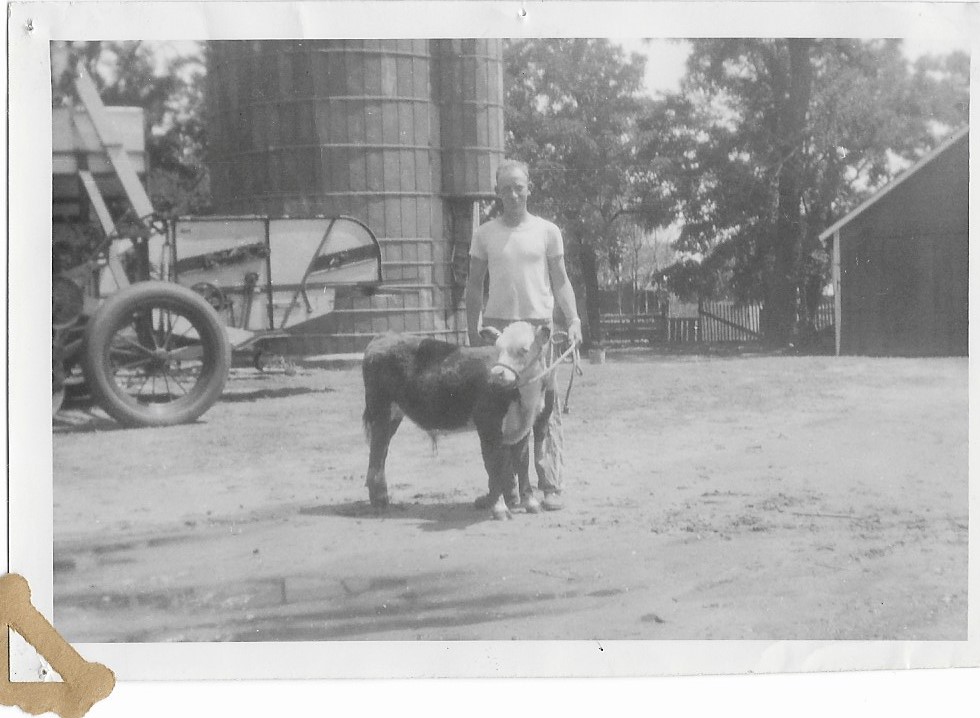
Melvin with a calf in the farm yard

The corrals were the backdrop for years of feeding and working cattle and the scrapes and bruises that go with that.  

Clarence

Marie and cattle - I'm pretty sure this was taken to send to Melvin when he was in Korea. She definitely didn't dress up this much for her normal day on the farm!

The homestead welcomed a menagerie of dogs and cats throughout the years.

Grandma Ava and dog Tiny

Marie & "old Fuzzy" cat - as it says on the back of the photo

After Randy's sophomore year in college, Melvin and Marie moved a modular home onto the site, replacing the old farm house. That brick split level was one where they welcomed me as a new member of the family 41 years ago. 


And, honestly, I don't have many photos of that house either. There are photos of the people who lived there and the life that was lived. Honestly, I didn't dig through my tubs of photos in the basement to see if I could find photos of my kids playing, with the house in the background. No time for that with other things to do. (We did have a wedding last weekend. I can't wait for the official photos! And, if I'm honest, the packed-to-the-brim tubs from my kids' lives are overwhelming, and I have plenty of other spots to declutter first!)

Visiting Grandma & Grandpa at Halloween. Of course, Grandpa had a surprise for them, too!

Since Melvin and Marie's house was only two miles away from ours, Jill and Brent were frequent visitors. They stood on chairs and helped Marie cook. They pulled pots and pans out of the cupboards. They played with the toys that had been put away in the closet from Randy's and his siblings' childhoods.

Marie would hide plastic Easter eggs for the kids year 'round. Other than at Easter time, they didn't have anything special in them, but it was the thrill of the hunt, I guess. 

We gathered around a pickup bed to shuck corn. Jill and Brent would wield their own washrag from Grandma Marie, using her method to try and remove the silks from the corn cobs.  After their attention span waned, they'd run around the yard, playing where their ancestors had played before them.  

Randy says he remembers when the new house was moved in. He remembers watching it come down the road, toward the farm. I can't believe they didn't take photos. If they did, I don't know where they are.

Not all that long ago, both of us got tears in our eyes as we watched the semi depart from that farmstead with the final group of feeder calves that we'd raise and feed from the time they were babies to watching them go through the sale barn. 

November 2021

 (We're still involved and retain ownership. We're just not responsible for the day-to-day tasks.)

Yes, there are more memories than I can list. 


And we hope that will be true for the new family who will live there, too.