Showing posts with label wildfire. Show all posts

Tuesday, February 24, 2026

Ash Wednesday

The sunset on Ash Wednesday (February 18) was beautiful. But, as we stopped at the corner south of our house on that Ash Wednesday evening, I couldn't help but think about how ashes from massive wildfires south of us were helping to color that sunset. 

We were returning home after a drive through the baby calves. But 117 miles away or so, other cattle owners were fighting fires for the second day and still trying to move cattle to safety. 

It was only nine years ago that so many of these same ranchers lost their homes, farm properties, hundreds of miles of fencing and thousands of cattle in the Starbuck Fire. 

These were numbers from the 2017 fire. It will be days before everything can be accessed from this latest fire.

As Greg Gardiner of Gardiner Angus Ranch in Ashland says, their operation was almost to the point where they could say they'd "recovered" from the 2017 fire. Though how do you truly recover from that? 
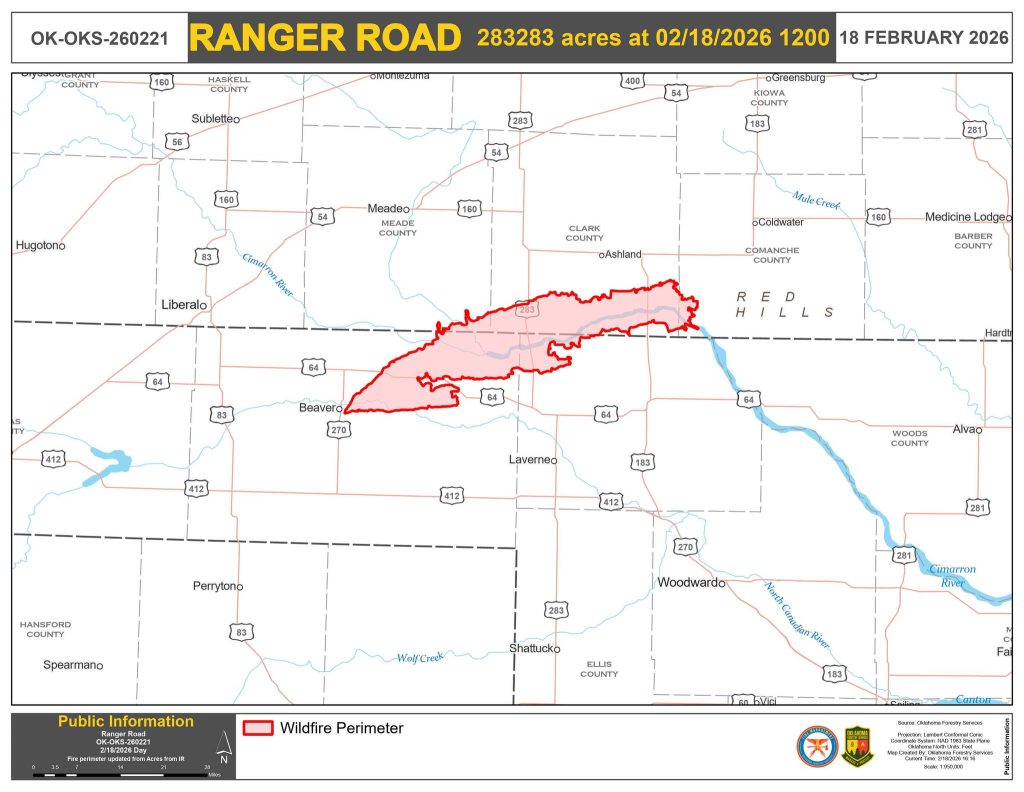
The 2026 Ranger Road fire burned more than 283,000 acres. Map courtesy Oklahoma Department of Forestry Wildfires4-RFP-022326. It is still not fully contained - a week after it started.

Beginning a week ago on February 17, 2026, wildfires ripped across areas of Oklahoma, Kansas, Texas and Nebraska, killing livestock, destroying structures and sending firefighters to the hospital with fire- and smoke-related injuries. Winds gusting over 65 miles per hour drove flames through dry fuel and kept air support grounded.

The largest fire this time, known as the Ranger Road fire, ignited in Beaver County, Oklahoma, and crossed the state line into southern Kansas, burning more than 283,000 acres. The towns of Ashland and Englewood, Kansas, were evacuated, as were rural residents along the fire's path. 

In television interviews, Gardiner says they learned many lessons from the Starbuck Fire in 2017, and they used that knowledge to try and mitigate the losses in 2026. But even your best efforts doesn't mean that you are able to dodge the inevitable.  

I sometimes wonder about the people who settled the Kansas prairie. Did they marvel at the sky? Did the call of birds wake them to see the hint of color painting the eastern horizon? As their covered wagons rumbled toward the west, did they marvel at the sunsets?

I imagine the temperaments that marked the people who set off from established homes in the eastern part of the U.S. and decided on adventure, traveling westward to a new kind of life.

Since the state was established in 1861, Kansans have had to pick up the pieces from all kinds of natural disasters. Why do they do it? 


That pioneer spirit brought people to Kansas. And some of the heartiness remains generations later. 

Maybe the fortitude to stay had something to do with the joy of seeing those cute faces in their cattle herds. As we drove through the cattle lots and watched the baby calves race one another or sip contentedly from their personal "mama milk machines," I couldn't help but think of the ranchers still battling the wildfires.

For those in the wildfires' paths, lives won't go back to normal anytime soon. They are still burying their livelihoods in big mass graves in the burned ground. They are tending to injured cattle, bottle feeding babies whose mothers died, rebuilding thousands of miles of fence. And some of them no longer have a home where they can lay their weary heads come nighttime, after days of physical labor and emotional heartache.

Even today - a week later - firefighters aren't saying the wildfires are totally under control. Instead, they say the blazes are "90 percent" under control. And today is another day when the wind is howling, stoking those embers yet again. 

It's going to take a new pioneer spirit for them to rebuild. Just like us, their families have been on Kansas soil for five generations, and, for a few, even six generations. That pioneer spirit is part of their DNA.

Like us, they delight in seeing new life every spring. 

To assist livestock producers affected by the Ranger Road fire, please reach out to any of the following. That way, you know the money or supplies will go to the people who need it: 

SHAW FEEDYARD: Shaw Feedyard in Ashland is a drop point for hay. Please contact Ryan Koons at (620) 805-4682 if you have any questions. The address is 2428 CR 15 in Ashland, KS.


ASHLAND FEED & SEED: Ashland Feed & Seed is a drop point for hay and feed. The address is 1975 CR U, Ashland, KS 67831. Contact the main office: (620) 635-2856.


Cash donations can be made to the ASHLAND COMMUNITY FOUNDATION. One hundred percent of the money will be redistributed to those in need. You can donate directly by clicking https://www.ashlandcf.com/donate-today or mail or drop off monetary donations to STOCKGROWERS STATE BANK, 622 Main Street, Ashland, KS 67831, or mail checks to ASHLAND COMMUNITY FOUNDATION, P.O. Box 276, Ashland, KS 67831.


KANSAS LIVESTOCK ASSOCIATION is helping organize in-kind donations for delivery to affected areas in Kansas. To donate hay or trucking services, call KLA at (785) 273-5115. Cash donations can be made through the Kansas Livestock Foundation (KLF), KLA’s charitable arm, by going to www.kla.org
and clicking on Donate under 2026 Wildfire Donations. Checks can be sent to 6031 SW 37th, Topeka, KS 66614. Please put “wildfire relief” in the memo line. KLF is a 501 c(3) organization. Donations to the foundation are tax-deductible. All funds will be used to support fire relief efforts for Kansas producers. 


From Isaiah 61 - The Year of the Lord’s Favor

61 The Spirit of the Sovereign Lord is on me,
    because the Lord has anointed me
    to proclaim good news to the poor.
He has sent me to bind up the brokenhearted,
    to proclaim freedom for the captives
    and release from darkness for the prisoners,
to proclaim the year of the Lord’s favor
    and the day of vengeance of our God,
to comfort all who mourn,
    and provide for those who grieve in Zion—
to bestow on them a crown of beauty
    instead of ashes,

the oil of joy
    instead of mourning,
and a garment of praise
    instead of a spirit of despair.
They will be called oaks of righteousness,
    a planting of the Lord
    for the display of his splendor.

They will rebuild the ancient ruins
    and restore the places long devastated;
they will renew the ruined cities that have been devastated for generations.


Tuesday, March 21, 2017

A Story To Tell: Ag Day 2017

I sometimes wonder about the people who settled the Kansas prairie. Did they marvel at the sky? Did the call of birds wake them to see the hint of color painting the eastern horizon? As their covered wagons rumbled toward the west, did they marvel at the sunsets?
I imagine the temperaments that marked the people who set off from established homes in the eastern part of the U.S. and decided on adventure, traveling westward to a new kind of life.

That pioneer spirit brought people to Kansas. And some of the heartiness remains generations later. Today is the 2017 National and Kansas Ag Day.
Four days last week, we worked baby calves. Last Friday, we temporarily separated another group of babies from their mamas. We loaded the babies into the cattle trailer through a fog of dust generated by dozens of hooves stirring up the dirt floor of a 75-year-old-plus barn.
I was tired after four days of it. But as I looked through the dusty haze, I realized how fortunate we were. We were doing our normal springtime cattle tasks. We temporarily separated mamas and babies and sent the babies through the working chute for their well-baby "appointments" and vaccinations.

And at the same time, cattlemen and women in southern Kansas had the grim task of burying thousands of cattle and calves that perished in the largest wildfire in Kansas history. Some of our farm and ranch neighbors in Oklahoma and Texas face the same seemingly insurmountable task. In Texas, some even lost their lives trying to move cattle to safety.
For those in the wildfire's path, lives won't go back to normal anytime soon. They are still burying their livelihoods in big mass graves in the burned ground. They are tending to injured cattle, bottle feeding babies whose mothers died, rebuilding thousands of miles of fence. And some of them no longer have a home where they can lay their weary heads come nighttime, after days of physical labor and emotional heartache.
It's going to take a new pioneer spirit for them to rebuild. Just like us, their families have been on Kansas soil for five generations, and, for a few, even six generations. That pioneer spirit is part of their DNA.

I don't watch a lot of national news. But, if my Facebook feed is right, there has been very little coverage of this emergency on the national level. The local TV stations, radio and newspapers have done a credible job of telling the stories. Yesterday, The New York Times featured an article, in which one rancher called the wildfires, "Our Hurricane Katrina."

I read the article, and then came back later in the day so I could link it to this blog post. I was dismayed by the comments from the majority of readers (up to 422 comments this morning). It again demonstrates how deeply the country is divided, as if we needed any reminders these days. (For the record, I didn't vote for President Trump, though most commenters assume I did - just because of where I live and what I do for a living.) After reading those comments, maybe it's better that the national media largely ignored this story. 

However, I know that many farmers and ranchers from across the country have responded with truckloads of hay and semis packed with fencing supplies. Some 4-H groups have volunteered to foster baby calves until the ranches have time to build fence and reintroduce the babies back into their herds. There have been funds set up so regular people like you and me can contribute to the rebuilding, including at Kansas Farm Bureau and at Kansas Livestock Association.

(FYI: I would recommend Amy Bickel's article in The Hutchinson News, plus sidebars and follow-up stories, as well as the accompanying photojournalism by News photographer Lindsey Bauman. The Wichita Eagle also provided in-depth coverage of the wildfire.)
 
This year's theme for National Ag Day is Agriculture: Food for Life. But the majority of the world would rather learn about food from people other than the producers. A couple of years ago,  I Am Agriculture Proud, posed this observation on their Facebook page:
Journalists, TV personalities, TV chefs and CEOs were all perceived as more influential on food than farmers, who come in at No. 50 on a list generated of The 50 Most Powerful People in Food on The Daily Meal.com.  And that was likely an arbitrary inclusion as a collective group. What's it gonna take for farmers to move up that list?
It's up to us - farmers and ranchers - to tell the story. As I've said before, I don't want to leave it to PETA or HSUS to tell the story of farming today. It's one of the reasons I began Kim's County Line seven years ago.

The Gardiner Angus Ranch has been in the news because of their losses. Two of the brothers - Mark & Greg - were in FarmHouse fraternity at K-State at the same time as Randy. The Gardiner Angus Ranch's annual production sale is still scheduled for March 31, though things will be somewhat different this year after losing more than 500 of their cows, hundreds of miles of fencing and even Mark's & Eva's home. But I was amazed at some of what Mark Gardiner had to say. I've put the link to the whole video clip below, but I wanted to highlight these quotes from Mark, just in case you don't take time to listen to the whole thing:


I want you all to know how truly fortunate we are to have so many friends and customers and family. When we had a bit of a challenge, our customers actually were some of the first ones who came running to help us. … 

The sale is on. It is on because it’s what we do. You know, we learn a lot in these situations about who we are as people. And people are good, especially people in agriculture and especially our customers, neighbors and friends. We’ve had some losses; we’ve had some challenges. …

We've had help from almost every state in the union. ... That’s what America is. That’s what rural America is. That’s what agriculture is. That’s what the cattle business is. We actually have no problems. We have worlds of opportunity. We have the greatest friends and the greatest nation … We’re excited about this sale. We’re excited about the things that matter with people, with family, with friends.

We need to celebrate this way of life. Even more importantly than the cattle, we need to celebrate the people who make this business so great.
If we listen to the detractors commenting on the wildfire story, it's clear that we're not doing a good job of sharing agriculture's story. With this post, I'll likely be "preaching to the choir." I can't seem to reach those people who really believe that we modern farmers are ignorant puppets who "are only looking for handouts."

The true story of agriculture is being written each and every day by the people who are living it.