Showing posts with label National Ag Day. Show all posts

Tuesday, March 21, 2017

A Story To Tell: Ag Day 2017

I sometimes wonder about the people who settled the Kansas prairie. Did they marvel at the sky? Did the call of birds wake them to see the hint of color painting the eastern horizon? As their covered wagons rumbled toward the west, did they marvel at the sunsets?
I imagine the temperaments that marked the people who set off from established homes in the eastern part of the U.S. and decided on adventure, traveling westward to a new kind of life.

That pioneer spirit brought people to Kansas. And some of the heartiness remains generations later. Today is the 2017 National and Kansas Ag Day.
Four days last week, we worked baby calves. Last Friday, we temporarily separated another group of babies from their mamas. We loaded the babies into the cattle trailer through a fog of dust generated by dozens of hooves stirring up the dirt floor of a 75-year-old-plus barn.
I was tired after four days of it. But as I looked through the dusty haze, I realized how fortunate we were. We were doing our normal springtime cattle tasks. We temporarily separated mamas and babies and sent the babies through the working chute for their well-baby "appointments" and vaccinations.

And at the same time, cattlemen and women in southern Kansas had the grim task of burying thousands of cattle and calves that perished in the largest wildfire in Kansas history. Some of our farm and ranch neighbors in Oklahoma and Texas face the same seemingly insurmountable task. In Texas, some even lost their lives trying to move cattle to safety.
For those in the wildfire's path, lives won't go back to normal anytime soon. They are still burying their livelihoods in big mass graves in the burned ground. They are tending to injured cattle, bottle feeding babies whose mothers died, rebuilding thousands of miles of fence. And some of them no longer have a home where they can lay their weary heads come nighttime, after days of physical labor and emotional heartache.
It's going to take a new pioneer spirit for them to rebuild. Just like us, their families have been on Kansas soil for five generations, and, for a few, even six generations. That pioneer spirit is part of their DNA.

I don't watch a lot of national news. But, if my Facebook feed is right, there has been very little coverage of this emergency on the national level. The local TV stations, radio and newspapers have done a credible job of telling the stories. Yesterday, The New York Times featured an article, in which one rancher called the wildfires, "Our Hurricane Katrina."

I read the article, and then came back later in the day so I could link it to this blog post. I was dismayed by the comments from the majority of readers (up to 422 comments this morning). It again demonstrates how deeply the country is divided, as if we needed any reminders these days. (For the record, I didn't vote for President Trump, though most commenters assume I did - just because of where I live and what I do for a living.) After reading those comments, maybe it's better that the national media largely ignored this story. 

However, I know that many farmers and ranchers from across the country have responded with truckloads of hay and semis packed with fencing supplies. Some 4-H groups have volunteered to foster baby calves until the ranches have time to build fence and reintroduce the babies back into their herds. There have been funds set up so regular people like you and me can contribute to the rebuilding, including at Kansas Farm Bureau and at Kansas Livestock Association.

(FYI: I would recommend Amy Bickel's article in The Hutchinson News, plus sidebars and follow-up stories, as well as the accompanying photojournalism by News photographer Lindsey Bauman. The Wichita Eagle also provided in-depth coverage of the wildfire.)
 
This year's theme for National Ag Day is Agriculture: Food for Life. But the majority of the world would rather learn about food from people other than the producers. A couple of years ago,  I Am Agriculture Proud, posed this observation on their Facebook page:
Journalists, TV personalities, TV chefs and CEOs were all perceived as more influential on food than farmers, who come in at No. 50 on a list generated of The 50 Most Powerful People in Food on The Daily Meal.com.  And that was likely an arbitrary inclusion as a collective group. What's it gonna take for farmers to move up that list?
It's up to us - farmers and ranchers - to tell the story. As I've said before, I don't want to leave it to PETA or HSUS to tell the story of farming today. It's one of the reasons I began Kim's County Line seven years ago.

The Gardiner Angus Ranch has been in the news because of their losses. Two of the brothers - Mark & Greg - were in FarmHouse fraternity at K-State at the same time as Randy. The Gardiner Angus Ranch's annual production sale is still scheduled for March 31, though things will be somewhat different this year after losing more than 500 of their cows, hundreds of miles of fencing and even Mark's & Eva's home. But I was amazed at some of what Mark Gardiner had to say. I've put the link to the whole video clip below, but I wanted to highlight these quotes from Mark, just in case you don't take time to listen to the whole thing:


I want you all to know how truly fortunate we are to have so many friends and customers and family. When we had a bit of a challenge, our customers actually were some of the first ones who came running to help us. … 

The sale is on. It is on because it’s what we do. You know, we learn a lot in these situations about who we are as people. And people are good, especially people in agriculture and especially our customers, neighbors and friends. We’ve had some losses; we’ve had some challenges. …

We've had help from almost every state in the union. ... That’s what America is. That’s what rural America is. That’s what agriculture is. That’s what the cattle business is. We actually have no problems. We have worlds of opportunity. We have the greatest friends and the greatest nation … We’re excited about this sale. We’re excited about the things that matter with people, with family, with friends.

We need to celebrate this way of life. Even more importantly than the cattle, we need to celebrate the people who make this business so great.
If we listen to the detractors commenting on the wildfire story, it's clear that we're not doing a good job of sharing agriculture's story. With this post, I'll likely be "preaching to the choir." I can't seem to reach those people who really believe that we modern farmers are ignorant puppets who "are only looking for handouts."

The true story of agriculture is being written each and every day by the people who are living it.


Tuesday, March 15, 2016

A Story To Tell: 2016 Ag Day

"A picture is worth a thousand words." 

That familiar, probably overused phrase is on a display of space photos at the Cosmosphere. Last summer, while at the national convention of the Master Farm Homemakers Guild in Hutchinson, we acted like tourists in our own backyard. One of my favorite Cosmosphere displays showed photographic images taken from space.
  The display says, in part: 
The best way to judge the role of the camera in space is to try to imagine what it would be like if it had not been taken along. Try to imagine how difficult it would be to visualize the stark beauty of the moon's surface or an Earth-rise over the lunar mountains or the brilliant rays of the rising sun reflecting off a space-walking astronaut as he dangles from his orbiting spacecraft. Imagine what would have been lost to us if we had not experienced the image of our small, fragile, blue Earth floating against the backdrop of the heavens. ... The photographic images are a permanent record that will forever demonstrate the role our few generations have played in the evolution of human history.
Today (March 15) is National Agriculture Day, a day designated each year by the Agriculture Council of America to celebrate the accomplishments of agriculture. This year’s theme is Agriculture: Stewards of a Healthy Planet.
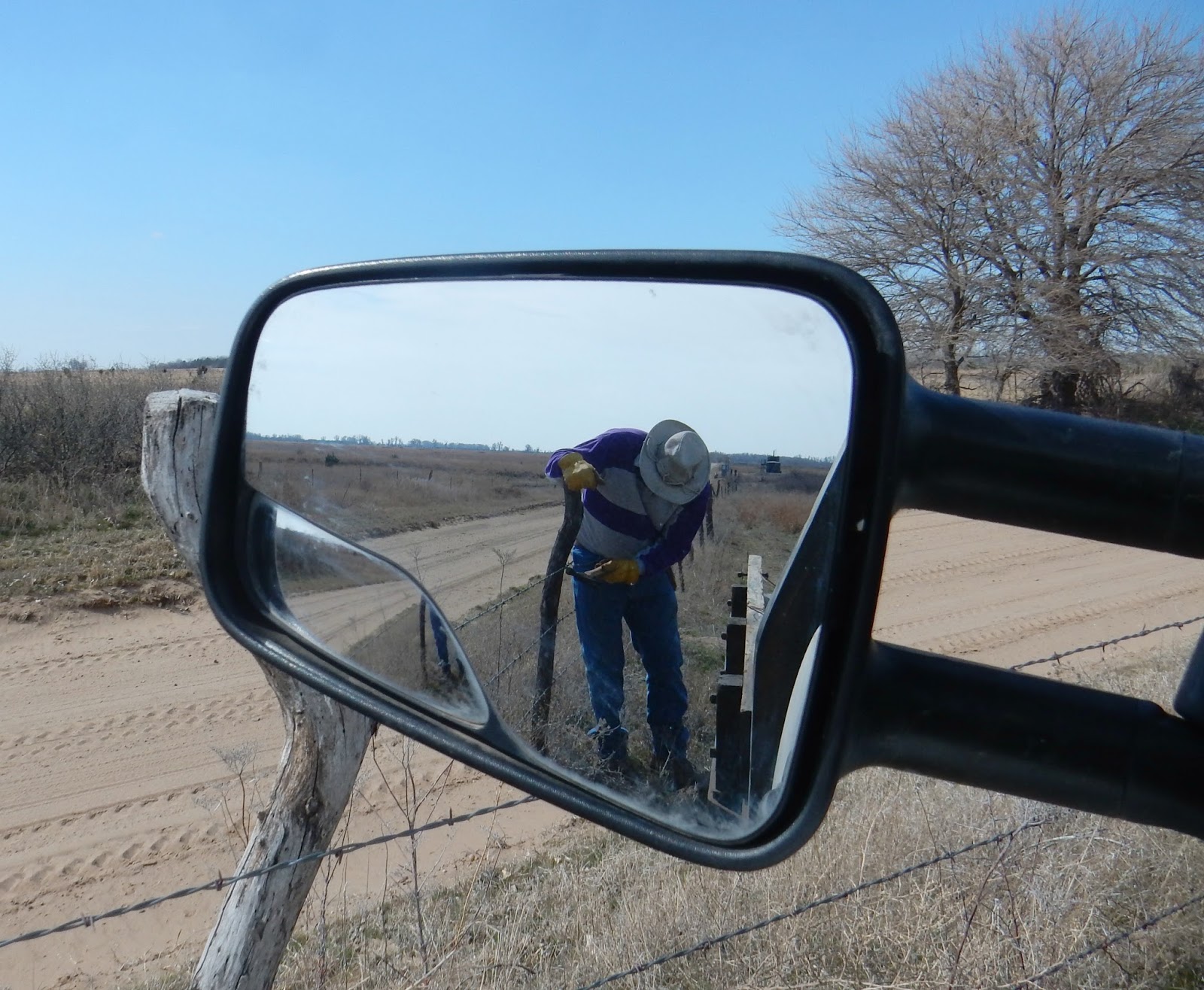
Last week, I was the pickup driver while Randy,  his cousin Don and Don's son, Hans, fixed fence at the Big Pasture. The pasture has been in the family for more than 100 years. The ground was purchased in 1900 for about $4 per acre by August Brinkman, a great-great-great uncle of Randy's. Originally in a tract of 1,040 acres, 560 acres remain in the Fritzemeier family.

A few years ago, this location was designated as a Farm Bureau Century Farm. Randy's Grandpa, Clarence, and two of his brothers owned the pasture together. Now Randy and Don are the owners.
Traditionally, we don't move cattle to the Big Pasture before May 1, but we were working on fence to get it ready for another season during which cattle can graze on the native grasses and drink from the Rattlesnake Creek that runs through it. Though the lushness of spring is several weeks away, there was still beauty in the starkness of the winter landscape, too, especially on a day that hinted of spring to come. 
It wasn't just a trip down memory lane for Randy, who is the fifth generation on his family's farm in Stafford County. I was also remembering that my first job on my parents' Pratt County farm was driving the pickup while my Dad worked on electric fence. I, too, am the fifth generation in my family associated with Kansas farming.
According to the 2012 Agriculture Census, there are 3.2 million farmers and ranchers in the U.S. Last year, American's farmers - who represent only 1 percent of the U.S. population - had 912 million acres in production of food and fiber.
  • The U.S. farmer of today produces enough food and fiber for approximately 160 people. This number was 19 people in 1940, 46 people in 1960, and 115 people in 1980.
  • Farmers receive just under 16¢ of every consumer dollar that is spent on food. The other 84¢ is spent on processing, packaging, marketing, transportation, distribution and retail costs of the food supply.
Yet it seems consumers would much rather get their information about how their food is produced from someone who has never set foot on a farm or a ranch. They let restaurant public relations gurus define what is safe to eat. Yet it is America's farmers and ranchers who devote their daily lives to it. 

Just like those astronauts who carried cameras to outer space, I carry my camera with me as we live and work on the County Line. It's up to us - farmers and ranchers - to tell our story. As I've said before, I don't want to leave it to PETA or HSUS to tell the story of farming today. It's one of the reasons I began my blog, Kim's County Line, six years ago.
For more than 100 years, Randy's family has been fixing fence in that very same pasture. Randy, like his father and grandfather before him, make sure those fence posts are in solid ground. If something isn't solid, he fixes it.
 
Just like other industries, farmers have changed some agricultural techniques through the years in an effort to improve and advance, all the while keeping their livelihoods and their families on solid ground. Just like looking in a rearview mirror, they use the past as a guide, but they also have their eyes firmly fixed on the future.
Information flies toward us, popping up on Facebook feeds. "Tweets" and "Snaps" signal their presence with immediate pings on the phones that are always in our pockets or in our hands. But maybe - just maybe - consumers could ask a  real farmer if they have questions about modern food and fiber production. What might change if they would look at photos or read words from a real Kansas farm and not just let a self-proclaimed "expert" determine their viewpoint?
 
Wouldn't that be a more solid connection with the world of agriculture? March 15 may be National Ag Day and Kansas Ag Day. But you know what? Every day is Ag Day around here, no matter the date on the calendar.
 
As the Cosmosphere photography display said: 
The photographic images are a permanent record that will forever demonstrate the role our few generations have played in the evolution of human history.
It's true for those images from space. But it's also true for we farmers and ranchers of today.

Wednesday, March 18, 2015

Kansas Ag Day: Years in the Making

 
Today is Kansas Agriculture Day. I'm posting a story about selling feeder cattle last Thursday. But, in reality, the story is about much more than one day selling cattle. The story began when Randy was in high school. He bought a cow, and it produced a calf each year. Then, when he was a junior at K-State in 1977, he bought 35 cows and began renting the Ninnescah pasture, where we still take cow-calf pairs each spring. It was the true beginning of his cow-calf herd.

Much the same, the journey with this crop of feeder calves didn't start and end on one day in March. The calves were born on the County Line more than a year ago, and we have been caring for them ever since. The sale ends one chapter, but the next one has already begun with a new crop of 2015 calves. It also continues with 25 sisters to the yearlings we sold last week. Those 25 heifers will be producing part of our 2016 calf crop.

So the legacy continues. Every day is Ag Day around here, whether we're doing farm work or living everyday life in a rural Kansas community.
***
Cattle buyers had their phones molded to their ears with just about as much ferocity as teenage girls gossiping about the new boy in school. They pulled the phones from their Wranglers and wedged them underneath their cowboy hats as they took call after call, matching cattle with feedlots' needs.

We were at Pratt Livestock last Thursday to sell 73 feeder cattle.  

According to the sing-song chant of the auctioneers, the buyers undoubtedly were searching for "fussy and fancy heifers" and "green steers."

"There's power in the blood, boys," the auctioneer warbled, touting their lineage. "Look at the length on them, and their bigger sisters are coming right behind them."

The cattle turned in circles in the sale ring, reminding me of my hubby and me at a wedding dance, staying in our own little box.
"We have 7,700 of the best stocker and feeder cattle in the world here today, boys," the auctioneer proclaimed.

Ours were among them, though, thankfully, we didn't have any of the "party girls" that ended up coming through the sale ring twice. (As heifers come through the sale ring, they are guaranteed open, in other words, not pregnant. If the buyer requests it, the heifers are evaluated by a veterinarian. Any that are pregnant are sent back into the ring and sold again so the buyers know what they are getting.)

Our steers averaged 904 pounds apiece. Since we retained 25 of the bigger heifers to breed back for our own cow herd, the heifers we sold were smaller, averaging 746 pounds each.

It was a long day at the sale. We got there just after 10 AM, but our heifers didn't sell until nearly 12:30 PM. It was almost 6 o'clock when our steers went through the sale ring.

But it was worth the wait as we picked up the check.

It isn't just a long day on sale day. Selling feeder cattle is a process that's more than a year in the making. The feeder calves were born to our heifers and cows during the winter of 2014.
They got the eartags starting with "4" to signify that they were born in 2014.

 Through the cold and snow, they grew next to their mamas' sides.
By early May, they had already put on some pounds.
Mama at top and baby below at the Ninnescah Pasture in May.
Then, it was time to go the the summer pastures with their mamas, where they continued to dine on milk and prairie grasses.
We brought them back to the farm in early November and weaned them from their mothers.
They had a visit with the vet before taking up residence in a small pasture closer to home.
 
 All winter, Randy & Jake fed them silage and hay.
Then, last week, the semi came and picked them up for their ride to Pratt Livestock.
And we were glad to be there when the auctioneer proclaimed, "Sold!"
It may be the end of this chapter. But the next part of the journey is already under way. Every day is Ag Day - whether it gets a special hashtag on Twitter or not.

Tuesday, March 19, 2013

Our Own Parade for Ag Day 2013

 I'll be celebrating National Ag Day and Kansas Ag Day today like I spent yesterday.
We have our own little parade planned on this special day, but there won't be a marching band. The parade will be single file through the calf cradle chute on our South Central Kansas farm.
 
The guests of honor don't get ribbon rosettes or badges, but bright yellow eartags.
There's no ticker tape. There is music - of sorts. You don't have to be fluent in "cow" to know that the mamas are singing the blues in double forte as they end up on one side of the pen and their babies are on the other during the calves' spring "doctor's" appointment.
 
We will celebrate Ag Day right where it ought to be celebrated - getting our feet and our hands dirty and being stewards of the animals and the land in which we have been entrusted. Randy is the fourth generation to be an owner/operator of a farm in his family.
My Kansas farming legacy goes back five generations on the Moore side and four on the Neelly lineage. Randy and I have been farming together now for nearly 32 years.
It doesn't take a special day for us to be thankful for the privilege of living and working together on a Kansas family farm. Still, I think it's good to recognize a National Ag Day. I joined a Facebook group, I Am Agriculture Proud, earlier this month. Organizers there posed this observation:
Journalists, TV personalities, TV chefs and CEOs were all perceived as more influential on food than farmers, who come in at No. 50 on a list generated of The 50 Most Powerful People in Food on The Daily Meal.com.  And that was likely an arbitrary inclusion as a collective group. What's it gonna take for farmers to move up that list?
It's up to us - farmers and ranchers - to tell the story. As I've said before, I don't want to leave it to PETA or HSUS to tell the story of farming today. It's one of the reasons I began Kim's County Line three years ago. The true story is being written each and every day by people just like us, who spend spring break riding a 4-wheeler instead of an amusement ride at Disney World.
The best part about working cattle during spring break? I don't have to stop and clean up to run to town for my middle school accompanist gig. The cows don't care what I'm wearing or whether I have make-up on. Randy doesn't care either ... or he wisely keeps his opinion to himself.

It's just another reason to celebrate on this Ag Day. We got 27 baby calves worked yesterday. We plan an all-day marathon session today. Let the parade begin. (Hopefully, those involved will stay on the parade route!)