Thursday, May 7, 2015

Parting Shots

It's a little quiet around here. Our youngest babies have left home for the first time. I feel kind of like a mom when she sends the baby of the family off to kindergarten.

I was one of those moms who took photos on the front steps before my kids boarded the big yellow bus and off they went. So, it's only right that these babies also got their Kodak moment before they boarded their own brand of "bus" and we took them and their mamas to summer pastures.
 
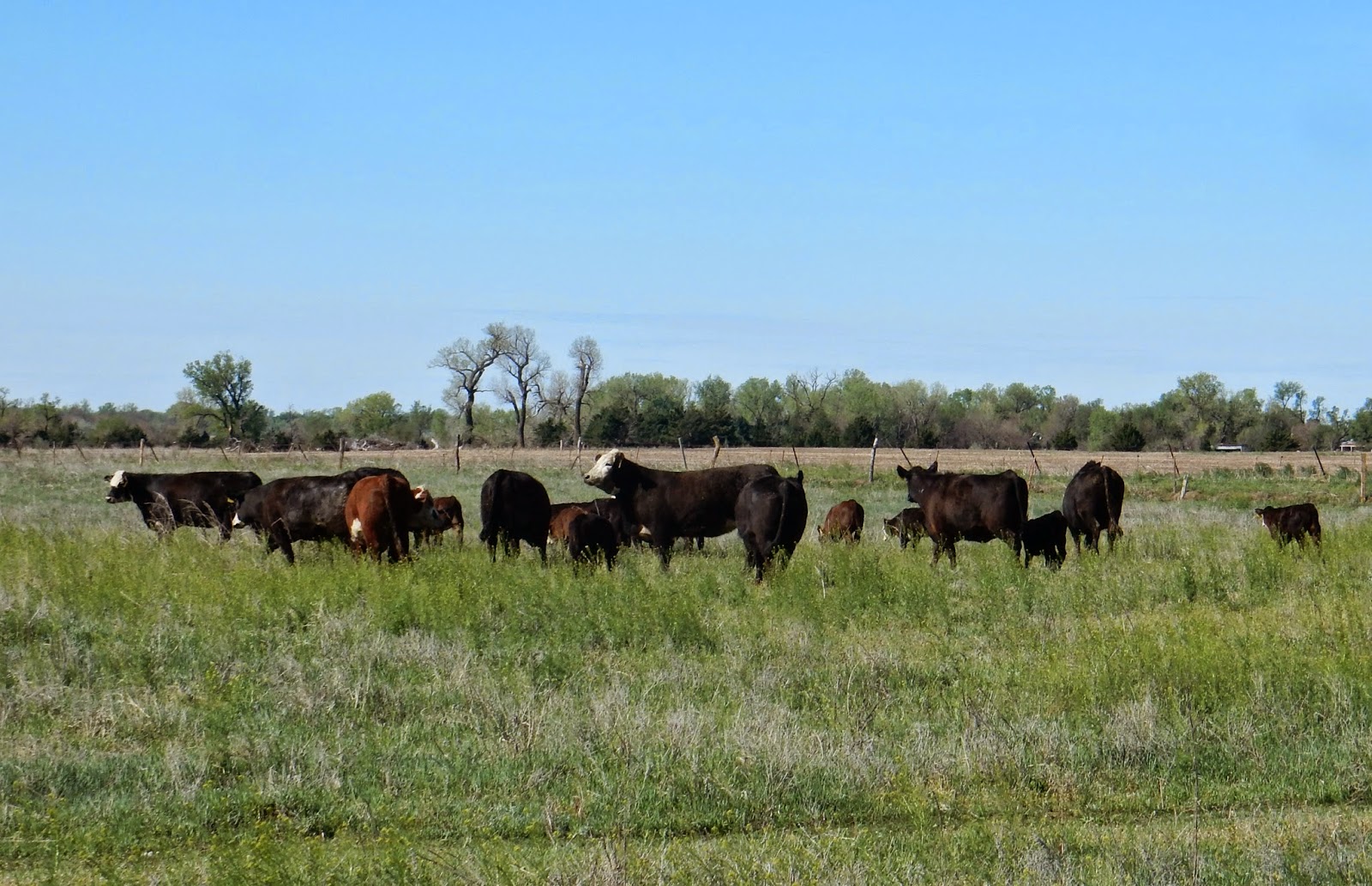
We took the final group to what we call the Big Pasture Wednesday morning. For more than 100 years, Randy's family has been taking cows and calves under the canopy of cottonwoods on this dirt road to the Rattlesnake. Back when Randy was a child, the pasture was co-owned and managed by his grandpa Clarence Fritzemeier and Clarence's two brothers, Ed and Harve. To be fair to everyone, no one took their cattle to the pasture before May 1.  The tradition stuck. Now, Randy and his cousin, Don, co-own the pasture. They still follow the May Day rule.

We had already run those babies through the chute, so it was just a matter of gathering and sorting this last group yesterday morning.

In addition to yesterday's cattle duties, we also spent three days last week sorting, working and hauling calves and cows. Like me on the first day of kindergarten, these four-legged moms had a little bit of separation anxiety.
They didn't realize they would be reunited after a separate trailer ride to their summer homes.

Randy says it feels good to quit staffing the daily "lunch truck." He and Jake got the feed truck cleaned up and ready to put in the shed.
This little Masked Man was born the night before he went through the working chute. The guys ended up carrying him and another young friend in and out of the trailer.
Others patiently waited for their turn at their first "doctor's" appointment.

We did add a step in the process of "working" the baby calves this spring. Besides the yellow ID eartag in their left ears, Randy added a blue insecticide tag in their right ears. It will help control flies, ticks and other pests on the babies. It takes the place of a pour-on insecticide we've used in previous years.
Whether under blue skies of last week ...
... or the overcast skies yesterday, the pastures look in good shape after some timely rains during the past month.
It doesn't look like a bad place to spend summer vacation, do you think?

Tuesday, May 5, 2015

The Road Home

The road home is as familiar as the back of my hand. I've driven it thousands of times. Most times, it's at full-speed-ahead mode as I'm late to the next thing on my list. Sometimes, I'm moving at a snail's pace in a filled-to-the-brim wheat truck. Once in awhile, the shakes and rattles of a cattle trailer hitting the pavement form an unintended bass line to whatever is playing on the radio.

Early in our marriage, we lived in a house right on the Zenith Road. But in all those north and south trips, we've never noticed the irises until this year. I must give credit to my sharp-eyed farmer. He's the one who saw them first, and he earns major brownie points for sharing them with me. 
It was an added bonus that it was at the "golden hour," that time when real photographers say the light colors the world in magical ways.

The irises are a bit incongruous. Maybe they are at a site of a long-ago farmstead, but there is no falling down barn or cement foundation that gives us that clue. These days, they are flanked by a CRP field, the dry, brown grasses of winter a sharp contrast to the brilliant colors and soft petals that form the old-fashioned spring flowers. As we examined them more closely, we noticed several of the stems devoid of their blooms. They were likely food for the deer that flash in and out of the same trees and have been the source of more than one close call on our Zenith Road travels.
Irises remind me of my Grandma Neelly, who had them in her backyard. As I stood at her kitchen window, the purple blooms would make dishwashing less of a chore.
And I was blessed by memories colored purple.

The flower offered of itself
And eloquently spoke
Of God
In languages of rainbows
Perfumes
And secret silence...
~Phillip Pulfrey
 from Love, Abstraction and other Speculations

Monday, May 4, 2015

Cleaning House

I can always find something I'd rather do than deep cleaning. But when I cleaned out a storage cabinet not long ago, I came across a forgotten treasure. (That should probably motivate me to do more, but let's be real. It probably won't!)

When Jill and Brent were little, Randy's mom, Marie, made them a finger play glove and several verses. I took them to Topeka, where a second generation can enjoy these handmade, interactive stories.

Marie sewed and decorated the felt pieces. She then attached Velcro to the shapes and to the glove.
 
Kinley enjoyed taking each of them off as I read the verses.
 
Some day, Brooke will want her turn, too. (That time is coming quickly, I hear. Even though we just saw them a couple of weeks ago, Brooke has mastered crawling, is pulling up to things and walking around them. Watch out world! More accurately ... watch out Big Sister!)
They don't seem to care that a couple of them are out of season.
Hidden treasures are always in season.

Friday, May 1, 2015

Cream of Coconut Cake

I'm not sure whether a coconut dessert has a place at the table for a Cinco de Mayo celebration. (And Cinco de Mayo, coming up on May 5, seems to be the current theme among food bloggers these days.)

But this Cream of Coconut Cake had good reviews at a church potluck dinner last weekend. And, since my husband is a coconut fan, it also got good reviews for leftovers consumed at home. 

When people ask for a recipe, I always feel a little guilty when it starts with a cake mix. But this one is doctored up with some extras, like pudding and coconut. And who can really argue with easy?

It's essentially a poke cake:  When it comes out of the oven, you use a fork and jab it like a maniac on one of those detective TV shows. Then, for even more subtle coconut flavor, pour cream of coconut over the cake. Cream of coconut can be found where you'd find ingredients for mixed drinks. It doesn't have any alcohol. It just has the tropical flavor. A word to the wise: This isn't coconut milk, so keep looking if that's what you find. It's a syrupy concoction that oozes over the cake and gives it delicious moistness. The bottle I found was 21 ounces, but this isn't an exact science. Don't make yourself crazy looking for that exact amount. If it's an ounce more or less, it's still going to work just fine.

Once the cake has completely cooled, top it with Cool Whip. Or make your own sweetened whipped cream from scratch if you're feeling all virtuous. (I wasn't.) Sprinkle with toasted coconut to make it pretty and add a little more flavor and texture.

So, whether for Cinco de Mayo or for a church potluck or to satisfy your coconut craving, this recipe will be the "cream" of the crop.
Cream of Coconut Cake
1 pkg. yellow cake mix
1 pkg. French vanilla pudding mix
4 eggs
1/4 cup oil
1 1/3 cups water
1 1/3 cups flaked coconut
**
1 21-oz. bottle of cream of coconut (not coconut milk)
1 tub Cool Whip
1 cup coconut, toasted

In a mixer, combine eggs, oil and water and blend until well mixed. Add cake mix and pudding mix. Blend until smooth. Add flaked coconut. Pour into 9- by 13-inch pan which has been sprayed with baking spray. Bake at 350 degrees for 25-30 minutes, until a toothpick inserted in the center comes out clean.

Remove the cake from the oven. Using a fork, poke holes all over the cake. Pour the cream of coconut over the cake. Put in the refrigerator to cool. When the cake is fully cool, spread Cool Whip over the cake. Sprinkle with toasted coconut to garnish.

Keep refrigerated until serving and refrigerate all leftovers. 

Thursday, April 30, 2015

Like a Flock of Dandelions

Who needs "Swan Lake" when you can experience Blackbird Ballet?

With a call that's been described as sounding "like a rusty farm gate," the symphony of my Blackbird Ballet may not have Tschaikovsky's staying power in the classical music world. But it is certainly a colorful dance and fortissimo musical rendition.

The past few mornings, the treetops in my front yard have been filled with yellow-headed blackbirds. I was a little afraid I'd landed in a scene from Alfred Hitchcock's "The Birds." I saw that movie when I was in elementary school. It may be why I've never liked horror films. Thankfully, they weren't dive-bombing me like in the movie. But they sure raised a racket. 
Randy had seen a bunch around the cattle corrals earlier in the week, and he called from Jake's house to say there were more there. I was headed to the car to drive down there to see them. But I decided I didn't need to leave my yard to experience the yellow-headed blackbird invasion.

They are evidently camera shy like me. They kept to the tippy-top of the trees, singing their little hearts out in a cacophony of noise. They swooped from one branch to branch and tree to tree in a bird-like ballet. 
My friend, Pam Martin, who works as an educator at the Kansas Wetlands Education Center at Cheyenne Bottoms, said they migrate to Kansas in mid-April and leave for the winter in September. Before pairing off and rearing young, they gather in big flocks and often feed at cattle yards. They nest in the cattails at Quivira National Wildlife Refuge and Cheyenne Bottoms.
"We have great flocks of them here at the Bottoms, so many they look like dandelions in the fields."
Pam Martin
I wish I'd thought of that poetic description!

As I've said before, I don't have a fancy camera, so it's hard to get portraits of my winged friends. While I was pointing my camera up to the treetops, I noticed another visitor on a line nearer to the ground. I snapped a photo and also sent it to Pam for identification
She says this guy is a barn swallow - not exactly an exotic visitor. Who knew they were so pretty! They usually dart around so quickly, catching insects mid-air, that I've never seen their pretty plumage. When I'm at the barn, maybe I'm too busy dodging cows to notice the bird's feathers as they swoop over my head.

Pam says, "In Ohio, it was considered good luck to have them next to your barn!"

As good educators do, Pam prompted me to do a little research on my own.
"If swallows nested in farm buildings, it meant well-being and good fortune for the owners. People believed that the presence of these birds protected farm animals from diseases and curses and buildings from fires." 
This barn swallow was on a wire near the barn. Yay for good luck!
I can always use a little bit of luck, well-being and good fortune, especially as we begin three days of working with cattle this afternoon!

Wednesday, April 29, 2015

Start and Stop

Corn planting for 2015 has been start and stop because of the weather. What else is new about life on the farm?

Randy initially started planting April 11, but we got rain that night and the next day, totaling 1.50 inches. Then, we got another 3.10 inches here at home on April 16 and 17. A week later, April 23, a couple of fields had dried out enough to plant more. But when Randy about got the tractor and planter stuck after moving to another field, he took another hiatus. He started again yesterday (April 28). And, just so there is no question, I'm definitely not complaining about getting rain. I know some parts of the state got little to none.
 
Wheat is still our primary crop at the County Line. Corn was a primary crop in this area when it was settled. The 6th Biennial Report of the Kansas State Board of Agriculture of 1888 reported that corn was the main crop for Stafford County, covering 48,030 acres. Oats were grown on 10,849 acres, while the winter wheat crop totaled 8,717 acres. Pasture ground was tallied at 13,446 acres. Other crops in 1888 were millet, spring wheat, rye, Irish and sweet potatoes, sorghum, castor beans, cotton, flax, hemp, tobacco and broom corn. Swine outnumbered cattle in livestock. (Information taken from Stafford County History: 1870-1990.)
Randy applies fertilizer to give the seed a boost of energy for germination and early growth.
In some ways, I guess we are returning to Randy's Stafford County farming ancestors' roots by planting corn. However, the corn planted today is much different than the varieties planted 125 years ago.
Today, many farmers plant RIB corn (refuge in a bag) - whether it's irrigated or dryland.

The green-colored seeds have a different genetic make-up and are treated with a different insecticide than the pink-colored seeds. The pink seeds are a refuge for several different insects in a field, giving them a habitat to satisfy EPA rules. Before RIB technology was available, farmers had to plant so many acres in a field to a corn that wasn't resistant to the bugs and the rest of the field could be resistant. With RIB technology, farmers can plant it all at the same time, without changing seed and figuring acreage requirements.
Our planter was set at 18,800 corn seeds per acre. Each $260 bag had 80,000 seeds and plants 4.3 acres. One bag of certified wheat seed costs $15 and plants a little more than 1/2 an acre. A bag of milo seed costs $100 and plants 14 acres.

Before switching to corn three years ago, we planted milo as our row crop. Corn offers a potential for higher yields. There is more drought tolerance built into dryland corn seeds than previously available.
Additionally, corn is Round-Up ready, and milo is not. We have been having trouble controlling weeds in milo. If there are weeds and grasses in the corn, we can spray with Round-Up without harming the growing plants.
We only have 200 acres of corn to plant. Who would have thought it would take 3 weeks to accomplish? (And I'd better not get ahead of myself. We're not done yet!)

Tuesday, April 28, 2015

Early Departure

When cattle start getting out, it's time to move them to another location. So that's what we did last week, even though conditions weren't exactly ideal for sorting cattle - or walking through lots without losing shoes in the mud.

Thankfully, my favorite farmer assigned me the job where I didn't need a flotation device. I do need to invest in a pair of waterproof boots. (On second thought, maybe the lack thereof led to my plum post. So maybe I'll just keep my ruined tennis shoes handy.)
The heifers got their feet wet, too, as we sorted them from their babies for the ride to the Ninnescah pasture.
Eventually, we got them divided - the babies behind one fence and their mamas behind the other. If ever you need a hearing test, the bawling will clean out your ears.
We take the mamas in one trailer ...
... and the babies in another. This protects the babies from getting stepped on during their chauffeured ride to the pasture.
After they were loaded, Randy sprayed them with an insecticide to keep the flies at bay.
It was a beautiful spring day for a drive.
The old cottonwood tree waved hello at the pasture gate.
Once at the pasture, the mamas and babies were reunited.
The 15 pairs arrived to the party early. They will have the buffet all to themselves until late this week, when we'll take another 55 pair and bulls to the Ninnescah pasture.
Stay tuned ...