Thursday, October 15, 2020

It's a Mad, Mad, Mad, Mad World

It's a mad, mad, mad, mad world. 

I realize that statement can be taken a variety of ways. It certainly seems plenty of people are "mad" in 2020. It's true whether we're talking about anger "mad" or chaos "mad" during this year that everyone is calling "unprecedented." From a pandemic to a hotly-debated election, there's plenty of madness to go around.

So I guess I wasn't surprised that our lilacs are going mad, too. Not a single one bloomed this past spring. We figured that a frost had nipped them in the bud - literally. 

However, last week as I returned to the farmstead after umpteen trips to the field as go-fer, I noticed a few purple blooms among the greenery. 

I went for a closer look and to take a few photos (of course). 

I was trying to use the bright blue sky as a backdrop and when I looked closer, I thought there was a bit of thread caught in the blooms. 
 
I tugged to remove it so it wouldn't ruin my photo.
 
And I realized that I had rudely disturbed a visitor.  

Once I realized the "thread" was attached to a praying mantis, I was surprised that my rude greeting hadn't resulted in my guest getting mad and swiftly departing the premises. 

But, no, he stuck around for a few close-up photos. 
 
While nothing about 2020 surprises me much at this point, I did have to Google why lilacs would bloom in the fall. 
 
First of all, I do not have boomerang lilacs, a trademarked variety that is bred to bloom both in the spring and the fall. 
 
But my regular, run-of-the-mill lilacs aren't alone in our mixed-up world of 2020. (I noticed our neighbor, Gary, has blooming lilacs, too.)

Anyway, Google tells me that lilacs and other spring blooming shrubs can sometimes be tricked into re-blooming when warm fall weather comes after a cool-down, or after a stressful summer.

"A stressful summer" ... Yes, add that to a stressful spring and it's no wonder the world is topsy-turvy. At least in this instance, there's some beauty in the mayhem.

So I will enjoy this particular anomaly ... however short-lived it is as another cold front barrels through today. 

Tuesday, October 13, 2020

Filling the Pantry: Silage Cutting 2020


Having a well-stocked pantry took on a whole new meaning this year. While we've always eaten the majority of our meals at home, suddenly all of America was scouring the freezer and the pantry for yet another meal to make during the stay-at-home orders due to Covid-19.

At the time, I joked that we could live off my food stash for a good long time. I grew up in a farm family, 15 minutes away from a grocery store. It wasn't a matter of running down to the corner store to get one lone missing ingredient to complete a meal. My mom had a well-stocked pantry and multiple freezers. I learned from the best. And it's a good thing: Just like my childhood home, our County Line home is 15 minutes away from a grocery store - or any restaurant offering either dine-in or carry-out options.

After last week, our cattle's "pantry" is again full, too. 

Harvesting silage is a different kind of harvest around here.


For one thing, it was all over and done with in about 4 hours. That's my kind of harvest. There's not the two weeks of wheat harvest angst with uncooperative weather and interminable breakdowns.

We hired Williamson Harvesting, St. John, to bring their silage cutter and trucks to cut 30 acres of silage.

For years, Randy's family and a neighbor family - the Hornbakers - did the job themselves. (I looked for photos, but I didn't find any.) When Randy was young, they had a one-row, pull-type silage cutter. Then they upgraded to a two-row, pull-type silage cutter. They each provided a tractor, one to pull the cutter and the other to use to pack the trench silo.

They each provided a truck to haul the cut silage from the field to the silo. And the wives provided a harvest meal for the four- to six-man crew. I seem to remember my mother-in-law talking about creamed peas being on the menu as a side dish. You'd think I'd retain knowledge of the favorite main dishes, but I didn't.

Randy says it took two days to get everything ready. It took a week to get both family's silage cut and in the silos. And then it took another two days to get everything cleaned up. 

Just like other farm tasks, the methods and the machinery have evolved during Randy's lifetime. We've hired the job done during our married life (and that's nearly 40 years now).

Hiring it done certainly simplifies things - though it does mean writing a check. There are tradeoffs to everything in life, I suppose.  

Silage cutting is another one of those choreographed farm "dances."


The silage feeds into the cutter and is chopped. An auger carries the chopped silage into the truck. 
 

All this happens "on the go," with the truck and the cutter continuing in sync through the field until they get to the end of the rows. They then move into position for the next swath down the field.


As they cut, another truck follows behind, ready to move into position when the first truck is full. By design, Randy plants the silage in fields fairly close to the silo so that it doesn't have to be trucked so far. This year, it was literally as close as possible, in the field just north of the silo.


Once the truck is full, the trucker takes it to the silo. 

The silage trucker backs into the trench silo, dumps his load and takes off for another load-on-the-go. 

 I give the truckers an A+ for their backing skills.

Between trucks, the tractor driver packs the silage into our own "Green Mountain." 

We grow the silage (also known as forage sorghum) for cattle feed. This particular variety is dual purpose: It has both grain and forage (or roughage), both of which are important to the cattle's diets as TDN - total digestible nutrients.

Once in the silo, the silage goes through an "ensiling" process. The silage goes through chemical changes and heat builds up. It raises the pH of the silage so that it doesn't spoil or ferment any more. About the top 6 inches of it will rot, but then it forms an airtight seal, protecting the silage underneath.

After we bring the cows and calves off the summer pastures, we'll start feeding the silage to the cattle. The mama cows will get the silage as is. For the feeder calves, we add about 3 to 4 pounds of vitamin- and mineral-enriched grain per head, since they need the additional energy to grow to get ready for market.

I'll be back in the feed truck this winter, helping Randy care for our feeder calves and mamas.


Last year, we didn't have enough silage to fill the trench silo. We sold feeder calves earlier than normal because of the lack of homegrown feed.


This year's crop should keep the "pantry" full all winter.

Thursday, October 8, 2020

Life Is Sow-Sow

Life is sow-sow.  Sow some wheat in this field. Move to another field and sow some wheat there.

Actually, around here, we call the process "planting wheat," but there are those who refer to it as "sowing wheat."

Randy began planting our 2021 winter wheat crop on September 21. He finished up on October 6. For the 2021 crop year, 1,486 of our acres will be devoted to wheat. That's down from last year, when we harvested 1,575 wheat acres, the most we'd ever planted. In 2019, our wheat acres were down because of prevented planting.

We didn't get off to an auspicious start this year. The first day, we had a major breakdown with the tractor used to disc ahead of the planter. I made three or four trips to the field - which, of course, was the furthest location away from the farmstead.  (Kind of like childbirth, I've forgotten the actual number now.) I made a parts run to Hutchinson. Thankfully, I didn't have to make a parts run to Omaha, where we eventually found the part. 

"We'll be glad to pay overnight shipping," I told the clerk, while trying to keep my frazzled farmer calm after a frustrating by-phone and on-line search from cell phone never-never-land.

Thankfully, the parts - though important - were small. And, as I told Randy, overnight shipping was worth every penny. (I must admit I'm glad the parts weighed ounces, not pounds. But still ...)

As is always the case, there have been frustrating breakdowns along the way. But there have been bright spots, too. Literally.

On the first day of October, I rushed out the door after glimpsing the sky through our tree-lined farmstead. I drove to an unobstructed vantage point for the perfect way to start the day.
It's amazing to me how the sky changes in just the seconds it takes to travel a little further down the road. It's kind of a reminder that life can be like that, too. It can change in seconds, so I'd better appreciate living it - breakdowns and all.

But back to the facts. Here in Central Kansas, we plant winter wheat. It's planted in the fall and then goes dormant during the cold months of winter before coming out of its "hibernation" and growing again next spring, then maturing for a June (or July) harvest. 


We saved some of our 2020 crop in bins on the farm to use as seed wheat. It's binned during harvest, and then we load it into the truck to take to Miller Seed Farms near Partridge for cleaning. They treat it with a fungicide, which helps protect the small wheat plants from disease. It's also treated with an insecticide which helps keep bugs at bay. (Those treatments are what gives the wheat its pink tinge.) Then we auger it back into storage bins until it's time to plant. (Photo above.)

When it's time for planting, we load the binned wheat into a grain truck and deliver it to the field, where Randy uses an auger system to transfer it from the truck to the drill.


We also buy some certified seed from Miller Seed Farm to plant for our own seed wheat for the following year. This helps keep the purity in the seed. 


This year, Randy bought Bob Dole and Zenda for our certified seed wheat.

Since I'm the one who transported the bagged seed wheat from Miller's to home, I like to joke that I chauffeured Bob Dole.


I also fulfilled another vital job - sack stomping. It's the Kansas farm wife equivalent of grape stomping. That way, we could keep the sacks corralled until we could dispose of them.


Another of my duties was worrying as Randy climbed to the top of the slick wheat truck bed to sweep kernels down to the bottom as we finished up the final field.

OK, worrying wasn't in my job description from Randy. I was supposed to be augering the remaining wheat into the drill as Randy scooped.

Thankfully, we both completed our tasks without incident. 

As with every planting season, I think about the optimism that seems to be part of the fabric of every farmer. They put a seed in the ground and then wait like a kid on Christmas morning. 


They slow down as they pass a planted field, just waiting for that first glimmer of green.


And sprinkled in among the breakdowns and the frustrations, there are the beautiful skies that remind us to be thankful for each day and moment.

And we wait for yet another miracle - 9 months in the making.


Tuesday, October 6, 2020

And That's A Wrap: Corn Harvest 2020


The sun has set on Corn Harvest 2020. (Actually, it set a long time ago, but I had other things to write about.)

And the numbers are in.


The overall average was 98 bushels per acre. The high was 107 bu/acre and the low was 85 bu/acre. We don't have irrigation, so these are dryland crop totals.

How does Corn Harvest 2020 stack up with previous years' averages?

2020 - 98 bu/acre
2019 - 66.6 bu/acre
2018 - 82 bu/acre
2017 - 43.6 bu/acre
2016 - 71 bu/acre
2015 - 43.88 bu/acre
2014 - 108 bu/acre
2013 - 57 bu/acre (This was the first year we added corn into the crop rotation).

When you reach the end of a season, it's always good to look back to where you've been. To read more about each stage, click on the links:

 
Back in April, we received this "care package" in the mail from some anonymous friends (who didn't end up staying anonymous ... Thanks Bob and Debbie!)

Anyway, at the time, I made the hypothesis that given the Great Pandemic Toilet Paper Shortage of 2020, we might be smarter to bypass the corn itself and move directly to marketing the cobs.
Facebook photo post by Jim Chansler of our local grocery store, Paul's, on March 18
 
However, my farmer didn't go for that theory, so we planted corn April 20 through April 28, with stops and starts because of rain.  

April 2020

 
Wheat has always been our primary crop, and that was the case again in 2020. Because we are a totally dryland farm, wheat typically performs better than corn on our acreage.  
 
After 2019's increase of corn acreage because of prevented planting of wheat acres, we planted 600 acres of corn in 2019. This year, we were back to just 150 acres of corn planted. Our corn acreage is not going to "break the bunker," so to speak, at our local co-op, but it does play a role in our crop rotation here on The County Line. 

Planting, April 2020

The corn had emerged by May 1.
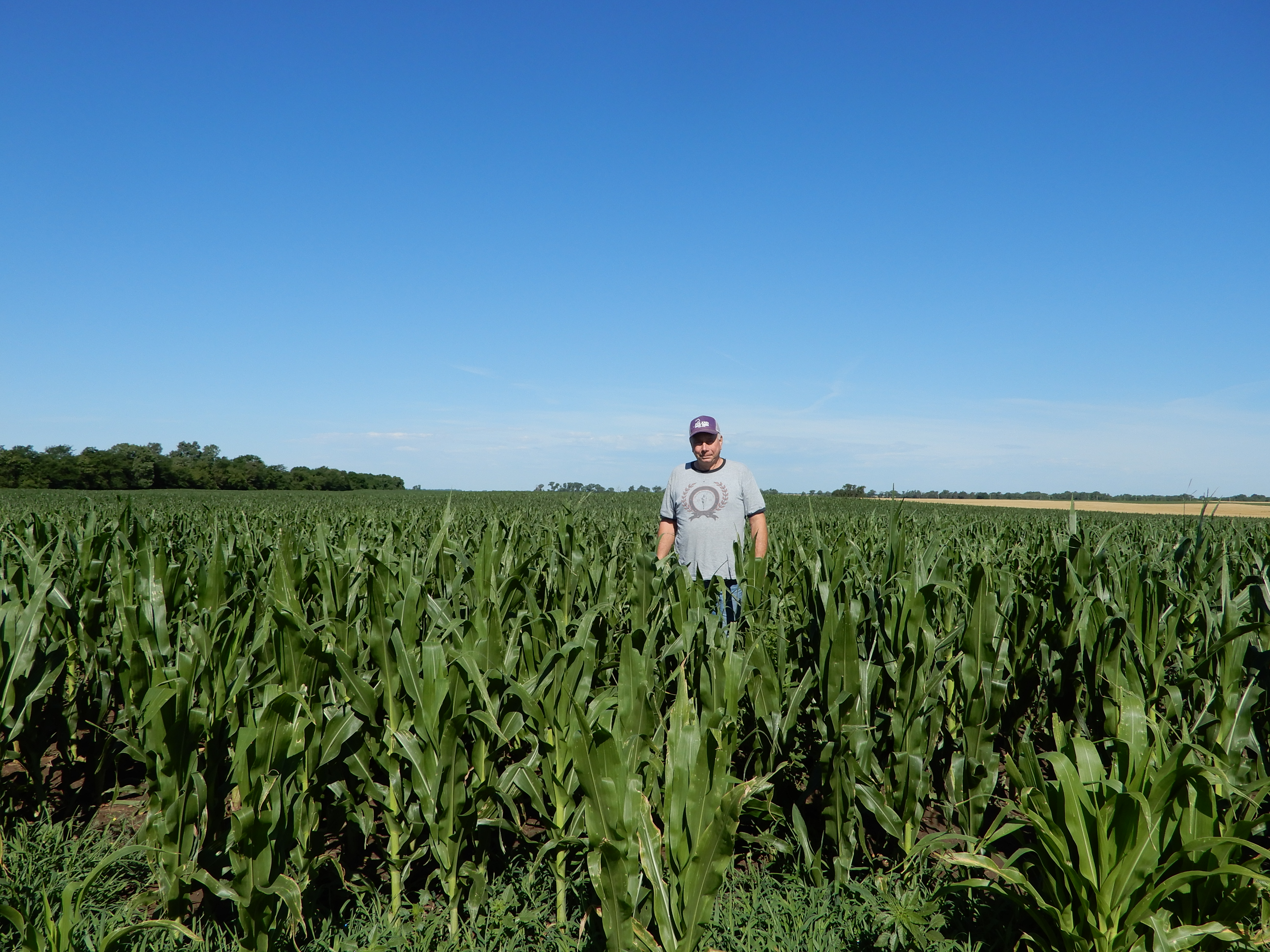
By the first week in June, it was off to a good start after beneficial spring rains.

The corn crop survived three different wind storms in June and July that demolished trees and made our lean-to "lean" a little more than it needed to.
June 22, 2020
It's amazing to me how quickly corn grows, compared to wheat. Wheat harvest is 9 months in the making. Corn goes from planting to maturity in just a little more than 100-114 days.
July 16, 2020
We were the first to deliver corn to the local elevator, though some of our neighbors had cut and delivered high-moisture corn to a nearby feed lot. I wrote "You Might Be a Farmer ..." when we began cutting.

And that's a wrap ... until next year.  On to milo and silage harvest! We hope to finish up our 2021 wheat planting today. There's always something to do.