Showing posts with label farming legacy. Show all posts

Thursday, January 26, 2023

The Tapestry of Kansas: Celebrating Kansas Day

Randy and the calving pen in 2010

Earlier this month, we sold the last bit of farming equipment. Though most of our farm equipment and supplies went on the auction block during our sale last August, Randy held onto the calving pen. 

It was at our house, rather than the farm headquarters. He decided to wait to sell it until it was calving season. That time came in mid-January. I put it on Facebook, and we had seven inquiries about it before we went to bed that night. The first one to call was the lucky owner of the new-to-them calving pen.

2020, milking a cow using the breakaway gate, so that we could feed her baby

The calving pen was located in the calving shed we erected in 2016 after the barn we had been using succumbed to gravity. Until I read the old blog post, I had forgotten, but we bought the pen in 2010 from another farmer who was retiring from the cattle business. Originally, it went in the barn. At the time, I wrote that some wives get little blue boxes from Tiffany's for Christmas presents. I got a calving pen.

Here's part of what I wrote:

Maybe you were like me and were initially thinking that the calving pen might have been a gift more suited to Randy. That's OK. I thought it, too. But then I got to thinking: Maybe this big metal box does say love. I remembered last February when Randy was at a meeting, and we had a heifer in trouble. My attempts to get the vet on the phone went unanswered. Jake (our farm employee at the time), a helpful neighbor and I finally got the calf delivered. But a nice calving pen, complete with head gate, would sure have made it easier. A pen with lots of different gates and openings would make it safer for the people and the animals.

That blog post turned out to be prophetic. The calving pen with its breakaway gate helped reluctant mothers and their new babies bond. The head gate helped contain mothers who needed some extra help when Mother Nature wasn't yielding a baby calf in a timely manner. (Click HERE for a photo essay of a birth using the calving pen.) Being able to use it saved several babies. The shed provided shelter for mamas and their new babies on particularly brutal winter nights.


And, I must admit, I was a little misty-eyed, thinking about it leaving the farmyard. 

But, on the other hand, it will serve another farm family in a similar way. Just like we benefited from buying someone else's equipment, they - and their cow-calf herd - will benefit from the purchase they made from us, too.  

We will celebrate Kansas Day on Sunday, January 29. It will be Kansas' 162nd birthday. Kansas became the 34th state of the union in 1861. My Moore ancestors came to Kansas in 1876, 15 years after Kansas became a state. My Neelly ancestors were a little later, in 1898. I'm sure all of them would be amazed at the changes in Kansas, and especially, in farming. 

I'm thankful that both sides of my family saw beauty and opportunity here. (Click on the links to read more about how the Moores and the Neellys came to Kansas.) Randy, who is a fifth-generation farmer in his family, still owns a pasture that's been in his family since 1900.

This is an undated photo of Randy's Grandpa, Clarence Fritzemeier, with a bull. The back of the photo has written (in Randy's Grandma Ava's handwriting): "He looks like he knew he was going to be sold."

As we near the Kansas Day celebration, I thought again about that calving pen. It was used by our friend, Joe. Then it came to our farm, and now it will serve another farm family in Central Kansas.

Those threads of connection are woven throughout Kansas history and Kansas agriculture. Even back in 1861, the livestock industry was an important aspect of the state's agricultural economy. The state ranked third in the nation in cattle population by 1890, a position it held for several decades. Mixed farming (grain-livestock) has always been the predominant form of agriculture on Kansas family farms, including both the Fritzemeier and Moore agricultural legacies.

Thousands of head of cattle were shipped on trains from rail heads in Kansas to packing plants in Kansas City, Chicago, and other cities to the east.  

A photo I took in 2011 during the Kansas Cattle Drive to commemorate Kansas' 150th birthday

Between 1867 and 1885, towns like Abilene, Ellsworth, Wichita, Newton, Caldwell, and Dodge City became famous for their place in the cattle industry.

Photo from the Kansas State Historical Society, dated between 1891 and 1912

With the closing of the open range, Kansas cattlemen began to place greater emphasis on the breeding of better stock.  Shorthorns and Herefords were popular in the 1890s, according to the Kansas State Historical Society. Herefords are still part of the genetics on our County Line farm, along with Angus.

Generation to generation - the legacy of Kansas and of Kansas agriculture continues. And Kansas farmers are a strong thread in the tapestry of our state.

Let no one say the past is dead. 
The past is all around us and within.
Oodgeroo Noonucal, Aboriginal poet

Happy Birthday, Kansas!

Kinley, Kansas Day, 2019. I shared my Kansas books and sunflower cookies with her first grade class.

If you want to celebrate with special Kansas Day cookies, here's a LINK to the recipe.


Thursday, August 25, 2022

Sale Day: Leaving a Lifetime of Farming


We hustled around on sale day, Saturday, August 13, for some family photos before the festivities began. Tye, who has taken over the farm ground we continue to own and who cares for our cow-calf herd in a partnership, was elected as photographer for 15 to 20 minutes worth of shots before the craziness of the day.


Originally, I had wanted some photos in the wheat field of our final harvest as active farm operators. I   had a professional photographer lined up. But it was just too hard to coordinate schedules and predict the weather. (I only knew that everyone was going to make it home a few hours before they arrived.) My second idea was having photos among the farm equipment before it started driving away or was hauled down the road.  But since school had started for the girls and for Susan the week before, it wasn't possible for them to all get here by the time golden hour rolled around the night before the sale. I knew that Randy would be addressing any issues with machinery on the day of the sale or answering last-minute phone calls about it before the bidding began. Other people were juggling plenty of other balls that day, too. Tye did a great job, and we'll save the pro shots for a time down the line. 


Jill snapped a few of Randy and me by various farm equipment. I definitely wanted one by the feed truck. I spent a lot of time in it during winters the last few years. Randy was always glad to tell any callers that his wife drove the old Army truck. One of my favorite times of the year was riding the buddy seat of the combine during harvest time. I'll miss that.

Anyway, I'll treasure these last glimpses of farm life as we've known it. We used the backdrops you'd expect - the 4-wheel-drive tractor and the combine. 

But I also wanted some photos gathered around the old 8N Ford Tractor. 

Jill also requested a photo by the relic.

I snapped a few of Grandpa with the girls.

The last time Kinley had been on that tractor was when she was a baby in her mom's arms 10 years ago.

April 2012

Randy grew up operating the Ford tractor. Our kids also got the "privilege" of putt-putt-putting down a road on the way to help build fence. While I never drove it, I certainly was part of the team that helped build miles of electric fence to contain our cattle in the fall. (Click HERE for a blog post about one fence building session.) But it, too, went on the auction block at the farm sale. 

Randy's Dad and Grandpa had purchased the Ford tractor in the 1960s. (And, yes, it started on sale day!)

Clarence (Randy's Grandpa, seated), his Dad Melvin and Randy holding Brent in 1988.

Maybe the winning bidder will restore it for parades. Or maybe they'll use it like we did, who knows?

It's amazing to think how far farm equipment has come in the time since our ancestors began farming in the late 1800s. My mom did an amazing job of photographing new machinery they've used during their 69 years of farming together.

(My dad as a toddler and his Dad)


She compiled them into history books she gave to grandchildren. (I may still have one in my dining room curio cabinet for "safe keeping.")

The evolution of technology has exploded since 1972, when Randy began farming as a high school sophomore.

This was a page from Randy's FFA project - 1972 - when as a high school sophomore, he began putting up hay on his great-uncle's ground for a percentage of the hay crop.

In the late 1990s, I compiled this collage to give to Melvin after his final harvest as an active farmer. It shows several pieces of farm equipment we used at that time.

Farm technology has evolved significantly since our marriage in 1981.
Melvin's final wheat harvest

And we certainly didn't have the ultimate examples of modern machinery, but it served our needs at a price we could afford.

Photo by Brent

The girls had to give the big tractor some equal posing time after their modeling on the 8N Ford tractor.

Randy had some restless nights in the week before sale day. He wasn't sure he'd gotten enough phone calls expressing interest in all the machinery. Would in-person bidders come? Would the people who told him on the phone that they'd be bidding online actually follow-through and do it? Would we get a reasonable value for the equipment? Would this part of our retirement plan pay out? I was not immune from the nighttime thoughts that made for some restless nights. 

But Randy was all smiles the day of the auction.


   (These moments were captured on my camera by Kinley, the budding 4-H photographer.)

Photo by Brent

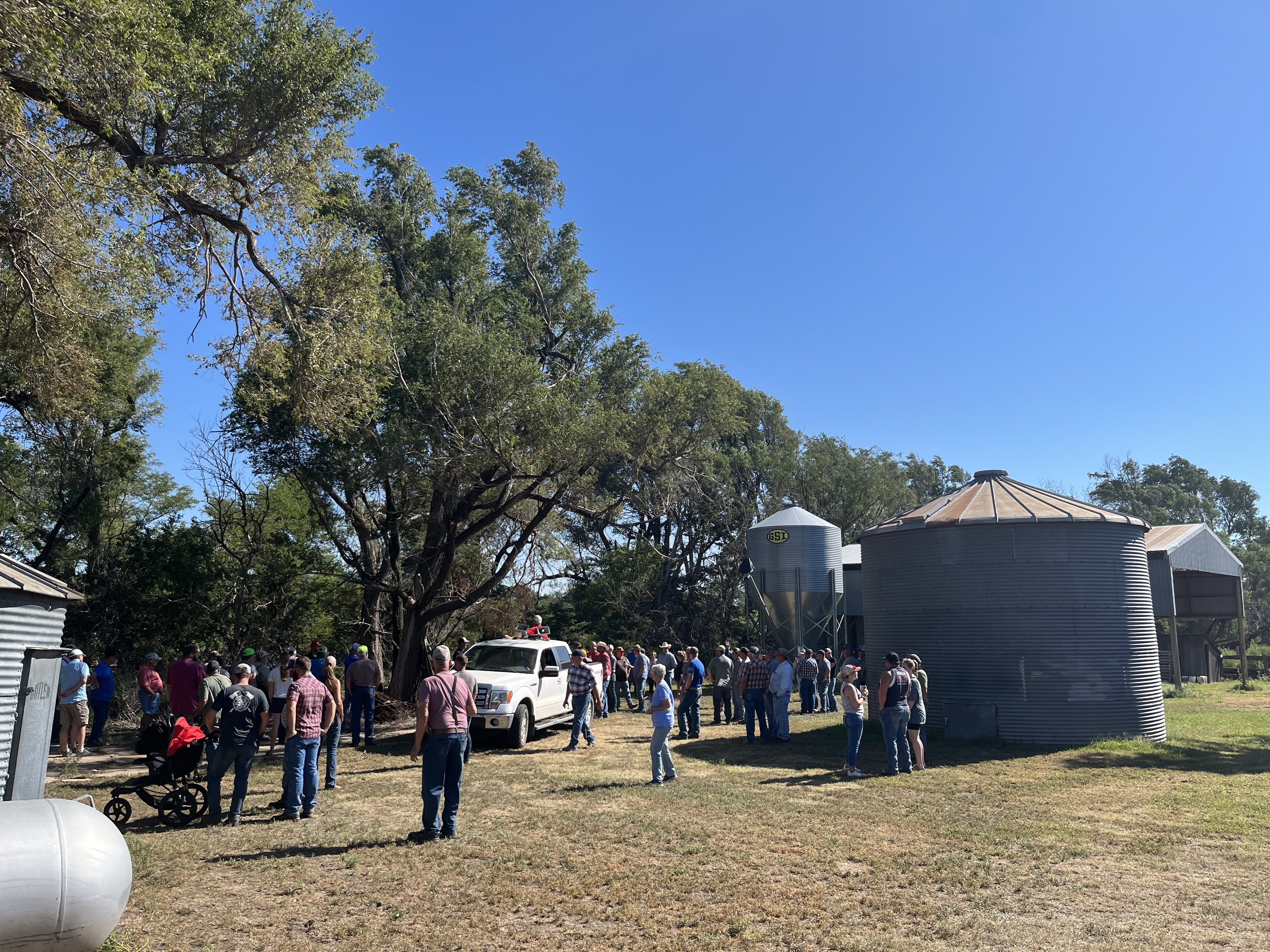
Ultimately, we were thrilled with the large crowd who arrived on sale day.

Some arrived early enough for the small "stuff" on trailers.

Photo by Brent

There was an even larger crowd for the big equipment - both in-person and online.


Photo by Andrew Webb (my brother-in-law)

The day was awfully hot, but the auctioneer with Carr Auction kept the bidding moving along well.
Photo by Andrew Webb

Some of the items began leaving the field before the auction was even over. By Wednesday, August 17, we had only a few things left to be picked up by the new owners. The combine and the drill left that day. The last pickup left last Friday (August 19). We are down to a couple of tractors still awaiting pickup.

Ultimately, this list of farm equipment left our farm to do the job at another farm on down the road. 

We also closed on Randy's folks house on the Monday following the sale, and the young couple who purchased it has already started moving in and making it their own. (Click HERE for the blog post I wrote before that sale.)

It's been a year full of emotion - highs and lows, doubts and dreams. But we feel at peace with the decision. And we're ready for the next chapter. Bring on some K-State football and some trips to National Parks this fall. (We'll add plenty of trips to see the family for good measure.)


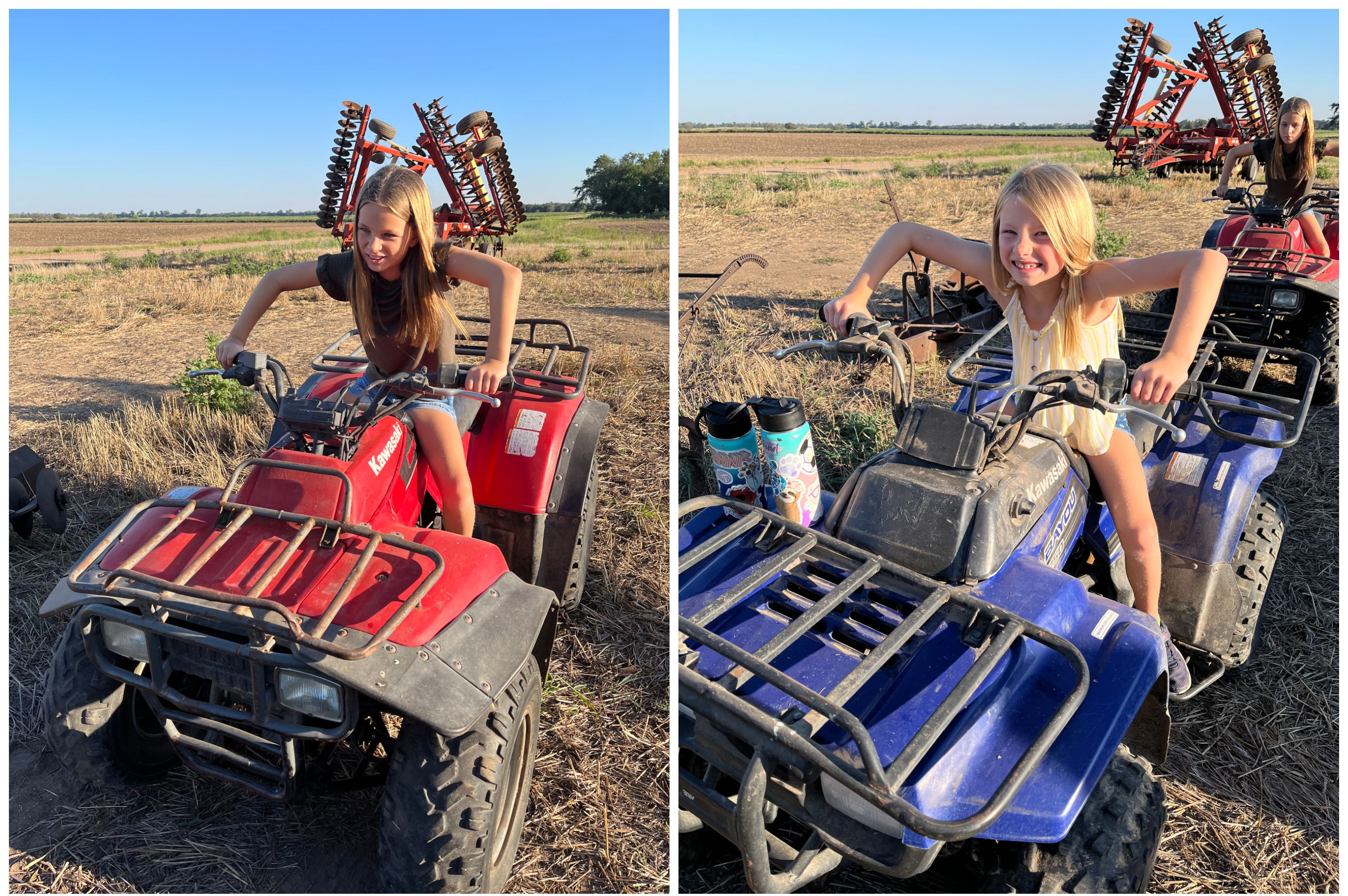
The girls were hoping that they could convince their parents they "needed" the 4-wheelers. They had ridden them for a fishing trip during a stay at The County Line last year. Alas, they'll have to settle for Grandpa's new (to us) Gator. The girls approve of Grandpa's new ride. (Uncle Brent may have given Kinley some unauthorized driving lessons on the Gator.)

Next time: Photos from the retirement party

Tuesday, November 19, 2019

Building Fence: A Link to Memories

 
I lifted my foot from the accelerator and did my mental, "one little second, two little second, three little second ... " all the way to six little seconds.

Randy and I were building fence. Well, Randy was building fence while I drove the pickup to carry the fencing supplies. My life on a farm truly has come full circle. I was probably 6 years old the first time I drove a pickup for fence building.
Kim - May 1965 - Almost 8 years old
My dad was the guy who hopped on the back of the pickup between fence post intervals way back when.
It was a bit like looking in a rearview mirror to see where you've been, I suppose.
During this latest fence-building expedition, Randy initially was telling me when to start and stop. But after awhile, I started counting the seconds between fence posts and we developed an unspoken rhythm for the work. (Hence the "one little second ..." chant.)
The fence building isn't just a deju vu experience for me. There's plenty of Randy's past tied up in the tools we use. That's especially true for the Ford 8N tractor.
These days, we have a wire winder on the back and use it for rolling out electric fence so we can move cattle to stalks for grazing.
The wire winder itself is homemade from a Model T frame, adding to the longevity of this farm workhorse.
 
 I think the rust is the only thing holding the tractor together these days.
But there is something about tradition. That tractor seat has been occupied with five different generations now. 
Melvin and Clarence bought the tractor back in the 1960s, when Randy was in grade school.
Clarence (Randy's Grandpa, seated), his Dad Melvin and Randy holding Brent in 1988. 
Clarence and Melvin used it to load silage for feeding cattle. Randy remembers using it to pull a two-row John Deere planter when they planted milo. He also cultivated milo with it when he was junior high age.
Now he uses it to roll out wire.

That wire also tells a story. There is about 1 1/2 miles of wire on each spool. At one time, Randy says they had 12 miles of wire and posts they used for temporary fencing projects.  Over the years, he's had to discard some of the rusty sections of fence that have fallen victim to inclement weather and age.
Randy says that he used to find splices in the wire that he could attribute to his dad. Melvin twisted the wire a bit differently than Randy does. So the farming legacy stretched between the two generations even after Melvin's death.
And who knows how long that tool has been called into service for fencing projects?
But all those tools - and yes, the aging people - are still getting the job done.
The fence went around sudan fields and milo stalks. Many years, we bale sudan. This year, the crop wasn't very abundant. Randy did swath the edges of the fields to make it easier to put up fence.
Last week, after the "ladies" got their OB/GYN checkups with Dr. Bruce, we moved them to the stalks for a little winter dining.
They were ready to check out their new "digs."
Now if only the deer would quit crashing in to the fence.