Showing posts with label ranching. Show all posts

Friday, January 31, 2014

Harvesting Faith: Praying for Rain

A photo from Celeste Settrini's Facebook page:  Photo by Sally Strohn, taken on her ranch located just outside of Salinas, California
Denver Broncos quarterback Peyton Manning seems to throw a pass from the magazine insert cover right into my living room. Sports pundits endlessly debate "yay" or "nay" about the verbal bravado of Seattle Seahawks defender Richard Sherman. Companies are "leaking" previews of the commercials for which they paid $4 million for 30 seconds of prime time. Party planners are jotting down menu plans.

Super Bowl XLVIII is coming on Sunday:  You would have to be living in the same hole as Punxsutawney Phil not to realize that. (Sunday, February 2, is also Groundhog Day, by the way.)

But you likely don't know about another event on Sunday. It hasn't been on the national news. It doesn't occupy the fronts of popular magazines. Yet, it could have a much deeper impact than whose team has more points on the scoreboard after four, 15-minute quarters on Sunday night.

On Sunday, you're invited to Harvesting Faith: A day of reflection, prayer and fasting. It was organized by someone I've never met in person, Celeste Settrini, a rancher near Salinas, Calif. I first heard her on KFRM 550 AM, the radio station where I give my daily Central Kansas reports. I clicked her name on Facebook, and we became "friends."

She is an ag-vocate. In addition to raising cattle in California, she travels to events across the country promoting agriculture. A couple of weeks ago, she set up the Harvesting Faith Facebook page, with these words: 
In good times and in times of need, I have often turned to prayer to pull me through. We celebrate in thanksgiving for the good that has been given to us and, when times are not so good, I pray for guidance, help and balance in all God puts in front of me.

This is different for me ~ I have never vocally shared my faith or my need of help. That is something I have done within the privacy of my own self. However, this past week I had someone tell me “Celeste, you need to create a day of prayer and fasting, and if anyone can get it done, it will be you. You have the ability to take the lead, and we will follow." My friend inspired me enough to say, "What do we have to lose?"

On Sunday, February 2, I ask that you all join me in prayer and fasting to ask for rain for our livestock, our crops, our livelihood here in California and in those places that need added moisture. How? Maybe it is extra time spent at your worship service, maybe passing up on your favorite treat and taking that time to think. Whatever the situation may be, I ask that you join me in praying for rain. It's that simple. And when it does come, I ask that you give thanks. God Bless!
Here on the Central Plains of Kansas, we understand drought. For more than two years, we were in exceptional drought. Here on the County Line, we brought cattle home from summer pasture early, then sold off the calves, since we didn't have enough feed for the winter for them and the mama cows both.
Rattlesnake Creek, Summer 2012
 Crops wilted and failed
2012 milo crop, which we baled up for feed.
Last year was better. We got good moisture from snow and some timely rains in the spring and summer. And while Kansas isn't "drought free," conditions have improved.

I'm not asking you to fast on Super Bowl Sunday, but I am asking you to say an extra prayer for rain for those who so desperately need it. If you feel so inclined, "join" Harvesting Faith on Facebook.
From Celeste's Facebook page this week.
It won't cost you a thing except a little time. But the effects could make all the difference in the world. Thanks, friends!

Friday, April 30, 2010

Rebirth


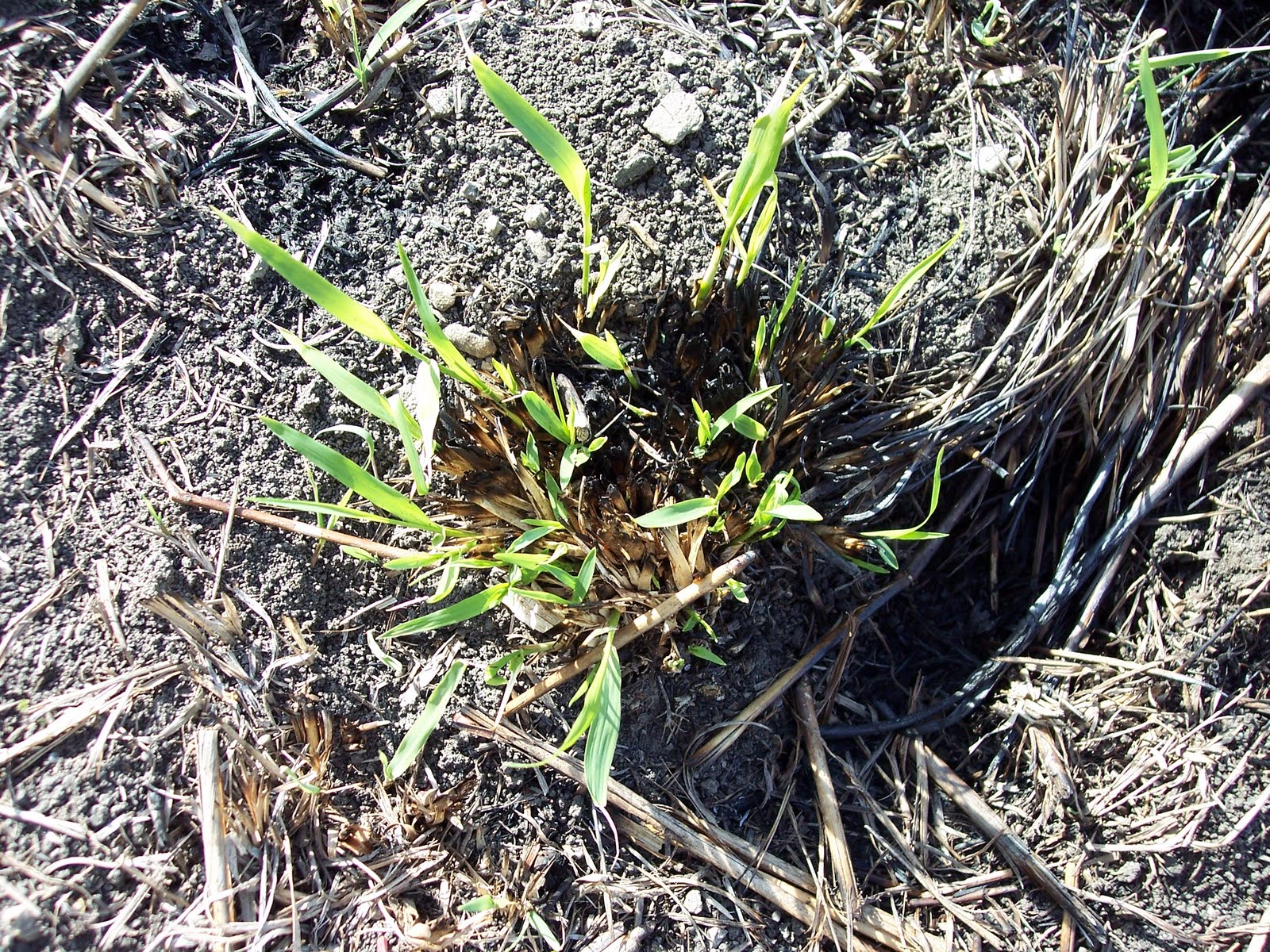
Spring brings fire to the plains of Kansas. Yes, there are the vibrant yellows, reds and oranges of spring flowers and budding trees, the colors that remind us of flames.

But we also see the smoke signals that drift into the Kansas skies from controlled burns on Kansas pasture lands.

We think of fire as a destructive thing, and it certainly can be. But it can also be a vehicle of rebirth.

On my recent stop at the Tallgrass Prairie National Preserve south of Council Grove, I could see the remnants of a prairie fire in the charred grasses and scorched branches.


But from the charred earth was green regrowth lifting toward a vibrant blue sky.


It seems counter intuitive. Why would fire - which seems such a destructive force - bring this new life?

Yet as ranchers light fires to clear the dead grass and small brush, it makes way for a new carpet of green just weeks later.


And the cycle of life begins again. The Flint Hills are part of the tallgrass prairie, which stretches from Canada to Texas. Ranchers have a saying: Take care of the grass and it will take care of you. Burning pastures has been part of caring for the prairie even back to the days of the Indians. It's an age-old partnership with cattle, birds, wildflowers and the grasslands.

The prescribed burning mimics the seasonal fires that have shaped the tallgrass prairie for hundreds of years. Burning also reduces the chances of destructive wildfires such as those in California and other states. The practice helps ranchers control invasive species, such as eastern red cedars, that squeeze out native grasses.

As I drove home on that Saturday afternoon two weeks ago, there was a haze in the air as ranchers burned. That haze can be controversial. Congressman Jerry Moran introduced legislation this month that would protect the ability of Flint Hills landowners to use prescribed fire as a tool to maintain the tallgrass prairie ecosystem.

The Environmental Protection Agency is attempting to regulate how and when landowners can burn in the Flint Hills by asking Kansas to develop a smoke management plan. During recent years, a narrow window for grassland burning caused heightened air quality readings in Wichita and Kansas City. HR 5118 would recognize the multiple benefits of prescribed fires by exempting landowners and local governments from EPA's enforcement of Clean Air Act standards if it involves smoke from pasture burning in the Flint Hills.

And it's not just a rite of spring in the Flint Hills. Though it's not on as grand a scale, there is prairie burning in other parts of Kansas, including here on the County Line. We don't do a lot of burning, but we did burn a couple of pastures this spring.

Unfortunately, I wasn't around to capture the images. So, I'm sharing something I found on Youtube. This is just a short video that shows scenery from the Flint Hill and some burning. If you want a longer version about the history of the practice of burning - even back to the Indians - go to www.youtube.com and type in Meditation 3 - Prairie Fire (Warning: It's over 7 minutes long but it's more comprehensive.)

I've given you a few glimpses of still photography of the Flint Hills. But if you can find a National Geographic issue featuring the photography of Jim Richardson, I would recommend it. Richardson, who has a photography studio in Lindsborg, has traveled all over the world taking photos for National Geographic. His images of the region are breathtaking.