Showing posts with label agriculture. Show all posts

Tuesday, March 24, 2020

Just A Box of Crayons: Ag Month 2020

I gave a memorial service earlier this month for the Kansas Master Farm Homemakers Guild annual meeting. I used some missing crayons to illustrate the "holes" left behind by the unique members who've joined Chapter Eternal during this past year. Just like all the crayons in the box, each one had his or her own job to do. They leave a little less "color" in our world in their absence.

Anyway, our gathering in Manhattan happened just as the U.S. response to Covid-19 - or the coronavirus - was beginning. There was some talk of postponing the meeting, but several of our members were already on the road driving to Manhattan about the time the Big 12 canceled the rest of its tournament. While there, the NCAA sidelined the Big Dance. Governor Laura Kelly's request to limit group gatherings to 50 or less didn't come until after we'd all packed our bags to come home. And the 10-person limit was a week-and-a-half down the road at that point. The crowd was a little fewer than planned, but, for the most part, the Kansas Master Farmers/Farm Homemakers showed up to honor the six new couples who joined our ranks.

Since the 1920s, Kansas Farmer magazine began to publicly recognize excellence in farming, homemaking, farm living and rural citizenship. In 1953, K-State Extension got involved, handling the details of selecting Master Farm couples and planning the March recognition banquet. Local extension councils and districts submit nominations, and a committee picks one couple from each extension area, plus two couples at large. 

The farm families are all different. Some have a lot of acres. Some don't. Some are primarily livestock operations. Others focus more on grain production. But all have figured out how to combine their livelihood with community service - though that looks different from couple to couple and from community to community, too.
The month of March has been proclaimed Kansas Agriculture Month, and today - March 24 - has been declared Kansas Agriculture Day. Farmers and ranchers make up less than 2 percent of the population, and that number drops each year.  We also run businesses that are highly technical, are not very well understood and operate on razor-thin margins.
Not terribly long ago, a new acquaintance asked what I did. I explained that my husband and I are both fifth-generation farmers in our respective families. His response floored me when he said, we had "quite a racket sitting back and collecting government payments."
I was so stunned that I didn't respond quickly enough and the moment passed. It bothered me for two weeks before I wrote an old-fashioned letter to him to try and explain why he had the wrong idea about farmers and farming. He has since apologized, and I hope I made a difference by opening one person's eyes.
 
It's what I try to do all the time. Every day is Ag Day for me, whether I'm helping with cattle tasks (like Saturday and yesterday) ...
 
... or delivering meals to the field during busy times ...
 ... or visiting the Case parts counter ...
... or writing some children's books about farm life ...
... or contributing to my rural community.

It could be via  my KFRM Central Kansas reports and through blog posts via Kim's County Line, where I offer a glimpse at one Kansas farm family by featuring farming, family, faith, food and photography.
 
Every day is Ag Day for Randy, who works to provide food, fuel and fiber through crops and livestock.
As our society moves away from its agrarian roots, fewer people seem to recognize the value. As organizers of Ag Day say:
We know that food and fiber doesn't just arrive at the grocery or clothing store or magically appear on the dinner table or in our closet. There's an entire industry dedicated to providing plentiful and safe food for consumption.
  • Each American farmer feeds about 165 people. Agriculture is America's No. 1 export.
  • New technology means farmers are more environmentally friendly than ever before. 
With the coronavirus outbreak, the Department of Homeland Security has labeled agriculture a critical industry, allowing businesses to continue operating as usual amid current and potential restrictions created to stem the spread of the virus. Farm groups had been concerned about the potential for movement restrictions put in place to limit exposure of the virus, including the potential for halted shipment of inputs needed for the upcoming planting season.

Still, farm businesses are doing their part to prevent the spread, too. At our local co-op, visitors need to go through the office to arrange for services. Some of the extraneous interactions have been curtailed for the time being - whether that's getting together for a cup of coffee to talk rainfall or commodity prices while they wait for a tire repair or that bunch of retired farmers playing dominoes in the farm store.
At the Master Farm Homemakers Guild meeting, we sang "The Sunflower Song," penned by one of our Kansas members, Rachel Imthurn. The words of the second verse seemed meant for the moment:

We celebrate this nation with roots deep in the sod.
Our hearts are with our children.
Our souls reach up to God.
Our joys grow in sharing the sunshine and the rain.
And when those hard times come along 
Friends help to ease the pain.

Farmers will still plant their spring crops, as long as they can get the inputs needed. Farmers and ranchers like us will continue to sort and work baby calves like we've done since our families settled as Kansas pioneers - and just like we did on Saturday and again on Monday. (More on that later.)

Just like other industries right now, there are plenty of "what ifs" and "what about that?s" that are being contemplated, whether that's supply and demand, the tottering economy and seasonal labor concerns.

The world is different today than it was a month ago. But we all need to figure out how to work together and live in the "same box."
***
And, by the way, I didn't mention it in my memorial service, but some crayons have a farm connection. Soybean oil can be substituted for paraffin wax in some brands of crayons. In fact, the Wisconsin Soybean Association estimates that one acre of soybeans can produce about 82,368 crayons. Prang Crayons are made with 85 percent soybean oil.

Happy Agriculture Day!

Tuesday, May 29, 2018

Innovation not Stagnation: Discover Kansas

Scott County, Kansas (April 2018)
Not long ago, a headline popped up on my Facebook feed:

Rural Kansas is dying. I drove 1,800 miles to find out why.

It was an article in The New Food Economy. The subtitle claimed: A native Kansan returns home to find that the broken promises of commodity agriculture have destroyed a way of life. 

OK. That made me squirm. After all, I've been a resident of rural Kansas all my life, and I'm involved in commodity agriculture. So the author is talking about me and a lot of other people like me.

You may have seen the article, too. Several of my Facebook friends linked the article to their own timelines. Most of them went on to explain what they were doing to help their own small Kansas towns thrive. Our son, Brent, read the article and sent it to me, too, to make sure I'd seen it, and we had a good conversation about it.
Photo courtesy of Millie Dearden
Ironically, the article was making the rounds at about the same time that Randy and I went on a field trip to Scott County with our Kansas Master Farmer/Master Farm Homemaker group. I couldn't help but wonder what the author of the article would have thought had she visited Scott City.

I also came away with the same thought I usually have after reading how modern farming practices are destroying rural America: How is it that farming is the only business that is supposed to exist in a time capsule? Why do some consumers want us to farm like our ancestors did 100 years ago? And isn't it interesting that these same people are espousing their views from the latest cell phone or computer while eating what they want, when they want to?

In 2011, Scott City was designated an All-American City. Their economic development tagline is: "We've Invested Millions in Ourselves." More than $80 million in capital improvements have been made in the county during the past decade, including a state-of-the-art hospital. Now, they are addressing the need for assisted living options for the aging population. Building houses for young families is another priority. "Come Thrive With Us," they say in one of their full-color brochures.

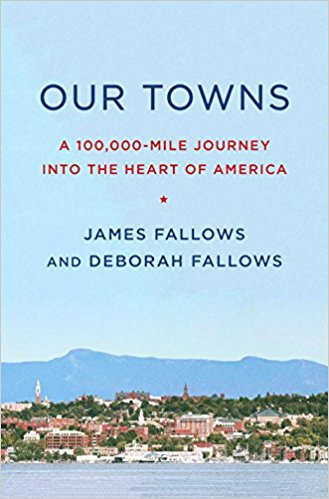
Shortly after we returned from Scott City, we also watched a segment on CBS Sunday Morning. In it, they interviewed James and Deborah Fallows, the authors of Our Towns: A 100,000-Mile Journey into the Heart of America.
For the last five years, the Fallowses have been traveling across America in a single-engine prop airplane, visiting dozens of towns. They met hundreds of civic leaders, workers, immigrants, educators, environmentalists, artists, public servants, librarians, business people, city planners, students,and entrepreneurs to take the pulse and understand the prospects of places that usually draw notice only after a disaster or during a political campaign.

They came to a different conclusion about rural America. James Fallows said this:
"Americans don’t realize how fast the country is moving toward becoming a better version of itself."
Wow, a glimpse of optimism from a national journalist! Fallows, who writes for The Atlantic magazine, wrote a portrait of the civic and economic reinvention taking place in America, town by town and generally out of view of the national media. (I've signed up for the book from my library, and I'm anxious to read it when my name gets to the top of the reserve list!)

The Fallowses acknowledge the problems rural America face, but they also found people who are  crafting solutions on the local level. They found people with energy, generosity and compassion, dreams and the determination to make things better.
America is becoming more like itself again. More Americans are trying to make it so, in more places, than most Americans are aware. Even as the country is becoming worse in obvious ways—angrier, more divided, less able to do the basic business of governing itself—it is becoming distinctly better on a range of other indicators that are harder to perceive. The pattern these efforts create also remains hidden. Americans don’t realize how fast the country is moving toward becoming a better version of itself. 
James Fallows in The Atlantic
And, yes, he found some of those places in Kansas:
“We may be ‘conservative.’ but we’re progressive,” Melissa McCoy, who grew up not far from Dodge City and is now the city’s Project Development Coordinator, told Fallows. “There was a time when we had a really negative self-image as a town. But people thought, If we won’t invest in ourselves, how can we expect anybody else to? It was a matter of getting the community behind it and realizing that we needed to back ourselves up to get outside investment and support. Now we’re starting to see it pay off.”
From an article in The Atlantic, Why Not Dodge City, Why Not Stockton
The authors could have discovered that "can-do" spirit in Scott County, too.  Leaders and citizens embrace their historic past. But they put a modern spin on them by tying history to tourism and business. Another of their taglines is "Where History and Progress Meet." The Kansas Master Farmers/Homemakers experienced that firsthand.

Next time, more on our trip to Scott City and the first in a series of blog posts about possible Kansas Staycations.

***
On Memorial Day yesterday, I posted these photos to my Facebook page. While this doesn't have a thing to do with the economy of small-town Kansas, it does show there are fringe benefits that aren't possible to compute in dollars and cents.
 On this Memorial Day, I'm thankful for small town Kansas patriotism. Thanks to the Patriot Guard who accompanied a Korean War veteran to his final resting place on Saturday and who stood at attention as people arrived at the memorial service. I also appreciate their raising the flag at every home football game. I'm thankful I live in a place that still pulls over for funeral processions as a sign of respect.

Friday, October 16, 2015

S'Wheat' Day!


Canned spinach was not on the menu. That's what Cottonwood Elementary School Principal Kyle Griffitts remembers from his childhood school lunches.
From a Cottonwood School mural
But during the Kansas Wheat Day celebration at Cottonwood last week, a school-made whole wheat bun was part of the "lesson plan" that connected Kansas farmers to the Kansas School Lunch program and students. (And, for the record, it was fresh broccoli with ranch dressing, for the vegetable - not canned spinach.)

Randy and I joined Julia Debes, a Hoisington farmer and Kansas Wheat staffer, as the farmers who shared our passion for wheat with second graders at Cottonwood Elementary. Kansas Wheat Day was one part of a week-long celebration, October 12-16, of the healthy and nutritious foods grown on Kansas farms that end up as part of school lunches. In addition to Kansas Wheat, the Kansas State Department of Education partnered with the Midwest Dairy Council and Kansas Pork Association to organize other school activities.

October is also Farm to School Month. Randy, Julia and I brought glimpses of our Kansas farms to the classroom, then joined the elementary school students for lunch.
Julia brought her own form of "show and tell" to lunch, with her bundle of wheat and her daughter's toy combine. I put together a slide show of photos from planting to harvest to help describe the 9-month journey that helps bring wheat products to school lunch rooms and their family's homes.
Salina Journal Photo, Michael Strand
We all shared the book, "Celebrate Wheat" by Dan Yunk.
 
Courtesy of Kansas Farm Bureau, each of the second grade students and two classrooms of students  at Heartland Preschool got to take a copy of the book home with them.
We are always happy to talk about wheat, but this particular event was even more special because we got to work with our daughter, Jill, assistant director of child nutrition and wellness with the Kansas Department of Education, and some of her co-workers, as well as two representatives from the U.S. Department of Agriculture. Jill happened to know where to find a couple of farmers willing to help her out.
Last year, Kansas schools provided more than 73 million meals and snacks to children through the federal Child Nutrition Programs. Wheat ends up as a component of many of those meals - in everything from rolls to pizza crust to tortillas. School lunches have been part of the school day for more than 60 years.
Randy would gladly take every one of the kids on a combine ride. But they had to settle for sticking their hands in a bucket of wheat kernels and asking questions ... lots of questions!

What do farmers wear?
How long does it take for wheat to grow?
Many much wheat fits in a semi?
Can I take some of this wheat home to plant?
What does harvest mean?
How does a combine work?
Wow! It takes THAT LONG to harvest the wheat? (Randy asked the kids how long they thought it took us to harvest wheat. The guesses ranged from 2 to 10 hours. They thought 10 days to 2 weeks was a long time! Me too, kids, me too!)
 
I, for one, was glad to have someone else cook lunch for a change!

For more on the Kansas Wheat Day at Cottonwood, check out the article in The Salina Journal and the article at Kansas Wheat.

Wednesday, January 7, 2015

Christmas in the Country Reveal

I admit it:  I love mail. I realize in this fast-paced world, people are much more inclined to Tweet or SnapChat their friends instead of putting stamps on an envelope or box and sending their greetings via snail mail.

So it was a real pleasure to participate for the first time in Christmas in the Country. Four country-based bloggers coordinated the 2nd annual holiday event. Robyn Goddard (The Ranch Wife Chronicles), Jamie Rhoades (This Uncharted Rhoade), Laurie Link (COUNTRY LINKed) and Erin Mullins (Diaries from the Dirt Road) were the hosts for 70 participants. 

I got a little love in a box from MaryBeth Schwartz from Conway, Washington, who blogs at Small City Scenes of Stanwood. I didn't know MaryBeth until I received her box of goodies and letter. But, ironically, her daughter Cheri, who blogs at My Ranch Life from Ritzville, Wash., and I were already blog friends across the miles. It is, indeed, a small world that MaryBeth ended up being my Secret Santa.
MaryBeth's rural landscape is far different from mine in South Central Kansas, where grain and beef cattle are the predominant agricultural products. In her area, dairy farms dot the countryside, along with small vegetable farms and large potato operations. In the past, the area was known for logging, but that has transitioned to fishing, farming and ranching.

I loved seeing a glimpse of her area through her beautiful handmade cards that feature Washington scenery.

MaryBeth also sent me several products from Washington, including this Snow Day coffee and raspberry-chocolate spread. The Snow Day blend proved to be especially apt, since we've been in deep-freeze mode for weeks now. A cup of coffee paired with toast and preserves was a great winter morning breakfast. (She also sent me a few Christmas tree sugar cookies. Yes, I admit they got eaten before I took a photo of them. I wasn't the only one to blame though!)
She also sent some lavender soap made in the area, along with holiday cards/tags she made herself, which she sells at a little shop in Conway. I also got a keyring and a personalized cloth bag that tucks into a little package and fits inside your purse. (It's perfect for someone who never remembers her "green" shopping bags!)
Since I'd revealed that blue is my favorite color, she had her sister-in-law make a stocking cap especially for me. I wore it yesterday when we moved cattle on a day that didn't even crack the freezing mark.
I discovered that MaryBeth has quite a sense of humor, as evidenced by this homemade weather forecaster. (Click on the photo so that you can read the whole thing.)
She also made me smile with this magnet ...
... and this cowboy bubble bath.
My Christmas in the Country box went to Lindsay Chichester-Medahunsi in Lincoln, Nebraska, who blogs at Agricultural with Dr. Lindsay. She was raised on a cattle and sheep ranch in northern California and has since transplanted to the Plains. She has a background in microbiology, meat science and food safety and loves all things ag. How could I not like her already!? She has been blogging for a year now and is a great ag-vocate. Be sure and visit her blog and become a follower. Or connect on these other social media platforms:
Website (http://food.unl.edu/ag-and-food)
– Twitter/Instagram (agwithdrlindsay)
– Facebook (https://www.facebook.com/agwithdrlindsay)
– Pinterest (Lindsay Chichester-Medahunsi)

I didn't take any photos of the things I sent Lindsay, so she bailed me out when she posted photos for her Christmas in the Country link-up. I've now been following her blog, and it's fun to make another rural connection.

The Christmas in the Country was a way to meet some new blogging friends. Other bloggers participating can be found here at this link-up. Now that the holidays are over, I need to spend a little more time clicking on those links, and I invite you to do the same.

Thursday, March 27, 2014

Every Day Is Ag Day

 
Tuesday was National Ag Day. This sometimes-ag blogger didn't purposefully ignore it. I just didn't have an Ag Day blog ready to go, so I published something else. Poor planning on my part? Perhaps. But, I think it's OK.

I try to work ahead on my blog posts. Monday was busy. Besides my normal KFRM Central Kansas report and a blog post after a fire at our old high school, I helped serve a funeral dinner at church, accompanied at middle school choir and left school a few minutes early so I could be back to the church to sing at the funeral.

I poured coffee. I refilled water glasses. I scraped plates and washed dishes alongside my church friends.  I played a too-fast-for-me accompaniment for a boys' ensemble. I sang at a friend's memorial service.

I didn't have time to write about being part of an agricultural community that day. I was living it.

Usually at harvest time, there's a story in the local newspaper about a community coming together to harvest an ailing neighbor's fields. But it happens quietly many days.

Sometimes, we're on the receiving end.

Sometimes, we're on the giving end.

It's part of what it means to be living and working in a small, rural community.

So, no, I didn't blog about National Ag Day on Tuesday. I probably missed the opportunity to join a hashtag movement (if only I understood Twitter's hashtags) or piggyback onto some other form of publicity for myself, though I have no illusions that I'll become the next Pioneer Woman anyway.

I could have told you lots of interesting facts. For example (from the Corn & Soybean Digest):
  • The U.S. farmer of today produces enough food and fiber for approximately 160 people. This number was 19 people in 1940, 46 people in 1960, and 115 people in 1980.
  • Farmers receive just under 16¢ of every consumer dollar that is spent on food. The other 84¢ is spent on processing, packaging, marketing, transportation, distribution and retail costs of the food supply.
But, instead of chastising myself for my lack of pre-planning,  I'd like to think I jumped on the Ag Day bandwagon early when I hosted Flat Aggie from a fourth grade classroom in California. I was celebrating Ag Day when I helped my husband work baby calves three days last week during my "spring break" from my school accompanying job.
Randy did more of the heavy lifting than I did!
Every day is Ag Day for Randy, who works to provide food, fuel and fiber through crops and livestock. Every day is Ag Day for me, whether I'm helping with cattle tasks or delivering meals. It could be via  my KFRM Central Kansas reports and through Kim's County Line, where I offer a glimpse at one Kansas farm family by featuring farming, family, faith, food and photography.
 
It could be like I spent Monday, not specifically involved in agriculture, but being a part of a rural community.

Some day, I hope my kids and grandkids will use this as a record of our lives on this piece of God's earth on the Stafford/Reno County Line. And I hope they'll know it was more than just statistics. It was a way of life.

***
I'm linked to the Country Fair Blog Hop via Nicole's Tales of a Kansas Farm Mom. Click on the link for more news from the country.

Friday, January 31, 2014

Harvesting Faith: Praying for Rain

A photo from Celeste Settrini's Facebook page:  Photo by Sally Strohn, taken on her ranch located just outside of Salinas, California
Denver Broncos quarterback Peyton Manning seems to throw a pass from the magazine insert cover right into my living room. Sports pundits endlessly debate "yay" or "nay" about the verbal bravado of Seattle Seahawks defender Richard Sherman. Companies are "leaking" previews of the commercials for which they paid $4 million for 30 seconds of prime time. Party planners are jotting down menu plans.

Super Bowl XLVIII is coming on Sunday:  You would have to be living in the same hole as Punxsutawney Phil not to realize that. (Sunday, February 2, is also Groundhog Day, by the way.)

But you likely don't know about another event on Sunday. It hasn't been on the national news. It doesn't occupy the fronts of popular magazines. Yet, it could have a much deeper impact than whose team has more points on the scoreboard after four, 15-minute quarters on Sunday night.

On Sunday, you're invited to Harvesting Faith: A day of reflection, prayer and fasting. It was organized by someone I've never met in person, Celeste Settrini, a rancher near Salinas, Calif. I first heard her on KFRM 550 AM, the radio station where I give my daily Central Kansas reports. I clicked her name on Facebook, and we became "friends."

She is an ag-vocate. In addition to raising cattle in California, she travels to events across the country promoting agriculture. A couple of weeks ago, she set up the Harvesting Faith Facebook page, with these words: 
In good times and in times of need, I have often turned to prayer to pull me through. We celebrate in thanksgiving for the good that has been given to us and, when times are not so good, I pray for guidance, help and balance in all God puts in front of me.

This is different for me ~ I have never vocally shared my faith or my need of help. That is something I have done within the privacy of my own self. However, this past week I had someone tell me “Celeste, you need to create a day of prayer and fasting, and if anyone can get it done, it will be you. You have the ability to take the lead, and we will follow." My friend inspired me enough to say, "What do we have to lose?"

On Sunday, February 2, I ask that you all join me in prayer and fasting to ask for rain for our livestock, our crops, our livelihood here in California and in those places that need added moisture. How? Maybe it is extra time spent at your worship service, maybe passing up on your favorite treat and taking that time to think. Whatever the situation may be, I ask that you join me in praying for rain. It's that simple. And when it does come, I ask that you give thanks. God Bless!
Here on the Central Plains of Kansas, we understand drought. For more than two years, we were in exceptional drought. Here on the County Line, we brought cattle home from summer pasture early, then sold off the calves, since we didn't have enough feed for the winter for them and the mama cows both.
Rattlesnake Creek, Summer 2012
 Crops wilted and failed. 
2012 milo crop, which we baled up for feed.
Last year was better. We got good moisture from snow and some timely rains in the spring and summer. And while Kansas isn't "drought free," conditions have improved.

I'm not asking you to fast on Super Bowl Sunday, but I am asking you to say an extra prayer for rain for those who so desperately need it. If you feel so inclined, "join" Harvesting Faith on Facebook.
From Celeste's Facebook page this week.
It won't cost you a thing except a little time. But the effects could make all the difference in the world. Thanks, friends!

Tuesday, February 5, 2013

God Made a Farmer

I'm a little late to the party. (It's not surprising, since I'm not much of a party goer.) Yesterday, the agricultural blog world and Facebook were all "a Twitter" about the Dodge Ram commercial that aired during the Super Bowl and featured Paul Harvey's "God Made a Farmer."

When I asked Brent about the success of the Super Bowl party he hosted, he countered with, "Did Dad love the farmer commercial?"

Yes, Dad and Mom both loved the "farmer" commercial, along with most of farm country. I had heard Paul Harvey's essay before, but it again brought tears to my eyes. And as the beautiful photos transitioned - one to the other - other photos kept drifting through my mind.

They were the personal photos that tell the story of us - one Kansas farm family. That's one of the reasons I started this blog in 2010. It was to tell our story and not let HSUS or Greenpeace or PETA tell the world what modern farming is all about.

My brother is farming ground our maternal grandfather - Shelby Neelly - farmed. It is land that was first owned by our great-great grandparents on my mom's side of the family. On the Moore side of the family, my nephew Brian is the sixth generation to run a combine on ground that's been cultivated by Moores practically since the area was settled.

My husband is a fourth-generation farmer on both sides of his family. They are the reason that we have been farming for more than 100 years in Stafford County.

This is our life. This is our livelihood. This is our legacy. This is our love.

If you didn't see the commercial, please take time to watch it. (I have the link at the end of this post.) Besides the quality of the artwork and the stories each of those beautiful photos represents, viewing the commercial raises money for the FFA. A special Dodge Ram website, appropriately labeled, "Keep Plowing," says that the company will donate up to $1 million to the National FFA organization, depending upon the number of views the commercial gets on You Tube. The campaign is co-sponsored by Case IH and Farms.com, with support by Stihl, Bosch and Mossy Oak.

I could paper the house with photos - past and present - that tell the story of this Kansas farm family. These don't even scratch the surface. But I try to do it every day through my blog - whether I'm talking about farming, my family, my faith, what I'm serving on my country table or random thoughts from a busy Kansas farm wife.

Paul Harvey's, "God Made a Farmer" 
with photos from Kim's County Line
And on the 8th day, God looked down on his planned paradise and said, "I need a caretaker." So God made a farmer.

God said, "I need somebody willing to get up before dawn, milk cows, work all day in the fields, milk cows again, eat supper and then go to town and stay past midnight at a meeting of the school board." So God made a farmer.
 "I need somebody with arms strong enough to rustle a calf ...


 and yet gentle enough to deliver his own grandchild.
 
Somebody to call hogs ...
tame cantankerous machinery ...
come home hungry, have to wait lunch until his wife's done feeding visiting ladies and tell the ladies to be sure and come back real soon -- and mean it." So God made a farmer.
God said, "I need somebody willing to sit up all night with a newborn colt. And watch it die. Then dry his eyes and say, 'Maybe next year.'
 
I need somebody who can shape an ax handle from a persimmon sprout, shoe a horse with a hunk of car tire, who can make harness out of haywire, feed sacks and shoe scraps. And who, planting time and harvest season, will finish his forty-hour week by Tuesday noon, then, pain'n from 'tractor back,' put in another seventy-two hours." So God made a farmer.
God had to have somebody willing to ride the ruts at double speed to get the hay in ahead of the rain clouds and yet stop in mid-field and race to help when he sees the first smoke from a neighbor's place. So God made a farmer.
God said, "I need somebody strong enough to clear trees and heave bales, yet gentle enough to tame lambs and wean pigs and tend the pink-combed pullets, who will stop his mower for an hour to splint the broken leg of a meadowlark.

It had to be somebody who'd plow deep and straight and not cut corners. Somebody to seed, weed, feed, breed and rake and disc and plow and plant and tie the fleece and strain the milk and replenish the self-feeder and finish a hard week's work with a five-mile drive to church.

Randy & his Dad at Melvin's last harvest; Jill & Randy, bottom left; Brent's first harvest at the bottom right.
Somebody who'd bale a family together with the soft strong bonds of sharing, who would laugh and then sigh, and then reply, with smiling eyes, when his son says he wants to spend his life 'doing what dad does.' "

My nephew Brian, brother Kent and Dad Bob. Brian is the 6th generation to work on the farm.
So God made a farmer.