Showing posts with label promoting agriculture. Show all posts

Tuesday, May 29, 2018

Innovation not Stagnation: Discover Kansas

Scott County, Kansas (April 2018)
Not long ago, a headline popped up on my Facebook feed:

Rural Kansas is dying. I drove 1,800 miles to find out why.

It was an article in The New Food Economy. The subtitle claimed: A native Kansan returns home to find that the broken promises of commodity agriculture have destroyed a way of life. 

OK. That made me squirm. After all, I've been a resident of rural Kansas all my life, and I'm involved in commodity agriculture. So the author is talking about me and a lot of other people like me.

You may have seen the article, too. Several of my Facebook friends linked the article to their own timelines. Most of them went on to explain what they were doing to help their own small Kansas towns thrive. Our son, Brent, read the article and sent it to me, too, to make sure I'd seen it, and we had a good conversation about it.
Photo courtesy of Millie Dearden
Ironically, the article was making the rounds at about the same time that Randy and I went on a field trip to Scott County with our Kansas Master Farmer/Master Farm Homemaker group. I couldn't help but wonder what the author of the article would have thought had she visited Scott City.

I also came away with the same thought I usually have after reading how modern farming practices are destroying rural America: How is it that farming is the only business that is supposed to exist in a time capsule? Why do some consumers want us to farm like our ancestors did 100 years ago? And isn't it interesting that these same people are espousing their views from the latest cell phone or computer while eating what they want, when they want to?

In 2011, Scott City was designated an All-American City. Their economic development tagline is: "We've Invested Millions in Ourselves." More than $80 million in capital improvements have been made in the county during the past decade, including a state-of-the-art hospital. Now, they are addressing the need for assisted living options for the aging population. Building houses for young families is another priority. "Come Thrive With Us," they say in one of their full-color brochures.

Shortly after we returned from Scott City, we also watched a segment on CBS Sunday Morning. In it, they interviewed James and Deborah Fallows, the authors of Our Towns: A 100,000-Mile Journey into the Heart of America.
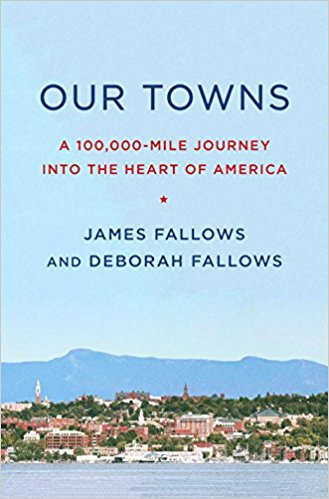
For the last five years, the Fallowses have been traveling across America in a single-engine prop airplane, visiting dozens of towns. They met hundreds of civic leaders, workers, immigrants, educators, environmentalists, artists, public servants, librarians, business people, city planners, students,and entrepreneurs to take the pulse and understand the prospects of places that usually draw notice only after a disaster or during a political campaign.

They came to a different conclusion about rural America. James Fallows said this:
"Americans don’t realize how fast the country is moving toward becoming a better version of itself."
Wow, a glimpse of optimism from a national journalist! Fallows, who writes for The Atlantic magazine, wrote a portrait of the civic and economic reinvention taking place in America, town by town and generally out of view of the national media. (I've signed up for the book from my library, and I'm anxious to read it when my name gets to the top of the reserve list!)

The Fallowses acknowledge the problems rural America face, but they also found people who are  crafting solutions on the local level. They found people with energy, generosity and compassion, dreams and the determination to make things better.
America is becoming more like itself again. More Americans are trying to make it so, in more places, than most Americans are aware. Even as the country is becoming worse in obvious ways—angrier, more divided, less able to do the basic business of governing itself—it is becoming distinctly better on a range of other indicators that are harder to perceive. The pattern these efforts create also remains hidden. Americans don’t realize how fast the country is moving toward becoming a better version of itself. 
James Fallows in The Atlantic
And, yes, he found some of those places in Kansas:
“We may be ‘conservative.’ but we’re progressive,” Melissa McCoy, who grew up not far from Dodge City and is now the city’s Project Development Coordinator, told Fallows. “There was a time when we had a really negative self-image as a town. But people thought, If we won’t invest in ourselves, how can we expect anybody else to? It was a matter of getting the community behind it and realizing that we needed to back ourselves up to get outside investment and support. Now we’re starting to see it pay off.”
From an article in The Atlantic, Why Not Dodge City, Why Not Stockton
The authors could have discovered that "can-do" spirit in Scott County, too.  Leaders and citizens embrace their historic past. But they put a modern spin on them by tying history to tourism and business. Another of their taglines is "Where History and Progress Meet." The Kansas Master Farmers/Homemakers experienced that firsthand.

Next time, more on our trip to Scott City and the first in a series of blog posts about possible Kansas Staycations.

***
On Memorial Day yesterday, I posted these photos to my Facebook page. While this doesn't have a thing to do with the economy of small-town Kansas, it does show there are fringe benefits that aren't possible to compute in dollars and cents.
 On this Memorial Day, I'm thankful for small town Kansas patriotism. Thanks to the Patriot Guard who accompanied a Korean War veteran to his final resting place on Saturday and who stood at attention as people arrived at the memorial service. I also appreciate their raising the flag at every home football game. I'm thankful I live in a place that still pulls over for funeral processions as a sign of respect.

Thursday, January 25, 2018

This Is Us: Farm Version

One of my favorite television shows is "This Is Us," a drama in its second year on NBC. For the uninitiated, it follows the life of three siblings - Kate, Kevin and Randall - through a series of flashbacks and present day life.

On last week's episode, the siblings and their mother come together in a counselor's office. While they all lived in the same house, they have very different perceptions about their shared experiences. While talking to his siblings later, Randall compares the different viewpoints to the experience of getting glasses as a youngster.

He talks about sitting in the exam chair at the eye doctor and being asked, "Is this better? Or is this better?" After the eye doctor shifts the lens, he's again asked, "Better here ... or here?" The changes are often minuscule, but they eventually lead to the proper prescription.

He reminds his siblings that we all view life through different lenses.

It really struck a chord with me. I vividly remember the trip home from Great Bend after I got my first pair of glasses in grade school. From my perch in the back seat, I suddenly saw things more clearly. Trees weren't just big green blobs: They had individual leaves. The world was sharper, more in focus. It was a revelation.

This week, I celebrate a "birthday" of sorts. It's my 8th "blogiversary." I hit the "publish" button on Kim's County Line for the first time on January 24, 2010. In eight years, I've published 1,683 posts, and there have been more than 1.78 million "page hits" on Kim's County Line.
Part of the reason I began Kim's County Line was to share our life on a Central Kansas farm. I subtitled the blog, "Camera Clicks and Commentary from a Kansas Farm Wife." In truth, I didn't have a solid plan. In fact, it was kind of one of those things your mother tells you not to do: My sister, niece and daughter were already blogging, so I decided to do it, too.

But, as it evolved, my focus became what I refer to as the 4 F's ... and a PH that sounds like an "f:" Farming, Family, Faith, Food and Photography.

Kim's County Line allows me to tell our story - through my own lens.

These days, it seems everyone is an "expert" on GMOs. Everyone has a magic bullet for improving health - and it probably does not include gluten, a protein found in the wheat that's the largest market share on our Central Kansas farm.

I'm not willing to let a Mexican restaurant chain declare that our method of farming isn't responsible. I'm not willing to have the Humane Society of the United States or Greenpeace say that I'm not a compassionate guardian for the planet or for the animals we tend.

So, I keep telling our story. I'm not blogging as much as I did at first. The first year - 2010 - I wrote six days a week and cranked out 265 blog posts. Last year - blogging only two days a week or so - I wrote 116 posts, my lowest total yet. But even though the frequency has waned, I'm still writing and photographing life on our Kansas farm - one blog post at a time
Each quarter, I publish a hard-copy version of the blog. My latest blog book arrived last week. I am running out of storage space. But I also know it's a comprehensive history of our life on a Kansas farm. While pioneer farm wives wrote in journals or diaries by the light of a lantern, I sit at my computer and type words into cyberspace. Still, just like those handwritten journals of the past, my words may some day reveal my life to my grandchildren or great-grandchildren or even strangers. They are both family history and farming history.

For now, it gives landlords a glimpse of what's going on. It gives me an outlet for my writing and photography.
And, along the way, I hope it sheds a little light on modern agriculture ... even if it's just one person's perspective. I do thank those of you who visit my little spot on the internet - whether it's every time I post or just on occasion. Thanks for joining me on the journey.

Want to know why it's called Kim's County Line? Click here for my very first post to find out.

It's my blogiversary, but to celebrate, one person will get a gift from me - a selection of my photo notecards. To qualify, either comment about this blog post in the comment section of the blog or on my Facebook page, Kim Moore Fritzemeier. Or, if you have trouble with either of those avenues, you may email me at rkjbfarms@gmail.com. The winner will be chosen at random from the commenters. Enter your comment by January 31 for a chance to win.

Monday, June 26, 2017

Connecting with Consumers: Carbetarians Unite!

Leaving the farm during wheat harvest isn't standard operating procedure. Well, unless it's a flying trip to the parts counter. (Is it a bad thing when they call you by name when you walk in the door of the Case dealership? Yes, yes, it is. But it happens when you visit the parts counter three times in 24 hours.)

Anyway, on June 17, I didn't make a parts run or a grocery store stop. I drove 2 3/4 hours (one way) to Manhattan for the National Festival of Breads.
I could say it was for these two cuties. But in reality, they live in Manhattan and were going with their mom and dad anyway.
 
Plus, they know a little bit about wheat after visiting Grandpa Randy's and Grandma Kim's farm during harvest and having specially-designed reading material about farm life from Grandma.

I try to do my part in connecting the farm with consumers through blogging, something I've done since beginning Kim's County Line in January 2010. But face-to-face interaction is better in the long run. So I spent some time on Saturday, June 17, in the children's activities area of the National Festival of Breads. (I actually worked with the two ladies below, and yes, I intentionally moved out of the photo when it was taken.)
Photos from Kansas Wheat
With all the gluten-free promotion and companies marketing "non-GMO" to consumers, it's important for those of us in production agriculture to tell our stories. Goodness knows, popular restaurants and so-called nutrition experts aren't shy about doing it.  (For the record, there is no GMO wheat commercially available at this time. And yes, those with celiac disease must avoid gluten. However, many of those who don't have celiac disease avoid gluten based on inaccurate information from non-medical professionals who make unsubstantiated claims.)
So I was glad to do my part to develop a new generation of "Carbetarians" at the National Festival of Breads by baking up silver-dollar-sized pancakes featuring three grains grown in Kansas - wheat, soy and corn.  The smell of freshly-baked pancakes had little consumers and their families lining up for a nibble.
The children also got to mix together the dry ingredients to take home to use to make their own pancakes.
Kinley and Brooke already help in the kitchen at home, but I hope it gave other children - and their families - a glimpse of using Kansas-produced commodities to make nutritious, cost-conscious meals at home.

Our daughter Jill also helped behind the scenes in the afternoon, setting up and cleaning up for the on-stage demonstrations.
She grew up on a farm and is a dietitian who went to school for five years to study nutrition and the role it plays in our lives. She promotes eating a balanced diet, all things in moderation, including carbohydrates and gluten.
Earlier in the week, Kinley and Brooke had experienced harvesting the wheat with Grandpa Randy.
The girls learned that Mommy had driven the truck during harvest during her high school years. But at the Festival of Breads, the girls - and other children - tried their hand at grinding wheat with a mortar and pestle. 
They tried a hand grinder ...
... and then an electric grinder, taking on milling in miniature and making whole wheat flour.
While our two granddaughters had just ridden a combine that week at our Central Kansas farm and have a tangential connection to Kansas agriculture, fewer and fewer consumers do these days. In 1870, 50 percent of the U.S. population was directly involved in agriculture. Today, farm families comprise less than 2 percent of the population.

So, in a nutshell, that's why I left the farm during the middle of wheat harvest. (I left the noon meal in the slow cooker and had the supper coolers packed and in the fridge, ready for the guys to grab at noon. Randy worked it out so they could be in the same general area and didn't need to move repeatedly during the day. And we all hoped and prayed for no breakdowns since the go-fer parts runner was hours from home. Thankfully, all that worked out.)
Timing for the festival is a legitimate question, and one that I heard on Sunday at church.

"Why would they schedule a Festival of Breads in Kansas during wheat harvest? Aren't people too busy? Doesn't it make it harder to involve farm families?"

Yes, summer is busy. Yes, it does make it harder to involve farm families. But, yes, it makes perfect sense. If I had any question, it was answered as I talked to some of the eight finalists.
Photo from the Kansas Wheat Facebook page
The day before the baking competition, the contestants traveled to a wheat farm near Brookville in Central Kansas. They took turns riding a John Deere combine as it "ate" its way across a golden field of ripened wheat. For most of them, it was their first time on a farm, their first ride on a combine and the first time they'd had a chance to talk directly to a farmer about producing the wheat that will eventually end up in the flour they'll put in their shopping carts and make into meals for their families and entries for the cooking contests they love.
Lunch for contestants and others in a farm shed on June 16, 2017 - From Kansas Wheat's Facebook page
After I completed my volunteer time in the children's area at the Festival, I talked to several of the finalists as they made their winning recipes three times during the day.
Cleveland, Ohio, baker Michele Kusma was ready for a job on a farm during wheat harvest. I told her it could be arranged.

She and the other finalists will go back to their homes in Maryland, Ohio, Arkansas, Pennsylvania, Utah, Missouri and Minnesota with a story to tell.  The people in their communities may actually listen to them more readily. They can tell about their trip to a Kansas farm. They can share their memories of hospitality offered by Kansans and farm families. 

And that's why I left home during harvest to go, as did several of my fellow producers.

Here's the recipe for the pancakes we served. (I should have taken more photos, but I was too busy mixing ingredients and making pancakes)! For recipes from the finalists and more bread baking tips, visit the National Festival of Breads website.

Three-Grain Pancakes
From the National Festival of Breads
1/2 cup all-purpose flour
1/2 cup whole wheat flour
1/2 cup cornmeal
1 tbsp. baking powder
1/2 tsp. salt
1 large egg
1 1/2 cups soy milk or regular milk
1 tbsp. corn oil
3 tbsp. honey
1/2 tsp. vanilla extract

In a large bowl, stir together dry ingredients. Combine wet ingredients and mix well. Add wet ingredients to dry all at once. Whisk until blended and still a little lumpy.

Pour 1/8 cup batter onto a hot, lightly greased frying pan or griddle. Flip when pancake has bubbly surface and slightly dry edges.

When cooked through, remove pancakes. Serve with butter, maple syrup, jelly, etc., if desired.

Friday, October 16, 2015

S'Wheat' Day!


Canned spinach was not on the menu. That's what Cottonwood Elementary School Principal Kyle Griffitts remembers from his childhood school lunches.
From a Cottonwood School mural
But during the Kansas Wheat Day celebration at Cottonwood last week, a school-made whole wheat bun was part of the "lesson plan" that connected Kansas farmers to the Kansas School Lunch program and students. (And, for the record, it was fresh broccoli with ranch dressing, for the vegetable - not canned spinach.)

Randy and I joined Julia Debes, a Hoisington farmer and Kansas Wheat staffer, as the farmers who shared our passion for wheat with second graders at Cottonwood Elementary. Kansas Wheat Day was one part of a week-long celebration, October 12-16, of the healthy and nutritious foods grown on Kansas farms that end up as part of school lunches. In addition to Kansas Wheat, the Kansas State Department of Education partnered with the Midwest Dairy Council and Kansas Pork Association to organize other school activities.

October is also Farm to School Month. Randy, Julia and I brought glimpses of our Kansas farms to the classroom, then joined the elementary school students for lunch.
Julia brought her own form of "show and tell" to lunch, with her bundle of wheat and her daughter's toy combine. I put together a slide show of photos from planting to harvest to help describe the 9-month journey that helps bring wheat products to school lunch rooms and their family's homes.
Salina Journal Photo, Michael Strand
We all shared the book, "Celebrate Wheat" by Dan Yunk.
 
Courtesy of Kansas Farm Bureau, each of the second grade students and two classrooms of students  at Heartland Preschool got to take a copy of the book home with them.
We are always happy to talk about wheat, but this particular event was even more special because we got to work with our daughter, Jill, assistant director of child nutrition and wellness with the Kansas Department of Education, and some of her co-workers, as well as two representatives from the U.S. Department of Agriculture. Jill happened to know where to find a couple of farmers willing to help her out.
Last year, Kansas schools provided more than 73 million meals and snacks to children through the federal Child Nutrition Programs. Wheat ends up as a component of many of those meals - in everything from rolls to pizza crust to tortillas. School lunches have been part of the school day for more than 60 years.
Randy would gladly take every one of the kids on a combine ride. But they had to settle for sticking their hands in a bucket of wheat kernels and asking questions ... lots of questions!

What do farmers wear?
How long does it take for wheat to grow?
Many much wheat fits in a semi?
Can I take some of this wheat home to plant?
What does harvest mean?
How does a combine work?
Wow! It takes THAT LONG to harvest the wheat? (Randy asked the kids how long they thought it took us to harvest wheat. The guesses ranged from 2 to 10 hours. They thought 10 days to 2 weeks was a long time! Me too, kids, me too!)
 
I, for one, was glad to have someone else cook lunch for a change!

For more on the Kansas Wheat Day at Cottonwood, check out the article in The Salina Journal and the article at Kansas Wheat.

Friday, September 25, 2015

Ask A Farmer


"Ask a FARMER."

It makes sense, doesn't it? If you need help with taxes, you go to an accountant. A broken leg requires a trip to the doctor. In a little legal snafu? A visit to a lawyer is probably in order. We pay professionals to use their expertise to help us out.

So it would seem to make sense to ask a farmer questions about farming. But in these days of quick internet solutions, it seems there are an awful lot of people who profess to be experts about farming and food production who have never planted a seed or prayed for rain to bring it up.

That's one reason our trip to the Kansas State Fair last week wasn't just about eating a Pronto Pup or ice cream under the grandstand, though we did that, too. As a Kansas Association of Wheat Growers board member, Randy spent four hours in the Kansas Wheat booth, hoping people would "Ask a Farmer."
Most people just wanted the free pencils and the recipe books from the National Festival of Breads. And that's OK. He was there to parcel those out, too. But he didn't have a single question about GMO wheat. (For the record, there is currently no GMO wheat on the market, despite what internet "experts" will profess.) He did come close to selling an "I love GLUTEN" t-shirt, but no one talked to him about the research into celiac-safe wheat, a project at the Kansas Wheat Innovation Center in Manhattan.

I refuse to give these so-called internet experts or TV doctors who profess to be farming and food production experts any additional traction by mentioning them by name. I will not mention the names of restaurants who tell us they are superior because they use only "organic, grass-fed beef, not raised with antibiotics."

But I was genuinely surprised yesterday when some people blamed a farmer for being a victim of a crime. It's a bizarre story to begin with, but on Tuesday night, a guy abandoned his vehicle and took a combine on a joy ride in Ellinwood, a little town 30 miles from here. After law enforcement officers shot 18 rounds of gunfire into the machine, the suspect finally surrendered. But that was after causing thousands of dollars of damage to private vehicles and police cars, power poles and other property, not to mention the totaling of a massive - and expensive - machine.

In her blog, Faith, Farming and Family yesterday, Caitlin wrote that people were actually blaming the farmer. Sure. Let's blame the farmer. We'll just add it to the regular diet of anti-farming rhetoric that's only a click away on the internet. If farming isn't happening with a horse and "heritage" seeds, it's big, bad "modern" agriculture, right?

That's one reason Randy spent four hours in a booth at the fair. When we went to a Master Farmer/Homemaker event later that day, some of our friends had worked in the Kansas Farm Bureau booth. We also have friends who spent time in Agri-Land in the Pride of Kansas building. There were corn, cotton, honey, soybean and beef producers scattered all through that building, waiting for consumers to ask them questions. Different people took their turns during the 10-day fair.  I have other friends who regularly open their farms and dairies to school groups.

Randy has served on a number of different agricultural boards since graduating from K-State. He believes it's important for producers to be involved on a state level in groups that may influence regulations. If producers aren't willing to get involved, regulations would likely be set by individuals or groups who don't have a personal stake or investment in agriculture. As he says, "If I'm not willing to serve myself, why would I expect others to make that investment of time and energy to make the industry better?" Groups like KAWG also work to connect producers with consumers, giving a name and a face to agriculture - if people will actually "Ask a FARMER."

And while I haven't served on state or local agricultural organizations, I try to do my part, too. Offering information via Kim's County Line is an attempt to put a face on modern-day agriculture. Consumers are increasingly interested in how their food is produced and what happens to it before it appears on grocery store shelves, where it is purchased for family tables across the country and the world. And that's great.

Through the blog, I try to inform consumers, who may not understand why our beef isn't totally grass-fed or why we use growth implants and vaccinations in our feeder calves. Through blog posts, readers could learn why we make the business decision to use herbicides, pesticides and fungicides on our grain crops, but still stress the safety of the food supply.

Sometimes, it may seem efforts to staff a Kansas Wheat booth or write another blog post are like going around and around on a carnival ride: You keep getting on the "horse," but you never get anywhere.

But, farmers are - by nature - optimists. So they keep showing up to try and talk to consumers. We keep writing blog posts, even when the number of "clicks" on those posts pale in comparison to the thousands of followers of those self-professed experts on food and health.
We hope for light to leak through those storm clouds of faulty public opinion.
It's what we do. Shedding light is always important.

Thursday, March 20, 2014

It's a Wrap, Aggie!

Our time with Flat Aggie has come to a close. When Aggie arrived from Miss Holbrook's fourth grade class at a charter school, Walden Academy, in Willows, California, we welcomed him to our farm on Salt Marsh Road. We live on the Stafford/Reno County line in South Central Kansas.

Stafford County is colored orange on this map of Kansas, and the orange dot is the city of Stafford. Reno County is the big rectangular county just to the right of Stafford County. Since we straddle the county line, we have farm and pasture ground in both counties. However, we probably identify more with Stafford County. It's where Randy attended school, as did our kids. It's where we go to church, participate in 4-H and where we do our banking and much of our other business. Our farm is just a few miles from the Quivira National Wildlife Refuge.

Through the magic of travel across the country, our Flat Aggie had some special properties. He arrived in his "normal" size - about 81/2- by 11 inches. But he also "morphed" into sizes 2 to 3 times his original size so that the fourth graders could see him better in some situations on the farm. (Click on the links below for more details about each of Aggie's adventures.)

Our primary crop is wheat. But when Aggie arrived, it was cold and wintery. Hard red winter wheat like we raise is dormant in the winter, so there's nothing we do with it during this time of the year. (We did have the co-op fertilize it while Aggie was here.) However, because wheat is so important to our farm and our livelihood, I wanted Aggie and the fourth graders to know more about the life cycle of wheat during the nine months it takes to get from planting to harvest. Aggie did visit a wheat field as it is beginning to green up and grow.
 
The fourth graders will have their own opportunity to grow some wheat. Randy and I sent a box to Miss Holbrook's class at Walden Academy. In it, we included some Kansas wheat postcards which had a small packet of wheat and growing instructions attached. Thanks to Kansas Wheat for providing the postcards, as well as pencils, lapel pins and book marks. Randy is on the board of the Kansas Association of Wheat Growers, one arm of Kansas Wheat.

We also sent a Kailey's Ag Adventures anthology, a series from the Kansas Farm Bureau. Even though it's for a reading level younger than fourth grade, we hoped the pictures and stories would help supplement Aggie's adventures from here on The County Line.

During his visit, Aggie got to experience much more on the cattle side of our farming operation. Because Randy can't do field work in the wintertime months, we schedule our cows and heifers to calve beginning in late January and continuing into March. 

When Aggie arrived, we were experiencing bitter cold, sub-zero temperatures and snow. That is not good calving weather. One weekend, Aggie went with us as we tried to save baby calves during the bitter cold and snow. Two calves died that weekend, despite our best efforts to care for them.
I asked my blog readers and Facebook friends about whether I should tell the fourth graders that part of the story. I never intended to lie and say that the calves had survived. However, I did think about just not telling that particular story. However, everyone encouraged me to tell the whole story, not just the happy parts. Many fourth graders have experienced the loss of a pet or maybe even a family member, so they already understand that life includes death. Aggie learned that, too.
But we also had plenty of success stories from our cattle adventures.
Aggie helped us round up a baby who had strayed from the pasture and helped us return him to his mama.
We looked for a beaver in one of our pastures. We found a beaver dam, but not the beaver.
Aggie became a cattle wrangler and helped us gather and sort feeder calves so that we could take them to the cattle sale. He also got to see the big semi come to haul the cattle to the sale barn.
Then, the next day, Aggie went with us to the cattle sale and watched the feeder calves sell.
Aggie liked listening to the auctioneer so much that we took him to a farm sale at a neighboring farm. Randy bought some used equipment. Aggie and I tried to keep our hands down so we weren't unintentionally bidding!
We couldn't find a hard hat Aggie's size, but he still got to go with us as we toured an ethanol plant near Pratt.

We are so glad that Aggie came to The County Line to visit us. We hope that his adventures help tell the story of life on one Kansas farm. Thanks to Nicole and her Tales of a Kansas Farm Mom blog for the opportunity to host Aggie. She makes it possible for Flat Aggies to travel the country and learn about agriculture, and we sincerely appreciate the time and effort she takes to serve as a "travel agent" for Aggie.

We also are thankful to Kansas Wheat for the goodies we were able to send for the fourth graders. Thanks to Walden mom, Sandy, for delivering the package to the school and serving as Nicole and my contact to make Aggie's visit possible. 

You can keep up with Aggie's adventures on the Flat Aggie Facebook page. Thanks for visiting us, Aggie! Hope you enjoy your next adventure. Tell your friends at Walden Academy "Hi!" from Kansas!

***
I'm linked to Tales of a Kansas Farm Mom's Country Fair Blog Party. Click on the link to read other blog posts from the country.