Tuesday, October 29, 2019

No Tricks! These Are Tasty Treats

It's "H" week in Pre-K. Brooke told me that's because it's Halloween week.

Brooke and her sister will have more reasons to celebrate the spooktacular holiday this week, since their Mommy got creative and has several spooky suppers on the meal plan. Randy and I got in on one of them for Sunday lunch after church.
As with most Pinterest creations, the "real" version wasn't quite like the air-brushed and "fluffed" photo:
Photo from Pocket Change Gourmet
For one thing, Jill knew that her diners would prefer their salad in a separate bowl. Brooke still ate her fair share of the green stuff, but it stayed separate from the spider's "web." Jill also knew that the leftovers for her and Eric's lunch would be less soggy without the lettuce touching the bread. Jill also served homemade guacamole and salsa with chips. (And the girls - and Daddy - might have had one piece of candy from their stash after their church's Trunk and Treat.)

Even if it didn't look exactly like the photo, the girls seemed to like the results of Mommy's nod to the upcoming holiday.
Also on the menu plan this week are these Candy Corn Quesadillas. (Eric wanted to make sure it didn't involve melted down candy corn. It does not: It's a savory "candy" corn.)

For the recipe, go to Taste of Home's website. (Click on this link.)

And if you want to "spin" your own excitement for supper this week, here's the recipe Jill used:

Spider Taco Ring

1 lb. ground beef, cooked and drained
1 small onion (about ½ cup) chopped finely
½ cup green pepper, chopped finely
1 package taco seasoning
¾ cup of water
2 tubes refrigerated crescent rolls
1 tube refrigerated bread sticks (you will only need 4)
2 tablespoons butter, melted
Shredded lettuce
2 large pitted black olives

Instructions
Preheat oven to 350 degrees. Brown ground beef with onion and green pepper until cooked through and the vegetables are tender; drain well. Return to pan; add taco seasoning and water. Simmer until liquid is gone, about 15 minutes.

On a round pan or cookie sheet, lay out the crescent rolls in an overlapping circle with the small point facing out. Add ground beef mixture around the ring. Flip the crescent dough rolls into the center.

Bake at 350 degrees for about 20-30 minutes or until golden brown.

Spider Legs
Spray cookie sheet with cooking spray. Divide each breadstick in half, then form a "V" and place on cookie sheet. Bake for about 10-15 minutes or until golden brown.

Assemble
Add lettuce to the center of the taco ring, then add olives for eyes. Add legs. Serve salsa and cheddar cheese on the side, if desired to make the dish a little more filling.

Jill has also made this mummified Cheeseburger Roll-Up during other Halloween seasons.
And here are some treats with a Halloween or fall theme. (Click on the links under the photos for the recipes. They are definitely treats - not tricks!)

Thursday, October 24, 2019

Letting the Beauty Speak for Itself

My sunrise tree at sunset

A Time to Think

Never say there is nothing beautiful in the world anymore. There is always something to make you wonder in the shape of a tree, the trembling of a leaf. 
–Albert Schweitzer, theologian and medical doctor

A Time to Act

Take time today to nourish your soul with beauty and silence.
Devotional from Guideposts.com

Not many words today: I'll let the beauty speak for itself.


Tuesday, October 22, 2019

Anticlimactic: Milo Harvest 2019

Say "harvest" in a room of farmers and it could be a little like shouting "Fire!" in a crowded theater.
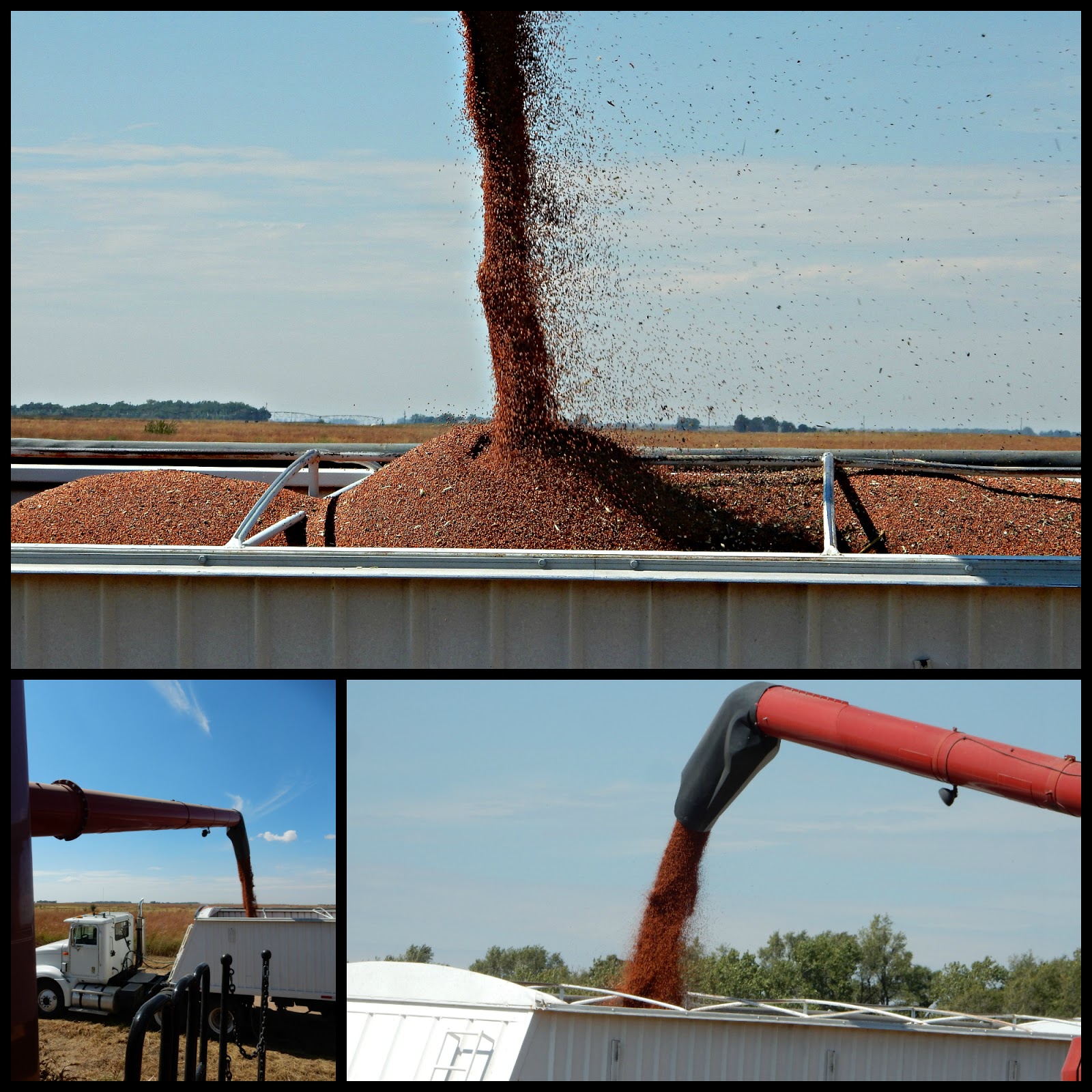
However, milo harvest on our farm this year was anticlimactic. While Kansas grows more sorghum than any other U.S. state, here on the County Line, we are not contributing much to the total.
In 2014, Kansas ranked first in grain sorghum production in the U.S. with more than 200 million bushels grown, which equated to more than 40 percent of the country's total production. 

The use of sorghum for human consumption is being developed further in countries where malnutrition and hunger are prevalent. Kansas State University College of Agriculture Ag Report says:
In the Mara Region of Tanzania, one of the most starved areas of the world, K-State grain scientist Sajid Alavi is part of a research team working to improve child nutrition and health by providing a sorghum-soybean porridge blend to children younger than 5. ... While the results of the five-month study are yet to be finalized, Alavi said the early indications are that children were more healthy and had average growth rates.
But milo is getting some additional traction in the U.S., too, as consumers seek gluten-free alternatives. On a Discover Kansas trip with our Kansas Master Farmer Homemaker group a couple of years ago, we toured NuLife Market in Scott City.
NuLife Market Founder and President Earl Roemer gave us a tour. Earl’s family has farmed in the western Kansas for four generations. For years, his family grew grain sorghum – also called milo – as a feed grain crop for livestock. But then Earl began exploring how sorghum could be a human food source, especially as more and more consumers wanted gluten-free products. Sorghum has no gluten.

He admits that the early grain sorghum products “tasted like cardboard and the texture was like sand.” In 2007, Earl founded NuLife Market in Scott City to produce and market sorghum-based products and sell sorghum ingredients to other food companies.

NuLife uses sorghum grown in the region, providing value-added opportunities for area farmers. And now NuLife supplies sorghum and sorghum products for companies like Kashi, Bear Naked, Go Lean and Annie's Organic, just to name a few. Their sorghum products can be found in more than a thousand products, such as gluten-free baked goods, cereal bars and snacks, represented by some 80 brands. Nu Life Market is shipping its products coast to coast and beyond.

Our little milo crop just travels a few miles to the Zenith branch of the Kanza Co-op. Some of the milo in our area goes to the ethanol plant near Pratt.
 We only had 95 acres of milo, so it only took a couple of afternoons from start to finish.
It was not a bin buster in yield either. The overall average was 40.1 bushels per acre, with a range from 27 to 67 bushels per acre on different fields.
I came home from an afternoon meeting and decided I'd better go ride the combine if I wanted to experience milo harvest at all this year. A parts run took me away from the field the other afternoon.

Compared to wheat, the whole life cycle of milo is much shorter, too. Randy planted the crop in early June.
By June 13, it was up and growing.
June 13, 2019
 
By August 23, when I took the photo below, the milo was headed out and starting to turn.
 And, with that, the sun sets on another harvest of 2019.

Thursday, October 17, 2019

Proving Hypotheses, Bovine Version

Hypothesis: Photo quality goes down when responsibilities go up.

After examining my photos from a recent visit from our veterinarian, Dr. Bruce Figger, my hypothesis appears to be proven.

Bruce was there to work a small group of calves and preg-check 25 heifers. (I should probably call him Dr. Bruce or Dr. Figger, but he was in 4-H with my kids. He's been Bruce to me for a long time.)

But I digress. Anyway, since we haven't had a full-time hired man since the end of June, my list of responsibilities during said appointment expanded.
Most of my photos were from the rather unglamorous end of the cow (but not as unglamorous as Bruce's position, I must admit). After I helped Randy get four or five heifers from the pen into the lane toward the working chute, I inserted an awkward 20-pound steel pipe behind them to keep them in position.
Then, after each "young lady" finished her turn at her ob/gyn appointment, I would "urge" the next one in line to take her place. And after they were through the chute, we did it all again with the next group. (It was the country version of weight training to lift that heavy pipe multiple times.)
I think Bruce's other "assistant" would have had a better angle for photos. But Tess lacks opposable thumbs, so that option was out, too. (Even Tess refused to look me in the eye for a photo op. It was not a good photo day.)

I've been called into duty a lot this summer and fall for cattle chores. But after a cursory look through several files, I realized I don't have much photographic evidence to prove it.
It's a little hard to use my right hand for running the throttle on the 4-wheeler and my camera shutter at the same time.
 
And, without an extra person, I didn't figure taking a "time out" for a quick photo op would go over too well.
So most of my photos were taken before or after the actual work.
After we rounded up this group of mamas and babies from Peace Creek and I got them turned south, the camera went back into my pocket so I could "keep the dogies" moving, as they say in cowboy speak. (Not that I'm a cowboy either.)
I've had plenty of morning and evening excursions to the Ninnescah Pasture to help shepherd five pair of perennially escaped cattle back into the confines of the fence. And I've seen some new country as we've chased said cattle out of shelterbelts, through hay fields and back to their summer home. But, again, I've refrained from pulling the camera out during these already-frustrating round-ups. Hard to believe, I know.

I guess you'll just have to take my word for it this time.
Even though the photo quality isn't good, these two photos have to rank among my favorites of the summer/fall.
Many, many thanks to our neighbors, Keith and Hendrik, who penned our five pair of escapees and hauled them to our farmstead corrals while we were in Wichita with our granddaughters. Randy took the renegade cattle to the sale barn at Pratt this week. I had lost count of the number of times we put them back in and fixed fence this summer/fall.
 
I don't believe I've ever been so happy to watch a trailer leave. There's a photo worth framing - no matter the photo quality!


Tuesday, October 15, 2019

For Want of a Nail ...

Go to the Case parts counter.
Do not run into the library.
Do not go into Smith's Market.
Do not pass "Go!"
Do not collect $200. (In reality, leave some money behind. "Would you like to put that on your Case charge account?")
Come right back to the farm shop.

In the last few weeks, I've had plenty of time to think as I've run to Hutchinson or Pratt or Partridge for parts or seed wheat or some other last-minute errand or contemplated the futility of another trip to Sylvia to coax cattle back to their pasture yet again.

And a quote by Benjamin Franklin came to mind. I couldn't remember it exactly, so I Googled it (of course):

For the want of a nail, the shoe was lost.
For the want of a shoe, the horse was lost.
For the want of a horse, the rider was lost.
For the want of a rider, the battle was lost.
For the want of a battle, the kingdom was lost.
And all for the want of a horseshoe nail.

The same could be said of $20 bolts: For want of a $20 bolt, the multi-thousand-dollar combine was immobile ... until said bolt was duly installed.
It's true for $20 bolts. But most of all, it's true for people.

Sometimes, we may not see our significance. We aren't a big name on a corporate letterhead. There's no gold-plated nameplate on a desk. There may not even be a desk. You may do what you do without a paycheck. Our own agenda may be superseded by a more pressing need.
The welcoming committee: Bulls butting heads.
Sometimes, we "butt heads" when we're more concerned about our own importance than our role as team players.

We're just "a cog in the machine," which is, by definition, "someone who has only a small role in a company or institution, someone who is insignificant."

It's easy to take things for granted. We enjoy Oktoberfest and don't thank the people who went to committee meetings for a year so the rest of us could enjoy a small-town festival. We complain to our city leaders or our school board members instead of appreciating their sense of civic pride and the time they spend to make our communities better. The list is endless for people who serve quietly and without fanfare.
 
But that $20 bolt should remind me that even the smallest thing has a great deal of significance. In reality, if a cog doesn't work correctly, the entire machine may fail. (Our combine and tractors remind me of this continually.)

A few years ago during a Bible study, someone used the redwoods as an illustration for living life in community.
Muir Woods, California
Most trees have a root system that grows deep into the earth to anchor the tree and feed it. That's not how redwoods grow. Instead, they integrate their roots with other redwoods close to the top of the earth. This integration, or intertwining, of roots helps all the redwood trees stay together and live a long and healthy life. 
Sunlight through the redwoods, Muir Woods, California
I've only seen the redwoods once in my life on a trip to the Muir Woods near San Francisco, and they definitely made an impression. But I have symbols of this interdependency just down the road. Randy should get done planting our 2020 wheat crop this week. When you think about it, wheat is a pretty amazing plant, too.
 
You plant a kernel of wheat. And through a process called tillering, that one kernel becomes many. "Tillering" refers to the production of side shoots, enabling that original, initial, single seedling to produce multiple stems or tillers. When the right amount of moisture, nutrients and light come together, that single kernel of wheat produces a bountiful harvest.
Too often in our busy lives, we forget the importance of our small contributions. But, in reality, our small part may be the thing that keeps the whole "machine" we call life moving ahead.
 
We, too, need to bloom where we're planted. We, like wheat, can "tiller" and branch out to make a difference.
 
 Ecclesiastes 4: 9-12, NIV
9 Two are better than one, because they have a good return for their labor: 10 If either of them falls down, one can help the other up. But pity anyone who falls and has no one to help them up. 11 Also, if two lie down together, they will keep warm. But how can one keep warm alone? 12 Though one may be overpowered, two can defend themselves. A cord of three strands is not quickly broken.
Even though we sometimes forget it when we're feeling insignificant, being a "cog in the wheel" or that $20 bolt that helps the whole machine run is pretty valuable after all.