Thursday, February 6, 2020

Birth Day

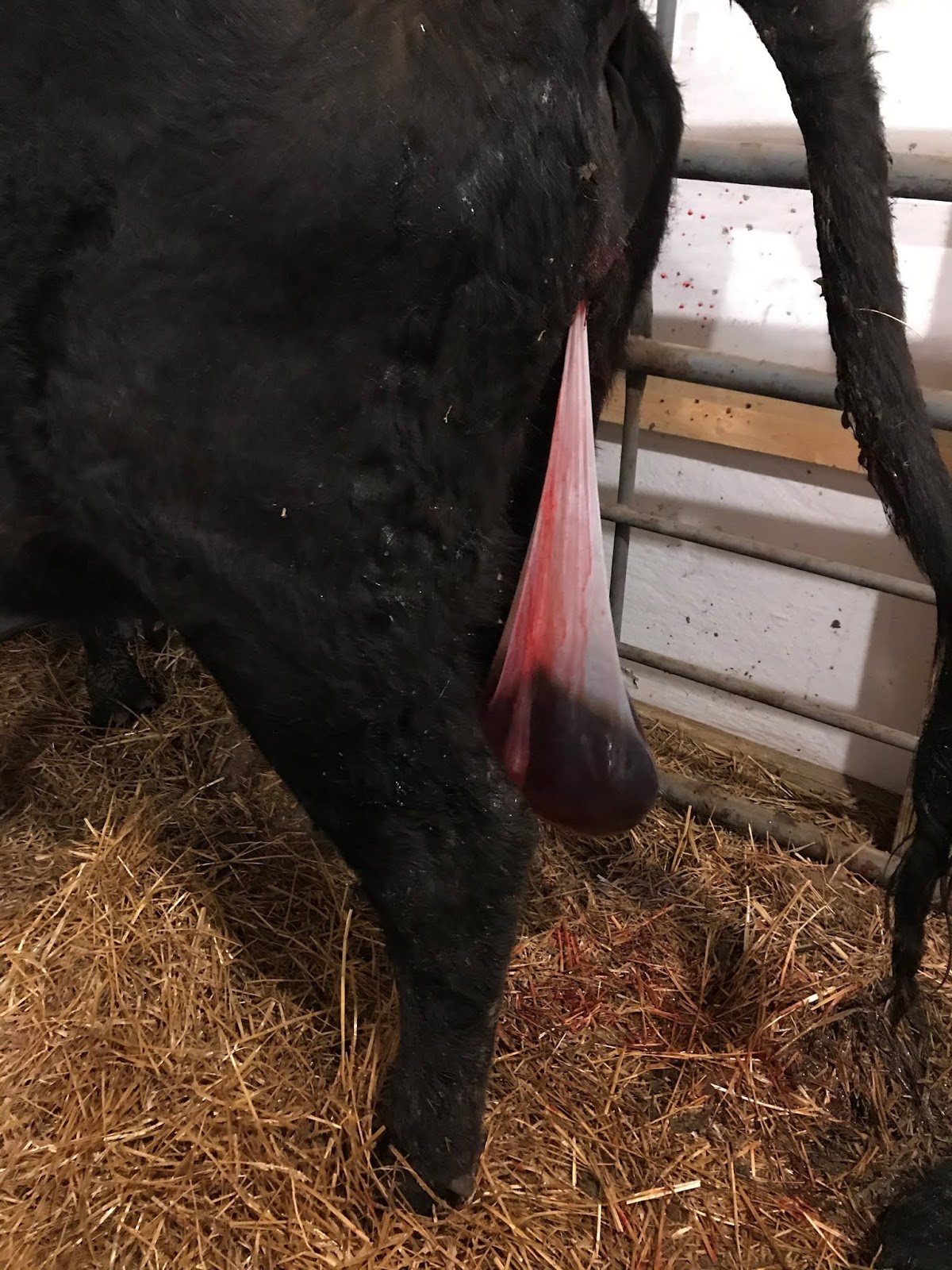
This is what happens when you are trying to take a photo one-handed!
In these days of sexual harassment claims, I probably should have gotten this heifer's permission to post her personal "business" all over the internet.
Goodness knows, I didn't want video cameras or even still cameras documenting the birth of my offspring until the action was over. And even then, I let the Lamaze coach and the guest of honor be the focus of the star's first-ever photo shoot.

However, I guess it's in No. 885's "contract" for room, board and plenty of food that the Chief County Line Correspondent gets to have exclusive coverage of her baby's birth story.

The heifers - including No. 885 - are in a corral to the east of our house. That makes it easier for Randy to check them more frequently and gives us easy access to the calving shed. Because they are first-time mothers, Randy checks the heifers throughout the day and night, just in case one is having difficulty.

With the heifers, Randy uses a bull for "calving ease" - a bull whose progeny is lower birth weight but which gains well after birth. Most of the time, the heifers calve naturally, but, once in awhile, they need a little help.

No. 885 had been showing awhile, and after an hour, Randy didn't see any further progression. We ran her into the calving shed to pull the calf, something we do to help both the mama and the baby.
We put the heifer in the head gate, my Christmas gift of 2010. Sometimes cows can be riled up with the birthing process, so having them contained in the head gate is a much safer option for both mama and people. She set her feet and didn't want to go into the head gate. But, once we finally got her situated, she was very calm.
Randy first splashed disinfectant on the heifer to try to keep the birthing canal as clean as possible. (We've been using the same Tupperware bucket for this job since Randy's folks were in the cow-calf business. It was part of our inheritance.) Just like on Grey's Anatomy or Chicago Med, Randy gloved up for the procedure.
I should have done the same, but my work gloves were in the house, and I wasn't all "up in her business," as I might euphemistically describe. It would have just been more sanitary for me. Randy tied a chain above the ankle on each of the front hooves of the calf. Then he tied the two chains together.

Randy attached the chains to a calf puller, which is a long rod with a pulley on the end. (Since I was helping, I used the photo below from another year.)
 Randy put the leather strap of the calf puller on the cow's rear end, and I held it in place to get started.
   
Then Randy used the pulley system to gently pull the calf from the mama's womb, sometimes pausing to wait for another contraction. The baby comes out with the front feet and the head first.

 Welcome to the world, baby!
The mama still had part of the birth sac hanging immediately after birth. Many times, it bursts as the calf is delivered, but not in this case. However, just like with a human birth, the mama then delivers the after-birth.
Mama gets the job of cleaning off the baby by licking it. It's part of the bonding process for the pair.

We left the two alone in the calving shed to get to know each other.
In 2012, I wrote "The Miracle of Birth," which showed photos of the guys pulling a baby calf. Click here to read that post and see the photos. (Since I was just an observer instead of a helper, you can probably see the equipment used better in that post.)

And, while the farm is full of miracles like this birth, this life also encompasses the other end of the spectrum. We did our best to help this baby whose mama didn't accept it. We thought we'd successfully grafted it to another mama. But it died over the weekend. RIP, little 003.

Tuesday, February 4, 2020

Winter Snowscape Dessert with Snowmen

Dessert is important at women's meetings.

Maybe we don't want to admit it out loud, but it's true. It seems women are genetically predisposed to the promise of a sweet treat at the end of a business meeting.

It was my turn to provide the refreshments at a PEO meeting for one of our January meetings. And I was in search of a treat that would speak to the stark, winter landscape.

I did consider doing a warm dessert, like chocolate cobbler topped with ice cream or an apple cake with a warm caramel sauce. But my mind kept returning to snow and snowmen.

When I found a recipe for White Chocolate Lasagna, I decided it would become Winter Snowscape Dessert for my PEO sisters.
 
 
I also clicked on numerous links for building my own snowmen out of food, not snow. I got the ingredients to cover large pretzel rods. But when I tried it, the eyes, nose and buttons ended up sliding off the top of the pretzel.
So Plan B was born. And they turned out pretty cute, if I do say so myself. Actually, I didn't have to say: My PEO sisters said so, too.

The downside? Constructing a snowman army is time consuming. But the dessert was pretty simple and quick, so I guess it all balanced out.

I know everyone has transitioned to thinking about Valentine's Day this month. But there's some snow in the forecast today. And no matter what Punxsutawney Phil says, I'm fairly confident we're not done with winter. 

Want to try it? Here's how. Enjoy!
Winter Snowscape Dessert
1 pkg. Golden Oreos
6 tbsp. butter, melted
8 oz. cream cheese, softened
1/2 cup butter, softened
1 cup powdered sugar
16 oz. frozen whipped topping, thawed
7.8 oz. white chocolate instant pudding mix (or use 2 small packages)
3 cups whole milk
White chocolate bar (opt.)

Crush Oreos using a food processor to get a fine crumb. Melt 6 tablespoons butter. Combine with Oreos. Press into the bottom of a 9- by 13-inch pan, covering it evenly.

In a medium bowl, blend softened cream cheese and butter, mixing well. Add powdered sugar; mix again. Add half of the whipped topping. Blend well. Spread out over the crust layer.

In another bowl, combine pudding mix and milk. Beat until thickened. Pour over cream cheese layer. Refrigerate at least 5 minutes.

Top off with the rest of the whipped topping. Refrigerate at least 1 hour before serving.

Optional: You may top the dessert with white chocolate curls. (Mine didn't make nice, long curls like I'd envisioned, but maybe that made it look more like snow.
Marshmallow Snowmen
Large marshmallows (2 per snowman)
White coating chocolate
Lifesaver gummies
Mini or micro-mini peanut butter cups or Hershey's Kisses
Black piping gel
Orange piping gel
Pretzel sticks, broken in half
Flat gummy candy like Airheads or fruit leather
White sanding sugar (opt.)

Melt coating chocolate. Put a little coating chocolate between the marshmallows to stick them together. I used Airheads and cut them in half for the scarves. I added the scarves right after putting the marshmallows together. The excess chocolate helps stick the scarf to the body. If needed, I added a little more coating chocolate on the underside of the scarf to attach it more firmly.

Attach the peanut butter cup to the Lifesaver gummy to form the hat. Attach the hat to the top of the snowman.

Using piping gel, make dots for the facial features.

On a piece of waxed paper, put a small dollop of melted coating chocolate. Sprinkle with white sanding sugar, if desired. Press the completed snowman into the melted coating chocolate. You may have to hold it up for a minute or so until it begins to set up. You can't work too far ahead or the chocolate will get too hard and you won't be able to press it into the chocolate dollop.

After the snowman is firm, snap pretzel sticks in half. Press broken ends into melted coating chocolate. Push into the bottom marshmallow.

Note: You may have to reheat your coating chocolate in the microwave if it starts to get hard.

Thursday, January 30, 2020

Super Bowl = Super Snacks

At Christmastime, I typed "cheese dip" into my blog's search engine, hoping to save a little time and not dig through a pile of printed-out recipes. Some cheesy recipes popped up, but it wasn't the dip recipe I was looking for. I tried other combinations because I was just sure that I must have shared such a tried-and-true recipe before on Kim's County Line.

Nope.

So when one of my friends asked if I was going to do a Super Bowl food blog post, I decided it was time to remedy that oversight. After all, we'll need all the sustenance possible to cheer on the Kansas City Chiefs in the Super Bowl this Sunday!

This Southwest Ranch Cheese Dip was a recipe shared by my friend, Kim Volker, back when I was compiling favorites for a recipe book project as a shower gift for Jill and Eric.
They've been married more than 10 years now, and both Jill and I have used the recipe over and over again. Even though we eat leftovers for our after-Christmas-dinner supper, I always stir together Southwest Ranch Cheese Dip to serve alongside the ham sandwiches. And it's a favorite with Mexican meals and for parties, too.

It's super simple, and I usually have all the ingredients on hand in my fridge and pantry. Though the original recipe's directions called for using a slow cooker to heat up the dip, I've also sped up the process by combining the ingredients in a microwave-safe bowl and "zapping" it.
It's great served as-is with chips or fresh veggies. You can also use it as a topping on tostadas or baked potatoes.

It's been 50 years since our Kansas City Chiefs have been in the Big Game, so having the right munchies is paramount. Besides the recipe for the cheese dip, I've provided links to more tried-and-true recipes from Kim's County Line. I don't put them on the blog unless we've enjoyed them ourselves.

With Kansas City known as a barbecue hub, try out the BBQ Oven-Baked Ribs, BBQ Meatballs or BBQ Beef Under a Bun.

Since the Super Bowl is in Miami this year, I shared some tropical flavors with both the Lemon Buddy Snack Mix and the Chili Lime Tacos with Grilled Pineapple Salsa. Or try Jill's Guacamole recipe.

You'll also find a variety of sandwiches, snack mixes and sweet treats compiled below.

Enjoy and Gooooooooo CHIIIIEEEEEFFFFS!
Southwest Ranch Cheese Dip
From the kitchen of Kim Volker
1 can fiesta corn, drained
8 oz. cream cheese
8 oz. fiesta blend cheese, shredded (the original recipe called for Monterey Jack. I always have the fiesta on hand)
4 oz. can diced japalenos
1 pkg. dry ranch dressing mix
8 oz. sour cream
A little milk, if needed

Mix together all of the ingredients (except milk). Heat for 2 hours on low in a slow cooker, stirring every 30 minutes or so. If the dip is too thick, add a little milk to thin it.

Optional: Microwave the ingredients in a glass bowl. Microwave for 1 to 1 1/2 minutes at a time and stir. Keep heating and stirring intermittently until it's melted. Add additional milk as needed to thin it.

It's also good as a dip for raw vegetables or served as a topping for tosadas and baked potatoes, for example.

***

Click on the links for the recipes pictured below. Looking for something else? Type "bar cookie," "snack mix," "cookies," "sandwiches," "soup," etc., into the blog search engine. The search engine is found in the upper lefthand corner of the blog post.

Oven-Baked BBQ Ribs AND Sweet & Sour Baked Beans

BBQ Meatballs - Make them full-size or bite-sized
Brownies for a Crowd

Let's hope the San Francisco 49ers have Butterfingers - NOT the Chiefs!
Butterfinger Blondies

Peanut Butter S'Mores Bars

Tuesday, January 28, 2020

And So It Begins Again: Class of 2020

There's no hiding from it: Calving season 2020 has begun. With more snow on the way today, we'll see if the expectant mamas respond to that old wives' tale that says births happen when there are changes in the weather.

We didn't get off to a momentous start. Last Tuesday, a baby was born 3 weeks early to a cow on Peace Creek. It was just too small to survive.

Our 25 heifers began calving last Thursday. While the projected due date was today (January 28), the heifers who are calving are delivering full-term babies. We schedule our heifers to begin calving a couple of weeks prior to the whole cow herd, since the first-time moms require more frequent checking.
This little white-faced guy was the first one to join the Class of 2020. However, the ear tag doesn't support that claim.
Even though this black calf was born second, he got the 000 ear tag.
 
Location, location, location: He was closer to the gate when we arrived with the ear tags the next morning. And, contrary to the triple-zero moniker, it doesn't mean this calf is worth nothing ... nada ... zip. In our herd, the first number signifies the year that the baby was born. In this case, the year 2020 meant our numbers begin with "0" for this calving season.
We have the heifers in a corral near our house. The mamas were born on The County Line in 2018, and Randy chose 25 of them to retain for our own herd.

The too-early arrival wasn't the only challenge we've already faced. This little guy's mama was not interested in claiming it.
Randy moved the calf into the calving shed to warm it up. Then, we tried to corral the mother and put it in the calving shed with the calf. She jumped the fence twice, leading a few of her compatriots astray as they all tried out for the heifer version of the Olympic high jump trials.

After the second time, I told Randy, "We need to find some higher panels." So we added three more panels to the corral right outside the calving shed. (I can testify that my muscles could feel the "burn" the next morning after lifting the panels into the back of the pickup, taking them out and helping to position them.)
We ran a group of the heifers into the corral again. And the mom (No. 849, for the record) tried to jump the fence again. The taller fence prevailed, and we finally got it into the shed. But then she burst through the head gate. And Randy decided it wasn't worth getting either of us hurt.
We mixed up some colostrum and fed the calf with a tube feeder. (Yes, the photo is blurry. It's not easy to do a job and take photos at the same time. That's why there are no photos of the round-up itself, and this one is blurry. Someone asked me the other day how I can work and take photos at the same time. The answer is this: Sometimes I can't.)

After we fed the calf, we left it in the calving shed, figuring we'd have to continue to tube feed it or bottle feed it.
 
Then Randy had a brainstorm. Another heifer had lost a calf the same day. We would attempt to graft that heifer and the orphaned baby calf.
This heifer is much calmer and more cooperative. At first, Randy milked the heifer.
She wasn't sold on the idea at first.
But, as the song from "Fiddler on the Roof" says, "Wonder of wonder, miracle of miracles" the two have found each other.

As you can see in the top two photos, it took awhile for the calf to figure out which end of the mother yielded the warm treat.  Success!
That makes the farmer happy. (And the farmer's wife, too!)
Tomorrow - January 29 - is Kansas Day, and our state celebrates its 159th birthday. Kansas was admitted as a state of the Union in 1861. Even back in those days, the livestock industry was an important aspect of the state's agricultural economy. The state ranked third in the nation in cattle population by 1890, a position it held for several decades. Mixed farming (grain-livestock) has always been the predominant form of agriculture on Kansas family farms, including both the Fritzemeier and Moore agricultural legacies.

Thousands of head of cattle were shipped on trains from rail heads in Kansas to packing plants in Kansas City, Chicago, and other cities to the east.  Between 1867 and 1885, towns like Abilene, Ellsworth, Wichita, Newton, Caldwell, and Dodge City became famous for their place in the cattle industry.
Photo from the Kansas State Historical Society, dated between 1891 and 1912
With the closing of the open range, Kansas cattlemen began to place greater emphasis on the breeding of better stock.  Shorthorns and Herefords were popular in the 1890s, according to the Kansas State Historical Society. Herefords are still part of the genetics on our County Line farm, along with Angus.
 
Happy Birthday, Kansas! Maybe we'll increase our party attendance with a few more calves.
For more on my family's arrival in Kansas, check out this blog post from Kansas Day 2016. More information about the Fritzemeier's history in the Kansas cattle industry can be found here.