Showing posts with label Wheat 2022. Show all posts

Thursday, July 7, 2022

The Final Numbers: Wheat Harvest 2022


I was born during wheat harvest. A rain had taken my dad out of the harvest fields that year, so my arrival didn't even mess with getting the wheat in the bin. 

The photo above was before my recruitment as a truck driver, but I've been taking combine rides for much of my life.

However, through the years, I've had plenty of birthday celebrations right in the midst of harvest, and this year was no exception. 

Before I even had a driver's license, I was helping during harvest, moving the truck closer to the uncut wheat so that my dad didn't waste as much time driving the combine to the truck to dump wheat. This was pre-grain cart days. Or maybe it was just a ploy to get me more comfortable in the truck. At any rate, as soon as I had my learner's permit, I was trucking wheat to the Iuka Co-op.

So it's probably not surprising that one of my favorite Bible verses has something to do with wheat:

John 12: 24
24 Very truly I tell you, unless a kernel of wheat falls to the ground and dies, it remains only a single seed. But if it dies, it produces many seeds.  
 It's an "everyday" miracle in farm country, I suppose. We plant the hard kernels of wheat in the fall. 
 
These wheat kernels are "pinkish" because they were treated with insecticide.

 
We watch the green sprouts stand "at attention" like miniature soldiers in the brown earth ...

 ... and then become a green blanket.
 

We marvel when snow and ice don't kill the miraculous plants - even though we've seen it again and again.


And then we watch as the warmer temperatures of spring waken the sleeping crop and green heads begin filling with plump, soft berries. 
 

Then comes the rustle of golden wheat ...


... which gives way to the roar of the combine, chopping its way through fields and separating wheat from chaff. (There are Bible verses about that process, too.)


We have been planning for retirement for several years, and it was Randy's intent all along to "go out with a bang," planting the majority of our crop acres to wheat for our final summer harvest. As it turned out, the "big bang" harvest was last year - the best of our farming career.


This year's overall average was 34 bushels per acre. We had a high of 46 bushels per acre, and a low yield of 19 bushels per acre. That's what happens when you have a dry winter and spring. 
 

It's always interesting to see how start and end dates compare from year to year. Here are the stats since I began blogging:

2010:  June 18
2011:  June 10
2012:  May 26 (an anomaly and the earliest harvest, by far, we've ever had)
2013:  June 21
2014:  June 17
2015:  June 20
2016:  June 15
2017:  June 12
2018: June 12
2019: June 26
2020: June 16
2021: June 17 
2022: June 13 
 
 
The finish dates are all over the board in the past dozen years, too:
2010: June 25
2011: June 20
2012: June 9 (an anomaly)
2013: July 6
2014: July 7
2015: July 1
2016: July 13
2017: June 28
2018: June 29
2019: July 22
2020: July 7
2021: July 12
2022: June 28

June 25, 2022


Yield averages in the years since I've been blogging have been:

2010: 37.2 bu/acre
2011: 36.7 bu/acre
2012: 45.5 bu/acre
2013: 52 bu/acre
2014: 24.5 bu/acre
2015: 50 bu/acre
2016: 48.5 bu/acre
2017: 50.84 bu/acre
2018: 39.2 bu/acre
2019: 23.6 bu/acre
2020: 49.5 bu/acre
2021: 58 bu/acre
2022: 34 bu/acre

As I said earlier, 2021 was our best year ever. Though our average was 58 bushels/acre in 2021, our high yield was 86 bushels per acre. Our low was 31 - just a smidge under our overall average this year.

We had about 1,900 acres planted to wheat this year. We harvested 1,300 ourselves - from June 13 to 28 (with rain delays interspersed). We had about 600 acres of our crop custom harvested. Three combines going all at once can go over acres quickly. 


Next wheat harvest, God willing, we'll still be living in the same house, down the same dirt road. I imagine that if I want to get out in a wheat field to take photos, our neighbors or tenant farmers won't mind too much. 


But it will be different. However - like Vincent Van Gogh - I imagine I'll always find poetry in a wheat field (as long as my ankles aren't itching too badly.)

The wheat field has ...poetry; it is like a memory of something one has once seen. We can only make our pictures speak.
Vincent Van Gogh 
 

If you stand in a wheat field at this time of year, ... it’s not hard to imagine you’re looking at something out of mythology: all this golden sunlight brought down to earth, captured in kernels of gold, and rendered fit for mortals to eat. But, of course, this is no myth at all, just the plain miraculous fact.” 
 Michael Pollan
American journalist


Tuesday, February 22, 2022

LOVE = RAIN or SNOW: February Wheat Update


During this month devoted to love, the 2022 wheat crop hasn't gotten enough of it.

At the moment, LOVE for a Kansas wheat farmer would be spelled with another four-letter word: RAIN ... or even SNOW.

We have gotten a bit of moisture on the Stafford/Reno County Line since my January 21 wheat update. However, the Kansas drought monitor shows worsening conditions - not improvement - in our part of the world. 

On February 8, the drought monitor looked like this, putting us in a region of moderate drought:

 Just a week later, our area worsened to Severe Drought.
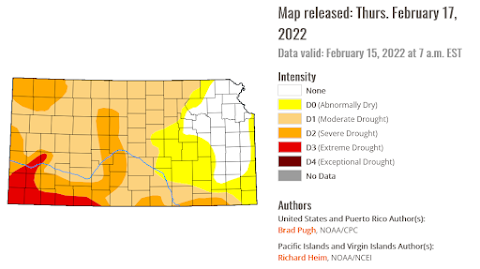

We did get some snow February 2 and 3.

It just wasn't enough to make much of an impact.

The above photos were taken on February 4.

But, something is better than nothing. 

 By the time this snow melted down in the rain gauge, it amounted to about 1/2 inch.


Weather forecasters predicted snow for us February 16-17. However, our area received just a dusting.

This month's wheat update photo on February 21 was taken on an unseasonably warm day - hence short sleeves and no jacket for Randy. It was 73 degrees on Monday.

When we got up today, the temperature was 8 degrees, with the wind chill below zero. It's just one other motion on the roller coaster temperature fluctuations that this winter has brought.

Since the wheat crop is still in dormancy, the impact of the swing in temperature won't likely be appreciable, Randy says.

Another issue facing Kansas wheat farmers is the price of fertilizer, which has more than tripled in the past year. Thankfully, we put 60 to 70 pounds of nitrogen per acre on our wheat ground before we planted last fall. Randy chose to put herbicide and another 10 pounds of nitrogen on one field already this winter. It's a field that was replanted last fall. Because it wasn't established as well, it blew badly in the December 15 windstorm. He put the herbicide and fertilizer on after that, hoping to give that field a boost. 

He likely will have the co-op put herbicide and 10 pounds of nitrogen per acre on the remaining acres next month, biting the bullet on the high price of fertilizer with the hopes of bumping yield.

We aren't the only ones contemplating the lack of moisture and the price of fertilizer. At a February meeting of the Kansas Association of Wheat Growers (KAWG), board members reported that wheat fields across Kansas were generally planted into sufficient moisture conditions and went into winter with decent stands. However, more moisture will be needed over the winter and into the spring to kickstart a crop emerging from dormancy and maintain growth. 

According to the USDA’s National Agricultural Statistics Service, Kansas topsoil moisture supplies as of January 23, 2022, were 77 percent very short to short and 23 percent adequate to surplus. Subsoil moisture supplies were 31 percent very short, 41 percent short and 28 percent adequate. In the same report, the Kansas winter wheat crop was rated at 30 percent good to excellent, 39 percent fair and 31 percent very poor to poor. The next crop progress and condition report is scheduled to come out later today.

Perhaps more importantly, KAWG members conveyed the difficult decisions producers are currently making with their fertility programs. This winter application of nitrogen allows the nutrients to move into the root zone with precipitation well before jointing begins to be most efficiently utilized by wheat. Having adequate nitrogen available supports spring tillering and helps ensure good yield potential.

This year, however, fertilizer prices have exploded due to international supply chain disruptions during the COVID-19 pandemic. According to a January 2022 report by Texas A&M University’s Agricultural and Food Policy Center, “Based on current spot markets, it appears as though fertilizer prices will increase in excess of 80 percent for the 2022 planting season (relative to 2021).” KAWG members and their neighbors are feeling this cost crunch, reporting many in their areas are putting off normal topdressing applications to wait for moisture. 

“While we cannot control the weather and its impact on the wheat crop’s yield potential, it is important to note that Kansas farmers are holding off on fertilizer applications due to high prices and availability of supplies,” said Kansas Wheat CEO Justin Gilpin. “Even with welcome winter snow and — fingers crossed — well-timed spring showers, these decisions could affect the final grain yields and quality of this year’s wheat crop.” 

When fertilizer prices will stabilize or decrease is a difficult question, but KWCH Chief Meteorologist Ross Janssen did offer welcome longer-term predictions for weather patterns during Kansas Commodity Classic. Janssen predicted shifting weather patterns could bring near to below normal temperatures and wetter than normal moisture conditions to the western two-thirds of Kansas in the next three months. Overall, he predicted while winter will continue to drag out, Kansas farmers should see near-normal rainfall this spring and are unlikely to have a major drought this summer or a prolonged heatwave. Both predictions are positive for the Kansas wheat crop as wheat plants emerge out of dormancy this spring and continue their growth cycle until this summer’s harvest. 

With a projected 7.3 million acres of wheat planted in Kansas, according to the USDA’s Winter Wheat and Canola Seedings report released on January 12, 2022, Kansas farmers are keeping their eye on the markets and on the sky to make the most of this year’s crop. That includes the farmers on the County Line, who are looking ahead to harvesting our final wheat crop as active farmers.
 
(Thanks to www.kswheat.com for some of the information in this monthly update on the County Line 2022 Wheat Harvest report.)


Tuesday, November 30, 2021

The March Toward Harvest: November Update

November 21, 2021
 

The march toward Harvest 2022 continues. As I wrote last month, I have "borrowed" an idea from Stafford County Flour Mill. During the last growing season, the mill posted monthly photos on its Facebook page. 

Our summer 2022 harvest will be our final one as active farmers, so I decided to do something similar. Since we began planting wheat on September 21, I chose the 21st of each month as my target date. The photo at the top of the post is November's entry into this online journal of sorts.

October 21, 2021

Here's how the wheat looked a month earlier on October 21 at the same location. 

In October, I also photographed wheat that we'd planted in a field where we'd harvested corn. We had volunteer corn coming up among the wheat. 


At that time, I said that a hard freeze would "zap" the corn, and it would no longer be viable. But the winter wheat is designed to survive the winter.

Even though a hard freeze was later in our region than it normally is, it did happen. The still green-colored growth is wheat and the dried up plant matter is the corn. You can also see a portion of a corn cob.


The dying corn gives fields where it's located a yellow tinge. But the wheat will be just fine. 

Our planting was delayed by some rain. We didn't finish up planting and replanting until October 23. 

That wheat is a month behind the earliest planted wheat and you can definitely tell the difference. It's not nearly as thick and lush looking.

You can see where Randy replanted in this field. He ran the wheat drill a different direction, trying to fill in the stand.

I decided to take a photo at the same location I'd taken the October sunset photo. As you can see, there's still some water in the mudhole.
 

We are not alone in seeing the discrepancies in our wheat stand. We subscribe to "The Wheat Farmer/Row Crop Farmer," a publication that caters to wheat farmers. One of its Kansas columnists said this in the November 2021 issue:

Many farmers delayed planting because it was either too hot or too dry, while others went ahead and dusted in wheat. Then when they did get started, they ran into rain delays. There was a great deal of replanting. I know of several farmers who planted the same fields three times. ... In our case, we have a lot of terrific looking stands but others, while good enough to keep, are just scrappy looking. There could be some weed issues on those fields next spring.
Vance Ehmke, Ehmke Seed, Healy, Kansas
in The Wheat Farmer/Row Crop Farmer

Another columnist from Belle Plaine, Kansas, said:

There are good fields, and there are bad fields. ...

And that sums up farming in a nutshell.

Until next month ...
 

Tuesday, October 5, 2021

Marathon, Not a Sprint: The Journey Toward Wheat Harvest 2022


The journey toward Wheat Harvest 2022 is a marathon, not a sprint. Since I've never been much of a sprinter, that's a good thing. 

We began planting our 2022 wheat crop on September 21. And we're still at it. We have had a few days hiatus, beginning last Thursday when we got 2.25 inches of much-needed rain. We got another shower last Saturday. We may be back in the field later today. The verdict is still out.

Wheat is the primary crop on our dryland farm on the Stafford/Reno County line. And this year, we're going big: Randy is planting 1,900 acres to wheat. No wonder it's taking awhile!

One of my favorite photos from wheat planting so far was taken at sunrise. The day was brand new, so there wasn't time for anything to have gone wrong or broken down yet. You gotta love a Kansas sky, and this one looked painted with "Hope" to me.


It's what keeps farmers planting the next crop and doing the next task, time and time again. Randy has been doing that for 50 years.

Here in Central Kansas, we plant winter wheat. We plant it in the fall, and then it goes dormant during the cold months of winter before coming out of its "hibernation" and growing again next spring, then maturing for a June/July harvest.

We saved some of our 2021 crop in bins on the farm to use as seed wheat. It's binned during harvest, and then we load it into the truck to take to Miller Seed Farms near Partridge for cleaning. 

 v


They treat it with Cruiser, a fungicide, which helps protect the small wheat plants from disease. It's also treated with Vibrance Extreme, an insecticide which helps keep bugs at bay. That's what gives it its pinkish tinge.


Randy uses a grain-fill auger to transfer the seed wheat from the truck to the drill.

Randy wonders if he could get a Flex Tape endorsement commercial. Flex Tape is one of the tools in his repair kit. So far, so good.


So why is wheat our primary crop? First, we don't irrigate. Wheat is more drought tolerant than corn or soybeans. While the seed genetics are getting better and helping make dryland corn and soybeans a more viable crop in this part of the state, wheat is a proven performer in less-than-ideal conditions. (Of course, we would love to have ideal conditions, but that rarely happens.)


In this part of Kansas, the textbooks say that October 1-10 is the ideal time to plant wheat. Since we can't get the whole crop in the ground during that time, we start a little sooner. Many years, we don't finish before October 10 either. 
 

As with every planting season, I think about the optimism that seems to be part of the fabric of every farmer.

 
They put a seed in the ground and then wait like a kid on Christmas morning. 
 
 
They slow down as they pass a planted field, just waiting for that first glimmer of green. And then the miracle begins again for yet another season. 
 
And through sunrises and sunsets for some nine months, we hope and pray that the crop comes to fruition.

 
This wheat crop will be our final one as working farmers. Randy plans to retire after wheat harvest next summer. So this planting time has meant some time for reflection. But even as we turn the reins over to a younger farmer, our hearts will always be tied to the land. As farmers' kids before we were farming ourselves, it's part of our DNA. And we've been working together for more than 40 years. We are blessed.