Showing posts with label Kansas homesteaders. Show all posts

Thursday, August 29, 2013

Hieroglyphics

A faithful sentinel welcomes me home.
Summer ... 
Fall...
Winter ...
Spring ...
... the old cottonwood opens its arms in greeting.

As pioneers came to the area in covered wagons, they homesteaded on the wide open prairies, taking advantage of the provisions set forth in the Homestead Act of 1862. Settlers also could obtain a quarter section of ground for a timber claim. Through the Timber Culture Act of 1873, a settler could pay a $14 filing fee and plant trees on 10 acres of a quarter section. After the family cared for the trees for eight years, the land became theirs. Many of the pioneers came from the eastern United States, so they were used to more plentiful trees. They hoed them and watered them. As their own children grew, their trees did, too.

Did those settlers imagine that one day the trees would provide a landmark and shade for generations to come? I don't know when the cottonwood just south of our drive was planted or whether it was part of a timber claim. If only the markings on felled trees could tell me their story like hieroglyphics on cave walls. 
It's sad to see some of these majestic old trees breath their last and topple into ditches or among their peers in windbreaks.
If only they could tell their tales. They have been the silent sentinels as the world has changed. The horse and plow gave way to the first tractors and now to machines guided by GPS.
They have been the witnesses as a father passed the mantle of leadership on the family farm to his son, generation after generation.
Two summers of prolonged drought ravaged some of these faithful witnesses to history. Underneath the bark, insects have burrowed and left their homemade hieroglyphics. As I've driven by shelterbelts the past two summers, the dead and dying trees seem more noticeable. Were the rains that fell in July and August enough to save them? Or, like people, are these trees just at the end of their long and productive lifespans?
May "snow"storm
The tree at the end of the driveway is like an old friend -
as the fluff of its white "cotton" drifts along the ditches in the spring ...
as it stands strong when the January wind rattles the ice-covered branches ...
as sunlight kisses the fall leaves with gold ...
and as birds make their nests among the bright green leaves and their song joins the music of the south wind ...

Thanks, old friend.

Advice from a tree: Stand tall. Go out on a limb.      Remember your roots. Drink plenty of water. 
Enjoy the view. 
Bear Grylls
The cottonwood on my parents' farm
For more about a special cottonwood tree on my own family farm in Pratt County, click on this link.

Wednesday, February 1, 2012

Century Farm: The Neellys


Homer Socolofsky was still teaching Kansas history at K-State when my brother arrived 10 years after me.

To his credit, Kent didn't just recycle my 16-page paper about the history of the Moore family farm. (He probably didn't want to type that much.) He did use some of the information I'd gathered, but he took it a step further. He also explored the history of the Neelly family farm, my mom's farming heritage. (His paper was only eight pages, and he dealt with two families: What can I say? I still need an editor!)

My mom's family has been farming in northern Pratt County since the turn of the century. I'm not into genealogy, though I admire the persistence of people who are. I like the stories. What made that person who they were? What did they love? How did they spend their time? What was important to them? Those glimpses of the people in my past help put together the puzzle of family and heritage.

Here are a few tidbits from Kent's paper:

The earliest record of a Neelly in America is that of John Neelly. He arrived on October 18, 1716, at Philadelphia. The family settled in Botetourt County, Virginia, but later left the area for unknown reasons.

Thomas Neelly Jr. was born in Maury County, Tennessee, and later married Mary "Polly" Moore in 1856. Thomas was a farmer and blacksmith until a stroke left him paralyzed. Charley James Neelly was the fourth child born to Thomas and Polly Neelly. He was born near Hoberg, Mo., but in 1898, he came to Kansas and went to work for a farmer who lived about five miles north of Naron in Pratt County. In 1900, Charley married Ethel Denton. They had 10 children - six boys and four girls. Shelby Merle Neelly (my Mom's Dad/my Grandpa) was their second child.

Food for a family of 12 was a major concern. The Neellys had an orchard and a very large garden. It was not uncommon for them to can more than 1,000 quarts of vegetables and fruits. They also butchered their own meat and sold some of it to their neighbors.

For a behind-the-scenes story about this house, click here.

Charley had a fondness for horses and made money by trading them. He also liked good driving horses and owned 11 race horses during his lifetime. During the 1910s and 1920s, Charley and the children farmed six or seven quarters of cropland. In 1919, they had more than 500 acres of corn. Shelby, his older brother Archie, and two hired hands shucked corn all winter. Corn at that time was worth 25 cents per bushel.

After graduating from high school in 1925, Shelby attended Kansas State College. But in 1928, he had to leave school because of the Depression. He returned home and earned money by shucking corn for 2.5 cents per bushel. In 1929, he went back to K-State and earned his bachelor's degrees in physical education and biology in 1933.

He coached and taught school, farming on the side. In 1945, he began farming full-time. In 1987, he sold his machinery and transferred operation of his ground to his grandson, Kent, who still farms that ground today.

The farming roots run deep, not only on my mom's paternal side. Her mother's family farmed northeast of Trousdale. I love this photo taken in 1907. My grandma, Lela Johnson Neelly, is the baby being held in her mother's arms on the porch of the farm house. Doesn't it look like Americana personified?


Randy's family also has ties to agriculture for more than 100 years. A few years ago, our pasture was recognized as a Farm Bureau Century Farm. Initially, Randy's Great Great Great Uncle owned the ground. It was inherited by his great grandmother. Then his Grandpa Fritzemeier and two of his brothers owned the pasture together. Now Randy and his cousin are the owners.

Our roots run deep in Kansas. And I wouldn't change a thing.

Tuesday, January 31, 2012

Century Farms: The Moores

(My dad as a toddler and his Dad)

As Kansas celebrated its 151st birthday on Sunday, I re-read a 16-page term paper I wrote in 1979 for History of American Agriculture, a class I took as a senior at Kansas State University. It didn't have a lot to do with my career goals at the time. But it was one of the best classes I took since it encouraged me to learn more about my heritage.

Every person and every family has a story. I did learn that in journalism school.

Today, my Dad and brother continue the story of the Moore family farm, which was established 135 years ago in Pratt County. The photos were gathered by my Mom into a family history book. She presented a copy to each grandchild. I keep telling the kids that I'm holding onto the books for safekeeping.

Excerpts from the paper:

Sometime in the late 1860s, Kentuckian James T. Moore spent a brief time in Kansas as a helper to a buffalo hunter. He was impressed with the potential of western Kansas for cattle grazing and went home to tell his wife, Chalista, that the grass stood as high as the stirrups on a horse.

He couldn't forget that undeveloped frontier. In 1876, the family came to Kansas in a covered wagon drawn by oxen. They arrived in December 1876 in Sodtown, later known as Stafford. A hotel proprietor mentioned to J.T. that he might do well to homestead in Pratt County.

A man whose business it was to locate claims helped J.T. and his family. The son, J.J. who was 9 at the time, later described the trip:
He told us of a place that we could homestead down in Pratt County where Kelly the buffalo hunter had put down a well. We started with an ox team to a wagon and the driver carried a compass as he drove. On the hind wheel of the wagon was tied a rag, and a man sitting in the back counted the revolutions of the wheel. So we came out 23 miles, so far south and so far west. We hit the place all right and found the government corners. We went to Larned and put in the (homestead) papers.
The Moores began living on the claim - located 3 miles east and a half mile north of present day Byers - in spring 1877. They later filed a timber claim which gave them a total of 320 acres of land.

(This was my childhood home for the first 6 years of my life.)

But times weren't easy in this new place. J.T. gathered buffalo bones from the prairie and hauled them to Larned or to Hutchinson to sell for fertilizer. The trip took all day, but he needed the $5 or $6 per wagon load to purchase food and necessities for his family. After delivering the load, he would spend the night in Larned (45 miles away) or Hutchinson (55 miles away). His wife, Chalista, would be scared and lonely while he was gone, so she would take the children to the barn and spend the night there with the horses for company.

My Dad's Grandpa, J.J. Moore, was the second owner/operator of the family farm. Besides farming, he played a part in the founding of Byers in 1914. J.J. also owned the bank in Byers. During the Depression, he lost the bank but was able to save the farm ground.

J.J. had many talents besides farming. He purchased young, strong mules and broke them for work on the farm. When they were well trained, he sold them for a good profit and repeated the process. He was also an accomplished blacksmith, making his own tools, sharpening shears and shoeing his own horses.

My Dad is the third owner/operator of the farm. The family tradition continues with him and my brother, Kent. A year ago, wheat harvest provided an opportunity to take a photo with the 4th, 5th and 6th generations to work on a family farm in South Central Kansas.

6th, 5th & 4th generations to work on the Moore Family Farms
Brian, Kent & Bob Moore

Monday, January 30, 2012

Ad Astra Per Aspera

You probably wouldn't think about having a birthday party in a cemetery. But as Kansas celebrated 151 years of statehood yesterday, I thought about those pioneers who settled this land I now call home. On January 29, 1861, Kansas was admitted to the Union and became the 34th star on the American flag.

Peace Creek Cemetery is just a mile from Randy's boyhood home. Some of his ancestors rest in this quiet plot at the edge of a wheat field. Maybe a visitor or two who takes the wrong road to Quivira National Wildlife Refuge might happen across it. But, for the most part, it's off the beaten track. The chilly silence may be broken by the growl of a tractor or a pickup traversing the sandy road. But most often, the sound is just the breeze through the trees that stirs the music of a wind chime near one of the graves.

As we drove by one January evening, I asked Randy to stop. I watched the sun sink into the horizon of the western sky, and I thought about those pioneers who came before me. They may have marveled at a similar sunset sky, the velvet blue lightened with pinks and yellows and oranges - the vibrant colors that come only on a cold January night.

There were probably fewer trees then, but the same sun and the moon still hung from the sky. These celestial bodies defined their days - probably more so than they do mine since they would have lit their homes with candles or kerosene lanterns on dark January nights.

I wonder about the people buried there, some as long ago as 1879. There are mothers and fathers, babies and toddlers, neighbors and friends.

Were they adventurers? Were they dreamers? Were they looking to improve life for themselves and their families? Under the Homestead Act, any person older than 21 could choose 160 acres of land on which to farm or ranch. If the homesteader could live and farm on the land for a period of five years, they could own it.

Clearing the land of the tall, tough prairie grass was back breaking work. They had to figure out what crops would grow, often a process of trial and error. Droughts, thunderstorms, bitter winters, prairie fires and grasshopper invasions stood in the way of fulfilling their hopes for a different way of life.

The dreams they planted on the Kansas prairie took root like the trees they planted to block their homesteads from the unrelenting wind.

And they worked hard. They planted churches and schools along with the winter wheat.

They raised their families. They lived and they died on the Kansas prairie.

And as we celebrate 151 years of statehood, I am thankful for my ancestors and those of my husband who had a vision and worked hard to provide a future for their children and their children's children and beyond.

Kansas is celebrating its birthday. But we got the gift.


Friday, June 25, 2010

Harvesting Memories

I've been around for my share of harvests. In fact, I entered this world at harvest time more than 50 years ago. However, back in 1957, it had rained enough that harvest was momentarily stopped just in time for my arrival into this world. So my Dad didn't even have to get off the combine to take my mom to the hospital.

However, I was not around for the harvest pictured above. I rediscovered the photo when I was digging through a box, looking for some other photos. It was one we brought home from Randy's folks' house. When we were going through all the "stuff" of their lives, we got down to the photos and everyone was tired of sorting.

As an admitted photo fiend, I didn't want to throw them away, so I said I'd take them home and store them until people wanted to go through them and divide the rest of them. That day never came. So here they still sit, taking up space in my basement.

Anyway, with harvest 2010 in full swing, I thought it was perfect timing to find a photo of a harvest from days gone by. I don't know who the people are or the year it was taken. I assume they are some of Randy's relatives. My Grandpa Leonard, who was also a farmer, had a similar photo hanging in his home office in Haskell County.

It does make me thankful for modern equipment. And I also appreciate that I don't have to feed a crew that big. Sure, I have a couple of extra people at the table or gathered around for our impromptu field "picnics." But I count at least nine people in the long-ago harvest crew. That would be a lot of meat and potatoes!


The combine pictured above was owned by my parents. It was a 1957 model, just like me. My Mom and Dad gave all the grandkids a history book several years ago and included family and farm photos and stories. It was a great gift (and one that I haven't yet passed along to my kids. I am storing the books for safekeeping. My sister says her kids have to be 30 before they get their books. I think that's a good idea, since I pull them out all the time and use the photos and information.)

My Dad, who is also a saver, kept sales receipts and other records. I think it's fascinating that a brand new combine had a $6,275 price tag. Let's just say the price for new combines has gone up faster than the price of grain.

In 1964, my sisters and I posed with my Dad in the photo below. I would have been 7. I hadn't debuted as a harvest helper yet, but by this age, I was already driving the pickup in the field while my Dad picked up fence posts. My sister, Lisa, worked the foot pedals on the pickup, since we needed to use the clutch. I do remember it took us a little while to get the hang of it.

Maybe that's why my Dad had me helping in the harvest field at about age 12. I was the oldest child and the first to qualify for harvest duty. I began moving the grain trucks around in the wheat field before I was old enough to make trips to the elevator. After my Dad would make another swath with the combine, I'd move the truck closer so he didn't have to take time driving to the truck. I don't know whether that was really helpful or whether it was a job to get me used to driving the truck.

I can't remember for sure, but I think this old truck was still around the farm when I started, though we had bigger and more modern trucks, too.

When I had my license, I was promoted to a "real" truck driver and took loads of wheat to the Iuka Coop. I remember being coached by my Dad and also by another truck driver named Ed, who taught me the fine points of waiting in line, unrolling the tarp, how to dump the truck and instruction in the fine art of elevator etiquette.

My Dad always said I was a better truck driver than any teenage boy would be. I don't think he was just "saying" that. I know I wasn't whipping the truck around corners to show off, gunning the engine or anything like that.

That's not to say I wasn't trying to impress. I distinctly remember putting on makeup and eye shadow before going to the field for the day. Those cute custom harvesting crew drivers might see me when I got out to unroll the tarp at the coop.

When I think back about that now, I can't help but laugh at myself. I doubt those drivers were looking in my direction - other than to see if it was their turn to drive onto the scales at the elevator. And any efforts to "doll" myself up were probably lost in a cloud of wheat dust anyway.

But I think it's a natural phenomenon among teenage girl truck drivers. I seem to remember a certain truck driver named Jill who was definitely interested in the whole seeing-and-being-seen part of trips to the elevator.

Yes, the truck driving skill was passed down to the next generation here on the County Line. She was all about working on her tan while waiting on Dad to load the truck.

There also was some multi-generational teamwork going on at my childhood farm during Harvest 2010. My Mom took these photos from the Moore family harvest, featuring my nephew Brian as combine driver. My Dad was his personal consultant. My brother kept irrigation systems going, but he happened to be available for a three-generation shot.

The equipment has changed. The technology has changed. But the teamwork to accomplish the harvest is still there. Brian was driving the combine on ground homesteaded by his great-great-great-grandfather. He's the sixth generation to work the Pratt County land.

Randy is the fourth generation of his family to farm in Stafford County.

Brian, Kent & Bob Moore

I'm proud to be part of this century-old tradition on the Kansas plains.

Saturday, May 15, 2010

An Epitaph: And the Rest of the Story

The tree is more than first a seed, then a stem, then a living trunk, and then dead timber. The tree is a slow, enduring force straining to win the sky.
~Antoine de Saint-Exupéry, The Wisdom of the Sands

The rings of a tree are said to represent its time on this earth. And, oh, if the rings could tell the story of lives touched by a tree's grandeur!

I got an email yesterday from our friend Dorothy, who grew up in this house, along with her brother, Jim. Her parents, James and Katherine Johnson, were married in 1938. James' grandfather built the house for them as a wedding gift.

She wrote: "The memories I have of the trees is that they have always been there. Jim and I used to spend hours playing under those trees on the north of the house. We had a swing set under the trees, a sand pile and Jim built many roads there with his big construction equipment. Many a mud pie was concocted under those trees, which I decorated with the red berries from the bushes in the yard."

Another little boy - our Brent - also played under trees in the yard.

This freezer box was stationed under the pine outside my kitchen window and was a great hideaway for Jill and Brent while it lasted.

Dorothy added in her email: "The rabbits loved to nest under the trees in the front yard. At certain times of the year, there would be baby bunnies running all over the front yard. We were taught not to chase, touch or torment them because they were part of nature. Dad always said that if we touched them, the mother would disown them because of the human scent."

Randy is definitely a planter. I don't think he could be a lumberman. Of course, if that's how he was raised and that was the family business, maybe it would different.


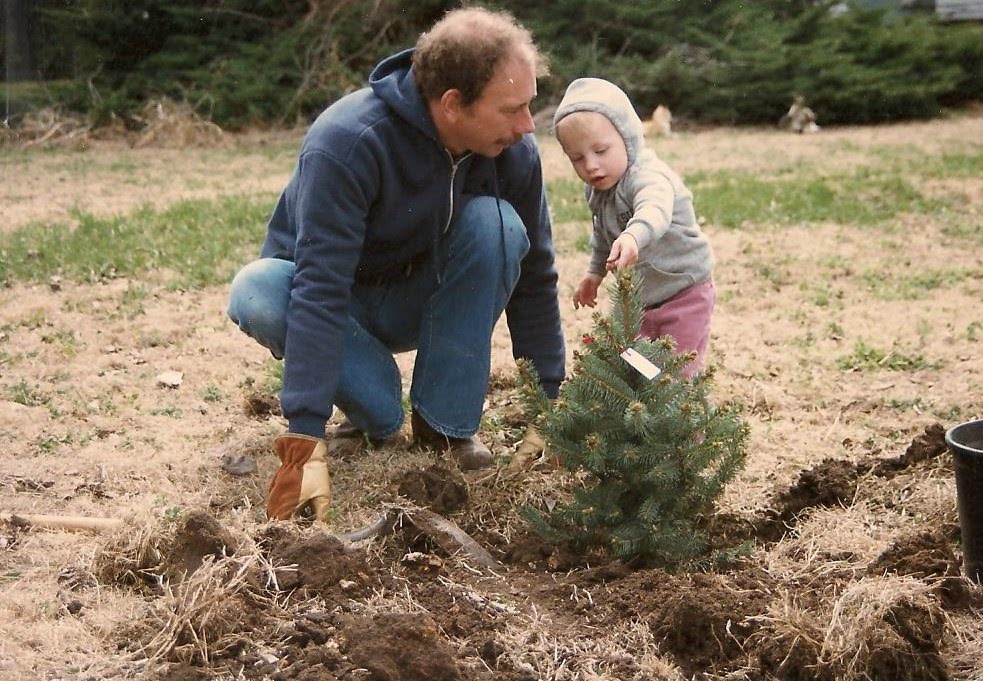
(Randy & Jill plant the blue spruce in 1987.)

Before the limbs were all cleaned up, Randy was already making plans.

"We should plant some trees," he declared. Yesterday afternoon, we were at a nursery in Hutchinson exploring our options. Pines are not recommended in Kansas any longer. But we could choose blue spruce, autumn blaze maple or willow oak.

This is a big decision. These trees will be our legacy to future generations.

So, just like the members of the Johnson family who homesteaded this part of the prairie in the 1880s, Randy is sure to leave behind a tree or two for another generation to enjoy.

Trees are your best antiques.
~Alexander Smith


Amen.

(This tree in the backyard is home to our swing. It is still alive, well and looking good after a haircut.)

Friday, May 14, 2010

Saying Goodbye

(This was the tree outside my kitchen window.)

We are saying goodbye to some faithful old friends here on the County Line.

On Wednesday and Thursday, four trees were cut down and hauled away. They had stood through ice storms, hail and high winds. They had weathered bitter, zero-degree winters and hot, 100-degree summer days. But they couldn't win the fight against pine wilt and old age.

We have lived here for almost 25 years. Our house was built in the 1940s, but this farmstead was originally settled in the 1880s. We presume the trees were planted soon after the farmstead was established.

So for 125-plus years, the pines have given shade and offered protection from the Kansas winds for the County Line. It's sad to see them go.

They fought the good fight.

(The pine trees to the left of this photo never greened up this spring.)

The first day started out foggy, almost like Mother Nature was crying to say goodbye to some of her faithful minions. It cleared off for a little while but was again overcast and dreary by the time the crew arrived to begin dismantling the trees.

The early settlers to Kansas didn't find many trees as they traveled across the prairie. As settlers filtered into the area, they tried to make it like the homes they'd left in Ohio, Iowa, Missouri and other forested areas to the east. The pioneers brought trees on covered wagons and gently planted, watered and cared for them. The government rewarded settlers willing to plant and care for trees with free land known as "timber claims."

We think the trees here on the County Line were planted on the original Johnson homestead claim, not a timber claim.

(The rings of time)

Kansas farmsteads today still benefit from the protection provided by majestic old trees.

(This mammoth tree probably towered 60 feet into the air. But I began to worry that it might crash into the house.)

When Jill was just a baby, Randy planted a blue spruce tree in our yard. Thankfully, that tree is thriving. It stood witness to its neighbors' demise yesterday.

When I returned from my walk, I could smell the hint of pine in the air as the tree crew ground up the stumps. But I knew the aroma would soon be gone, just like the sturdy pines.

Goodbye old friends ...