Showing posts with label Kansas farm. Show all posts

Thursday, September 1, 2022

Drought Has Calves "Moo-ving" Down the Road


 There are plenty of jokes about the hot weather:
  • It’s so hot the cows are producing evaporated milk.
  • It’s so hot chickens are laying hard-boiled eggs.
  • It’s so hot you can wash and dry your clothes at the same time.
  • It’s so hot I bought a loaf of bread, and by the time I got home, it was toast.

But, the heat and the deficit of rain are really no laughing matter. 

Kansas Drought Monitor, August 25, 2022

August continued the dry trend for 2022 in Kansas. The lack of moisture that began last winter took a toll on pasture lands this summer. Tye and Todd, who are managing and caring for our cow/calf pairs, made the difficult decision to sell calves born last winter earlier than usual. 

August 17, 2022

Typically, we don't sell calves until the following winter or spring. However, this isn't the first time that we've had to sell early because of drought.

August 17, 2022 - This was an overcast day, but we didn't get rain.

The shortage of grass in pastures had them sorting the calves from the mothers and arranging for their transport to the Farmers & Ranchers Livestock Commission Co. in Salina for the August 25 sale. This will help conserve the grass for the mama cows, who are currently carrying babies who'll be born in early 2023.

Tye and Todd have marketed their cattle through the Salina sale barn before. However, it was the first time for Randy and me. (Randy had bought some cows at the Salina sale years ago, so he'd been there. It was my first experience.)


Randy and I have always marketed the majority of our cattle through the Pratt Livestock sale barn. We took a day trip to check out the unfamiliar action and watch our calves sell last Thursday in Salina.


We got there with plenty of time to spare, so after watching the action awhile and getting the lay of the land, I turned to a familiar past-time - reading my book until it was our turn.

This was a first for Randy. He didn't help gather or sort the calves from the cows. He volunteered, but they accomplished the task without him. (As hot as it was, he ended up being OK with that.)

The calves averaged 454 pounds apiece. The steers averaged 476 pounds and the heifers averaged 443 pounds each. Randy was pleased enough with the price.

2022 is shaping up to be a historically severe year for dry, hot weather in Kansas. But, it still falls far short of the worst droughts in the state’s history. Roughly one-third of Kansas is now in extreme or exceptional drought. But nearly three-fourths of Kansas has some degree of drought.

In Dodge City, this year ranks as the 4th hottest and 12th driest on record going back to the 1870s. But Jeff Hutton, meteorologist with the National Weather Service in Dodge City, says 2022 still won’t come close to becoming the driest, hottest year in recorded history. Hutton says 2012, 1980 and 1936, still stand up as the driest and hottest years for most parts of Kansas. Hutton expects the state to get enough precipitation this fall to keep 2022 from breaking those records.

Rattlesnake Creek pasture (Big Pasture) - August 17, 2022

In an interview with the Kansas News Service, Kansas State University meteorologist Chip Redmond said frequent breaks in the heat and timely bits of moisture have kept 2022 from surpassing the records set by the most extreme years in Kansas history. That illustrates the complexity of trying to compare one bad year with another. 

“We can look at basic statistics, such as average monthly precipitation and temperature and their departure from normal,” said Redmond, who manages K-State’s Kansas Mesonet climate monitoring system. “(But) that doesn’t tell the whole story.” Based on historical data, he said, the years that top the charts for drought and heat in Kansas history came during the Dust Bowl of the 1930s — particularly 1934 and 1936 — and then in 1956, 1974, 1976, 1980, 1983, 2000 and 2011-2012."
 from Kansas News Service

Rainfall totals this year are several inches below normal across Kansas. Hays has received around 9.5 inches of precipitation so far in 2022. That’s roughly half of the 18 inches it can usually expect to bank by this time of year. Hutchinson has seen fewer than 14 inches of precipitation when it’s supposed to have more than 22 inches. Only 6.5 inches have fallen on Scott City — way less than its usual 15 inches. 

Here’s another way to look at it: How many inches of rain would a town need today in order to get back in line with its historical year-to-date average? For places like Hays, Hutchinson and Scott City, it would take more than eight inches of rain to climb out of their current deficits. Some pockets of northwest, central and southeast Kansas would need more than 10 inches of rain just to get back to average. But even with how dry it’s been this year, 2022 doesn’t come close to being the driest in Kansas history. “This year has quite a bit of work needed,” Redmond said, “if it wants to rank high.” Out of 358 Kansas weather stations measuring precipitation, none have recorded their driest-ever 40-day period in 2022. That’s compared to 46 stations that set records for their driest 40-day period in 2000, 39 that set records in 1983 and 10 that still have records standing from the Dust Bowl in 1936.

This chart from The Kansas News Service shows that we are more than 11 inches behind "normal" in Stafford County. A lack of moisture can directly fuel hotter temperatures, too. The drier soil gets, Hutton said, the faster it heats up. 

Another way to assess this year’s heat is to compare the number of days that reached 100 degrees. In Wichita, 23 days have hit that mark so far this year. Wichita’s total puts 2022 in the top 10 percent of its recorded history. But it’s still not close to breaking records. “I’ve already heard people say, ‘Oh, it’s the hottest year ever,’” Hutton said. “No, it’s not. We only have to go back 11 years to 2011.” Dodge City set a record with 50 days of 100-degree weather that year. So far in 2022, it has seen 31 days that hot.

While that doesn’t come close to touching 2011’s record, it still means that 2022 already has the sixth most 100-degree days ever recorded in Dodge City. 

I have photos from the 2012 drought and its effects on our Rattlesnake Creek pasture.

August 2012 - no water in the Rattlesnake - at the bridge
At the eastern border of our pasture - August 2012

In comparison, there was some water remaining in the creek in mid-August, though it was definitely low. 

August 17, 2022 - at the eastern border of our pasture

We did get some help with our totals on August 27. The Rattlesnake pasture got 2.4" of rain. At home, we had about 1.25". However, people who lived south of us, even as little as 10 miles, got nothing. My brother, who farms in northern Pratt County, got very little rain.

So we know how fortunate we were to get last Saturday's rain. But we'd still love to be able to order up several rainy, cool days.

August 17, 2022 - at the bridge

Thursday, August 25, 2022

Sale Day: Leaving a Lifetime of Farming


We hustled around on sale day, Saturday, August 13, for some family photos before the festivities began. Tye, who has taken over the farm ground we continue to own and who cares for our cow-calf herd in a partnership, was elected as photographer for 15 to 20 minutes worth of shots before the craziness of the day.


Originally, I had wanted some photos in the wheat field of our final harvest as active farm operators. I   had a professional photographer lined up. But it was just too hard to coordinate schedules and predict the weather. (I only knew that everyone was going to make it home a few hours before they arrived.) My second idea was having photos among the farm equipment before it started driving away or was hauled down the road.  But since school had started for the girls and for Susan the week before, it wasn't possible for them to all get here by the time golden hour rolled around the night before the sale. I knew that Randy would be addressing any issues with machinery on the day of the sale or answering last-minute phone calls about it before the bidding began. Other people were juggling plenty of other balls that day, too. Tye did a great job, and we'll save the pro shots for a time down the line. 


Jill snapped a few of Randy and me by various farm equipment. I definitely wanted one by the feed truck. I spent a lot of time in it during winters the last few years. Randy was always glad to tell any callers that his wife drove the old Army truck. One of my favorite times of the year was riding the buddy seat of the combine during harvest time. I'll miss that.

Anyway, I'll treasure these last glimpses of farm life as we've known it. We used the backdrops you'd expect - the 4-wheel-drive tractor and the combine. 

But I also wanted some photos gathered around the old 8N Ford Tractor. 

Jill also requested a photo by the relic.

I snapped a few of Grandpa with the girls.

The last time Kinley had been on that tractor was when she was a baby in her mom's arms 10 years ago.

April 2012

Randy grew up operating the Ford tractor. Our kids also got the "privilege" of putt-putt-putting down a road on the way to help build fence. While I never drove it, I certainly was part of the team that helped build miles of electric fence to contain our cattle in the fall. (Click HERE for a blog post about one fence building session.) But it, too, went on the auction block at the farm sale. 

Randy's Dad and Grandpa had purchased the Ford tractor in the 1960s. (And, yes, it started on sale day!)

Clarence (Randy's Grandpa, seated), his Dad Melvin and Randy holding Brent in 1988.

Maybe the winning bidder will restore it for parades. Or maybe they'll use it like we did, who knows?

It's amazing to think how far farm equipment has come in the time since our ancestors began farming in the late 1800s. My mom did an amazing job of photographing new machinery they've used during their 69 years of farming together.

(My dad as a toddler and his Dad)


She compiled them into history books she gave to grandchildren. (I may still have one in my dining room curio cabinet for "safe keeping.")

The evolution of technology has exploded since 1972, when Randy began farming as a high school sophomore.

This was a page from Randy's FFA project - 1972 - when as a high school sophomore, he began putting up hay on his great-uncle's ground for a percentage of the hay crop.

In the late 1990s, I compiled this collage to give to Melvin after his final harvest as an active farmer. It shows several pieces of farm equipment we used at that time.

Farm technology has evolved significantly since our marriage in 1981.
Melvin's final wheat harvest

And we certainly didn't have the ultimate examples of modern machinery, but it served our needs at a price we could afford.

Photo by Brent

The girls had to give the big tractor some equal posing time after their modeling on the 8N Ford tractor.

Randy had some restless nights in the week before sale day. He wasn't sure he'd gotten enough phone calls expressing interest in all the machinery. Would in-person bidders come? Would the people who told him on the phone that they'd be bidding online actually follow-through and do it? Would we get a reasonable value for the equipment? Would this part of our retirement plan pay out? I was not immune from the nighttime thoughts that made for some restless nights. 

But Randy was all smiles the day of the auction.


   (These moments were captured on my camera by Kinley, the budding 4-H photographer.)

Photo by Brent

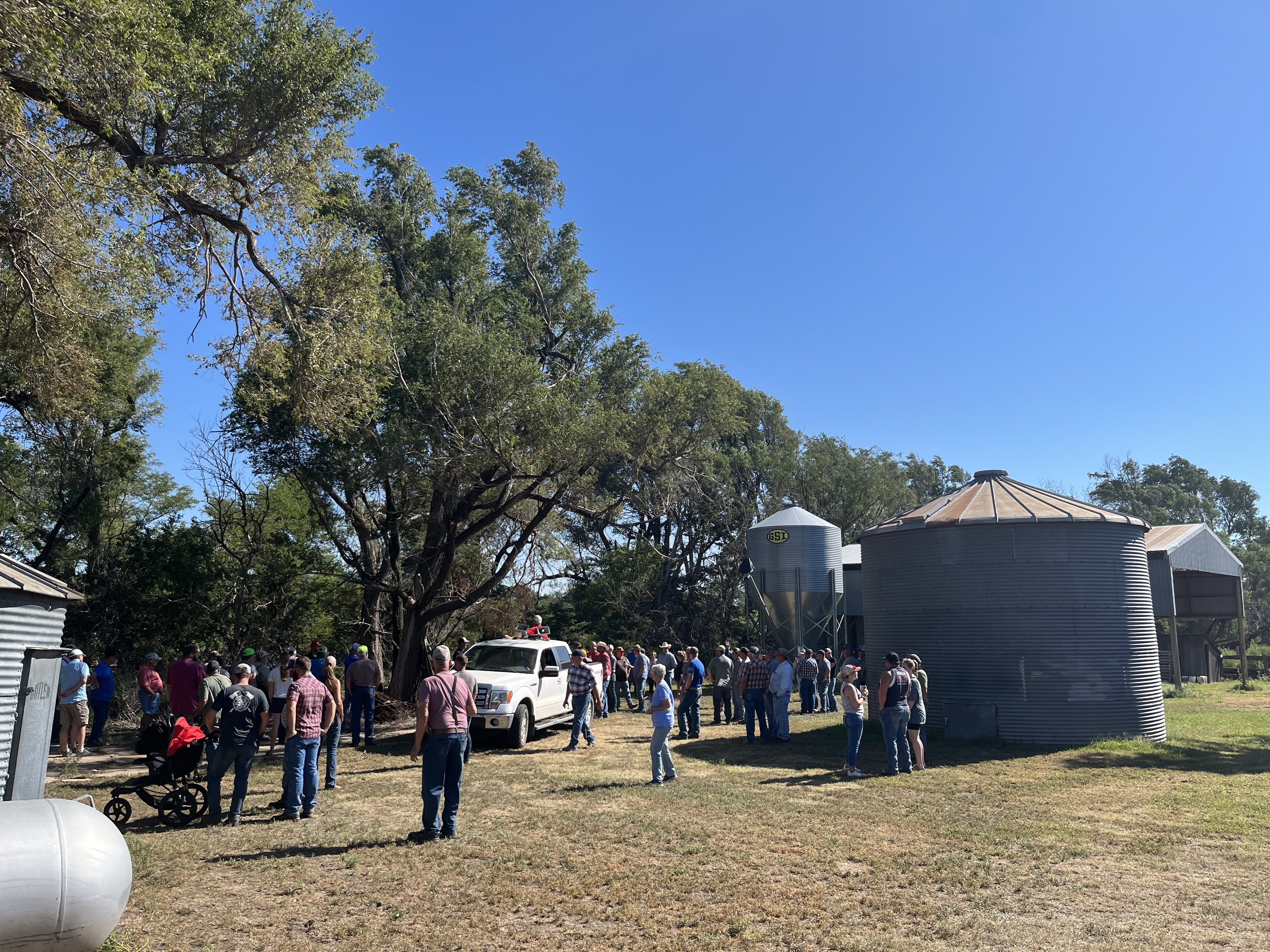
Ultimately, we were thrilled with the large crowd who arrived on sale day.

Some arrived early enough for the small "stuff" on trailers.

Photo by Brent

There was an even larger crowd for the big equipment - both in-person and online.


Photo by Andrew Webb (my brother-in-law)

The day was awfully hot, but the auctioneer with Carr Auction kept the bidding moving along well.
Photo by Andrew Webb

Some of the items began leaving the field before the auction was even over. By Wednesday, August 17, we had only a few things left to be picked up by the new owners. The combine and the drill left that day. The last pickup left last Friday (August 19). We are down to a couple of tractors still awaiting pickup.

Ultimately, this list of farm equipment left our farm to do the job at another farm on down the road. 

We also closed on Randy's folks house on the Monday following the sale, and the young couple who purchased it has already started moving in and making it their own. (Click HERE for the blog post I wrote before that sale.)

It's been a year full of emotion - highs and lows, doubts and dreams. But we feel at peace with the decision. And we're ready for the next chapter. Bring on some K-State football and some trips to National Parks this fall. (We'll add plenty of trips to see the family for good measure.)


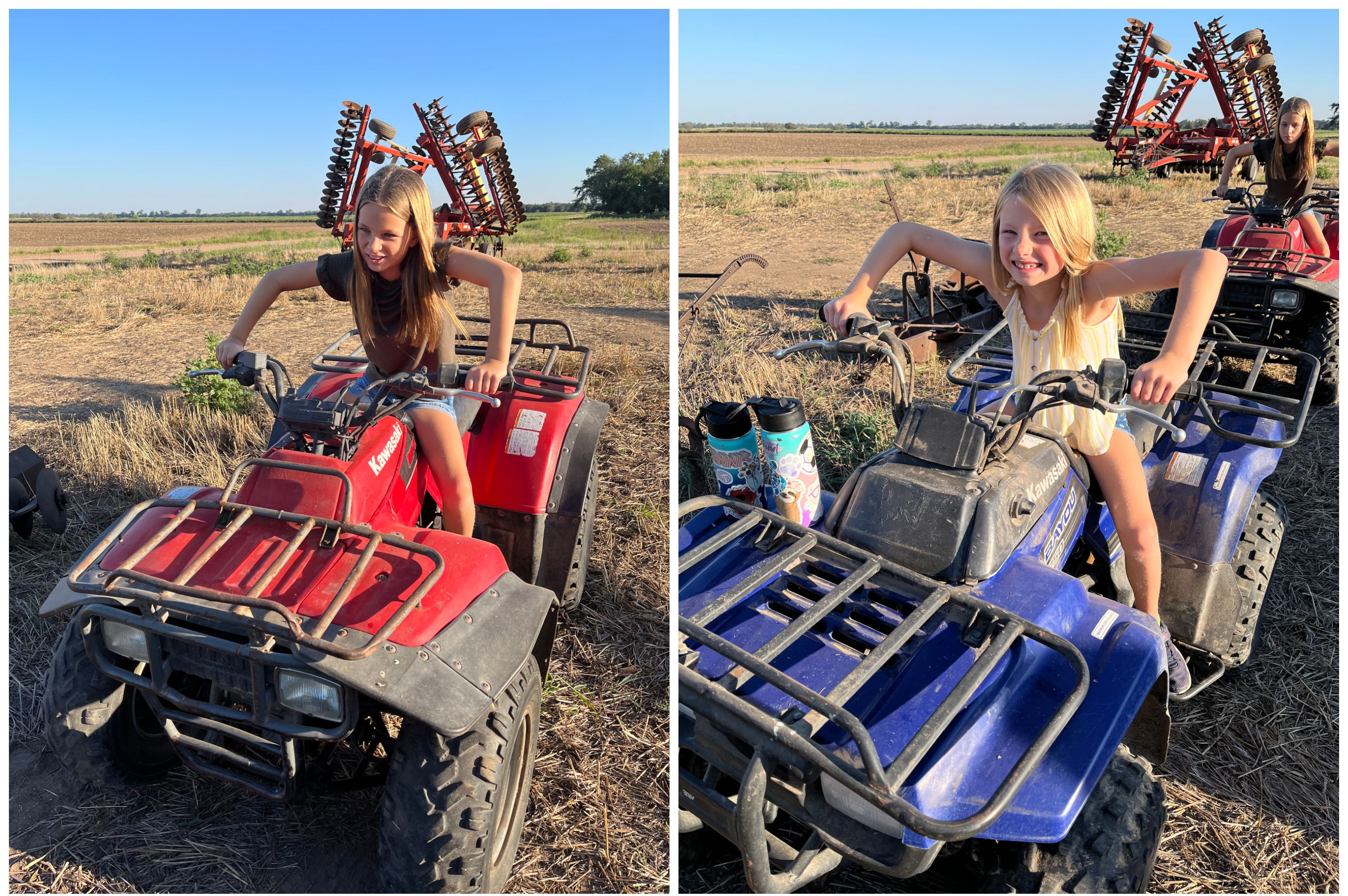
The girls were hoping that they could convince their parents they "needed" the 4-wheelers. They had ridden them for a fishing trip during a stay at The County Line last year. Alas, they'll have to settle for Grandpa's new (to us) Gator. The girls approve of Grandpa's new ride. (Uncle Brent may have given Kinley some unauthorized driving lessons on the Gator.)

Next time: Photos from the retirement party

Tuesday, October 5, 2021

Marathon, Not a Sprint: The Journey Toward Wheat Harvest 2022


The journey toward Wheat Harvest 2022 is a marathon, not a sprint. Since I've never been much of a sprinter, that's a good thing. 

We began planting our 2022 wheat crop on September 21. And we're still at it. We have had a few days hiatus, beginning last Thursday when we got 2.25 inches of much-needed rain. We got another shower last Saturday. We may be back in the field later today. The verdict is still out.

Wheat is the primary crop on our dryland farm on the Stafford/Reno County line. And this year, we're going big: Randy is planting 1,900 acres to wheat. No wonder it's taking awhile!

One of my favorite photos from wheat planting so far was taken at sunrise. The day was brand new, so there wasn't time for anything to have gone wrong or broken down yet. You gotta love a Kansas sky, and this one looked painted with "Hope" to me.


It's what keeps farmers planting the next crop and doing the next task, time and time again. Randy has been doing that for 50 years.

Here in Central Kansas, we plant winter wheat. We plant it in the fall, and then it goes dormant during the cold months of winter before coming out of its "hibernation" and growing again next spring, then maturing for a June/July harvest.

We saved some of our 2021 crop in bins on the farm to use as seed wheat. It's binned during harvest, and then we load it into the truck to take to Miller Seed Farms near Partridge for cleaning. 

 v


They treat it with Cruiser, a fungicide, which helps protect the small wheat plants from disease. It's also treated with Vibrance Extreme, an insecticide which helps keep bugs at bay. That's what gives it its pinkish tinge.


Randy uses a grain-fill auger to transfer the seed wheat from the truck to the drill.

Randy wonders if he could get a Flex Tape endorsement commercial. Flex Tape is one of the tools in his repair kit. So far, so good.


So why is wheat our primary crop? First, we don't irrigate. Wheat is more drought tolerant than corn or soybeans. While the seed genetics are getting better and helping make dryland corn and soybeans a more viable crop in this part of the state, wheat is a proven performer in less-than-ideal conditions. (Of course, we would love to have ideal conditions, but that rarely happens.)


In this part of Kansas, the textbooks say that October 1-10 is the ideal time to plant wheat. Since we can't get the whole crop in the ground during that time, we start a little sooner. Many years, we don't finish before October 10 either. 
 

As with every planting season, I think about the optimism that seems to be part of the fabric of every farmer.

 
They put a seed in the ground and then wait like a kid on Christmas morning. 
 
 
They slow down as they pass a planted field, just waiting for that first glimmer of green. And then the miracle begins again for yet another season. 
 
And through sunrises and sunsets for some nine months, we hope and pray that the crop comes to fruition.

 
This wheat crop will be our final one as working farmers. Randy plans to retire after wheat harvest next summer. So this planting time has meant some time for reflection. But even as we turn the reins over to a younger farmer, our hearts will always be tied to the land. As farmers' kids before we were farming ourselves, it's part of our DNA. And we've been working together for more than 40 years. We are blessed.