Showing posts with label selling hay. Show all posts

Thursday, April 21, 2022

The Last Load


I took this photo yesterday as a hay truck rumbled down a dusty dirt road toward another field. The photo itself is unremarkable. At that time, the skies were overcast, and the photo was shot through a dirty windshield with a cloud of dust stirred up on roads that haven't seen a rain for quite some time. It's not one of those photos that will end up enlarged in 16-by-20-inch format on my living room wall.

But it does represent the end of an era. The hay truck was on its way to one last hay field to collect our final alfalfa harvest. And, for Randy, it signaled the end of a way of life for the past 50-plus years. 

In reality, Randy has been working in hay fields much of his life - and, yes, that's longer than 50 years. Even before he was the farmer responsible, he helped as his family put up hay each summer. As is true with most "vintage" farmers, there are plenty of stories in the memory banks about bucking hay bales onto trailers and maneuvering them into hay lofts. 

But it was also a hay field where he began his "adult" farming journey. As a high school sophomore, Randy's Great-Uncle Glenn gave him the opportunity to put up hay on his ground. Randy got a share of the hay. 


Undated photo, but probably the mid-'90s. Randy with Uncle Glenn during wheat harvest as we harvested his crop. 

It was the start of Randy's own farming journey, independent of his dad. Last June, I wrote a blog post about it. (You can click HERE for the whole blog post.)

Back in the day, he used the alfalfa field as an FFA project, so we had some photos and descriptions of the experience (along with some really snazzy photos of Randy modeling clothes from the 1970s, including his letter jacket paired with plaid pants.)

Click on these images to enlarge them and read the text written by Randy for the FFA report.

As a senior, Randy won a crop production award in the South Central area of FFA. He still has the plaque on our office wall.

Sometimes, he has trucked the hay himself to various buyers. (You can read about that HERE and HERE.) However, this time a trucker with Sebes Hay out of Larned came to collect the final truckloads of the hay we harvested last summer. 


We fed some of the bales last summer, but with the Millers taking over the day-to-day care and feeding of the cattle this winter, we sold 10 loads of hay to Sebes for $150 a ton.


Randy operated the loader tractor as the truck driver gave him hand signals for placing the bales.


The process has always reminded me of a giant Jenga game - but there are more consequences with the pieces falling over when you're talking 1,500-pound bales!

No hay bales tumbled off, however. Thankfully, both of these guys were experienced in the fine art of bale stacking.

This is not the end. We still have our wheat harvest this summer and a farm sale scheduled for August. But there still were a few heartstrings tugged as we completed yet another task and the truck rumbled away.


Tuesday, March 3, 2020

Hay, Hay, Hay - Goodbye!

Have any of you been watching Lego Masters on Fox-TV this winter? Randy was more a Lincoln Log kind of guy in his youth, and we had some Tinkertoys at the Moore house. But our granddaughters love Lego Friends, so we've been enjoying the Wednesday night TV series.

Randy does his own form of building and stacking when he loads hay to sell. But the hay bales don't have those handy connective pieces. 
 
During a couple of years of drought, we barely raised enough alfalfa hay and sudan to feed our own cattle herd. Because of a lack of silage we harvested last fall, we sold feeder calves earlier than normal this year. So we had some extra hay we could sell.

Randy negotiated a price with Sebes Hay near Larned. Last December, the hay company picked up the first six loads. At the time, we were busy with other tasks, so Randy helped load the trucks, but he didn't haul it.
Since the beginning of the year, Randy loaded five loads of alfalfa on our own hay trailer and semi and hauled it to Larned. The price this year is "middle of the road," according to Randy. Last year, the price was almost double because of both drought and flooding - too much and too little of a good thing.
 
Photo from from the County Line archives. It was taken from the combine for a bird's-eye view!
After the alfalfa is baled in the summer, we stack it in rows near the road.
 
When we're ready to load the truck, Randy goes to those stacks and removes the bales one or two at a time. Then he places them two-across on the flat-bed trailer.
 
It's kind of like building with Lego. You just keep adding "pieces" to the "design."
 After the bottom rows were in place, he added another layer, positioning the upper deck in the "groove" between two bales.
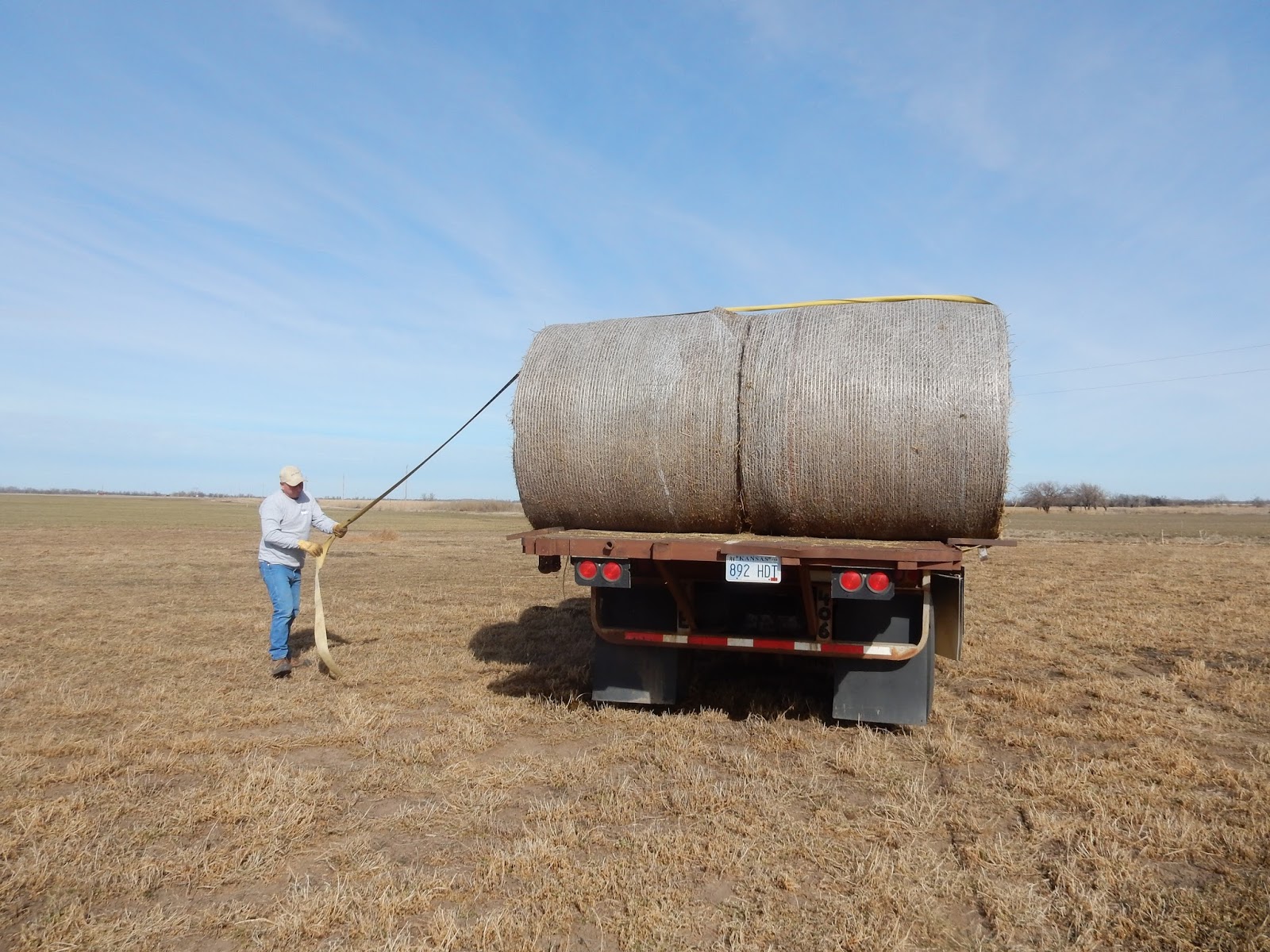
Randy straps down the bales so they stay in place. It's a good thing he's not afraid of heights!
 
He attempted to use the wind to his advantage, so it could help boost his throw. (It's probably good I don't have a video of this part!)
This series was taken when he was tying down the back bales before adding the top layer.
During the trip, these metal braces also help support the bales on the trailer. 
Randy added Wide Load signs to the front and back of the truck, along with flags on the front and back bales.
Once at Larned, he weighed the truck and then took it to the unloading area. Most of the time, a Sebes Hay employee off-loaded the hay. Then, he weighed the empty truck before returning home. (It didn't work into my schedule to go with him this year. Here's a link to a blog post from a trip to a Dodge City feedyard from 2015 that shows that process.)

Each truck averaged 25 tons, with bales weighing at at an average of 1,500 pounds apiece. Sometimes, we sell even closer to home. A neighbor who usually buys didn't need any this year. So we had a little more to sell.

Now that the hauling job is done, it's on to another project. And, hopefully, we'll again be stockpiling hay during the summer. 

Friday, February 3, 2017

In Its "Hayday"

Randy uses the loader tractor to place hay bales on the truck bed.

hey·day

/ˈhāˌdā/

noun
1. the period of a person's or thing's greatest success, popularity, or vigor: "the paper has lost millions of readers since its heyday in 1964" synonyms: prime, peak, height, pinnacle, summit, ...
After the bottom level is loaded, he ties down the front and back bales.
We may not be in our "heyday."
But we've been in our "hay day" all this week.
The guys have loaded a semi with round bales of hay, then trucked it to Sebes Hay LLC near Larned every day this week. We feed the majority of the alfalfa we raise, though we do sell what's not needed for feeding to our cow-calf herd and the feeder calves that we retain during the winter months.
It's a good thing Randy isn't afraid of heights!
Randy has sold 12 semi loads. Today, they will truck the 8th of the 12 loads and will load the 9th. Each semi load has 34 bales and weighs in at roughly 25 tons or 50,000 pounds.
It's important to get the bales firmly tied down to the truck bed for their 45-minute trip to the hay mill.
It takes longer to load the semi than it does to transport it. On average, it takes 11/2 to 2 hours to get the truck loaded and tied down.
To me, it resembles a Jenga game, strategically placing items in an effort to keep them upright. But we definitely don't want them to fall down.
 
Randy picks up each bale in the grapple fork on the loader tractor.
He then deposits it on the trailer bed, placing the second layer of beds in the groove between the two bales below it.
This shows the net wrap on top of a bale - just a different perspective.
When we were in a drought a few years back, we barely raised enough alfalfa hay and sudan to feed our own cattle herd. But with good rainfall last summer and the hay crop it produced, we have extra hay to spare.
I am glad that Randy does the loading. It takes a steady hand to exert enough pressure on the loader for the bale to stay in place but not push the one off on the other side!
Once all 34 bales are loaded, it takes teamwork to get the straps died down. This time, Ricky was on top of the trailer and threw the tie-down straps down to Randy.
Randy hooked the straps onto the trailer bed.
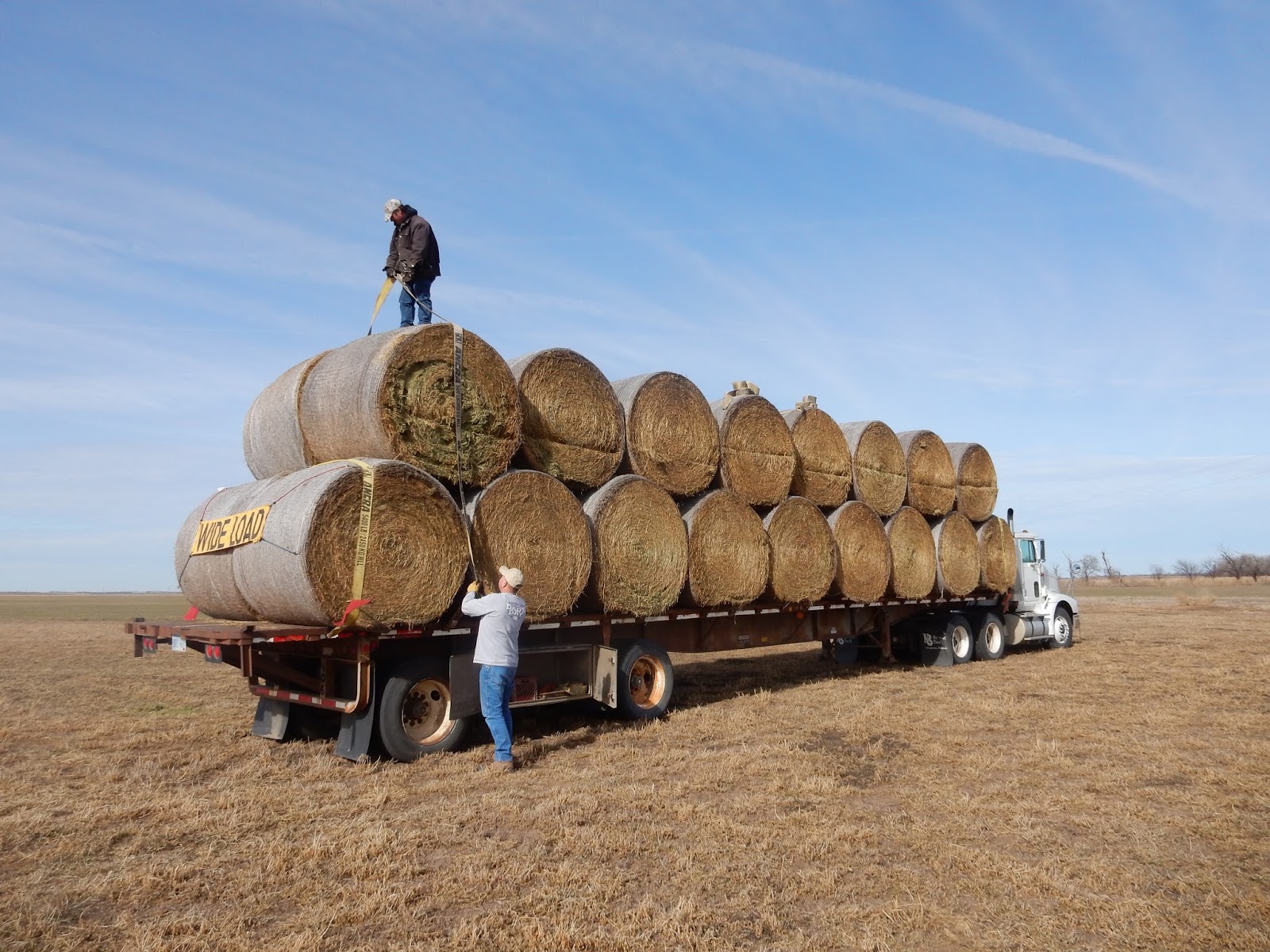
And they continued the process down the length of the trailer.
The guys also add safety flags. The flags are on wooden poles that get stuck in the bales.
(Note to self: Maybe some new flags would be a good Father's Day gift!)
Most of the time, Ricky has been hauling the load to Larned, so I haven't gone along to document that part of the process. Once there, he weighs the truck and then takes it to the unloading area. Most of the time, a Sebes Hay employee has off-loaded the hay. Then, Ricky weighs the empty truck before returning to the field for another load.
More Wide Loads ahead!

For more about harvesting hay on the County Line, please click this link.

Though I haven't been on a delivery run this year, click here to learn a little more about that process. (It's a different hay mill, but the processes would be similar.)