Showing posts with label hauling hay. Show all posts

Tuesday, March 3, 2020

Hay, Hay, Hay - Goodbye!

Have any of you been watching Lego Masters on Fox-TV this winter? Randy was more a Lincoln Log kind of guy in his youth, and we had some Tinkertoys at the Moore house. But our granddaughters love Lego Friends, so we've been enjoying the Wednesday night TV series.

Randy does his own form of building and stacking when he loads hay to sell. But the hay bales don't have those handy connective pieces. 
 
During a couple of years of drought, we barely raised enough alfalfa hay and sudan to feed our own cattle herd. Because of a lack of silage we harvested last fall, we sold feeder calves earlier than normal this year. So we had some extra hay we could sell.

Randy negotiated a price with Sebes Hay near Larned. Last December, the hay company picked up the first six loads. At the time, we were busy with other tasks, so Randy helped load the trucks, but he didn't haul it.
Since the beginning of the year, Randy loaded five loads of alfalfa on our own hay trailer and semi and hauled it to Larned. The price this year is "middle of the road," according to Randy. Last year, the price was almost double because of both drought and flooding - too much and too little of a good thing.
 
Photo from from the County Line archives. It was taken from the combine for a bird's-eye view!
After the alfalfa is baled in the summer, we stack it in rows near the road.
 
When we're ready to load the truck, Randy goes to those stacks and removes the bales one or two at a time. Then he places them two-across on the flat-bed trailer.
 
It's kind of like building with Lego. You just keep adding "pieces" to the "design."
 After the bottom rows were in place, he added another layer, positioning the upper deck in the "groove" between two bales.
Randy straps down the bales so they stay in place. It's a good thing he's not afraid of heights!
 
He attempted to use the wind to his advantage, so it could help boost his throw. (It's probably good I don't have a video of this part!)
This series was taken when he was tying down the back bales before adding the top layer.
During the trip, these metal braces also help support the bales on the trailer. 
Randy added Wide Load signs to the front and back of the truck, along with flags on the front and back bales.
Once at Larned, he weighed the truck and then took it to the unloading area. Most of the time, a Sebes Hay employee off-loaded the hay. Then, he weighed the empty truck before returning home. (It didn't work into my schedule to go with him this year. Here's a link to a blog post from a trip to a Dodge City feedyard from 2015 that shows that process.)

Each truck averaged 25 tons, with bales weighing at at an average of 1,500 pounds apiece. Sometimes, we sell even closer to home. A neighbor who usually buys didn't need any this year. So we had a little more to sell.

Now that the hauling job is done, it's on to another project. And, hopefully, we'll again be stockpiling hay during the summer. 

Friday, April 15, 2016

Hay? Did We Make A Tactical Error?

With apologies to the real nursery rhyme author ...
Rain, rain, come today!
And come again another day!

A few TV meteorologists lament that rain may ruin weekend plans, and I talk under my breath as if they could hear me, "Oh, please let it rain this weekend!"

It may disrupt someone's golf game or trip to the park, but we need rain in Central Kansas. Some Kansans were lucky enough to get some rain earlier in the week, but it missed us again.

This week's drought monitor shows we are in moderate drought, and much of the rest of the state is abnormally dry. So if a golf game or outdoor cookout gets canceled this weekend because of widespread rain, forgive me while I celebrate!


Since we are totally a dryland farm, we haven't planted any corn yet because of the dry conditions. And this week, Randy started worrying about having enough hay for cattle. He had already contracted to sell two more semi-trailer loads of hay to a feedlot near Larned. As the guys loaded the second truck this week under sun-filled skies, he began second-guessing his decision to sell.

If it doesn't rain, we will have to delay moving cattle to summer pasture. We don't have a lot of this year's alfalfa bales left. So, if the cows have to stay home for awhile, they will be eating leftovers - leftover sudan bales and leftover silage. Let's hope they like leftovers!
After lamenting the possibly premature hay sale, Randy decided we'd move some cattle today and tomorrow, "ahead of the rain."

Oh, there's my resident optimist! He was only momentarily absent. 

Tuesday, October 27, 2015

From Bloom to Bale to Back of the Truck

The snapshot told the story: From alfalfa bloom to bale to back of the truck, another Kansas crop was completing its life cycle.
Last week was haying moving week. We will feed the majority of the alfalfa, sudan and silage we raise to our own cattle, but Randy markets the extra hay through Sunflower Trading, a division of the Kanza Co-op. So far this year, he has contracted seven loads to Morrill Hay Company near Larned.
  
After we added a semi to our farm fleet, Randy bought a hay trailer from our neighbor. Both Randy and Jake got their Commercial Driver's Licenses (CDL), so this is the second year we are hauling the hay ourselves.
Photo from June 2008
After the alfalfa is baled in the summer, the guys stack it in rows near the road.
Jake picked up the bales, two at a time, and then brought them closer to the truck.

Then he puts each bale individually on the trailer, placing them two across on the flat-bed. It's kind of like building with Legos. You just keep adding "pieces" to the "design." Unfortunately, there are no handy connective pieces to keep everything stuck together like Legos.
After the bottom rows were in place, he added another layer, positioning the upper deck in the "groove" between two bales.
Last winter, the guys painted a white stripe down the middle of the flatbed trailer. That helps give a visual marker for getting the load centered. 
This particular load was a little smaller because it finished out the field.
This year, the bales are lighter in weight. They are also worth less. This year, we are getting $70 per ton, while last year's high was $130. Much of last year's crop was sold at $110.
The price difference can be attributed to availability. This year, western Kansas has gotten more rain, so there's more alfalfa available. In addition, feed grain prices are down, making alfalfa worth less, too.
Once the bales were in place, the guys strapped them down.
Jake lifted Randy in the tractor bucket to place the straps over the top.
This is not the photo op your wife wants, believe me!
But they got it all strapped down with no mishaps and no insurance claims. Success!

Last year, we didn't sell any extra hay until February, so the photos weren't nearly as pretty as those on a beautiful fall day.

Friday, April 17, 2015

Curiosity and the Cattle

We all know what curiosity is said to do to cats. The cattle evidently haven't heard that cautionary tale. I know from experience that they are curious creatures, too.

I didn't really have time to spare on my way to a meeting. But the cattle lined up along the pasture fence caught my eye, so I had to stop. (Even though I backtracked from the corner after telling myself I should just go on, I made it on time!)

The cattle were watching Randy load alfalfa bales on the semi for a trip to a Dodge City feedlot. Randy's theory is that they were wishing he'd feed them those good alfalfa bales instead of the sudan ones that were in the feeder at that moment. 
But I know that they sometimes run to the fence to check out a passerby on a morning walk, too.
Whatever the reason, they made me smile. (Not getting the cattle and the tractor in the same photo frame didn't. Well, I got one, but it was blurry. That's what I get for hurrying!)

Tuesday, February 3, 2015

Big Rig Journey

When you live 11 miles from town, road trips are a fact of life. However, my road trips don't usually involve hoisting myself up into a semi truck.

This past year, we added a semi truck, grain trailer and flatbed trailer to our farm fleet. It gives us the ability to haul grain and hay to markets.

Our usual trips are hauling grain just a few miles away to the Zenith branch of the Kanza Co-op. But transporting our hay to a customer has lengthened the journey.
I recently went along for the ride as Randy delivered a load of hay to Maverick Feeders, just east of Dodge City.
It looked like they had a fair amount of hay already in place.
These were sudan bales. We brought alfalfa bales, so they went in a different place.
Once we weighed the load at the scale house, Randy pulled the truck to an unloading area and started releasing the tie-down straps. (See how the hay was loaded in this post.)

Then the feedlot's front loader operator began removing the alfalfa bales, one at a time, from the trailer.
He put each one in a pile near the feed mill.

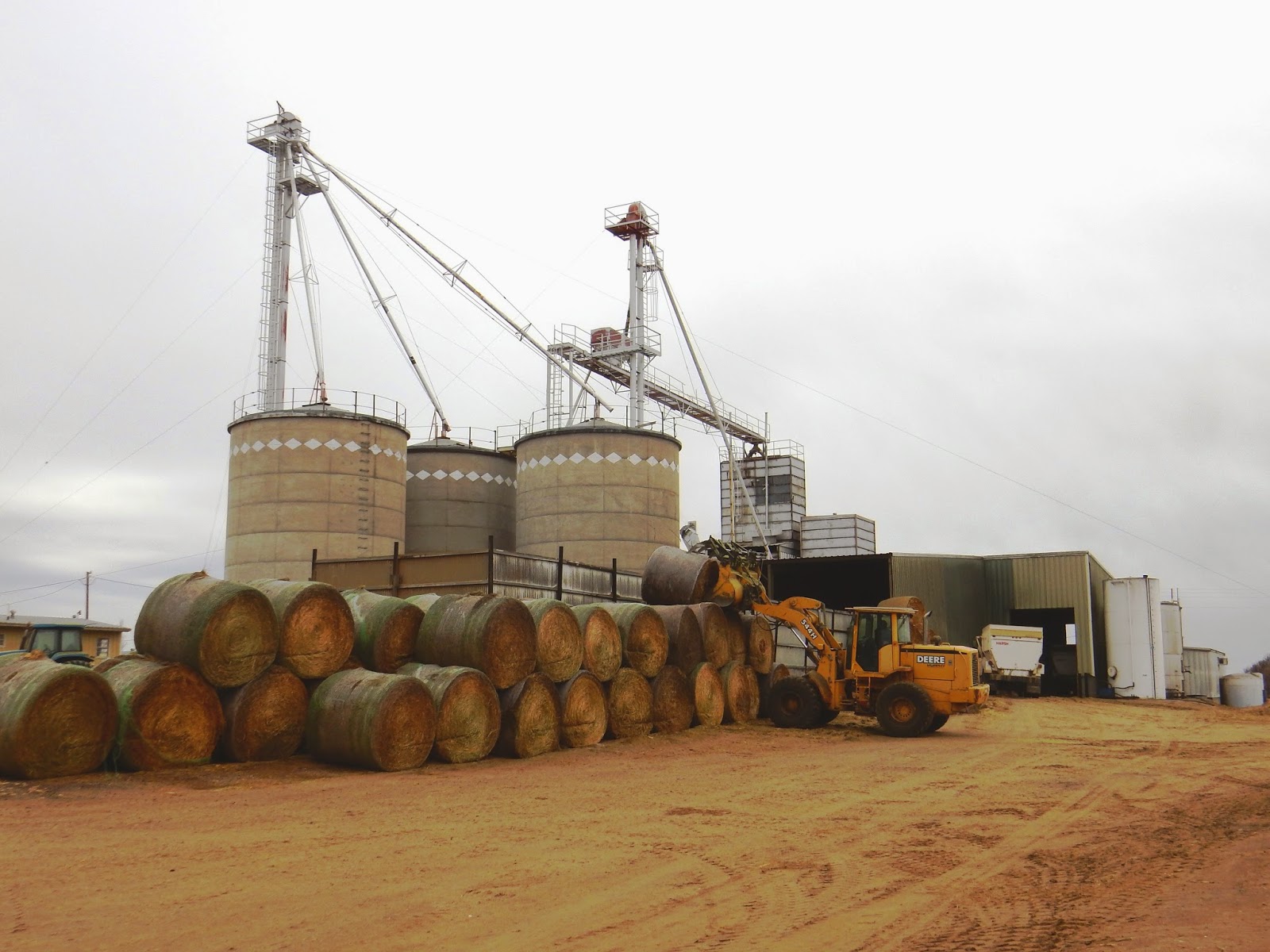
Inside the mill, they prepare a ration for the cattle. It includes ground hay, corn (stored in the silos), molasses (stored in the white tanks to the far right of the building). They also add wet distiller's grain (the yellow "pile" in the foreground of the photo at the lower right.)
In this photo, you can see the feed truck ready to go into the feed mill. You can also see the molasses tanks to the right of the mill. In the lower left photo, you can see ground hay. The yellow substance in the right photo is wet distiller's grain.
The feed truck dispenses the ration into troughs for the cattle to eat.

While the feedlot unloaded our hay, Randy worked on rolling up the straps, then stored them in the compartment between the tires.
We stopped again at the scale house for an empty weight. We had delivered 75,540 pounds of hay in the 30 bales we took to Maverick. Our maximum weight for this split-axle trailer is 85,000 pounds.
I must admit that I often read a book when I'm the passenger on a road trip. I didn't crack the cover this time. I was too busy watching the road and the scenery.
Out the front window ...

... or out the back.

And, if I'm totally honest, it also makes me a little nervous. I had thoughts of the bales rolling off onto the highway behind us, despite watching the guys carefully tie them all down. Since that didn't happen, I guess the journey was a success!