Showing posts with label small town living. Show all posts

Thursday, March 9, 2023

76 Years in the Making: A Trip to State Basketball

Window at Main Street Market, our hometown grocery store.

The last time Stafford High School earned a trip to the state basketball tournament, Harry Truman was president. The future queen of England was still a princess when she married her prince. World leaders were contemplating the Marshall Plan after World War II.

The year was 1947. 

And in 2023 - 76 years later - we are back again. Today, the Stafford Trojans play the South Central Timberwolves in the KSHSAA Class 1A, Division II, basketball tournament. It will be at 4 PM this afternoon on the Barton Community College court at Great Bend.

What was going on in 1947? According to Baby Boomers, here's a smattering:

Getty Images - President Harry Truman signs the Marshall Plan

  • President Truman formulates "Truman Doctrine" of providing aid to countries whose governments are threatened with overthrow
  • U.S. Secretary of State George Marshall calls for a European recovery effort, popularly called the "Marshall Plan."
  • Britain’s Princess Elizabeth marries Phillip Mountbatten, Duke of Edinburgh

BUSINESS & ECONOMY:

  • Henry Ford dies, leaving behind a fortune of over $600 million
  • Americans are able to purchase the first new cars manufactured since the beginning of World War II

SCIENCE & TECHNOLOGY:

  • First airplane to break the speed of sound
  • Transistor invented at Bell Laboratories
  • Holography invented
  • "Broad spectrum" antibiotic introduced to fight typhus

Getty Images
SPORTS:

  • World Series:New York Yankees over Brooklyn, 4-3 (first televised World Series)
  • Jackie Robinson becomes the first African-American player in a major league baseball team (Brooklyn Dodgers)

ARTS & ENTERTAINMENT:

  • Movies: Gentleman’s Agreement, Miracle on 34th Street
  • TV Shows: Kraft Television Theatre, Small Fry Club (programming limited to approximately 18 hours per week)
  • Tennessee Williams’ A Streetcar Named Desire wins Pulitzer Prize

EVERYDAY LIFE:

  • More than 1 million veterans enroll in college through the G.I. Bill
  • First food processors
  • The average cost of a loaf of bread was 13 cents

FUN FACTS:

  • First documented sightings of "flying saucers"
  • Drive-in theaters become a booming industry

And, in Stafford, Kansas, USA, the Stafford High Trojan boys' basketball team went to the KSHSAA State Basketball tournament.  

The first state basketball tournament under the direction of the KSHSAA was at Emporia State Teachers' College in 1912 and was won by the Reno County High School team of Nickerson. All teams competed in one class until 1925, at which time all schools with enrollments of 200 or fewer were placed in a new division, Class B. In 1941, a third division was added and the schools were divided into three classes: AA (largest schools), A and B (smallest schools).

In 1945, the schools voted to go back to the pre-war plan of three separate state tournaments of 16 teams each. In 1947, Stafford High went to the Class B tournament in Hutchinson, where Inman High was crowned champion. Other champions in 1947 were: Class AA, Wellington High; and Class A, Buhler.  (Other KSHSAA state basketball history is available HERE.)

It was before the grandparents of SHS's current players were even alive.  Some of our friends have grandsons on the team. While we don't personally have family members competing, we've been following this group of seniors since junior high. We were among several fans who went to another league school (my alma mater) to watch them win the League Championship when the current seniors were 8th graders four years ago.

Several people have been sharing this photo on Facebook from their 8th grade year. This particular photo was taken by Jami Downing.

Today, those same guys - and a bunch of their friends - will take to the court at Barton Community College for the KSHSAA 1A, Division II, state basketball championships.

Photos by Nicholas Minks, who coached them as 8th graders and has taken amazing photos of their high school careers.

We - along with a bunch of other Trojan fans - drove to Ransom, more than 2 hours away, to watch the sub-state tournament last Friday and Saturday. It was worth every moment in the car.

Just ask the guys' coach. 

My photos aren't as good as Nick's, but they did capture the joy.

Stafford High has had wrestlers go to state championships, including Randy and several of his high school buddies. When Jill was an 8th grader, the high school girls' volleyball team earned a spot at state. 

You celebrate big when it's been 76 years since you've done something. Businesses in town have signs on their windows. Elementary school classrooms made posters to encourage the team. The after-school program made signs, too. 

Photo from STARS After School Facebook page

There was a welcome home impromptu parade last Saturday night when the team returned to town. There was a pep rally as school started this morning, and there's a send-off this afternoon down Main Street. 

Yeah, it's just a game. But it's really so much more. These are good kids off the court, too.

Above, I shared that photo Jami took four years ago. And while it's fun to see how those "little boys" have grown into young men about ready to tackle the world away from high school, I was also struck by what she wrote four years ago:

 ... They support each other, build each other up and want each other to succeed. They are hungry for success and they have been bringing their best every game this season.  But most importantly, they are just really good kids! I’ve been telling people for the last couple years just how fun they are to watch and encouraging anyone I can to show up and see it for themselves. I always add, that as fun as they are to watch and as good as they are on the court, they are such good kids off the court too. That alone, makes them a force to be reckoned with. 
 
As Maya Angelou said, “People will forget what you said, people will forget what you did, but people will never forget how you made them feel.” That is so true for this group of boys and the leadership and friendship they have given the rest of the boys on their team. They have encouraged the younger boys to step up, never give up and play with heart. They included them in every victory. Whether or not they played a second, they showed them what being a team was all about! They told them and showed them, but they truly made them feel it, and they won’t forget that! 
 
These boys are great role models on a team, in our school and in the community. It takes a village, and I. for one, am so very proud to have them in mine! I couldn’t ask for a better group of kids to be role models to my boys, and I will always appreciate the genuinely great kids that they are! I look forward to watching them continue to grow, the best is yet to come!
 

The best was yet to come! So GO TROJANS! I'm guessing half (or more) of Stafford will be in Great Bend this afternoon. We will! 

 
*** 

Team Effort

Reunion - 2011 - Skyline girls' basketball
 
I do have a little experience with state basketball tournaments on the girls' side. The KSHSAA Girls' Basketball championship wasn't added until 1973. I was a champion bench sitter on Skyline's team, and we won the first-ever Class 1A tournament. 

We won again the following year, and we made a trip to state my senior year, 1975, and placed third. Skyline won again in 1977, when my youngest sister was part of the team.

I wrote this blog post in March 2011 about KSHSAA's celebration of 100 years of service to member schools. State basketball winners of the past were recognized and Skyline girls showed up - including the bench sitter.

But as my dad always said, there is value in those people who practice against the stars every day, too. So, to all the SHS basketball players who likely won't get on the court during the game today: I see you. And you're important, too!
 
Click HERE for the blog post, Team Effort.  It echoes what Jami said about being a team - whether you're the star or not.

Tuesday, January 17, 2023

Loving Our Library


Our hometown library is undergoing a renaissance. 

In October 2021, the Preserving Nora's Legacy fundraiser began. The goal was to raise money for restoration projects at the Nora E. Larabee Memorial Library. A dedicated group of volunteers dreamed big. They called their neighbors. They called their classmates. They sent letters. They talked about their dreams at civic clubs and in the local grocery store aisles. They wrote grants. They talked some more. 

And the community responded, raising more money than even those big-dreaming volunteers thought possible in a little town during uncertain times. A Wall of Giving - Preserving Nora's Legacy - was recently installed at the library. (Thanks to local artisan Robert Owens for his beautiful work.) It includes the names of those who donated at least $100 to the project. 

This photo is by "courthouselover" on Flickr. Currently, they are working on the front door replica and the yard was torn up as crews worked on the foundation, so I didn't take my own photo.
And I took this photo in 2014. (We could sure use the moisture from that snow!)

The Preserving Nora's Legacy Facebook page appropriately uses a children's book analogy to symbolize the volunteer's efforts: "I think I can, I think I can..." It's a book we all read as children, whether it was in the basement children's room at the Larabee Library or from a library in another town or sitting on our mother's lap. And, we, like that Little Engine That Could, dreamed about doing big things.

I can't help but think of the people who originally gifted the library to the city. They were certainly big dreamers as well. The Larabees left quite a footprint in Stafford - in banking, flour milling and civic leadership.

Nora Larabee was the only daughter of two of Stafford's leading citizens, Mr. and Mrs. J.D. Larabee. When Nora died of tuberculosis in 1904, her parents wanted to build a tribute to her. In 1906, they erected a red brick building at a cost of $5,000. Nora Larabee's portrait in stained glass dominates one of the library's west windows.


The building was designed by Charles E. Shepard, a leading architect in Kansas during the first part of the 20th century. At that time, most libraries weren't designed by architects. But he envisioned the dark red brick building in a Corinthian style. The Larabees and Shepard also cooperated on a bank building in Stafford at Main and Broadway. (It is currently one of the buildings used by the Stafford County Historical Society.)


 The library hasn't been without controversy:

      The library is unique as a focal point in a 1907 feud between the town banker and The Stafford Courier editor. The building became a public library only after a controversy which turned the town upside down. Public sentiment about the library was so strong that the entire Stafford City council and mayor resigned before the deed for the building was finally accepted. The condition of the deed that caused the furor read as follows: "Owing to certain unwarranted attacks made by The Stafford Courier…it is made a condition of this deed that the present editor of said newspaper, nor any of his family shall at any time be a member of the said board of directors."
        Finally, in May of 1907, a petition from Stafford citizens requested the library council to either accept the conditions of the deed to the library or resign. The new city council voted to accept the building from the Larabee family along with the stipulation that the editor of The Stafford Courier and his descendants be barred from membership on the library board in perpetuity.
Information from http://skyways.lib.ks.us/towns/Stafford/libhist.html

Besides the individual donors, the library received monies from the Heritage Trust Fund grant program from Kansas State Historical Society.

The renovation projects include:

  • Trenches were dug and pipes were laid to carry water from the downspouts away from the building to the curb. The trenches are now back-filled, the sidewalk replaced, the lawn graded and leveled and grass sown.
  • The interior basement walls got a functional facelift; the bricks and stone were re-pointed with the historically-correct mortar "recipe."
  • The exterior will be spot-repointed and masonry reconstruction will restore a portion of the north wall.
  • The historic door was irreparable, but a master craftsman is working on a new replica that will incorporate the original beveled glass.
  • The electrical system has been updated.
More projects listed on the architect’s report of 2017 are now under consideration by the board and committees. Topics under discussion are:
  • Updating entries, steps and one bathroom to meet ADA-compliance recommendations.
  • Making the envelope of the building safe and secure, specifically windows. 
  • Front step renovation.
  • 4 windows (double-hung and beveled glass surround), stained glass windows around Nora's portrait window, trim repair/painting, replacement of overhead light fixtures in two original rooms, and baseboards.
The stained glass window isn't the only unique feature of the library. Many of the other windows feature leaded glass. (Even though it doesn't show the woodwork, I like the angled view below because I could avoid the storm siren and the power lines you see when you look out the window directly.)
The windows are encased in beautiful original woodwork.
This photo also shows one of the pieces of 100-year-old Mission-style furniture in the library. It's a photo I took in 2014. 


Photo taken January 2023

The library remains today, more than 100 years after it was constructed as a memorial to honor a beloved daughter. 

It's not just the building that's undergoing a renaissance. During the past couple of years, the library has added a First Friday event to its programming in the spring, summer and fall. They've featured artists, musicians, photographers, magicians, a car show, readers, crafts and much more. 

The library also offers classes and other special events, along with summer reading for children and adult reading programs all through the year. In fact, I picked up my next contest sheet when we were at the library the other day.

(NOTE: I took some of the photos of the library in 2014, when there was snow on the ground.)

Tuesday, May 29, 2018

Innovation not Stagnation: Discover Kansas

Scott County, Kansas (April 2018)
Not long ago, a headline popped up on my Facebook feed:

Rural Kansas is dying. I drove 1,800 miles to find out why.

It was an article in The New Food Economy. The subtitle claimed: A native Kansan returns home to find that the broken promises of commodity agriculture have destroyed a way of life. 

OK. That made me squirm. After all, I've been a resident of rural Kansas all my life, and I'm involved in commodity agriculture. So the author is talking about me and a lot of other people like me.

You may have seen the article, too. Several of my Facebook friends linked the article to their own timelines. Most of them went on to explain what they were doing to help their own small Kansas towns thrive. Our son, Brent, read the article and sent it to me, too, to make sure I'd seen it, and we had a good conversation about it.
Photo courtesy of Millie Dearden
Ironically, the article was making the rounds at about the same time that Randy and I went on a field trip to Scott County with our Kansas Master Farmer/Master Farm Homemaker group. I couldn't help but wonder what the author of the article would have thought had she visited Scott City.

I also came away with the same thought I usually have after reading how modern farming practices are destroying rural America: How is it that farming is the only business that is supposed to exist in a time capsule? Why do some consumers want us to farm like our ancestors did 100 years ago? And isn't it interesting that these same people are espousing their views from the latest cell phone or computer while eating what they want, when they want to?

In 2011, Scott City was designated an All-American City. Their economic development tagline is: "We've Invested Millions in Ourselves." More than $80 million in capital improvements have been made in the county during the past decade, including a state-of-the-art hospital. Now, they are addressing the need for assisted living options for the aging population. Building houses for young families is another priority. "Come Thrive With Us," they say in one of their full-color brochures.

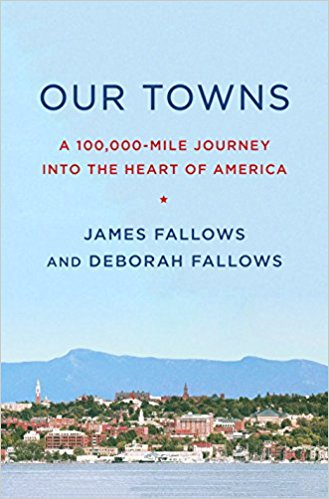
Shortly after we returned from Scott City, we also watched a segment on CBS Sunday Morning. In it, they interviewed James and Deborah Fallows, the authors of Our Towns: A 100,000-Mile Journey into the Heart of America.
For the last five years, the Fallowses have been traveling across America in a single-engine prop airplane, visiting dozens of towns. They met hundreds of civic leaders, workers, immigrants, educators, environmentalists, artists, public servants, librarians, business people, city planners, students,and entrepreneurs to take the pulse and understand the prospects of places that usually draw notice only after a disaster or during a political campaign.

They came to a different conclusion about rural America. James Fallows said this:
"Americans don’t realize how fast the country is moving toward becoming a better version of itself."
Wow, a glimpse of optimism from a national journalist! Fallows, who writes for The Atlantic magazine, wrote a portrait of the civic and economic reinvention taking place in America, town by town and generally out of view of the national media. (I've signed up for the book from my library, and I'm anxious to read it when my name gets to the top of the reserve list!)

The Fallowses acknowledge the problems rural America face, but they also found people who are  crafting solutions on the local level. They found people with energy, generosity and compassion, dreams and the determination to make things better.
America is becoming more like itself again. More Americans are trying to make it so, in more places, than most Americans are aware. Even as the country is becoming worse in obvious ways—angrier, more divided, less able to do the basic business of governing itself—it is becoming distinctly better on a range of other indicators that are harder to perceive. The pattern these efforts create also remains hidden. Americans don’t realize how fast the country is moving toward becoming a better version of itself. 
James Fallows in The Atlantic
And, yes, he found some of those places in Kansas:
“We may be ‘conservative.’ but we’re progressive,” Melissa McCoy, who grew up not far from Dodge City and is now the city’s Project Development Coordinator, told Fallows. “There was a time when we had a really negative self-image as a town. But people thought, If we won’t invest in ourselves, how can we expect anybody else to? It was a matter of getting the community behind it and realizing that we needed to back ourselves up to get outside investment and support. Now we’re starting to see it pay off.”
From an article in The Atlantic, Why Not Dodge City, Why Not Stockton
The authors could have discovered that "can-do" spirit in Scott County, too.  Leaders and citizens embrace their historic past. But they put a modern spin on them by tying history to tourism and business. Another of their taglines is "Where History and Progress Meet." The Kansas Master Farmers/Homemakers experienced that firsthand.

Next time, more on our trip to Scott City and the first in a series of blog posts about possible Kansas Staycations.

***
On Memorial Day yesterday, I posted these photos to my Facebook page. While this doesn't have a thing to do with the economy of small-town Kansas, it does show there are fringe benefits that aren't possible to compute in dollars and cents.
 On this Memorial Day, I'm thankful for small town Kansas patriotism. Thanks to the Patriot Guard who accompanied a Korean War veteran to his final resting place on Saturday and who stood at attention as people arrived at the memorial service. I also appreciate their raising the flag at every home football game. I'm thankful I live in a place that still pulls over for funeral processions as a sign of respect.

Monday, April 7, 2014

What's Cooking at Rural Schools? More Than You'd Think!

Stafford Schools USD 349 is a small school in a small Kansas town. But small doesn't equate with dying or stagnating. The small school continually is looking for big ways to make a difference in the lives of their students and in the community.

For the past two years, Stafford Schools has been working to convert its Family and Consumer Science room into a commercial kitchen.

A couple of weeks ago, Randy and I went to a fundraiser dinner at the school for the culinary arts program. SHS Alumni Barry and Meta (Newell) West shared their knowledge of cooking and baking with culinary arts students at SHS during the day.
Then Barry (SHS Class of 1961) and Meta (SHS class of 1965) demonstrated techniques to the patrons who gathered that evening to see the new kitchen being used (and eat a fabulous three-course meal).
Culinary Arts instructor Denise Dickson talks about the program with dinner attendees.
For several years, Superintendent Mary Jo Taylor and the Stafford USD 349 Board of Education had been contemplating the future of the Family and Consumer Science program. The leaders were looking for a way to make FACS more relevant to career-oriented individuals.

Career emphasis isn't a new idea at Stafford Schools. Several years ago, the school opened the Stafford Entrepreneurship and Economic Development (SEED) Center at a downtown Main Street location. The SEED program is an innovative approach for meeting the educational and school-to-work preparation needs of high school students.   SEED Center classes are elective classes.  Students learn entrepreneurship and marketing principles while participating in individual and group projects. Each student operates an entrepreneurship project and utilizes marketing strategies to promote his/her business project. Students are allowed to keep 70 percent of their net profits. (Businesses have included T-shirt design, converting videos to DVDs, personalized dog collars and lip balm, just to name a few.)
The SEED Center, Photo from SEED's Facebook page
In addition, there are students who've been taking classes in a health care curriculum. They can get health care certifications, like Certified Medication Aide, etc. Many of them gets hands-on experience working at the Stafford County Hospital. (Randy had blood expertly drawn by a high school senior for some recent lab work there. The same student helped draw blood at the health fair last year.)

The commercial kitchen is yet another way to introduce students to possible future careers.
"The Commercial Kitchen is a project that was built out of a desire to have culinary arts curriculum available at SHS," Superintendent Taylor said. "This hope became a reality when a grant from the state became available from the Kansas State Department of Education (KSDE) called a Rigorous Program of Study (RPOS grant).  The effort to earn the grant was successful.  For the past two years, the Board of Education and staff have worked at planning curriculum and kitchen space.  Teachers have had to be trained for this unique method of teaching and learning.  In the end, the entire Family and Consumer Science Room has been remodeled and turned into a commercial kitchen.  It is an exciting new venture for the school."
School photo
Superintendent Taylor said that KSDE was looking for an innovative idea to provide a model for other schools in the state.

"KSDE leaders, especially a former FACS teacher now at KSDE, Gayla Randel, loved the idea of proving that a rural school could take on a project like this and provide a model for rural schools," Taylor said. "Most folks think this grant money should go to large schools to affect more students.  But, if many rural schools could learn from this, many students will be affected.  That is why much of our funding was to go to staff development training and technology.  We are supposed be be able to document our progress and present it in a way for other schools to learn."

After the school got the RPOS grant, Stafford County Economic Development Director Carolyn Dunn obtained another grant from the Federal Home Loan Bank for $20,000 to help pay for the new equipment.  The school paid for the remodeling of the kitchen.

As a component of the grant, the school also had to establish corporate sponsorships.  They include: Stafford County Flour Mills (more on that tomorrow), Apron Strings, Elroy's Pizza, Joan's Cafe, Wheatland Cafe and Catering and Stafford County Farm Bureau.  These entities don't necessarily give money but serve in an advisory capacity (although a couple of them are generous, Superintendent Taylor says).  Other partnerships are:  Kansas Sampler Foundation, Kansas Small Business Development Center, Wetlands and Wildlife National Scenic Byway, Stafford County Economic Development, Stafford County K-State Extension, Stafford Chamber of Commerce, STARS After-School Program and Kansas Restaurant and Hospitality Association.

"An advantage of learning this curriculum at the high school level is that students can obtain professional certifications that put them ahead of the game if they pursue this career path," Taylor said. "For example, an industry standard is the "Serve Safe" certificate.  Another is the "Pro-Start" certificate.  Upon graduating from high school a student may go straight to work as a cook in a restaurant or already have the background to take their career to the next level as a caterer, restaurant manager, restaurant owner or any number of careers in Hospitality and Tourism."

If students decide to climb the management ladder, SHS has articulation agreements with two community colleges, Barton Community College and North Central Kansas Technical College at Beloit and Hays.

"By articulating, it means that courses are already seamlessly coordinated to go from one step to the next with ease, thus increasing the efficiency of the education obtained," Taylor said.  "The only college currently offering a bachelor's degree in this major is Fort Hays.  We expect K-State to offer this major soon."

Culinary arts students at SHS can take classes offered in a Culinary Arts and Management Strand through a Career Cluster, part of KSDE's Career and Technical Education Curriculum. The classes include culinary arts I and II, baking and pastry I and II, food science and event planning and management. SHS won't offer all the classes each year.

The reason I am such a big fan of CTE," Taylor said, "is that students can take an interest and pursue it a little or turn it into their life's work.  Certainly the certificates could help a college student get a higher paying job at a restaurant and help them with college expenses."

Yes, high school classes can have a profound effect on your life. Meta Newell West, who was one of the chefs at the culinary arts fundraiser, brought with her a recipe book she compiled during Stafford High School home economics classes. (Her former home economics teacher, Betty Byer, was at the fundraiser dinner!)
The methods may change over the years, but SHS has been working to effectively educate its students for more than 100 years.

**If you're in the Stafford area and missed the fundraiser, you still have an opportunity to see the commercial kitchen, as well as other new features of the school, including a greenhouse and safe room. The school will host an open house from 6:30 to 8 PM Tuesday, April 8. Enter through the high school and check in at the Commons Area for tours**

Thursday, January 17, 2013

Local Economy On A Roll

A movie marquee from Stafford's Ritz Theatre in 2010.
Going the Distance: Small towns and rural communities in Kansas and across the U.S. are trying to figure out how to do just that. One county in Iowa has a simple idea that's making a big difference.

The Chamber of Commerce in Greater Franklin County (Iowa) is making an impact on their local economy one toilet paper roll at a time.

It doesn't sound very glamorous, does it? And it's getting mighty personal. But think about it: What product does every person use every day? Young or old, male or female, farm or town: Everybody uses toilet paper. In fact, the average person uses 105 rolls of toilet paper a year. It costs an average of $1.25 per roll.

So, in December 2011, the Greater Franklin County Chamber of Commerce promoted an idea: Buy toilet paper at a hometown store, not a big box store. And, believe it or not, the idea is starting to clean up (so to speak).

There are 15,000 people in Greater Franklin's service area. They did the math (which is good, since it's not my best skill):
From their Buy One Product Local website:
That one item (toilet paper) would keep almost $2 million dollars in sales in the county.  It would also generate $140,000 in sales taxes.

Last year, it was estimated that the amount actually spent on toilet paper in greater Franklin County was $335,800 – that’s lost revenue of $1,631,244!
The idea worked. After a year, Franklin County stores that sell toilet paper have seen an increase in sales.

Our county doesn't have that many people, so the math will be different. But what would happen if residents of rural Kansas "swiped" the idea and bought their toilet paper from hometown stores? What if we then added a tube of toothpaste or some laundry detergent to the shopping cart? How would our local economy be impacted if we spent money in our hometown for everything from apples to deodorant to soap to zucchini, instead of driving 30-plus miles to a big box store for supplies?
Notice that Angel Soft toilet paper is even on sale this week at Paul's!
My husband has always been an advocate of shopping locally. I must admit that I do shop in the chain stores on occasion, but I do try to do the bulk of my grocery shopping at our small town grocery store, Paul's.

Last October, the Stafford Mercantile opened. It's a variety store owned by local investors. It fills a niche in our small town that was left when our Duckwall's store was closed in 2010.
Yes, I really did have toilet paper on the pickup hood. I got some weird looks.
When something new opens, there's always an initial curiosity and foot traffic. Hopefully, that led to some purchases, too. But when the newness wears off, we forget that we need to be the solution to having things like wrapping paper, bridal shower gifts, office supplies, toys and more available just down the street instead of 30-plus miles away.  (Our Stafford Mercantile also has a refurbished, vintage soda fountain, so come enjoy a scoop of ice cream, a milkshake or a fountain drink.)

If we aren't willing to open our wallets in hometown stores, we are "voting" against having those services available locally. Maybe we'll have to pay a little more for the convenience. But what's the real payoff?

Reasons to Shop Local (from Buy One Product Local's website)
  • When you purchase locally, those businesses you buy from purchase from other local businesses.  Those same local businesses often support local charities.
  • Small businesses are the largest employers nationally.
  • Local businesses are looking to hire someone with specific product expertise – meaning better customer service.  Plus, they live and work in the community and really know their customers.
  • Generally, local business owners are more invested in the community.  Their children attend the schools, their family goes to a local church.
Who knew toilet paper could be such a big deal? I'd like to find out. Will you join me?

Friday, December 10, 2010

First-Name Basis


"Makin' your way in the world today
Takes everything you've got
Taking a break from all your worries
Sure would help a lot
Wouldn't you like to get away?

Sometimes you wanna go
Where everybody knows your name
And they're always glad you came
You wanna be where you can see
Our troubles are all the same
You wanna be
Where everybody knows your name."
Theme song from the TV show, Cheers


I love walking into the Hutchinson Public Library and having the librarians know my name. (They'd know your name, too, if you put as many books "on hold" as I do.)

But I'd just as soon not go to another place where the receptionist knows my name. And I had to visit there again this week.

It's bad when you walk in the door of your dental office and the receptionist says, "Hi, Kim!" I love a friendly greeting as much as the next person, but really: Wouldn't it be better if she didn't know me by name? It rightfully suggests that I spend more time there than my yearly cleaning and hygiene appointment.

And, yes, I made an unexpected trip to Hutchinson this week to have a crown reattached. This is probably the fourth visit in the last two months. This visit was in the midst of hosting PEO and preparing for Brent's graduation from K-State tomorrow.

So while I'm glad I could get in to the office before the photos of me and the happy graduate, I still would prefer that I wasn't such a frequent flyer at the dental office.

To cheer myself up, I also went to the library.

It got me to thinking about other places where people know my name.

They know me by name at the parts counter at Straub International in Hutchinson. Well, they know I'm Randy's wife, and they know that I'm there to pick up whatever part (more likely part"s") he's called in to set aside. And Norman, the salesman, knows me by name. I'm not sure that's a good thing.

They know me by name at my Stafford Duckwall's Store. But after January 9, the Duckwall's Store will be no more. Alco is closing all 20 Duckwall Stores in small towns in rural Kansas. Nobody knows me by name at the Hutchinson WalMart, that's for sure.

They know me by name at Paul's Grocery and at Freund's Crafts 'n' Flowers and Quivira Insurance and Stafford Lumber and Harter Automotive and Elroy's Pizza and Kanza Co-op and the Post Office and the bank and all the other stores in Stafford. I'm thankful for our local body shop, Top Notch (but I'd just as soon they don't know me because of another car vs. deer encounter). I'm thankful for small-town businesses who know me by name.

I'm thankful my kids went to a school where everybody knew their names. I'm thankful for a church that's more like a family than an institution.

My family members are frequent attendees at K-State graduations - every two years or so (with an extra semester thrown in on occasion). They may not know my name, but I kind of feel like they do with more than eight decades of family history there.

No, I am never one of those people on Southwest Airlines who gets to be seated first because I'm a frequent flyer.

But that's OK: I like being where "everybody knows my name."

Except at the dentist's office, of course.

(And, just for clarification, I don't have any bars where people know me by name. Just in case anybody was wondering.)