Showing posts with label Kansas rural life. Show all posts

Tuesday, May 29, 2018

Innovation not Stagnation: Discover Kansas

Scott County, Kansas (April 2018)
Not long ago, a headline popped up on my Facebook feed:

Rural Kansas is dying. I drove 1,800 miles to find out why.

It was an article in The New Food Economy. The subtitle claimed: A native Kansan returns home to find that the broken promises of commodity agriculture have destroyed a way of life. 

OK. That made me squirm. After all, I've been a resident of rural Kansas all my life, and I'm involved in commodity agriculture. So the author is talking about me and a lot of other people like me.

You may have seen the article, too. Several of my Facebook friends linked the article to their own timelines. Most of them went on to explain what they were doing to help their own small Kansas towns thrive. Our son, Brent, read the article and sent it to me, too, to make sure I'd seen it, and we had a good conversation about it.
Photo courtesy of Millie Dearden
Ironically, the article was making the rounds at about the same time that Randy and I went on a field trip to Scott County with our Kansas Master Farmer/Master Farm Homemaker group. I couldn't help but wonder what the author of the article would have thought had she visited Scott City.

I also came away with the same thought I usually have after reading how modern farming practices are destroying rural America: How is it that farming is the only business that is supposed to exist in a time capsule? Why do some consumers want us to farm like our ancestors did 100 years ago? And isn't it interesting that these same people are espousing their views from the latest cell phone or computer while eating what they want, when they want to?

In 2011, Scott City was designated an All-American City. Their economic development tagline is: "We've Invested Millions in Ourselves." More than $80 million in capital improvements have been made in the county during the past decade, including a state-of-the-art hospital. Now, they are addressing the need for assisted living options for the aging population. Building houses for young families is another priority. "Come Thrive With Us," they say in one of their full-color brochures.

Shortly after we returned from Scott City, we also watched a segment on CBS Sunday Morning. In it, they interviewed James and Deborah Fallows, the authors of Our Towns: A 100,000-Mile Journey into the Heart of America.
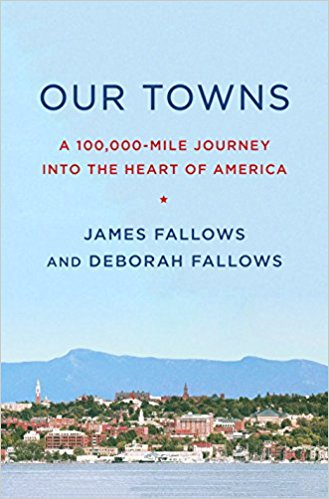
For the last five years, the Fallowses have been traveling across America in a single-engine prop airplane, visiting dozens of towns. They met hundreds of civic leaders, workers, immigrants, educators, environmentalists, artists, public servants, librarians, business people, city planners, students,and entrepreneurs to take the pulse and understand the prospects of places that usually draw notice only after a disaster or during a political campaign.

They came to a different conclusion about rural America. James Fallows said this:
"Americans don’t realize how fast the country is moving toward becoming a better version of itself."
Wow, a glimpse of optimism from a national journalist! Fallows, who writes for The Atlantic magazine, wrote a portrait of the civic and economic reinvention taking place in America, town by town and generally out of view of the national media. (I've signed up for the book from my library, and I'm anxious to read it when my name gets to the top of the reserve list!)

The Fallowses acknowledge the problems rural America face, but they also found people who are  crafting solutions on the local level. They found people with energy, generosity and compassion, dreams and the determination to make things better.
America is becoming more like itself again. More Americans are trying to make it so, in more places, than most Americans are aware. Even as the country is becoming worse in obvious ways—angrier, more divided, less able to do the basic business of governing itself—it is becoming distinctly better on a range of other indicators that are harder to perceive. The pattern these efforts create also remains hidden. Americans don’t realize how fast the country is moving toward becoming a better version of itself. 
James Fallows in The Atlantic
And, yes, he found some of those places in Kansas:
“We may be ‘conservative.’ but we’re progressive,” Melissa McCoy, who grew up not far from Dodge City and is now the city’s Project Development Coordinator, told Fallows. “There was a time when we had a really negative self-image as a town. But people thought, If we won’t invest in ourselves, how can we expect anybody else to? It was a matter of getting the community behind it and realizing that we needed to back ourselves up to get outside investment and support. Now we’re starting to see it pay off.”
From an article in The Atlantic, Why Not Dodge City, Why Not Stockton
The authors could have discovered that "can-do" spirit in Scott County, too.  Leaders and citizens embrace their historic past. But they put a modern spin on them by tying history to tourism and business. Another of their taglines is "Where History and Progress Meet." The Kansas Master Farmers/Homemakers experienced that firsthand.

Next time, more on our trip to Scott City and the first in a series of blog posts about possible Kansas Staycations.

***
On Memorial Day yesterday, I posted these photos to my Facebook page. While this doesn't have a thing to do with the economy of small-town Kansas, it does show there are fringe benefits that aren't possible to compute in dollars and cents.
 On this Memorial Day, I'm thankful for small town Kansas patriotism. Thanks to the Patriot Guard who accompanied a Korean War veteran to his final resting place on Saturday and who stood at attention as people arrived at the memorial service. I also appreciate their raising the flag at every home football game. I'm thankful I live in a place that still pulls over for funeral processions as a sign of respect.

Wednesday, June 3, 2015

Quiet Places

A Time to Think

We can't always withdraw
 to quiet hillsides to pray, 
but Christ will meet with us
in the quiet places of our hearts. 
–Sheila Walsh, author
(from a Guideposts email devotional)
 He'll also meet us in the quiet places on a country road.
All the rain has given a new green vibrancy to rural Kansas.
Sun shines through the old cottonwood at our driveway.
The wildflowers are blooming.
From the familiar yellow sunflowers, waving hello against the green and blue ...
To the other wildflowers that have been well-watered and prolific due to May rains.
Light and shadows
Each is beautiful in its own right.
May all your weeds be wildflowers.
Milkweed attracts Monarch butterflies.

Thursday, July 11, 2013

Mundane Everyday Life


I looked beyond the back porch window sill with its collection of dead bugs and thin layer of dust. Clouds tinged in cotton-candy pink billowed above the tall trees to the south of our house. Still, I went to the basement to begin my normal morning routine.

As I sat in my wood-paneled office underground and waited on gmail to cycle up, I couldn't quit thinking about the clouds. Emails and blogs and KFRM radio reports could wait for a few minutes.

So many times, we walk past the beauty in life. I don't even remember now why I went to the porch to begin with. It's not a mandatory stop on my day. Maybe I glimpsed the unusual clouds through the bathroom window and decided to get a closer look.

Our house is surrounded by big old trees, so I grabbed my camera and told Randy I was going to drive down the road to check out the sunrise.

Many times, I'm disappointed by the photos. I can't always get the camera's eye to duplicate the beauty and majesty of the Kansas sunrise or sunset. The night before, Randy called me as he was driving a tractor toward home. A storm was blowing through and the sky was unusual. And, try as I might, I couldn't get the camera to capture the moment the same way as I was experiencing it in person. 
July 9, 2013 - Sunset
But I'm persistent. (Some might say stubborn.) So the "failed" sunset photos didn't keep me from trying to capture the sunrise yesterday morning. See, there are sometimes fringe benefits to being persistent.
July 10, 2013 - Looking to the south
A little later yesterday morning, I sat in a pickup cab in an old farmstead yard while I waited on Randy and Jake to round up heifers and a bull on 4-wheelers. I rolled down the windows and listened to the birds call to each other and heard the cottonwood leaves rustle in the wind. Birds played hide and seek in the branches.
Taking photos helps me to "see" the beauty all around me. To tell the story of our farm and our life on the County Line, I look for ways to illustrate the words with photographs.

But it doesn't take a camera in hand to notice the little things. Yesterday, as light streamed through the bathroom windows, the lace edge of the curtains made a pattern on the wall. I caught a glimpse of a bluejay as it darted across the backyard. Three baby kittens played tag in the backyard.

Beauty isn't just found in the spectacular. Neither are blessings. They just require me to open my eyes. And then count them, kind of like that old Sunday School song we used to sing in the basement of the Byers United Methodist Church:

Count your many blessings, name them one by one,
And it will surprise you what the Lord hath done.
View of the eastern sunrise sky - July 10, 2013

Friday, February 8, 2013

Stafford: Making Sundaes from Plain Old Vanilla

From a mile away, you can see our "skyscrapers" in the background.
"Stafford Next 5 Exits."

The sign is accurate, though the tongue of the creative sign maker was planted firmly in cheek. There are five streets from which travelers can choose to turn off U.S. Highway 50 and enter Stafford: Population 1,042.
However, Stafford County mirrors what is happening in rural America. Parts of the rural Great Plains have been losing residents since the Great Depression. Some areas saw a baby boom after World War II. In the 1940s, Stafford experienced a modest population gain during an oil boom.


Main Street looks different than it did in this photo from 1955 (found in Stafford's Centennial book, Crossroads of Time: 1885-1985). The latest census shows what everyone already knows: The population in rural communities, including Stafford, keeps decreasing. But, instead of giving up, Stafford citizens are pulling together and trying to make lemonade out of lemons - or, in this case, beautifully topped ice cream sundaes out of plain old vanilla ice cream.

Tomorrow, Senator Jerry Moran will be in Stafford to present a Building Better Communities Award. The award spotlights positive community action in Kansas and shows how creative thinking and teamwork make a positive difference. Senator Moran will be at the Stafford Mercantile at 9:30 AM, Saturday, February 9, to honor the residents of Stafford for efforts to revitalize the community.

 In a speech on the U.S. Senate floor on January 30, Senator Moran said:

     In small communities across America, the people there, they work hard. They come together to find common-sense solutions. They solve problems. They try to make a difference in the life of their families and their community. They also strive to provide a better future for their kids, so that every child has the opportunity to grow up, pursue the American Dream and reach their goals.
     For rural communities to survive and prosper, citizens have to work together to create their own opportunities for success. … The reality is that those communities that are going to have a bright future are those who decide, on their own, to work together within that community to make certain that’s the case.  An example of a community that rallied together in a way to make good things happen and make the community better for the future is the community of Stafford. ...
     Rural communities across Kansas have been hit hard by the economic downturn over the last few years and many towns have encountered the closing of businesses. Main Street looks a lot less appealing. There's a shortage of health care services. The younger generation is leaving home in search of employment. In light of these challenges, the community leaders of Stafford have taken steps to secure that town’s future.  …


Comments from Senator Jerry Moran, R-Kansas

Speech from the floor of the U.S. Senate

January 30, 2013

See the complete speech
It seems fitting that the senator will be at the Stafford Mercantile to make the presentation. The variety store on Main Street Stafford has been open since last fall. Local investors came together to return a business to the vacant storefront, after national retailer Duckwall's pulled its stores from most small Kansas communities two years ago.
The Mercantile makes it possible for residents to shop for things like Wrangler jeans or a bridal shower gift without driving 30 minutes to Pratt or Great Bend or 45 minutes to Hutchinson. 

The centerpiece of the Mercantile is a 1928 marble soda fountain. It was originally in Smart Drug in Stafford, but was stored in a neighboring town for years. 
From the Stafford Centennial Book. You can see the marble soda fountain as it was in Smart Drug on the lefthand side of the photo.
Those renovating the soda fountain added oak columns from a Stafford Victorian-era home. The back bar was from a prohibition-era speakeasy near Stafford Lake, and booths and marble tables are original to the same drug store as the soda fountain.  All were dug out of different storage places and refurbished.
Senator Moran's staff also prepared a video that's been posted to Youtube (That link is at the bottom of this post.) There are three other videos that focus on specific ways Stafford is looking to thrive (click on each of the underlined links to see those videos.) Besides featuring the Stafford Mercantile, another talks about how the community rallied to save the Stafford District Hospital. Another features Stafford USD No. 349's SEED (Stafford Entrepreneurship and Economic Development) Center, a charter school for high school students. It's where students develop a business plan, talk to the banker, make a product or deliver a service and then actually open and operate their own business on Main Street Stafford.
Stafford is proving that when communities look within themselves for growth, they do have the capability to forge a stronger, more positive future.
Stafford County Economic Development Director Carolyn Dunn
It's about using plain old ingredients - like vanilla ice cream - and making that tasty sundae - complete with cherry on top.

Or maybe revitalizing a community is like making an old-fashioned cherry limeade. Even in a community "squeezed" by challenges, the future looks a lot more "rosy" when people get "stirred up" and come together. (You can get one of those cherry limeades at the Mercantile's soda fountain by the way. They are even half-priced on Thursdays!) 


See this related post. Yes, even toilet paper can make a difference in a small community.

Thursday, January 17, 2013

Local Economy On A Roll

A movie marquee from Stafford's Ritz Theatre in 2010.
Going the Distance: Small towns and rural communities in Kansas and across the U.S. are trying to figure out how to do just that. One county in Iowa has a simple idea that's making a big difference.

The Chamber of Commerce in Greater Franklin County (Iowa) is making an impact on their local economy one toilet paper roll at a time.

It doesn't sound very glamorous, does it? And it's getting mighty personal. But think about it: What product does every person use every day? Young or old, male or female, farm or town: Everybody uses toilet paper. In fact, the average person uses 105 rolls of toilet paper a year. It costs an average of $1.25 per roll.

So, in December 2011, the Greater Franklin County Chamber of Commerce promoted an idea: Buy toilet paper at a hometown store, not a big box store. And, believe it or not, the idea is starting to clean up (so to speak).

There are 15,000 people in Greater Franklin's service area. They did the math (which is good, since it's not my best skill):
From their Buy One Product Local website:
That one item (toilet paper) would keep almost $2 million dollars in sales in the county.  It would also generate $140,000 in sales taxes.

Last year, it was estimated that the amount actually spent on toilet paper in greater Franklin County was $335,800 – that’s lost revenue of $1,631,244!
The idea worked. After a year, Franklin County stores that sell toilet paper have seen an increase in sales.

Our county doesn't have that many people, so the math will be different. But what would happen if residents of rural Kansas "swiped" the idea and bought their toilet paper from hometown stores? What if we then added a tube of toothpaste or some laundry detergent to the shopping cart? How would our local economy be impacted if we spent money in our hometown for everything from apples to deodorant to soap to zucchini, instead of driving 30-plus miles to a big box store for supplies?
Notice that Angel Soft toilet paper is even on sale this week at Paul's!
My husband has always been an advocate of shopping locally. I must admit that I do shop in the chain stores on occasion, but I do try to do the bulk of my grocery shopping at our small town grocery store, Paul's.

Last October, the Stafford Mercantile opened. It's a variety store owned by local investors. It fills a niche in our small town that was left when our Duckwall's store was closed in 2010.
Yes, I really did have toilet paper on the pickup hood. I got some weird looks.
When something new opens, there's always an initial curiosity and foot traffic. Hopefully, that led to some purchases, too. But when the newness wears off, we forget that we need to be the solution to having things like wrapping paper, bridal shower gifts, office supplies, toys and more available just down the street instead of 30-plus miles away.  (Our Stafford Mercantile also has a refurbished, vintage soda fountain, so come enjoy a scoop of ice cream, a milkshake or a fountain drink.)

If we aren't willing to open our wallets in hometown stores, we are "voting" against having those services available locally. Maybe we'll have to pay a little more for the convenience. But what's the real payoff?

Reasons to Shop Local (from Buy One Product Local's website)
  • When you purchase locally, those businesses you buy from purchase from other local businesses.  Those same local businesses often support local charities.
  • Small businesses are the largest employers nationally.
  • Local businesses are looking to hire someone with specific product expertise – meaning better customer service.  Plus, they live and work in the community and really know their customers.
  • Generally, local business owners are more invested in the community.  Their children attend the schools, their family goes to a local church.
Who knew toilet paper could be such a big deal? I'd like to find out. Will you join me?

Wednesday, June 15, 2011

Somewhere Over the Rainbow

June 14, 2011
You can see the double rainbow just to the left of the intense rainbow.

You can travel the world over and see beautiful places and spectacular scenery. But a stormy Kansas sky has to rival even the most photographed places.


Otherwise, why would Dorothy have wanted to go home so badly?

I've teased the guys that I'm not going to bring supper to the harvest field anymore. They aren't going for that idea, even though we've had complications. Every. Single. Time.

For the first three nights, it was breakdowns. The scorecard so far? Two combine breakdowns and one truck battery failure. All happened around suppertime.

Yesterday's harvest complication had to leave a smile on your face, even though it meant another interruption.

As usual, it's impossible to capture the magnificence of a rainbow. Both ends were vibrant, and the shadow of a double rainbow decorated each end. Where's a panoramic camera when you need one?

We knew the storm was coming. And even that was beautiful. Randy wolfed down supper and picked up a passenger. (There was no time to pause for photo ops as Trevor climbed into the combine cab.)

It was a race to get as much wheat cut as possible before the winds blew in the rain.

But there was time for Trevor's sister, Emalee, to dance in the pickup bed ...

and to steal a potato chip or two from her Daddy's lunch before she and her mom, Katie, took a trip to the elevator with Jake.


There's no place like home ... there's no place like home ... there's no place like home.


***

I love this version of Somewhere Over the Rainbow with What a Wonderful World. We used it as background music for Jill's portion of her wedding slideshow. It's a Kansas girl's theme song, for sure. Enjoy!


Wednesday, May 18, 2011

A Thriving Metropolis

The state of Kansas may not have sprung for new signage along U.S. Highway 50. But someone with a sense of humor did.

Last week, as I was approaching Stafford, I saw a red flag fluttering from a new sign.

"Stafford Next 5 Exits," it proclaimed.

I had to smile. But it's not false advertising. There truly are five different streets where you can turn to explore our fine community. You can see one of our skyscrapers in the background.

And just in case travelers missed the opportunity, here's the other side of the sign:

It's not often that you see an NC+ seed sign coupled with one of those "Big Town, USA, next 5 exit" signs.

(Read more about Stafford signs - and get a couple of great cake recipes - by clicking here.)

Monday, April 4, 2011

Another Man's Trash

One man's trash is another man's treasure, so the saying goes.

But sometimes it's just trash.

Why do people feel the need to use country roads as a dumping ground? I am amazed at the amount of trash I see scattered along the roads.

My most interesting find on a recent walk was a half-eaten PopTart. First of all, I was surprised the toaster pastry remained intact after a flying trip from a car window. But what does that say about its viability as a breakfast selection? Is it a metaphor for the rock it makes in the eater's stomach?

At least the PopTart was biodegradable. However, I did notice that no creature came and ate it. It was still there the next day, a little worse for wear, but still unconsumed. Perhaps the creatures are wiser than we are.

The closest McDonald's is 35 miles away, but I still see the paper bag remnants of a fast food meal. There are pop cans, water bottles, plastic sacks and more along the ditches.

But the old saying did come true for us one time. The best "trash" we ever found was Mindy.

Don't get me wrong: I am certainly not advocating anyone take an unwanted pet to the country and leave it there to fend for itself.

A landlord found Mindy and asked if we wanted a dog. Mindy had obviously had a rough life up to that point. She shied away from men for quite sometime.

But she and a little boy named Brent became best of buddies.

When Brent left home for college, I had to promise I'd pet his dogs - Mindy and Ralph - every day. It was one of the hardest phone calls I had to make to Brent to tell him that Mindy had died.

She definitely ended up as treasure to our family. But, much as I loved Mindy, I wish people would keep their trash to themselves. Have we become too lazy to pick up and be responsible for ourselves?

My aversion to the trash heap along the roadside reminds me of an old public service announcement. Maybe it wouldn't hurt for us to run it again.

Wednesday, March 2, 2011

In Like a Lamb ... Or A Feeder Calf

March came in like a lamb yesterday. Or in the case of life on the County Line, March came in like a feeder calf. (It doesn't have the same ring to it, does it?)

It was a beautiful morning to sort calves. The sun was out. There was a vibrant blue sky dotted with wispy cotton-candy clouds. It was a sweatshirt morning instead of a coverall morning, Jake and I decided as we manned the gates. Last year, it was 21 degrees when we did this job. I liked the 40-degree weather better.

We sorted the feeder steer and heifer calves we'd weaned from the mama cows in November. They were born during the last calving season - from late January through early March 2010 - so they are about a year old.

We will sell the steers and a few heifers at the Pratt Livestock Sale on Thursday. We've hired a semi to come today to transport them to the Pratt sale barn, so we needed to separate the cattle we plan to sell and those we plan to keep.

Randy is keeping extra heifers this year as replacement heifers. They will become the cows in our cow-calf herd in the future.

This (above) is one of the 34 heifers who will stay in the County Line's cow-calf herd. Randy is keeping more heifers this year because we have several older cows which he plans to "cull" from the herd and take out of production.

And this was one of the steers I guided the other direction with the pull of a gate. We'll sell 69 head on Thursday. Most of them are steers, though there are a few heifers that Randy isn't keeping for our herd.

During the sorting job, Jake mans the first gate and I operate the second one. Randy is the one who tells us "sell" or "save." Thankfully, Jake has better eyes than I do and can read the ear tag numbers on each calf more readily. Each heifer that was calfhood vaccinated is supposed to have a separate red tag in its ear, but some of the tags have fallen out during the winter. So Randy consulted his back-up list and called out the verdict for each one.

My job is to open the gate the correct direction and then do my best fence post impersonation so the calf comes through the gate with the least balking possible.

I think I did my job well, even when I got distracted by the play of light and shadows in the corral on a beautiful morning.

So, thankfully, March came in like a lamb yesterday. I know the old saying says that it will go out like a lion to compensate. But it would be OK with me if it goes out like a lamb, too.