Tuesday, July 9, 2024

Grandma and Grandpa Camp

Down and ready! Maybe that's the way grandparents need to be when they have been elected temporary softball parents for the weekend.

We were ready for the sunscreen application. We did fine on the multiple jugs of water for our player (and the spectators). We remembered the bag with all the "stuff" - the helmet, the bat, the glove and the mitt. But Grandma wasn't necessarily ready for two afternoons of 100-degree temperatures. But I survived and even made supper afterwards before collapsing on the couch. 

Best of all: The Dirt Eaters won their league! (It was probably all the raucous cheering from Grandma and Grandpa. OK, maybe the coaches and the girls had something to do with it.)

Jill and Eric were traveling for work, and it was our turn with the girls. Though we started in Topeka, we worked our way back home for the week. First, there was a stop at the Cosmosphere in Hutchinson.

The girls have changed just a bit since their last visit in 2016.

Kinley - 2016, Evidently, Brooke wasn't standing still for a photo in 2016.
 

2024

One small step in childhood; one giant leap toward the fast-approaching teen years! 

Last time, Brooke had to be held up to see out of the astronaut cutout.

This time, no extra boost was needed, but she was given the role of Space Alien by her big sister.

Unfortunately, much of the Hall of Space was closed for remodeling. But there was still plenty to see. (I just saw a news article that said the remodeling should be done by the end of July.)


Last time we were at the Cosmosphere, Kinley was 4. She had decided she wanted to be an astronaut and a Mommy. Brooke, at age 2, was not sharing her career goals at the time. However, now I'm not sure she would enjoy the accommodations.

Kinley has since moved on from the astronaut goal, but perhaps they will consider engineering. That was a focus of the Imax movie we saw, Cities of the Future.

Their favorite part (and probably Grandpa's and mine, too) was Doctor Goddard's Lab. 


What's not to like with fire and experiments?

They also built their own rockets and launched them in CosmoKids. 


The CosmoKids area had been added since we were there with the girls in 2016, and we thought it was a great addition to the facility. They also built their own habitat there.

I skillfully avoided the "which one is better" debate by making them work together.

They rode the simulator. That was the only thing that cost us extra. Parents and grandparents: If you haven't downloaded the Sunflower Summer app, you should. All four of us got into the Cosmosphere at NO COST. 

The next day, we returned to Hutchinson for an afternoon at Strataca, the underground salt museum. It was the favorite "tourist" stop for all of us.


Once we descended the 650 feet underground, we found a reference to Quivira, which is only a few miles from our farmstead.


Brooke had a Vanna White moment. No vowels were available to buy. However, there was plenty of salt.

I took a photo of a large family, and they returned the favor.

One of the most interesting areas to me is the Underground Vault and Storage. The business stores movie films and memorabilia, oil and gas data and other historical documents, including the movie, Salt, starring Angelina Jolie. Ironic, right?!

The first Twister movie is stored there. Maybe we'll see the second one this summer? (Or maybe not. I'm not a big fan of tornadoes.)


 But the train and tram tours were the favorite parts of all.


What came into the mine, stayed in the mine - including trash ...

...and vehicles. Grandpa liked the tractor.

We took a more in-depth tram ride called the Salt Safari (extra cost). For that tour, the guide handed us flashlights and said we were providing the light for him to see to drive and for us to view the mine. Lights were to remain on at all times - except when he wanted us to experience total darkness. We were glad to oblige!

Here's where we could pick up some salt to take home.

The Sunflower Summer app works at Strataca, too. 

Though those were our "tourist" parts of the visit, we also had plenty of other activities.

Both the girls had turns driving Grandpa's Gator. Brooke was tall enough to reach the pedals this time.

The girls were reintroduced to Will and Avery.

Kinley and I worked on mounting her 4-H photography. (Grandma fail: I didn't get any photos. But I had a good excuse. My fingers were sticky from helping Kinley get the adhesive-sprayed photos lined up on the mounting board.)


I did remember to get a few photos of Brooke working on her patriotic wreath for her 4-H craft project.

The girls met a friend at the Stafford Pool and had a treat at The Frosty Bean. (Grandpa was the chauffeur for that trip, so no photos.)


I did remind him to get a photo of their breakfast with Grandpa, Bob and the Boys at Joan's Cafe.

But then I was the person who forgot to get a photo when we visited Grandma and Grandpa Moore. We made up for it the next evening at the wedding rehearsal dinner for Brian and Taylor.

The week culminated in the wedding of Brian Moore and Taylor Clark on Saturday, June 29, at the Crystal Ballroom in Hutchinson. It was a beautiful wedding, and it was great fun to be together with the entire family. 

From left: Kinley, Eric, Jill, Brooke, Randy, me, Brent & Susan
My parents and Brian's proud grandparents

Me and Brent

We had to have one of we three, too - Jill, me and Susan!

Kinley and Brooke with my sister's grandchildren. They all looked pretty spiffy. We were missing Clara, the flower girl, in this photo. She was otherwise occupied.
 

Here's Lisa's whole crew - including Clara.


The proud parents of the groom, Brian. My brother, Kent, and sister-in-law, Suzanne.

My sister, Darci, and BIL, Andrew.

These girls were Dancing Queens at the reception.


We were all there celebrating the bride and groom, Brian and Taylor.

May be an image of 2 people, wedding and text
Photo by BC Emery Photography, St. John

I didn't want to leave out the Best Person, Madison, Brian's sister, so I'll include this family photo from BC Emery Photography, too.

May be an image of 9 people and wedding

What a wonderful time! Congratulations to the newlyweds!

Whew! Grandma and Grandpa had quite a week. I hope the girls did, too.


Tuesday, July 2, 2024

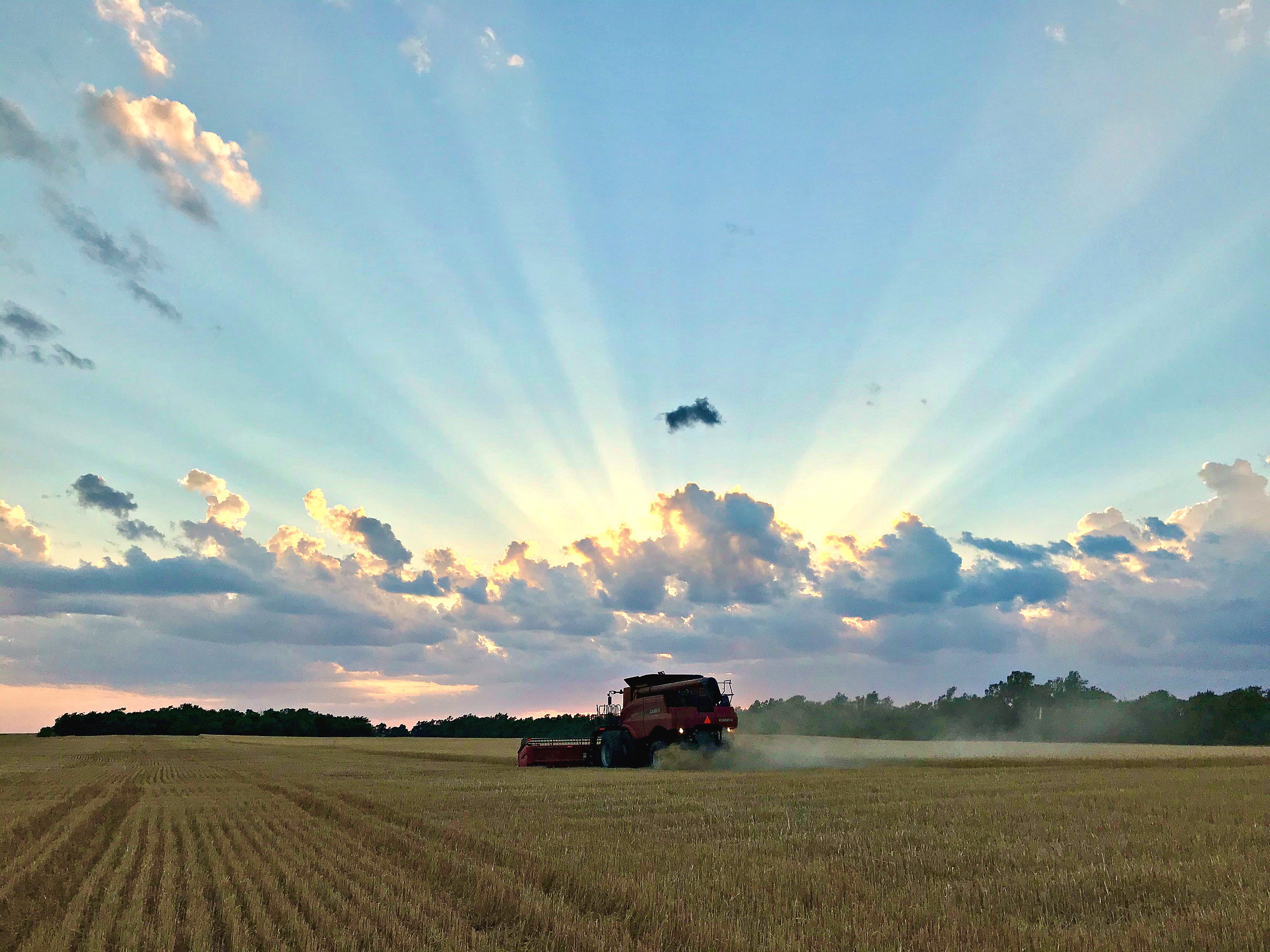
What? No Photos? Wheat Harvest 2024

All photos in this post are by Randy.

It seems like sacrilege, but I didn't take a single photo of our 2024 Wheat Harvest. We've been married (and farm partners) for 43 years. I know I was also around for the harvest before we got married. So, for 44 years, I'd documented wheat harvest on the County Line with photos. As a farm daughter and wheat truck driver growing up on a farm in Pratt County, I also took my share of wheat photos there.

Before retirement, I took dozens - maybe hundreds - each harvest. So it was definitely a weird feeling to know that I'd missed the whole thing. (I had a good excuse. My dad was in the hospital at the time. He's doing much better now.)

I told Randy that if he wanted photos of this year's harvest, he was going to have to pull the phone out of his pocket. He complied.


This year, the Millers opted to plant less wheat on our ground in an effort to combat rye. Only 15 percent of our owned ground was planted to wheat this year. In years past, it was closer to 50 percent. 

Plus, they hire their wheat cut by custom cutters, Frederick Harvesting and Trucking, based at Alden. So the whole process goes much more quickly than when we were combining and trucking the majority of it ourselves. Two combines and a grain cart pulled into the first field the afternoon of June 12. They moved locations and were totally done by about 10 PM that night. 

And there was another factor: The continuing drought certainly didn't produce a bumper crop. However, it was much better than we anticipated after an extremely dry fall, winter and early spring. 

We got the totals yesterday. As I said, we didn't have a lot of wheat planted on our ground this year. One field (which we refer to as Peace Creek) made 33 bushels to the acre. At our other field (Tretbar), the yield was 41 bu/acre. That gave an overall average of 37.8 bu/acre for this harvest. 


I got several texts from Randy that day as he rode in the combine with one of the custom harvesters. The newer John Deere combines had all the bells and whistles. The combine driver could even control the speed of the grain cart tractor from his machine. The grain cart showed how many pounds they were offloading from the combine. And, of course, Randy was watching the grain yield monitor about as closely as he did back when he was in the driver's seat. 

There are aspects of wheat harvest Randy misses. It was always his favorite time of the year. That is, UNTIL we had a breakdown. 


So when he sent this photo of the custom cutting crew making repairs, he said. "I don't miss this part." 

Nope, me neither. Though maybe I am missing my friends at the parts counter. On second thought, that's OK.


Tuesday, June 18, 2024

AirBnB: No Vacancy


I'm sorry. We're not taking extra guests at the backyard AirBnB Outhouse Suite. It has reached full occupancy.

These guests are loud, too. They put up a constant racket. 

It's a wonder we haven't gotten noise complaints from other travelers.


We didn't advertise it as providing breakfast, but the visitors are sure asking for a meal handout. They look kind of angry when dinner is late.

We're not sure whether there were three or four bodies squeezed into the accommodations. The peep hole is a little too small to tell.

We believe our visitors are house wrens. This is the second summer they've taken a vacation stay on the County Line. I think we're going to have to do some renovations or remodeling before next year's visitors arrive. The accommodations are looking a little worse for the wear. You have to watch out for those rambunctious AirBnB guests.

The house wren is a very small bird of the wren family, Troglodytidae. It's the most widely distributed native bird in the Americas. Its name means "hole dweller" and is is a reference to the bird's tendency to disappear into crevices when hunting insects or to seek shelter.

I guess the parents were off trying to scrounge up a meal. They didn't dive-bomb us as we were eavesdropping and taking unsolicited photos of their family.

They aren't the only backyard visitors. Our Baltimore orioles are back. Randy is keeping them happy with cheap grape jelly in a high-class container made from a 2-liter pop bottle.

Who wouldn't want to check in to our backyard accommodations? They are pretty economically priced (unlike most vacation spots these days). 


Tuesday, June 11, 2024

Happy Birthday, Turkey Red!

Photo note: This and all the other photos in this post - with the labeled exception - are from the Kim's County Line archive.
 

It may seem an archaic custom in 2024. But, back when I was a teenager in the 1970s, girls often received "hope chests" as gifts. Historically, it was a place to store linens and other household goods and the cedar-lined box kept away moths and pests.  I believe I got my hope chest when I graduated from high school. It still sits in our bedroom and has my kids' outfits they wore when they came home from the hospital, among other "treasures."

But it was a "hope chest" of another kind that continues to impact Kansas today. This chest delivered Turkey Red Wheat seed thousands of miles from the Ukraine to the United States, where Mennonites looking for religious freedom hoped to make a new life. And they did just that, planting the wheat kernels that helped transform Kansas' wheat industry. 

Seed chest exhibited at the Mennonite Heritage and Agricultural Museum, Goessel, KS. Photo from History.com

Bernhard Warkentin, the son of a Mennonite miller who is credited with setting up Ukraine’s prosperous wheat industry, came to the United States in 1871 to scout possible sites to do the same in America. Along with several of his fellow Mennonites, he traveled for two years by both horse and train covering a distance of over 10,000 miles in places like Canada, the Dakotas and Minnesota, looking for the ideal terrain.

In Kansas, he found what he was looking for: “The climate here is similar to that of the steppes in Ukraine,” says Fern Bartel, director of the Mennonite Heritage and Agricultural Museum in Goessel, Kansas. “Long winters. Dry in the summer, rainy in the fall and spring.”
From History Channel's "The Tools that Built a Nation"
 

In 1874, Warkentin settled in Halstead, Kansas, building a grist mill on the banks of the Little Arkansas River and encouraging other Mennonites to join him. Some 12,000 Mennonites moved to Kansas, mainly as a result of Warkentin's efforts. Many of them became wheat farmers. 

Wheat Harvest 2024 got under way in our area on Saturday, before being curtailed by a nice 1.70 inches of rain Saturday night into Sunday morning. (The rain was too late to help this year's wheat, but it certainly helped the spring-planted corn and soybean crops, alfalfa, pasture lands and farm ponds. Nobody around here was complaining about the delay to wheat harvest.)

Maybe the start and stop story of harvest is not so different from that of those immigrating farmers years ago. Certainly, the ultimate goal has not changed - using the land to produce food and fiber for the world while also providing for our own families. 

During Wheat Harvest 2024, we celebrate 150 years of Turkey Red Winter Wheat in Kansas. 


Before the Mennonites came to the region, many farmers who'd moved from the eastern regions of the U.S. were planting spring wheat, which was more acclimated for the Eastern seaboard. However, Kansas’s summers are hot, dry and windy, not ideal for wheat seedlings to thrive and produce a crop. On top of that, grasshopper swarms in the summer would completely devour what wheat did manage to survive.

But the influx of Turkey Red - a hardy winter wheat - was more suited to Kansas' climate. 


The Mennonite farmers arrived less than 10 years after the 34th State of the Union adopted the Homestead Act of 1862. It gave citizens or future citizens up to 160 acres of land if they lived on and improved it for five years. Many of those new immigrants from Ukraine took advantage of the Homestead Act to establish their own farms in Central Kansas. The first field of Turkey Red wheat was planted in Marion County in 1873 and harvested in the summer of 1874. The Mennonite farmers also brought new ideas to the region, Kansas Wheat reports. 
 
 
They also brought game-changing farming practices like leaving fields fallow in between planting cycles, applying fertilizer to fields and using large threshing stones to separate the wheat kernels from the stalks that enveloped them. Turkey Red was revolutionary, but it took time for the milling industry to adjust from milling soft wheat with lower protein and weaker gluten (think soft cookies) to the new hard red winter wheat, which had higher protein and stronger gluten (think of a loaf of bread that holds its shape). Just as the farmers discovered the hardiness of Turkey Red and the millers unlocked its better quality, the variety quickly spread and took over Kansas agriculture.
From a story from Kansas Wheat by Julia Debes, June 2024

At the same time, railroad lines expanded, communities were settled and giant elevators to store grain were built.

Turkey Red Wheat was one of the more popular varieties of wheat in Kansas until the 1940s, when higher–yield crops overtook it. But even today's varieties can trace their pedigrees back to foundations in Turkey Red hard winter wheat or other Crimean varieties. Kansas wheat accounts for nearly 20 percent of all wheat grown in the United States today.

[Turkey Red] genetic material is still the foundation of our varieties today. We’ve shortened them, we’ve given them stronger straw, we’ve improved drought tolerance and we’ve hopefully improved quality. But that’s really still the scaffolding on which everything is built.
Allan Fritz, Kansas State University wheat breeder 
Quote taken from a feature story by Jennifer Latzke in Kansas Farmer
 
Even today, visitors to the USDA Agricultural Research Service Southern Regional Performance Nursery in Lincoln, Neb., will see a check plot of Kharkov, a landrace similar to Turkey Red that is meant to show how the current wheat varieties stack up to the historic record. The world has come a long way from a 13-bushel per acre average in 1919 to the record 57-bushel average set in 2016 (also from the Kansas Farmer article)

Maybe the old farmers in the region looked at skepticism at those new farmers who brought different seeds and a different planting time table to the Kansas plains. However, Turkey Red winter wheat - and, ultimately, its descendants - were here to stay.

Just like the farmers of today, those long-ago farmers who'd carried those "hope chests" of seeds across the ocean didn't know what the planted seeds would yield until harvest time. Today, researchers continue to work on genetics that will improve yield and combat disease and drought. Manhattan, Kansas, is home to the Wheat Innovation Center at Kansas State University. K-State has a long history of sharing wheat germplasm with growers and farmers around the world, Fritz says,  even back to Ukraine, where Turkey Red first originated.
 
 
“There will only ever be one Turkey Red. That was really the foundation that we kind of built this whole industry and this whole region’s wheat production around."
Alan Fritz (quote from Kansas Farmer article)
Harvest 2021

Bernard Warkentin likely never dreamed that the seeds he and his Mennonite brethren were bringing to Kansas could one day lead to the state growing 244.2 million bushels of wheat in 2022, or 18 to 20 percent of the wheat crop of the United States. He may not have imagined that wheat production in the state would account for $4.3 billion of its economy and 15,245 jobs. Or that in 2023, half of every load of wheat that arrives at the local elevator would be destined for foreign buyers.

But, I'm sure glad he included Turkey Red wheat in his own "hope chest" as he left all he knew behind for a new adventure in a new land. 


***

For more information: The Goessel Museum is celebrating the 150th anniversary of Turkey Red wheat . Be sure to visit goesselmuseum.com, or stop by at 200 N. Poplar St., Goessel. Among the many exhibits you’ll see is the Wheat Straw Liberty Bell, a giant woven wheat art piece commissioned by the Smithsonian for display for the nation’s bicentennial in 1976.
 

And, to learn more about Turkey Red wheat’s influence in Kansas agriculture, listen to Kansas Wheat’s “Wheat’s on Your Mind: Thresher Nation” podcast episode, Wheat's on Your Mind, with Aaron Harries of Kansas Wheat and Glenn Ediger, author of “Leave No Threshing Stone Unturned,” a book about the Mennonites and Turkey Red wheat.