Showing posts with label Agriculture Day. Show all posts

Tuesday, March 21, 2023

Salt of the Earth: Ag Day 2023


Salt of the earth. 


When I started thinking about what I wanted to write to observe National Agriculture Day today - March 21 - I remembered some photos I took during a drive through the mama cows and babies. On a couple of trips, I'd asked Randy to park the pickup near a tub containing salt blocks. My goal? To capture that lip-smacking reaction as the calves sampled the tasty treat. 

Do you know how hard it is to catch that split second of the tongue escaping the confines of the mouth for a quick slurp? Let's just say I had a lot of near misses on my camera roll.  

Case in point? This one:

 
Persistence is key in agriculture. In photography, too. And I don't think it's much of a stretch to call agricultural producers "the salt of the earth."

The phrase is from a portion of Jesus' Sermon on the Mount found in Matthew 5: 13: "You are the salt of the earth." I'd just heard the verses again a few weeks ago at church as part of the Bible reading,. It's always been one of my favorites.
 
Jesus meant that the common people he was addressing – fishermen, shepherds, laborers – were worthy and virtuous. He was alluding, not to the tang of salt, but to its value.
 
Two for one on this shot - both calves had their tongues out!  
 

In other parts of the Bible,  salt is used metaphorically to signify permanence, loyalty, durability, fidelity, usefulness, value, and purification.
 
That sounds like America's agricultural producers to me. 
 
I learned more at World Wide Words:

Salt has always been one of the most prized commodities, essential both for life and for preserving food. Roman soldiers were paid an allowance to buy salt, the origin of our salary. A man worth his salt is efficient or capable. To eat salt with someone was to accept his hospitality and a person who did so was bound to look after his host’s interests. The Bible also speaks of a covenant of salt, one of holy and perpetual obligation. ...To Jesus, therefore, salt of the earth was a great compliment.

I've been writing these Ag Day blog posts since I began Kim's County Line in 2010, but this was the first time we aren't actively farming. I wasn't going to be working calves or riding a 4-wheeler to move cattle or performing some other task on our farm. 
 

But I kept thinking about the cattle and their attraction to the salt.  Just like we humans, the bovines seem to want to flavor their diets with a bit of salt. As a child, I remember going with my dad on salt block deliveries. A little residue from the salt cube was left behind on my fingertips, and I couldn't resist a secret taste. The cows also seem to crave the mineral in the cattle lots. I certainly prefer my food with a sprinkling of salt, too, even though my doctor would recommend I limit my sodium intake.


Being the "salt of the earth" is a worthy goal. This Ag Day 2023 is a good time to celebrate the American farmer. America's farmers are the world's most productive. Today, each U.S. farmer produces food and fiber for 168 people annually in the U.S. and abroad. This number was 19 people in 1940, 46 people in 1960, and 115 people in 1980. I can't think of many industries in which productivity has increased that much! 
 

And even though consumers often complain about the price of food, U.S. shoppers still pay much less of our disposable income on food each year, about 10 percent.

Information from Kansas Farm Bureau. Click on the link for a complete fact sheet about farmers and agriculture.

That's definitely not a reason to stick out your tongue - unless you're savoring a tasty slice of wheat bread made with Kansas wheat and slathered with butter made from Kansas dairy cattle ... or you're enjoying a perfectly-grilled Kansas steak ... or you're scrambling up eggs from a Kansas poultry house (with a sprinkle of salt)... the list goes on and on! 
 
Farmers receive just under 19¢ of every consumer dollar that is spent on food. The other 81¢ is spent on processing, packaging, marketing, transportation, distribution and retail costs of the food supply. 
 

There is something that might cause my tongue to stick out in aggravation: It seems consumers would much rather get their information about how their food is produced from someone who has never set foot on a farm or a ranch. They let restaurant public relations gurus define what is safe to eat. Yet it is America's farmers and ranchers who devote their daily lives to it.  
 
Farmers and ranchers are the original "environmentalists." The National Ag Day theme is "Growing a Climate for Tomorrow." Agricultural producers intentionally prevent soil erosion, preserve and restore wetlands, clean the air and water and enhance wildlife. Since 1982, the erosion rate on U.S. croplands has been reduced by more than 40 percent.


Farmers and ranchers truly are the salt of the earth. 


Kansas Farm Bureau has a fact sheet about farmers and agriculture. To see more facts about U.S. farmers, click HERE.


Tuesday, March 22, 2022

Then & Now: A Reality Check


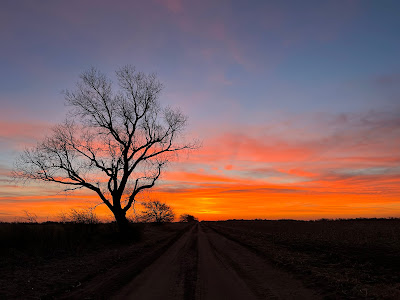
Even before Kansas was a state, the sun has been rising and setting on the Kansas plains. Back in the 1880s, our ancestors  saw that same expansive sky stretching across the horizon as the new days dawned on a new state in the Union.

While the view may be similar, it's amazing to consider the changes in agriculture during my lifetime, and even more so during my parents' lifetimes.

Today is Kansas (and national) Ag Day.  It's a day set aside to celebrate agriculture's role in American life.  

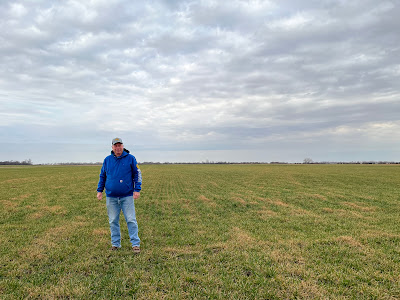
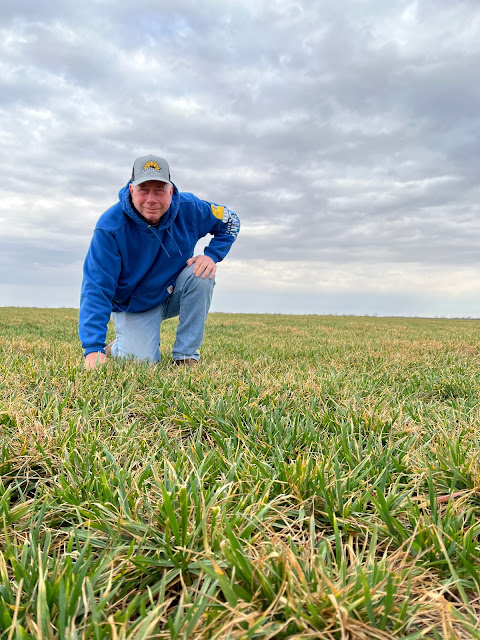
Yesterday was the 21st of the month, and this year, that means a photo update as we march toward summer 2022 and our final wheat crop as active farmers. Just like those sunrises, farmers have been scouting fields to watch the condition of their crops since farmers first began tilling the soil.

The yellow tinge on the wheat is freeze damage on the ends of the leaves and lack of moisture. However, there is green growing underneath. And, as we took the photos yesterday morning, we were hoping the cloudy skies would yield some rain.

We are fortunate: Yesterday and overnight, we got 1.5 inches of rain. Earlier, in this time since my February wheat update, we'd gotten some moisture from a couple of snowfalls, probably totaling 0.75 inches of moisture. 
 
The rain is good news on this Kansas Ag Day 2022. For 12+ years, many of my blog posts have told about our efforts on The County Line to provide food, fuel and fiber for American families and consumers throughout the world. But we're also glad to talk about farming in person, and we got that opportunity a few weeks ago when we spoke with second graders at Stafford Elementary School. I've done this a few times before at the request of second grade teacher Kylie Meyer. But it was great to be back in person, rather than on Zoom, this year.

As with any quality teacher, Mrs. Meyer gave us an assignment. She wanted us to compare the "then and now" of farming. The second graders are learning about comparison and contrast. Mrs. Meyer helps to illustrate the concept by inviting community members with different backgrounds to talk about their professions or interests and compare them, then and now. 

We may not be as interesting as Elroy's Pizza, but we were glad to do it.

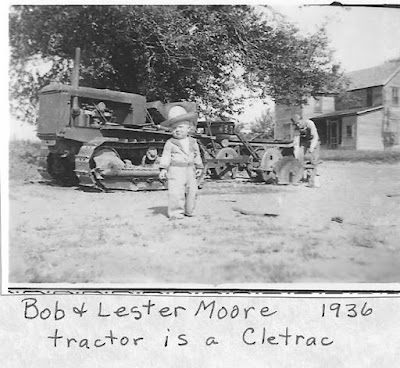
Several years ago, my mom compiled a family scrapbook for each of my kids, as well as her other grandchildren. Both my mom and dad wrote down memories, which were included in the books. In addition, she made copies of photographs. Some of those photos were of family. Others were of farm machinery.


She even included a photo of my dad as a 2-year-old in front of the family's Cletrac tractor.

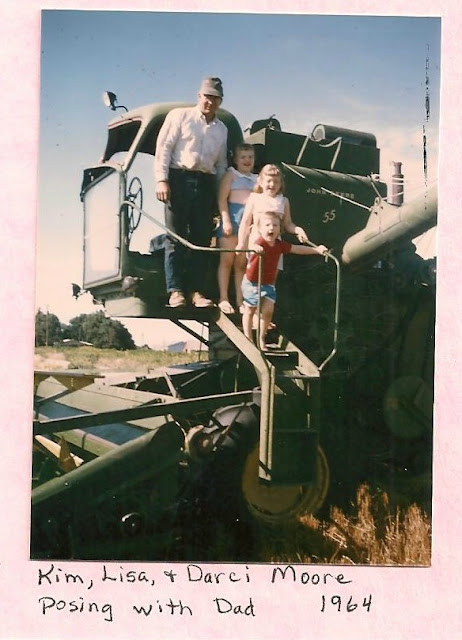
My mom did a great job through the years of taking photos of equipment as they added it to their farm in Pratt County. 


She had photos of some of the first equipment they purchased after coming back to the farm together in 1956 after their college days at Kansas State University. My parents also kept meticulous records of how much some of that machinery cost. 


The photo below shows that first tractor compared the size of the equipment these days. In 2021, they experienced their 65th harvest of their farming career together. (Thanks to my brother for the photo.)

My family's farming legacy goes back even further.  My dad's great grandfather came to Kansas and started farming in 1877. In 1898, my mom's grandfather came to Kansas and began working for a farmer. After he and his wife married, they began farming on their own early in the 1900s.

During my lifetime, my parents added irrigation to their farm. I also showed the second graders photos related to rural electrification, a cause championed by my maternal grandfather, Shelby Neelly. We talked about the decrease in rural population and what that meant for our rural community.

I have thousands of photos I've taken during our nearly 41 years of marriage and farming. But those old photos and the accompanying history gave me a great head start in preparing the PowerPoint presentation for the second graders, using the "then and now" theme. 


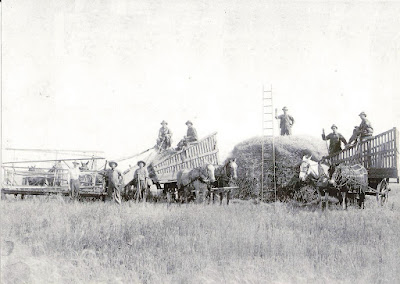
I have a few historic photos of Randy's family farm, but nothing nearly as complete as my Mom compiled. (I know how fortunate I am.) The photo above was in photos from Randy's family, but there was no information about the date it was taken or the people. 

We also showed a video, showing a similar team threshing wheat. Even though it obviously wasn't filmed in Kansas, it still showed a much different picture of harvest then and now.  

Randy's family has a similar history of farming in Kansas. This pasture on the Rattlesnake Creek has been in his family since 1900. 

I did share a few photos from their farm history in the slide show.

Randy's Grandpa Melvin

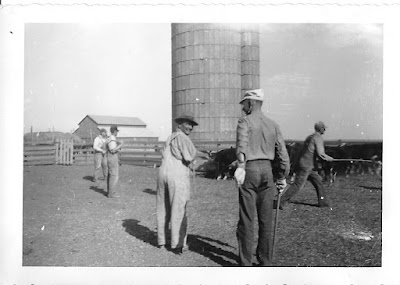
Randy's family on a cattle sorting day

I also pointed out the differences in farm wives today, compared to yesteryear. 


 Of course, we believe agriculture is important. We wouldn't be the fifth generation of farmers in our respective families if we didn't believe in agriculture.
As our society moves away from its agrarian roots, fewer people seem to recognize the value. As organizers of Ag Day say:
We know that food and fiber doesn't just arrive at the grocery or clothing store or magically appear on the dinner table or in our closet. There's an entire industry dedicated to providing plentiful and safe food for consumption.
  • Each American farmer feeds about 165 people. Agriculture is America's No. 1 export.
  • New technology means farmers are more environmentally friendly than ever before. 
Even that tally for feeding has changed: In the 1950s, when my parents were beginning to farm on their own, the American farmer fed 27 people. That's increased 138 people in about 65 years. Pretty amazing, right?

So Happy Agriculture Day - today and every day!

More about the Moore family farming legacy can be found HERE:

 More about the Neelly farming journey can be found HERE.

More about the Fritzemeier farming tradition can be found HERE.