Showing posts with label Kansas farmers. Show all posts

Tuesday, March 21, 2023

Salt of the Earth: Ag Day 2023


Salt of the earth. 


When I started thinking about what I wanted to write to observe National Agriculture Day today - March 21 - I remembered some photos I took during a drive through the mama cows and babies. On a couple of trips, I'd asked Randy to park the pickup near a tub containing salt blocks. My goal? To capture that lip-smacking reaction as the calves sampled the tasty treat. 

Do you know how hard it is to catch that split second of the tongue escaping the confines of the mouth for a quick slurp? Let's just say I had a lot of near misses on my camera roll.  

Case in point? This one:

 
Persistence is key in agriculture. In photography, too. And I don't think it's much of a stretch to call agricultural producers "the salt of the earth."

The phrase is from a portion of Jesus' Sermon on the Mount found in Matthew 5: 13: "You are the salt of the earth." I'd just heard the verses again a few weeks ago at church as part of the Bible reading,. It's always been one of my favorites.
 
Jesus meant that the common people he was addressing – fishermen, shepherds, laborers – were worthy and virtuous. He was alluding, not to the tang of salt, but to its value.
 
Two for one on this shot - both calves had their tongues out!  
 

In other parts of the Bible,  salt is used metaphorically to signify permanence, loyalty, durability, fidelity, usefulness, value, and purification.
 
That sounds like America's agricultural producers to me. 
 
I learned more at World Wide Words:

Salt has always been one of the most prized commodities, essential both for life and for preserving food. Roman soldiers were paid an allowance to buy salt, the origin of our salary. A man worth his salt is efficient or capable. To eat salt with someone was to accept his hospitality and a person who did so was bound to look after his host’s interests. The Bible also speaks of a covenant of salt, one of holy and perpetual obligation. ...To Jesus, therefore, salt of the earth was a great compliment.

I've been writing these Ag Day blog posts since I began Kim's County Line in 2010, but this was the first time we aren't actively farming. I wasn't going to be working calves or riding a 4-wheeler to move cattle or performing some other task on our farm. 
 

But I kept thinking about the cattle and their attraction to the salt.  Just like we humans, the bovines seem to want to flavor their diets with a bit of salt. As a child, I remember going with my dad on salt block deliveries. A little residue from the salt cube was left behind on my fingertips, and I couldn't resist a secret taste. The cows also seem to crave the mineral in the cattle lots. I certainly prefer my food with a sprinkling of salt, too, even though my doctor would recommend I limit my sodium intake.


Being the "salt of the earth" is a worthy goal. This Ag Day 2023 is a good time to celebrate the American farmer. America's farmers are the world's most productive. Today, each U.S. farmer produces food and fiber for 168 people annually in the U.S. and abroad. This number was 19 people in 1940, 46 people in 1960, and 115 people in 1980. I can't think of many industries in which productivity has increased that much! 
 

And even though consumers often complain about the price of food, U.S. shoppers still pay much less of our disposable income on food each year, about 10 percent.

Information from Kansas Farm Bureau. Click on the link for a complete fact sheet about farmers and agriculture.

That's definitely not a reason to stick out your tongue - unless you're savoring a tasty slice of wheat bread made with Kansas wheat and slathered with butter made from Kansas dairy cattle ... or you're enjoying a perfectly-grilled Kansas steak ... or you're scrambling up eggs from a Kansas poultry house (with a sprinkle of salt)... the list goes on and on! 
 
Farmers receive just under 19¢ of every consumer dollar that is spent on food. The other 81¢ is spent on processing, packaging, marketing, transportation, distribution and retail costs of the food supply. 
 

There is something that might cause my tongue to stick out in aggravation: It seems consumers would much rather get their information about how their food is produced from someone who has never set foot on a farm or a ranch. They let restaurant public relations gurus define what is safe to eat. Yet it is America's farmers and ranchers who devote their daily lives to it.  
 
Farmers and ranchers are the original "environmentalists." The National Ag Day theme is "Growing a Climate for Tomorrow." Agricultural producers intentionally prevent soil erosion, preserve and restore wetlands, clean the air and water and enhance wildlife. Since 1982, the erosion rate on U.S. croplands has been reduced by more than 40 percent.


Farmers and ranchers truly are the salt of the earth. 


Kansas Farm Bureau has a fact sheet about farmers and agriculture. To see more facts about U.S. farmers, click HERE.


Tuesday, November 12, 2019

All in the Family: The Big Pasture

These two cousins have been rounding up cattle at the Big Pasture for several decades. They did it again last week.

I helped with the round-up there for the first time last week. To our knowledge, I was the first woman to help with the actual cattle work since the ground was purchased by a family member in 1904. After it was all over, I accused Randy of trying to scare me with "worst case scenario" options.

As you can tell from their smiles - and the fact that I was able to convince them to take a photo - we didn't end up with any major mishaps. It was a beautiful fall day. And Don said I was hired for next year. I told him they must have a fairly low threshold for "employment."

But as I waited with Randy and Don for the cattle trailer to return for the next load, I did hear one story that qualified in the "worst case scenario" category. One year, a cow tried to hurdle Melvin, knocked him off his 4-wheeler and a hoof hit him in the head.

Thankfully, there were no cows trying out for the Olympic team last week.

The waiting gave me an opportunity to eavesdrop on the two cousins' conversation while I pretended to read my book. (I did do some reading, too.) Later, Randy said he always enjoys that part of the day. We live halfway across the county from Don, so they don't get as many opportunities to visit. There used to be a family reunion a couple of times a year, but as the older generation passed away, those gatherings died, too.

As Randy and Don sat on the back of the pickup and talked, I thought about the family that came before them and worked to give them the opportunity to keep running cattle on this pasture on the Rattlesnake Creek.
The three brothers on the back row owned the pasture. Clarence was Randy's Grandpa; Ed was Don's dad.
Years ago, Randy's grandpa Clarence and his brother, Ed (Don's dad) owned the pasture with their brother, Harve. I used a working photo from a 1950s cattle round-up in my last blog post. This one looks like it was from a wedding anniversary celebration, and it includes their sisters, Minnie and Edna. But, even as young boys, Randy and Don got in on the family affair that the fall round-up entailed.
Undated photo - Clarence and Melvin
As our feet dangled off the back of the pickup and we ate our ham sandwiches, I thought about the previous generations who'd done the very same thing. 

Eventually, Randy's dad, Melvin, inherited the pasture from Clarence, while Don's portion was passed on to him by his dad.
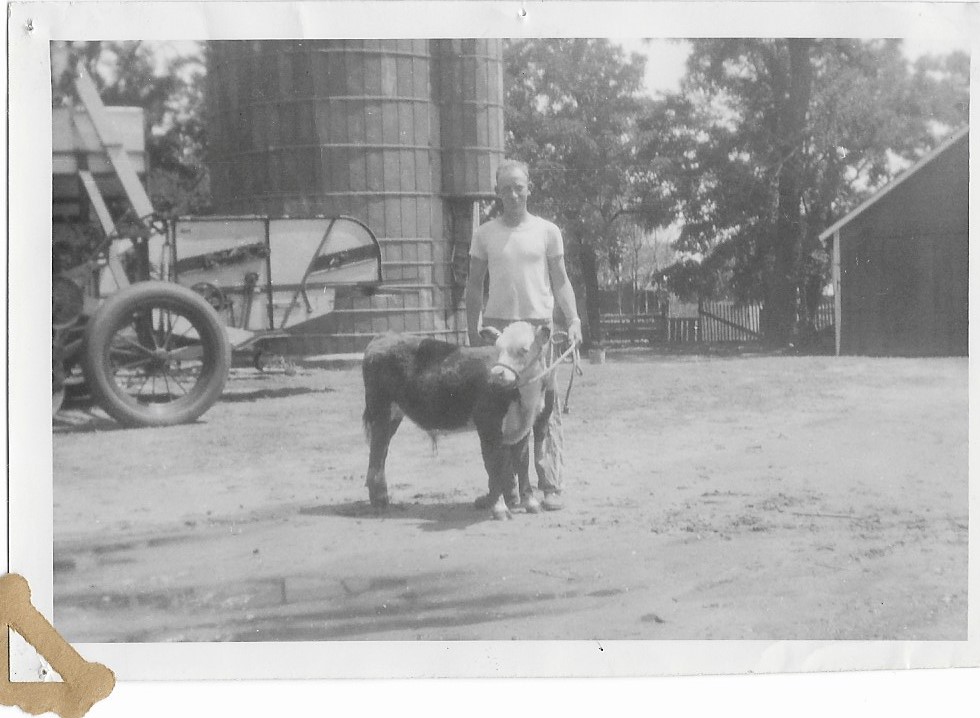
Who knows? Maybe this Hereford pictured with Melvin was on the big pasture at some point. At that time, the Fritzemeiers raised horned Herefords.
Now, Randy and I also have Hereford bulls as well as Angus bulls for our crossbred herd. But we have opted for polled Herefords. 

Before this year's round-up, Randy had been bringing a pickup with hay to the pasture in hopes that they'd come running for a free buffet. However, one lonely cow was the sole curious observer when we first arrived.
Well, that's not entirely accurate. A herd on the other side of the road was curious enough to come to the fence to watch the action and to chime in with a chorus of "cattle calls."
But, eventually, all my honking had generated some interest in our pasture, too.
For the record, alfalfa doesn't give cows "minty fresh breath."
I know because a few of them had their heads practically in my window.
Once the 4-wheelers had made the circuit and had pushed the cows and their calves toward my honking pickup, we began the "parade" toward the corrals, with me leading the way and the cattle following in a cloud of dust.
Then it was time to urge them into the corrals.
While the guys made one final sweep of the pasture to look for stranglers, I sat and read my book.
Then it was time to set up panels, the loading lane and loading chute so we could get the cattle from the pens to Don's semi.
Don built the lane and chute one winter.
The two cousins (along with a couple of other helpers) sorted while I ran the gate. The guys have been doing this a long time and they seemed to know instinctively what the other was going to do. It took four semi trailer loads - two with cows and two with calves - but the job was finally done.
It was just in time. As we were getting ready to leave, the clouds covered the sun and gave us a stunning farewell sky.
We almost got everything unloaded and put away at home before the cold front blew in.

The vet will be here today to preg-check the cows from that pasture and then vaccinate the calves from both the Big Pasture and the Ninnescah. It's going to be a cold day.

But it's a good feeling to have the cattle home - even if it means I now have a daily job driving the Army truck-turned-feed truck. More on that to come.

Tuesday, July 3, 2018

Wheat Harvest: Now That's a Wrap!

Wheat Harvest 2018 is now in the rear view mirror.

We finished up June 29 after starting on June 12. Well, we tried to start on June 12 and would have, except for the raccoon going through the combine. That delayed the start to June 14. We then limped along with repeated visits from the Case repair guy because of an engine power problem, unrelated to the raccoon. We finally started making headway on June 17, a good Father's Day gift for my farmer.

This year's start date was consistent with recent history. (I have good records since 2010 because I've been blogging that long). Our start dates are:

2010:  June 18
2011:  June 10
2012:  May 26 (an anomaly and the earliest harvest, by far, we've ever had)
2013:  June 21
2014:  June 17
2015:  June 20
2016:  June 15
2017:  June 12
2018: June 12 (sort of)
Because of the rough start to harvest, we opted to have a custom cutter harvest 290 acres of our 1,321 acres this year. Even though it's an added expense we'd prefer not to have, we're glad we did it now, after having several days of rain. And, no, we aren't complaining about the rain or cooler temperatures that arrived June 22-26. The rains were beneficial to corn, feed, alfalfa and pastures.
But, back to wheat harvest. Yield averages in the past few years have been:

2010: 37.2 bu/acre
2011: 36.7 bu/acre
2012: 45.5 bu/acre
2013: 52 bu/acre
2014: 24.5 bu/acre
2015: 50 bu/acre
2016: 48.5 bu/acre
2017: 50.84 bu/acre
2018: 39.2 bu/acre
Our 2018 average was 39.2 bu/acre. We had a low average of 11 bushels an acre and a high of 56 bushels per acre. Most of it was in the 35 to 45 bushels per acre range. The 11 bushels an acre was on ground the landlord bought primarily for hunting, so it's less productive ground. Because of our dry fall and winter, much of it didn't come up until the spring. That put green heads among the dry heads, which was one reason for the delay in cutting and the poor quality.
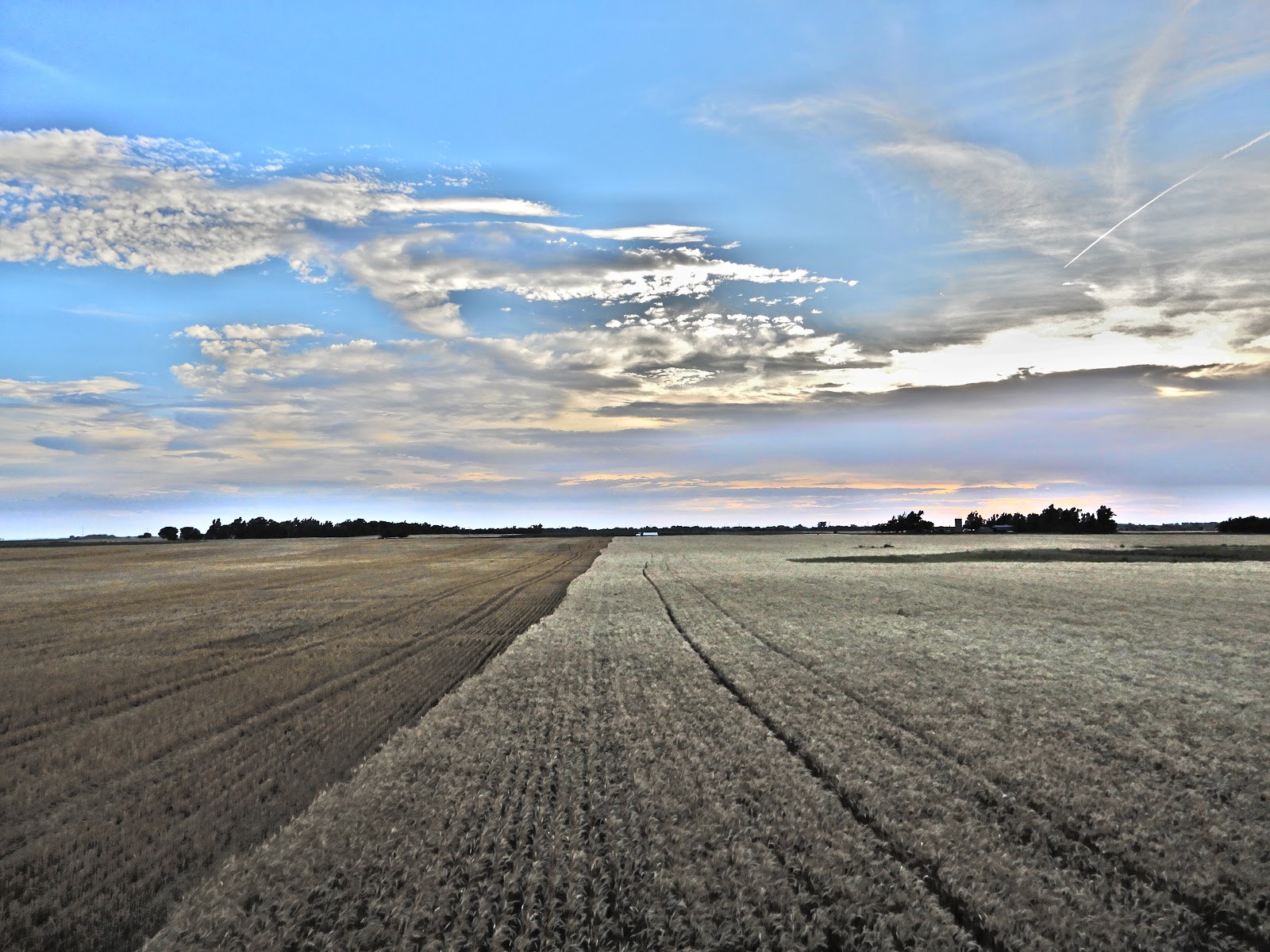
Used the "painting" setting on the camera for a different look
After being in an exceptional drought category for much of the winter and spring, Randy was pleased with the yield totals. Some late spring rains came at just the right time for the filling of the wheat heads, and we are thankful!
Randy is always thankful for harvest pie, too. He doesn't get dessert all the time. Blueberry pie with crumb topping makes harvest a little more palatable and was my Father's Day gift to him. (Here's a two-crust version at this link.)
Photo taken June 22, 2017 - Wheat Harvest 2017
Wheat Harvest 2018 isn't just about cutting wheat in June. It actually started with Wheat Harvest 2017. (Notice how I capitalize Wheat Harvest. It's a "Big Deal" to our farm. By far, wheat is our biggest crop.) Each year, we plant some certified seed, which we use for seed wheat for the following year. Randy binned KanMark (a K-State release) and WB 4458 (a WestBred variety) to plant for seed wheat for our 2018 crop. During the 2017 harvest, we binned the seed wheat in on-farm storage.
Then, last July, we took the wheat to be cleaned to Miller Seed Farms. (See blog post: A Kernel of the Process: Cleaning Seed Wheat.)
In October 2017, we planted the 2018 wheat crop. (Read more about it here: Planting Wheat, Harvesting the Sky.)
 
The lack of moisture was a concern during the winter and spring. In fact,  November 2017 to January 2018 ranked as the driest (lowest precipitation) on record for Kansas, receiving less than 25 percent of normal precipitation for that time period.  (Read more about it here: Precipitation Woes.)
 
Our first measurable precipitation on the 2018 wheat crop after planting came in late March. (Read more here: Million Dollar Rain?)
Because of cooler temperatures and slow growing in April, a freeze didn't nip the growing point in our fields. (Read more here: Rain, Rain, Come Again Another Day.)
 
The wheat was heading by early May. (Read more here: April Showers.)
And then the main event came in June. Cutting wheat is usually Randy's favorite time of the year.
You sure can't beat the scenery seen from the elevated vantage point of a combine cab. (The poem in the photo above was written by a Kansas poet who lived for a time in Belpre, a town in the county to our west. Fittingly, her husband ran the grain elevator there.)
However, this year's harvest wasn't all beautiful scenery, as evidenced by Randy shaking out the air filter ... yet again. But there was plenty of good, too.
The last of that combine bin trickles out as the last bit of light fades from the sky.
And that, as they say in show business, is a wrap.

THE END ... until a new beginning for Wheat 2019.

Thursday, October 10, 2013

Sun Sets on Wheat Planting

God's canvas is as big as a Kansas horizon. As the sun sank into the west and tinged the clouds above with light, His masterpiece spoke of promise and hope. It's a good thing to remember as we come to the end of wheat planting.

As I've hauled people and meals to the field, the air has been heavy with dust as tractors pulling discs and drills run back and forth across dry land. Though we were blessed with some good rains in July, it hasn't rained appreciably since. And we are once again planting into dust.
This was a graphic I created last year, after reading the quote in The Hutchinson News.
It may not be as bad as it was last year during planting when we were in the second year of exceptional drought, but it still reminds me of the chorus of a Brad Paisley song:
And the tractor keeps rollin'
The dust rises high
Creating the only cloud in the sky
He's holdin' his ground
But it's gettin' tough
He's keepin' his faith
In the Lord up above
And prayin' for rain
Through a cloud of dust
We began planting the 2014 wheat crop on September 23 and finished yesterday, October 9. Wheat is the primary crop here on the County Line, with a little more than 1,400 of the acres we farm planted to wheat.
Here in Central Kansas, we plant winter wheat. It's planted in the fall and then goes dormant during the cold months of winter before coming out of its "hibernation" and growing again next spring, then maturing for a June harvest.

We saved some of our 2013 crop in bins on the farm to use as seed wheat. It's binned during harvest, and then we load it into the truck to take to Miller Seed Farms near Partridge for cleaning. They treat it with Cruiser, a fungicide, which helps protect the small wheat plants from disease. It's also treated with Vibrance Extreme, an insecticide which helps keep bugs at bay.
We also buy some certified seed in bags to plant for our own seed wheat for the following year. This year, Randy bought 1863, a new Kansas State University-developed variety, and Cedar, a WestBred-developed wheat seed. This gets new wheat varieties in our rotation and helps keep the purity in the seed.
Once we got home with the certified seed, it went immediately into the drill. We had to go back later to pick up the wheat in the truck, after it had been cleaned and treated. Randy then augered it into the drill for planting. 
As with every planting season, I think about the optimism that seems to be part of the fabric of every farmer. They put a seed in the ground and then wait like a kid on Christmas morning. They slow down as they pass a planted field, just waiting for that first glimmer of green. And then the miracle begins again for yet another season.

This year for the first time, we planted wheat in fields where we had just harvested corn. So, it's a different sight to see corn cobs lying in the newly-emerging wheat. And, some volunteer corn has sprouted along with the wheat. However, when we get a frost, the corn will die.
The corn is the rounded plant. The wheat looks like grass.
The wheat is coming up in the earlier-planted fields like little soldiers in a row. And the cycle of life continues here on the County Line.
Before the reward, there must be labor. 
You plant before you harvest. 
You sow in tears before you reap joy.
Artist Ralph Ransom