Showing posts with label harvest storm. Show all posts

Tuesday, June 23, 2020

Beauty and the Beast

Certain as the sun
Rising in the east
Tale as old as time
Song as old as rhyme
 
Beauty and the beast ...
From Disney's "Beauty and the Beast"

On Monday, as we drove around looking at damage from a straight-line storm that blew through Sunday evening, the song "Beauty and the Beast" rumbled around in my head.
No - I did not add a sunglow in editing this photo. Sunbeams really were streaking the sky!
Just last Thursday night, as the sun was setting, I was snapping photos
 to the north ...
to the south(west) ... 
and to the west ...

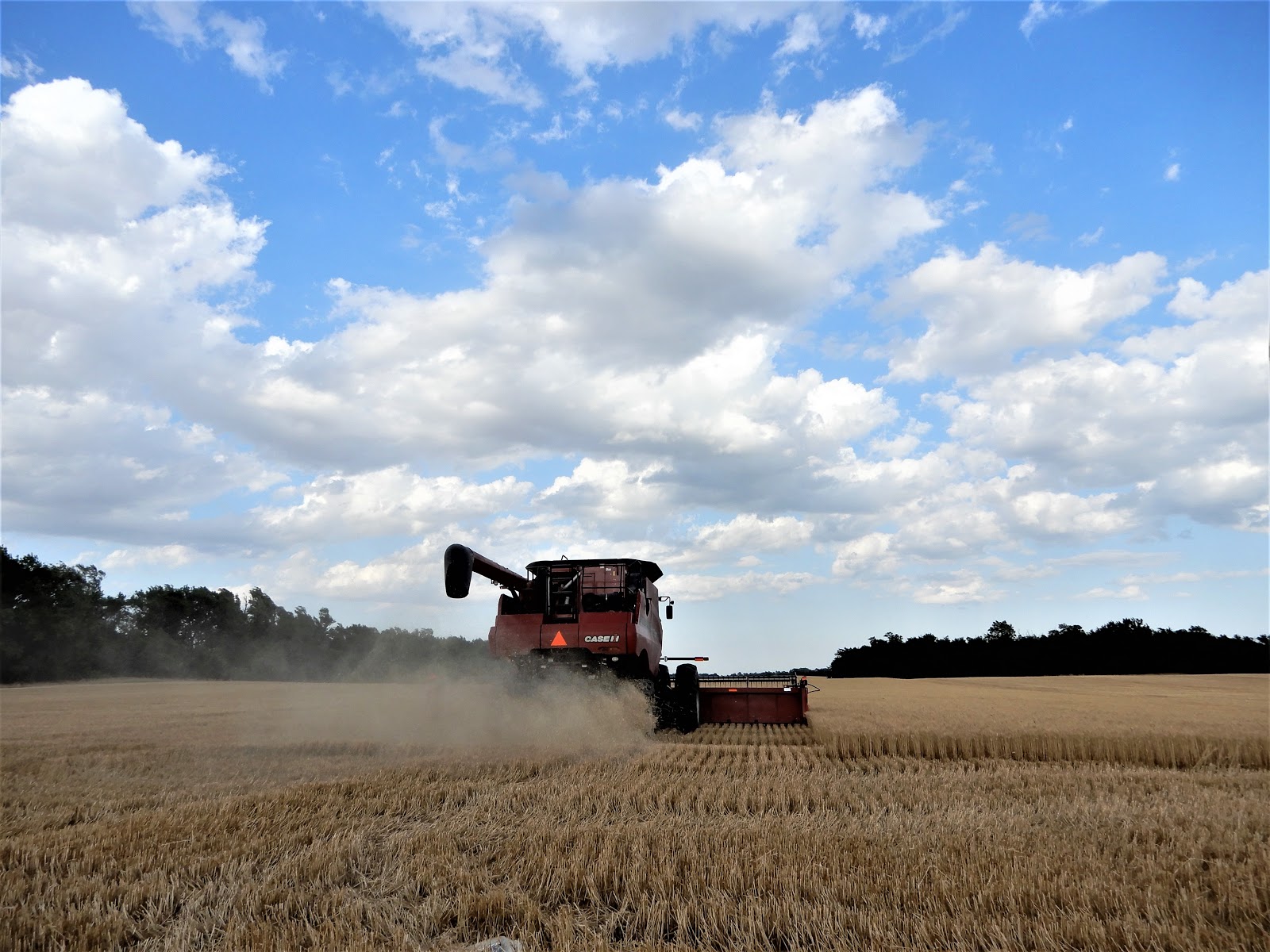
... as the clouds made a beautiful backdrop from a Kansas wheat field. (OK, I guess I missed the east but the show was great in every other direction)!
 
It was literally like the heavens were shining down on us.
But that night, it rained anywhere from 1.75 to 3 inches and halted harvest in its tracks after just three days of cutting.

"OK. It's great for the corn, the alfalfa, the pastures. I'll try to be happy." (Even though it kept our whole family from gathering for the weekend for the first time since the coronavirus pandemic began. Honestly, I was having trouble being happy.)

And then another storm blew through on Sunday evening, leaving behind another 1.25 - 1.60" of rain and some damage. Storms during harvest seem to be a "tale as old as time," all right! 

Our lean-to shed is leaning more than it's supposed to after 60-70 mph straight-line winds.
Our neighbor's semi cattle trailer is not ready for action after Sunday night's wind.
Randy had to find an alternate route to get to the pasture to check our heifers with so many large branches blown down by the Peace Creek Cemetery, a rural cemetery just a mile north of where Randy grew up.
I'm still trying to be thankful for the additional rain, which should help fall crops like corn, milo and silage, as well as the pastures.
Corn field - June 22, 2020
Silage - June 22, 2020
Ninnescah Pasture - June 22, 2020
But we'll be glad when we can get back to the wheat harvest field, too. Some places will be a little slower going, since the rain and the wind have knocked some of the better areas over.
It's hard to capture on the camera. This is a seed wheat field, which is better and thicker wheat. More of it is down, so it will make cutting a little slower.
But I hope I'll soon be able to add more pretty harvest pictures to the ones I took last Thursday evening.
As I told Randy then, I have already taken more "pretty" photos from harvest than I did all of last year.
 
Last year's harvest was bad because of flooding that began in the fall of 2018 and even prevented planting in some of our wheat fields. The water-logged fields continued into the spring. Our overall average yield in 2019 was 23.6 bu/acre.
In the three days we've been cutting in 2020, we've averaged between 40 and 70 bushels/acre in each field. Hopefully, the yield and quality will hold up as we get back in the field.
Ever just the same
Ever a surprise


Ever as before and ever just as sure as the sun will rise ...
( Or in this case, as the sun will set.)
Yes, Kansas weather can be Beauty and the Beast.


Wednesday, June 29, 2016

Stormy Weather ... and Attitudes

I used HDR in editing this photo (just FYI).
I was off on a parts run to Hutchinson when I got the dreaded phone call: "No need to hurry home. We just got rain, wind and hail where we were cutting wheat."

It was all I could do not to cry at the parts counter of Straub's. Yes, harvest is yet again halted in its tracks.

While I can't compete with Mr. Optimistic, in general, I'm a fairly positive person. But the stormy weather is creating some stormy attitudes on the County Line right about now. We started Wheat Harvest 2016 on June 15. Here we are - two weeks later - and we are a little more than halfway done.

At this little space on the internet, I try to leave a bit of beauty and light through photos and words. But there are times when some honesty is in order, too. I can't do a darn thing about the weather. Well, I guess I can complain about it, though it doesn't do any good.
The stormy sky as a backdrop for the Zenith elevator made for a pretty spectacular photo as I turned toward home. OK, there's a positive.

I know that I'm supposed to be all thrilled that it rained for our fall crops. And I am thankful for that. But let's get real: We are wheat farmers.

The current price of wheat at my local co-op is $3.26 per bushel. During the 9-month life cycle of this crop, we've spent money on seed, fertilizer, herbicide and fungicide. Throw machinery costs, fuel costs, labor costs, insurance premiums and land costs into the mix.
I'll tell myself we're breaking even. I'm not sure that's true. But it's why it's even more important to get it out of the field and into the elevator. After rain (and hail in one location), the wheat keeps sagging lower to the muddy ground, making it even more of a challenge to cut. 

We decided not to have any of our acres custom harvested this year because of purchasing the new-to-us combine at a farm sale this spring - and because the price is so low.

I read an article last week that said the price of wheat on July 1, 1976, was $3.50. Yes, you read that right: 1976, 40 years ago, the price of wheat was higher than it is today. Can you think of anything else that has gone down in price in the past 40 years? Me neither.
This wheat stalk must be the optimist in the bunch!
While at the co-op website to check the price, I looked at the weather forecast for the next few days:
Wednesday, 55% chance of precipitation
Thursday, 41%
Friday, 80%
Saturday,60%

On Monday, Randy fought mud as he slogged through the wheat field across the road, finally giving up and moving to what he hoped was a drier location. It's not drier any more. Randy was not the only thing that got soaked as he tarped the trucks yesterday. So did the wheat and the ground upon which it stands.
Sunshine after the storm went through. We only got 0.20" at home, but that's where he was fighting mud already.
So ... back to the fall crops: The rain was good for the corn. However, since we are exclusively dryland farmers, we don't have a large amount of corn or milo planted. Wheat is far and away our bread and butter - pun intended.
The corn is tasseling and pollinating now. The cooler temperatures are beneficial to that process, too.
Silver lining? I suppose. But we have a long time until harvest on corn, and I'm not counting on anything at the moment. 
Rant over? Maybe. I'll try to be back to my more cheerful self the next time. I do have some pretty photos to share from a 4-wheeler check of the Ninnescah Pasture during another rain delay. The rains nourish the pasture grasses and the cattle look great. Maybe reviewing those photos will lower my blood pressure. Or maybe I need another trip to listen to the water rush over the dam at the pasture.

Wednesday, June 22, 2016

The Bigger They Are, The Harder They Fall


Perhaps you have noticed that even
in the very lightest breeze,
you can hear the voice of the cottonwood tree.
--Black Elk

The big old cottonwood tree has had a supporting role in many a photo on the County Line.
As we've taken cattle in and out of the pasture we call "Palmer's," it has stood as a sentinel to our comings and goings just beyond the southwest gate. Its stance at the bottom of a cottonwood-tree-lined hill made it the focal point for photos as Randy would go back to close the gate and I'd step out of the pickup to document its fall or summer "outfit."
But a mighty wind felled the mighty cottonwood Friday night.
The weather ticker at the bottom of the TV screen Friday night said there were 58 mph winds at Quivira National Wildlife Refuge. That gave a definition to the howling I could hear outside my living room windows. I'm always a little concerned when the wind screams ferociously. Our house is nestled among many old trees. Someday, I envision one of them crashing into the roof. This time, our homestead trees survived. But one of my favorite cottonwoods did not.
 
The cottonwood stood just across the dirt road from this Quivira National Wildlife Refuge sign, "Headquarters, Visitors Center, 1 mile." (You can see the old cottonwood's leaves in the upper righthand corner of this photo from 2010.)

But it will no longer stand at attention as visitors drive to the refuge or as we make trips to the pasture. Look closely at the photo below and you'll see Randy in the center.
 That gives a better gauge of the massive size of the old cottonwood tree.
The tree snapped apart and completely blocked the road.
 
Randy didn't think our loader tractor could do the job of moving the massive trunk, so he called the township board. They already had it taken care of by Sunday evening.
We can't believe it didn't squash the fence when it crashed to the ground.
You can see how massive it is. Randy is in the lower right of this photo, hidden among the leaves.
More cottonwood trees line the road to the east. They survived this round of storms. As I stepped through the fallen branches, I realized that the cottonwood leaves that I'd used to frame many photos on the lefthand side were now framing the righthand side of the shot. .

Here the old cottonwood was decked out in its fall finery during one of our trips to take cattle to the pasture.
I have a lifetime love of cottonwoods. At my childhood home, an old cottonwood stands near the south driveway. The cottonwood tree has been one of the first things visitors see as they approach the farmstead and one of the last things you see silhouetted by a sunset sky at night.

Mighty cottonwoods form a canopy down many a country road in rural Kansas. Early Kansas settlers found the native trees as they arrived from the eastern U.S. When the Kansas Legislature chose the cottonwood (Populus deltoides) are the state tree in 1937, the proclamation read:
"Whereas, if the full truth were known, it might honestly be said that the successful growth of the cottonwood grove on the homestead was often the determining factor in the decision of the homesteader to 'stick it out until he could prove up on his claim'; and Whereas, The cottonwood tree can rightfully be called 'the pioneer tree of Kansas.' "
They are like the old family patriarch - tall, stately, but maybe a little rough around the edges after years of standing through the changing seasons. Just like the road to the Palmer pasture, many a country road is lined with these big old trees, which seem to wave a friendly greeting in the Kansas breeze. On early morning or late evening trips to check cattle, the cottonwood's leaves rustle and birds serenade from their branches. Their attire changes with the seasons - whether clothed in green for summer or in yellow finery for fall or stark and drab in winter's solemnity.

In 2011, the Kansas Cattle Drive herded longhorns down the road and past the cottonwood as they traveled to Quivira for an overnight stay.
The old cottonwood had towered over the longhorns and the riders as they traversed the dusty road.
You know that old saying, "The bigger they are, the harder they fall."  Yes, and the bigger they are, the harder to watch them fall, too.

Goodbye, old friend. It's been good to know you.