Showing posts with label 2018 corn. Show all posts

Thursday, September 27, 2018

Done Deal: Corn Harvest 2018

Corn at harvest time is not that pretty. Someone may revoke my farm wife license for saying that. But it's the truth, at least for me.

I think wheat is beautiful at pretty much every stage of its 9-month journey. And at harvest? Well, those "amber waves of grain" actually made it into a pretty famous song, so I'm not alone in my appreciation for a prairie "seascape" of wheat rustling in the hot Kansas wind under an azure blue sky.
 
Corn on the other hand? Well, it's dried up. So are the stalks where the corn grew. It's a sea of dry brownness. No wonder they didn't make up a song about that.
 
So I'm always looking for a different way to show the beauty of corn harvest. Having all those golden kernels pile up in the combine's grain tank behind you is kind of pretty ... even through dirty glass.
My favorite farmer loves being in the combine, so that makes for a pretty picture, too.
We started corn harvest September 4. After some rain delays, we finished on Monday, September 24. This year, we had 280 acres of corn, a little less than last year. Since we are an all dryland farm, wheat remains our primary crop.
This year, we had a high of 107 bushels per acre and a low of 60. The overall average was 82 bushels per acre. Randy says one-third of the crop was great and the rest was OK. It all depended on when and where the rain fell this summer and the timing for 100-degree days.
All the corn was No. 1 quality. It was a good test weight and dry.

How does Corn Harvest 2018 stack up with previous years' averages?
2018 - 82 bu/acre
2017 - 43.6 bu/acre
2016 - 71 bu/acre
2015 43.88 bu/acre
2014 - 108 bu/acre
2013 - 57 bu/acre (This was the first year we added corn into the crop rotation).

When you reach the end of a season, it's always good to look back to where you've been. To read more about each stage, click on the links below the photos:
We started planting corn April 24.
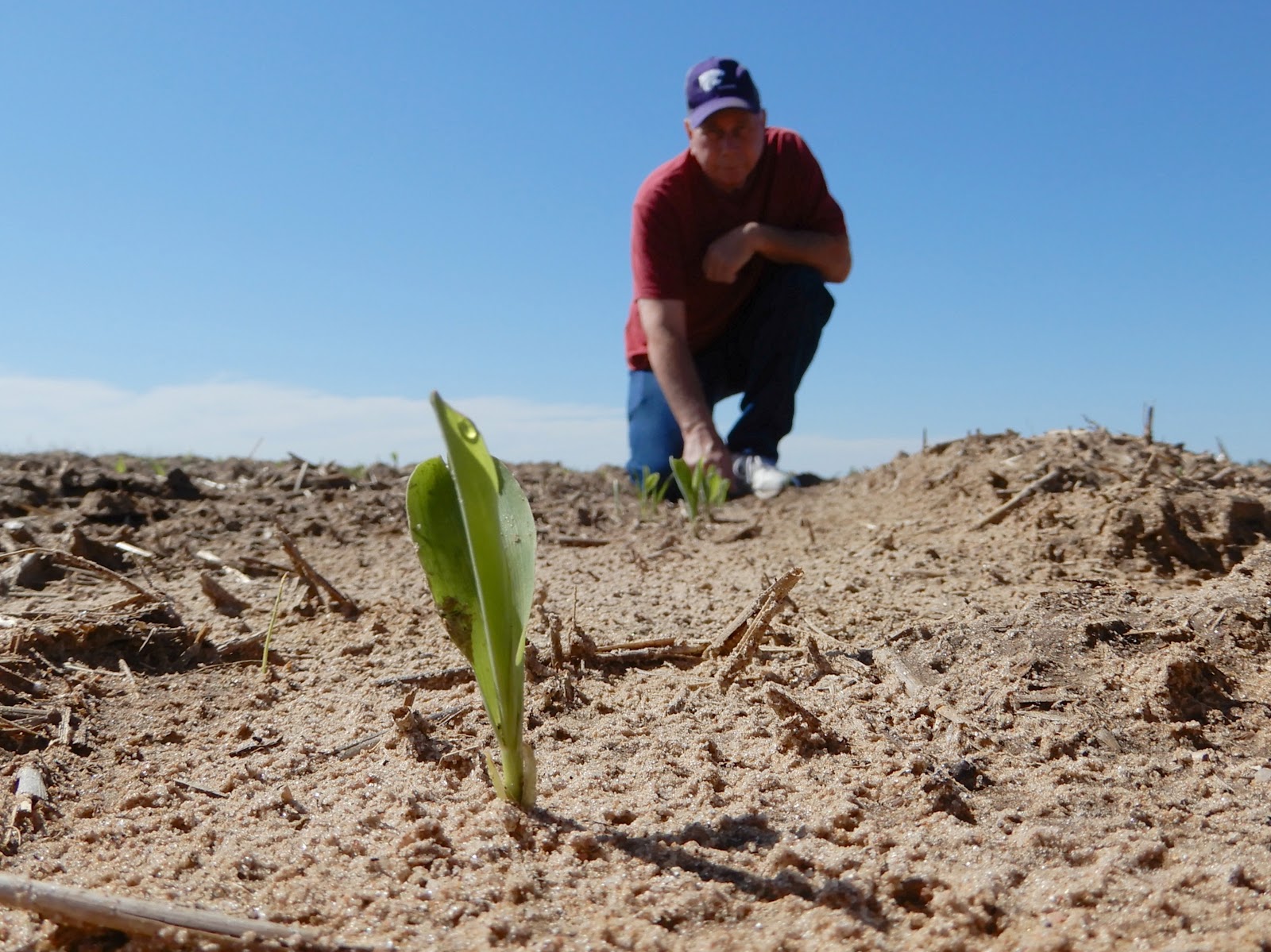
Some of the corn was emerging in early May.
On June 26, it was almost chest height on Randy. This year's variety was a little shorter to begin with, but it was also stressed with heat and lack of moisture as it started to grow.
By late June, some was starting to form ears.
I took the next photo updates on July 16.
There's always harvest drama of some sort. This time, soggy ground led to some sticky situations.
But, we eventually, got the job done.
Next up? It's time to plant wheat. We plan to get started today.

Tuesday, September 18, 2018

A Pickin' and A Grinnin'?

We were back to "pickin' " yesterday, but there wasn't much "grinnin' " going on. Corn Harvest 2018 started way back on August 31. We got one landlord's corn harvest completed that day.

And then it rained ... and rained ... and rained.

Not that we're complaining. Really. After a winter with no moisture of any kind -- neither rain nor snow nor sleet -- we aren't turning down moisture.

Randy tried to resume corn harvest after a 2-week hiatus on Monday. The corn is dry. The ground is not. He did get more harvested yesterday, but it also involved being pulled out of the muck several times with a 4-wheel drive tractor.
About the same time as he got stuck the first time, we had a breakdown with the disc. I was already going to Hutchinson to pick up my state fair photos. But, of course, the dealership in Hutchinson didn't have the needed parts.

So I had a lovely detour to Kingman on the way home. It could have been worse. The parts could have been out-of-state and we would be waiting on UPS to get it fixed. And it really was a nice day for a drive.

After filling the truck and combine, Randy switched jobs and baled sudan. The same deluge also soaked our sudan hay. Randy had abandoned one field of swathed sudan because it rotted after getting soaked repeatedly. He plans to let that field of sudan re-grow, and he'll turn cattle out on it this fall.
But he is trying to salvage some of the sudan. It looked like he was baling up the sun last night.

From stuck combine to sunset beauty, it's all part of life on The County Line.

Thursday, July 19, 2018

Don't Count Your Chickens (Or Your Kernels)

" Don't count your chickens before they hatch."
It's advice that's become so ingrained that we all know the saying.

I'm thinking I need to add an addendum for my chronically-optimistic farmer: 
Don't count your kernels before they're combined.

A 2.10" rain last weekend practically had Randy dancing between the rows of corn. (Well, he might have if he were a dancer. Instead, he wanted me to come and take a photo.) However, since our dryland corn has never been a bin buster in the 6 years we've had it in the crop rotation, I'm tamping down any feelings of elation I might have until I can see the elevator receipts. And we've got a while until that happens.
However, there's no question that more than 2 inches of rain were a blessing on our farm. We got another 0.25" Tuesday morning.
 
Still, it came too late for some locations. Compare this cob to the fully-loaded one in the other photo.
The recent rains should help with filling milo heads.
 
And it definitely helped give our pastures another needed boost. Since the second cutting of hay is off the fields, we're hoping for some good growth for the alfalfa crop, too. 
Randy was excited enough about fall crops that he entered field corn, milo and forage sorghum in the Stafford County Fair. They all got blue ribbons. (Nobody else entered those categories, but who's counting?!)

Thursday, June 28, 2018

Singin' in the Rain (But Not Dancing)

Milo field, June 26, 2018
"I'm singin' in the rain, just singin' in the rain.
"What a glorious feeling! I'm happy again. ...
"Come on with the rain, I've a smile on my face
"I walk down the lane with a happy refrain
"Just singin', singin' in the rain."

We'll skip the Gene Kelly dance. Dancing is not our forte. (I've been trying to forget my pitiful K-State Singers choreography audition for years, but it keeps playing like a nightmare in my dreams. Thankfully, K-State Concert Choir did not require dancing.)

A-n-y-w-a-y ... we may not be dancing in the rain, but we are singing God's praises with this timely rain,  even though I had hoped to write a wheat harvest summary by now.  However, since we still have 100 acres of wheat to cut, we'll move on to a tour of crops that have loved the 3.40 inches of rain we've had in different installments since June 20. We will try the wheat again later this afternoon.

MILO
Ah, the smell of geosmin on a summer day!

(Yeah, I didn't know what to call that unique aroma that wafts from a field after a rain, but a quick question typed into Google says it's ‘geosmin’ - literally “Earth smell.")

There's no better perfume according to a farmer who sees the little green plants visibly perking up after a soaking rain.
The milo was planted May 23, and this past week's rains should make it grow faster than a toddler on a growth spurt.

CORN
This photo was taken May 1, when we were planting the corn crop. (Corn planting was April 29 through May 3.)
On June 26, it's almost chest height on Randy. This year's variety is a little shorter to begin with, but it was also stressed with heat and lack of moisture as it started to grow. You can see the stress on the leaves.
However, the 3.40 inches of rain we've gotten in the past week has come at an opportune time for the crop, since the corn is pollinating.
 It's also forming ears.
The rain was "super beneficial and came at an opportune time. However, we'll need more rain in a few weeks for good yields"... a direct quote from my farmer.

SILAGE
I know this doesn't look much different than the milo field. But it's a silage field. It, too, likes the rainfall. Since our alfalfa has been impacted with drought conditions so far, we hope to have plenty of silage to put in the trench silo this fall to give our cows and calves plenty to eat this coming winter.

SUDAN

The rain has delayed the planting of sudan. Later this summer (if all goes as planned), we'll swath and bale sudan, also for cattle feed.

 Our rain Tuesday morning was somewhat unexpected, and Randy had already put some of the sudan seed in the drill.
I'd never noticed this handy-dandy chart for grain in pounds per acre inside the drill.
It will be ready to go when the fields dry out just a bit - maybe even today!
***
It's not "Singin' in the Rain" that I've been humming since last night. Instead, I've had a revolving medley of "Luck Be A Lady" and "Bushel and a Peck" after going to Music Theatre of Wichita and seeing "Guys and Dolls" last night. A friend sent us complimentary tickets we could use for any show this summer, and rain earlier in the week kept us out of the field on my birthday. Surprise! We had to go to the ticket office to exchange them in person for the real thing, and we were lucky enough that tickets were available. As always, the sets, the choreography and the performers were top-notch. It was the perfect birthday gift. Thanks, Sheila!

Tuesday, May 8, 2018

April Showers Bring Fall Corn?

If April showers bring May flowers, we hope May showers bring fall corn. (And those May showers sure don't hurt the wheat crop, alfalfa or pastures either!)
Randy started planting corn on April 24 this year, later than normal. I took these photos the afternoon of May 2, the second day when our part of the state had the chance of severe thunderstorms. Thankfully, we got 1.40" of rain, but missed the hail, tornadoes and high winds that other parts of the state experienced. It rained Randy out before he could finish the field, but he got done yesterday afternoon.

The rain certainly gave the newly-planted corn a boost. So does the nitrogen fertilizer Randy applies  to promote germination and early growth.
This year, we planted 280 acres of corn, a little less than last year. I'm sure that seems like small potatoes - or small sprouts - to anybody who has circles of corn. Since we are an all dryland farm, wheat remains our primary crop.
On a walk last Friday, we checked out the newly-emerged corn coming up in fields where he'd first planted.
Our walk also took us past a wheat field, where it was starting to head. The 2018 Wheat Quality Council's Hard Winter Wheat Tour was last week. And the 95 participants who traversed the state along six different routes found what we already knew: The 2018 wheat crop is behind schedule. Because most of wheat country has been in a severe drought since last October, the crop is shorter than normal and head size is smaller. 
Friday, May 4, 2018
The Wheat Quality Council's estimate for the 2018 Kansas wheat crop is 37 bushels an acre. Kansas Wheat reports that total production of wheat to be harvested in Kansas is 243.3 million bushels. If realized, this would be about 90 million bushels less than last year's crop and the lowest production in Kansas since 1989.
Monday, May 7, 2018
By Monday afternoon, many more heads were unfurled in the wheat fields.
My eternal optimist reports that the rains late in April and early in May should help some,  especially if we don't plunge right into summer temperatures. However, these days with 85-degree-plus temperatures won't do the crop any favors.