Showing posts with label milo harvest. Show all posts

Thursday, October 21, 2021

Go Big Red: Milo Harvest 2021


Go Big Red!

If we're talking high school football, red IS our color. 

We also cheer for RED when the Fighting Unicorns are playing. 

 
However, in the college football realm, we bleed purple around here.

K-State vs. Iowa State - Farmageddon - October 16, 2021


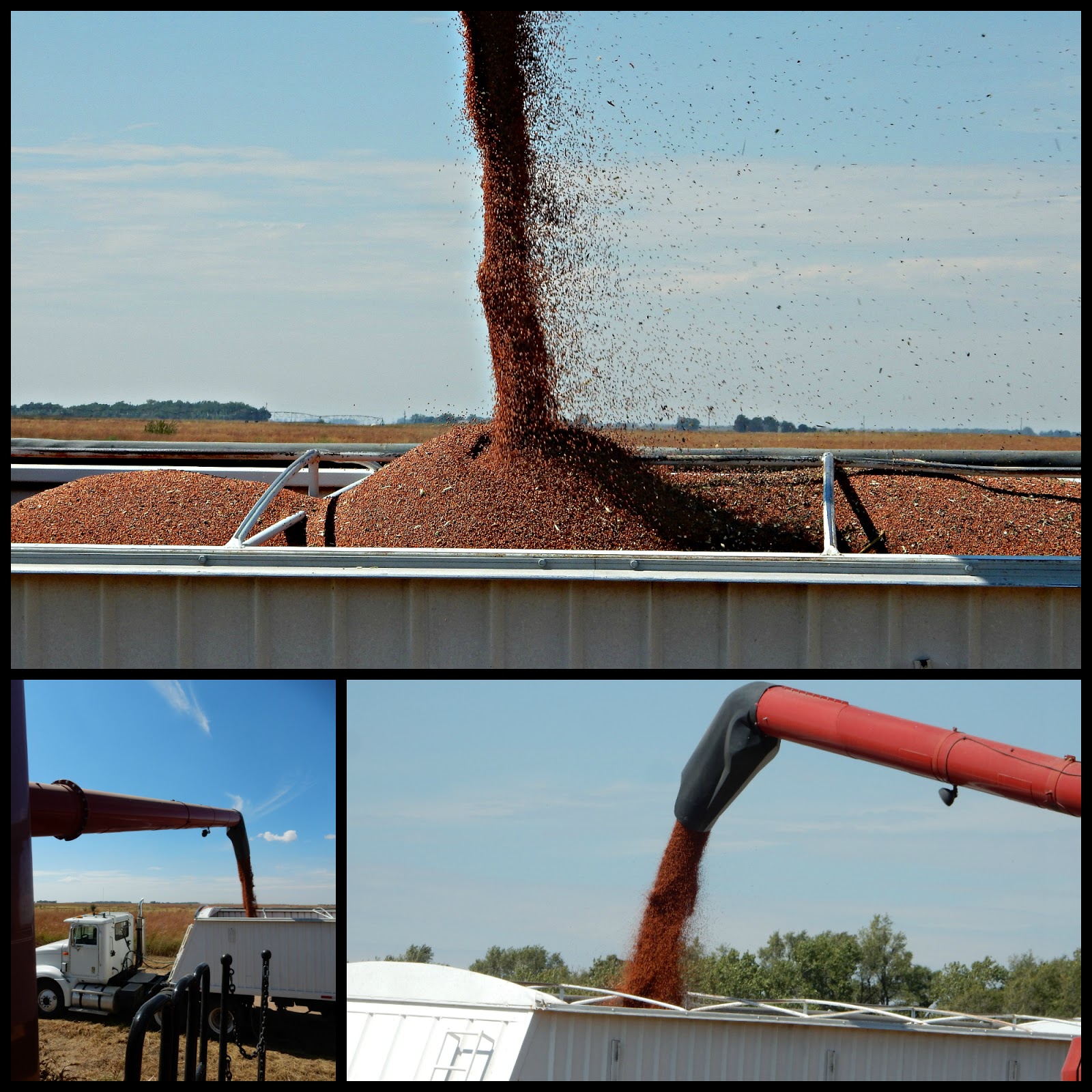
But the "Big Red" I'm talking about this week is our Big Red Case combine cutting our Big Red milo crop. ... OK, it's not such a big crop here on the County Line. 

However, Kansas grows more sorghum than any other U.S. state. Our personal milo harvest does not contribute much to the statewide total. We only had 50 acres of milo in 2021, and harvest was done in less than a day. But it's always good to cross another job off the list. And this one was important for a couple of reasons: 1) It's the last of this year's fall harvest; 2) It's our final milo harvest as active farmers. 

October 20, 2021
 (We are still planting wheat to be harvested next summer, so don't usher us out the door quite yet).


The use of sorghum for human consumption is being developed further in countries where malnutrition and hunger are prevalent. In the fall of 2016, the Kansas State University College of Agriculture Ag Report had an article about sorghum:
In the Mara Region of Tanzania, one of the most starved areas of the world, K-State grain scientist Sajid Alavi is part of a research team working to improve child nutrition and health by providing a sorghum-soybean porridge blend to children younger than 5. ... While the results of the five-month study are yet to be finalized, Alavi said the early indications are that children were more healthy and had average growth rates.

Milo is getting some additional traction in the U.S., too, as consumers seek gluten-free alternatives. 

Pheasants are big fans of the grain, too. As we were finishing up the field, we scattered several pheasants.

It wasn't so easy to capture the wildlife action through the dirty combine windows. These were the best I got.

Randy was both the combine driver and the trucker for milo. Our employee just up and quit mid-morning a couple of weeks ago. But that's another story. Randy's lifelong friend, Rex, has been helping us finish wheat planting. So he been driving the disc tractor to get the field ready for Randy to plant after a rain delay last week. (Que the music for "We Get By With a Little Help from Our Friends.")


Once Randy had the truck loaded, he tarped it and off he went to Zenith to deliver the final truck load of milo - and fall crops - for the year.

I

I may have another job to add to my list after his trip to Zenith though. One of the employees there mentioned "Randy's wife's" cookie baking. I think it was a subtle hint. 

And we are thankful for all the people who make it possible to do our jobs - from the Kanza Co-op staff to the parts counter guys at Case and John Deere to the friends who fill a tractor seat in a pinch. 

***

A quick look back at the 2021 milo crop:

Milo as it was coming up, June 4, 2021

And, by July 28, 2021, it looked like this:
We cut the crop on October 18, 2021:
That's a quicker turnaround than the wheat crop, which will take about 9 months from planting to harvest.

Tuesday, October 22, 2019

Anticlimactic: Milo Harvest 2019

Say "harvest" in a room of farmers and it could be a little like shouting "Fire!" in a crowded theater.
However, milo harvest on our farm this year was anticlimactic. While Kansas grows more sorghum than any other U.S. state, here on the County Line, we are not contributing much to the total.
In 2014, Kansas ranked first in grain sorghum production in the U.S. with more than 200 million bushels grown, which equated to more than 40 percent of the country's total production. 

The use of sorghum for human consumption is being developed further in countries where malnutrition and hunger are prevalent. Kansas State University College of Agriculture Ag Report says:
In the Mara Region of Tanzania, one of the most starved areas of the world, K-State grain scientist Sajid Alavi is part of a research team working to improve child nutrition and health by providing a sorghum-soybean porridge blend to children younger than 5. ... While the results of the five-month study are yet to be finalized, Alavi said the early indications are that children were more healthy and had average growth rates.
But milo is getting some additional traction in the U.S., too, as consumers seek gluten-free alternatives. On a Discover Kansas trip with our Kansas Master Farmer Homemaker group a couple of years ago, we toured NuLife Market in Scott City.
NuLife Market Founder and President Earl Roemer gave us a tour. Earl’s family has farmed in the western Kansas for four generations. For years, his family grew grain sorghum – also called milo – as a feed grain crop for livestock. But then Earl began exploring how sorghum could be a human food source, especially as more and more consumers wanted gluten-free products. Sorghum has no gluten.

He admits that the early grain sorghum products “tasted like cardboard and the texture was like sand.” In 2007, Earl founded NuLife Market in Scott City to produce and market sorghum-based products and sell sorghum ingredients to other food companies.

NuLife uses sorghum grown in the region, providing value-added opportunities for area farmers. And now NuLife supplies sorghum and sorghum products for companies like Kashi, Bear Naked, Go Lean and Annie's Organic, just to name a few. Their sorghum products can be found in more than a thousand products, such as gluten-free baked goods, cereal bars and snacks, represented by some 80 brands. Nu Life Market is shipping its products coast to coast and beyond.

Our little milo crop just travels a few miles to the Zenith branch of the Kanza Co-op. Some of the milo in our area goes to the ethanol plant near Pratt.
 We only had 95 acres of milo, so it only took a couple of afternoons from start to finish.
It was not a bin buster in yield either. The overall average was 40.1 bushels per acre, with a range from 27 to 67 bushels per acre on different fields.
I came home from an afternoon meeting and decided I'd better go ride the combine if I wanted to experience milo harvest at all this year. A parts run took me away from the field the other afternoon.

Compared to wheat, the whole life cycle of milo is much shorter, too. Randy planted the crop in early June.
By June 13, it was up and growing.
June 13, 2019
 
By August 23, when I took the photo below, the milo was headed out and starting to turn.
 And, with that, the sun sets on another harvest of 2019.