Showing posts with label modern agriculture. Show all posts

Tuesday, November 25, 2014

Old War Horse

I cringe when I see farmers depicted as country bumpkins. You know the drill: They are in overalls with a wheat straw in their mouth, but it doesn't matter anyway because they sound like uneducated fools. It's the "Green Acres" syndrome.

Of course, there is an increasing number of people who actually want farmers to take a step back into the early 1900s. While they bite the hand that feeds them via their latest version of iPhone and tweet their opinions about how farmers are poisoning the world, they would rather farmers use a horse and plow ... while wearing their overalls, of course. (By the way, my Grandpa Neelly wore overalls, and he was no country bumpkin either.)

So, when Randy fires up the old Ford 8N tractor and I share a photo of it on a Facebook post, I hope people don't think it's the way we farm.  We have our Case STX 375 tractor. (It has 375 horsepower, compared to about 25 horsepower for the Ford tractor.)
We have finally joined the army of semi trucks that take grain to our local co-op. (It has 425 horsepower.)
And we really went the Army route with our new-to-us feed wagon.
But, this past week, Randy again used the Ford tractor. These days, we have a wire winder on the back and use it for building and rolling up electric fence so we can move cattle there for grazing.
A photo from fall 2013.
 I think the rust is the only thing holding it together.
But there is something about tradition. That tractor seat has been occupied with five different generations now.  Melvin and Clarence bought the tractor back in the 1960s, when Randy was in grade school. They used it to load silage for feeding cattle. Randy remembers using it to pull a two-row John Deere planter when they planted milo. He also cultivated milo with it when he was junior high age.
Clarence (Randy's Grandpa, seated), his Dad Melvin and Randy holding Brent in 1988.
Randy was insistent that the tractor served as a focal point for a 2012 Easter-time photo with Kinley and Jill.
April 2012
We'll see if the weather is good enough to get both granddaughters on the old Ford this Thanksgiving.
It may be tired, but it's not retired.

Monday, October 24, 2011

Real Farmers, Real Food

Today is Food Day. You mean you didn't get the day off? Me neither. In fact, we'll likely try to gather up those heifers that didn't cooperate last week.

Food Day was organized by the Center for Science in the Public Interest. However, I'm not so sure that the Center for Science in the Public Interest is interested in me and my family, a real Kansas farm family.

Some of Food Day's founding principles downplay the importance of modern agriculture and criticize the way of life of many food producers who don’t fit the “local” or “niche” mold. For example, two of Food Day's goals include “limiting big agribusiness” and “reforming factory farms” – terms that conjure up negative and misleading stereotypes about today’s agriculture industry. Here's the truth: 99 percent of American farms are owned by individuals, family partnerships or family corporations. And in 2011, there are only 210,000 of us left.

By definition, I suppose our methods of food production here on the County Line aren't "local." We sell our grain to the local elevator, which sells it to bigger elevators for export, to flour mills in the region or to feedlots for feed grain. I'm not taking the wheat we raise and grinding it into flour myself. And, yes, we used fertilizer and herbicides on the crop. It's not "organic" by definition.

We sometimes sell half a beef to someone local. But it isn't organic or exclusively "grass-fed," two attributes that seem to be buzz words for "healthy" products these days.

I'm all for the producers who are making a living by selling organic foods or who have found a niche by selling locally. I love the Farmers' Market in the summertime, too. But it's not how we are going to feed our nation and the world.

I think that many of our most vocal critics would prefer that our farms still look like this. It's a photo from my husband's family from a hundred years ago or more. A similar photo was hung in my Grandpa Leonard's office. These images are part of both Randy and my history. We both come from families who have been farming for generations.

However, the same people who want us to farm with horses and mules still want to drive the latest cars. They spread the news about how unethical modern farming is by using the latest in phones and technology. I'm kind of guessing that they - like me - enjoy having grapes in the produce aisle all year long and an array of foods to fill the grocery cart.

I'm guessing they don't want to move back to middle America and take up farming themselves. Farmers and ranchers make up less than 2 percent of the population. If we go back to the horse and buggy days, it's going to take a bunch more of us to create the food and fiber necessary to feed and clothe America, much less have enough to share with hungry people around the world.

Modern food production relies on a mix of tradition and technology. And here's a news flash: Efficient cattlemen and women are a boon for the environment. Efficient grain farmers are a boon for the environment. Washington State University animal scientist Jude Capper says:
"In every part of the world, we're going to face the issues of feeding more people on less land with fewer resources."
She cited estimates that, by 2050, worldwide population will increase by 50 percent and we'll need 70 percent more food to support the people.

Just this weekend, I heard the population of the world topped 7 billion. We can't feed all those people solely with teams of horses and mules. It can't be done.

In 1977, it took five animals to produce the same number of pounds of beef that it takes four animals to produce today. Capper says the efficiency gains from 1977 to 2010 amount to a 19 percent point reduction in feed use, a 12-point decrease in water needed and a 33-point drop in land required per pounds of beef.

While our industry may not be perfect, American agriculture has shown a commitment to continuous improvement- be it for food safety, animal well-being, or environmental stewardship.

I clipped an article out of my regional newspaper last week. The headline was:
"Consumers paid more for food, gas last month."

When you read beyond the headline, the article says: "Food prices rose 0.4 percent in September, pushed up by big increases in the dairy, cereals, and fruits and vegetables categories. Gas prices rose 2.9 percent."

Nobody likes it when prices go up. I don't know many farmers who are raising everything they need for their own family's tables right on their own farms. We shop at the grocery stores, too. I don't like it when gas prices go up. I don't like it that it costs $300,000-plus to buy a new tractor (That's why we don't buy new. Used is expensive enough!)

But the truth is that U.S. citizens spend the lowest percentage of their disposable income on food.

And lest you think farmers are lining their pockets with all the extra dough we get from the 0.4 percent increase in food prices last month, here's another graphic about how the food dollar is divvied up.
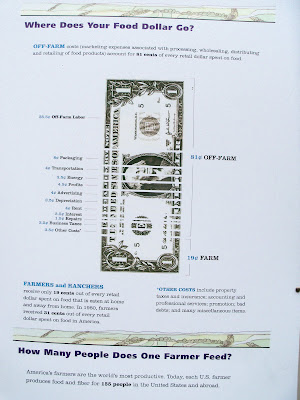
(Click on the picture to read the small print in the graphic.)

What it boils down to is that the farmer is getting about 19 cents of every retail dollar spent on food. Off-farm costs (marketing expenses, processing, wholesaling, distributing and retailing of food products) accounts for 81 cents of every retail dollar spent on food.

In 1980, farmers received 31 cents out of every retail dollar spent on food in America. (Remember, today it's 19 cents!) Today, each U.S. farmer provides food and fiber for 155 people in the U.S. and abroad. In 1980, when we were getting 31 cents out of each dollar, we were only providing food and fiber for 115 people. How's that for efficiency?


Want to learn more? Check out Real Farmers, Real Food. One section dispels myths about food production. You can even hear a message from our current Miss America Teresa Scalan about the importance of agriculture.

As she says, "Not everyone farms, but everyone has to eat."

So, Happy Food Day! I'll be the one out on the 4-wheeler hoping that the heifers cooperate this time.

Tuesday, October 12, 2010

"Sow" Frustrating

I am the first to admit that farming is a way of life. It's hard to argue that point when my brother is a fifth generation farmer in Pratt County and my husband is a fifth generation farmer along the Stafford/Reno County line.

But there are those in the world today who would prefer that farmers go back to Bible times. They would prefer we scatter seed by hand, like illustrated in the stained glass window in a Philadelphia church (October 2007 photo).

Or it might be OK if we evolved to using a horse for farming.

In the November 2010 edition of "O" magazine, there's an article titled, "From Urbanite to Farmer." A freelance journalist from New York City interviewed a Pennsylvania farmer, fell in love with him and eventually traded her 4-inch high heels for work boots and life as a farmer's wife.

Evidently, she couldn't give up part of the New York address because they then started a farm together in northeastern New York state. That's all well and good.

But I was struck by this statement:

"We use no pesticides or herbicides, and most of the work is done with draft horses instead of tractors."

GIVE ME A BREAK!

The article is under the banner: "Live Your Best Life." UGH!

For the record, I don't order "O" magazine myself. It's a gift from a friend.

I don't look at "O" for farm news. I have "Kansas Farmer" and "High Plains Journal" and a myriad of other publications for that.

But it does concern me that the little glimpse of farming offered for "O" readers is this cockeyed view that farmers should be using draft horses instead of tractors.

I can't help but find the whole view ironic. In this same magazine, the "O" List shares suggestions for things Oprah finds essential to life. In November, there's an eye makeup kit discounted for "O" readers to a mere $106, a $180 pair of earrings, a $595 Burberry coat, a pair of $200 flats and a $158 sparkly scarf.

The same people who want farmers to turn back life to the early 1900s still want the speediest internet, modern cars, cell phones with every feature, $200 flats and grapes in the grocery store in December for themselves.

So why is it OK to think agriculture should return to the Dark Ages?

Yes, farming is a way of life. It's a way of life I love.

But it's also a business. If we weren't able to make money, we couldn't stay in the business. Neither could our neighbors. Many of us have off-the-farm incomes supplementing our farm income.

Some of us don't make it in the business, just like some restaurants in New York City fail and some car manufacturers in Detroit go bust. Farming is about efficiency and productivity, just like it is with every business.

In 1900, approximately 80 percent of the U.S. population made their living in agriculture. Today, it's approximately 3 percent.

Technological advancements have made it possible for 3 percent of the population to feed the other 97 percent of U.S., plus export feed grains and meat to feed people all over the world.

We aren't going to be able to do that if every farmer trades in his tractors for draft horses.

We also can't feed the world without advancements in crop genetics and the application of fertilizers, herbicides and pesticides.

I don't have a problem with farmers who have made this their niche market. I understand there is a market for organically-grown food and that "local" food is all the rage right now.

If consumers want to spend the extra money for organically-grown produce and free-range chickens, that's their business. And power to the producer who is making a living doing it!

But the general public needs to realize that if all of the U.S.'s food was grown this way, America's farmers wouldn't be producing as much food. And with lower production, prices at the grocery store would rise astronomically. And people in some parts of the world would starve because we wouldn't have food to export to them.

Because we farmers couldn't farm as many acres with horses, some of the city dwellers would need to give up their jobs in the city and return to the farm if we hoped to raise enough food to feed everyone in the U.S.

Hmmm ... Wonder how that would go over?