Showing posts with label drought monitor. Show all posts

Tuesday, March 7, 2023

Wheat's Nine Lives

You know the old cliche, "Rain, rain, go away. Come again another day."?

Unless you're planning an outside wedding in Kansas, no one is buying into that sentiment. (And, if you're planning an outside wedding in Kansas in early March, what do you expect anyway?)

We got about 0.80 inches of moisture about a week ago. While we appreciate every drop, it didn't do much to alleviate the drought conditions in the Wheat State.

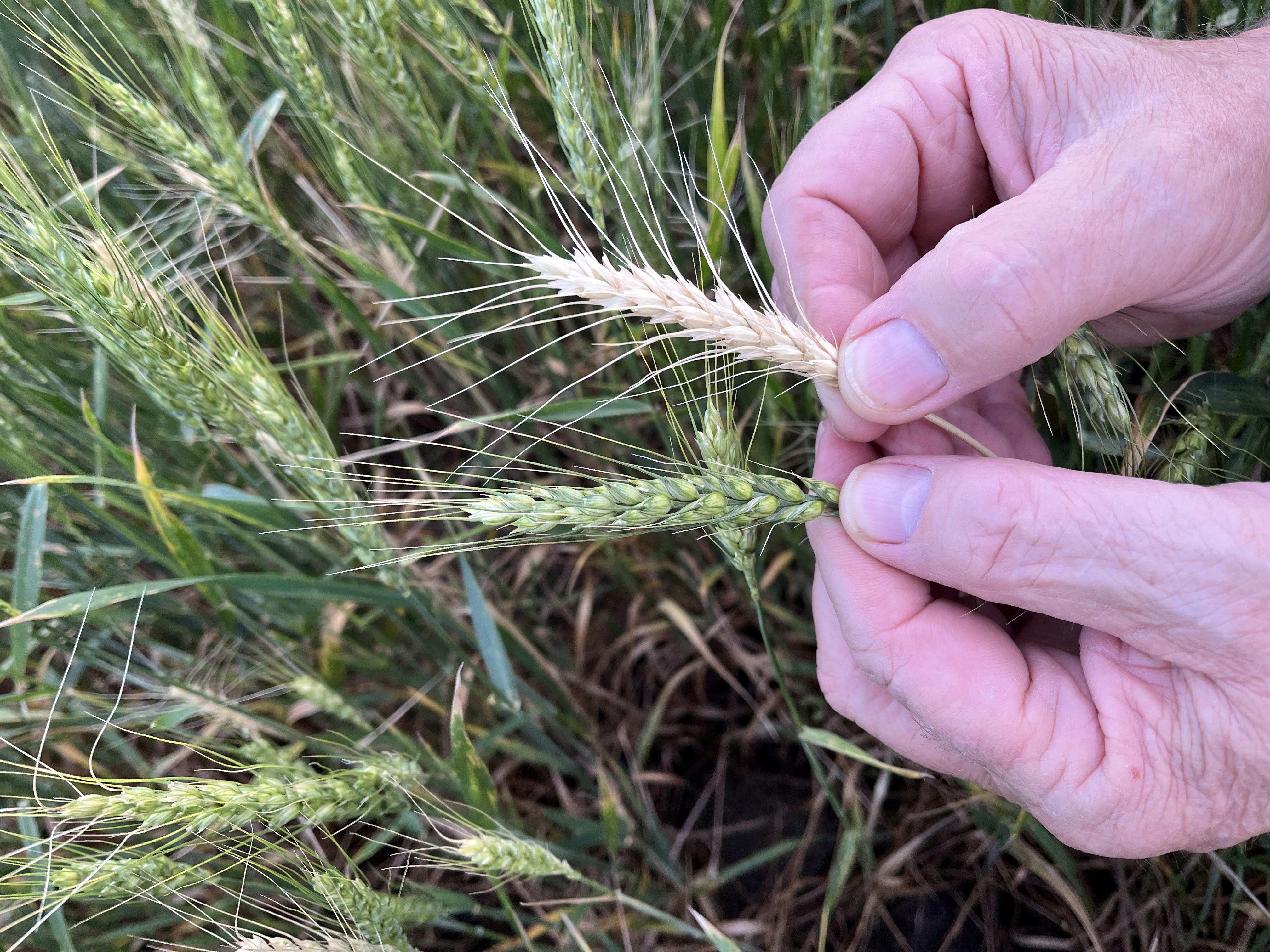
However, right now, Kansas' wheat farmers are wondering if there will be much of a 2023 crop this summer at all. Tye, who took over our farm ground after last year's harvest, called Randy after touring wheat ground over the weekend. So we went out for our own perusal.

It's not looking good. But Tye is not alone. The National Ag Statistics services released an update on crop conditions for the week ending February 26. The winter wheat condition is rated:

25 percent very poor
26 percent poor
30 percent fair
17 percent good 
2 percent excellent
 
There is certainly not 2 percent excellent in our part of the state.
 
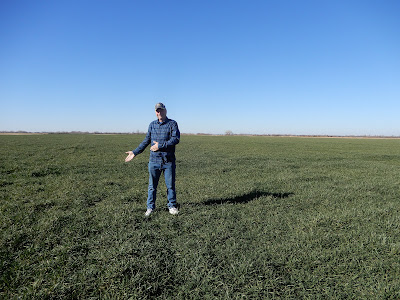
It varies from field to field, too. What we call the "home quarter" (directly above) looks better than the 80 acres south of our house (photo earlier in this post).

In our area, we are ranked at in the D3 or extreme drought category. My childhood farm in Pratt County is even worse - ranked in D4 or exceptional drought category, along with most of western Kansas. Only the northeast portion of the state is without drought conditions.

Graphic from Kansas Wheat

The USDA's Ag Statistics says that subsoil moisture supplies are rated 46 percent very short, 32 percent short, 22 percent adequate and 1 percent surplus. 

“You never want to count a wheat crop out; we talk about it being the crop with nine lives,” said Jeanne Falk Jones, a multi-county specialist with K-State’s Northwest Research-Extension center in Colby in a news release from K-State Research and Extension. “But some would say we ran through a few of those lives trying to get to this point in the growing season.”

Much of the Kansas wheat crop was planted last fall in extremely dry conditions, creating variability in wheat stands in the late fall and into this spring. With limited rain and snow fall this winter, those dry conditions haven't changed.

In the past year, precipitation in Kansas was about 10 inches below normal.

At this point, wheat is in a dormant period. Last week's rain did help green up some fields, but time will tell whether it can recover enough to harvest. 


Tye - like most farmers - is trying to weigh the options. Should fertilizer be applied when the outlook looks sparse? If you apply a herbicide, it reduces the options of what you could plant after a crop failure. So, what's the best management decision?

A crystal ball would be helpful in farming. So would some rain. 

Kansas is the nation’s leading wheat producer, known for hard red winter wheat that is used for whole grain white bread and other whole grain products. According to the Kansas Department of Agriculture, the state’s growers harvested 7 million acres with an average yield of 52 bushels per acre in 2021. This accounted for 10.4% of the state’s total agricultural receipts and 22.1% of the nation’s crop.

KDA estimates the direct impact of wheat production in Kansas at $1.3 billion in output and 3,231 jobs.

Weekly crop reports from USDA Ag Statistics begin this week as the countdown begins toward wheat harvest 2023. At least, we hope there's a 2023 wheat harvest.  

Harvest 2022


Thursday, September 1, 2022

Drought Has Calves "Moo-ving" Down the Road


 There are plenty of jokes about the hot weather:
  • It’s so hot the cows are producing evaporated milk.
  • It’s so hot chickens are laying hard-boiled eggs.
  • It’s so hot you can wash and dry your clothes at the same time.
  • It’s so hot I bought a loaf of bread, and by the time I got home, it was toast.

But, the heat and the deficit of rain are really no laughing matter. 

Kansas Drought Monitor, August 25, 2022

August continued the dry trend for 2022 in Kansas. The lack of moisture that began last winter took a toll on pasture lands this summer. Tye and Todd, who are managing and caring for our cow/calf pairs, made the difficult decision to sell calves born last winter earlier than usual. 

August 17, 2022

Typically, we don't sell calves until the following winter or spring. However, this isn't the first time that we've had to sell early because of drought.

August 17, 2022 - This was an overcast day, but we didn't get rain.

The shortage of grass in pastures had them sorting the calves from the mothers and arranging for their transport to the Farmers & Ranchers Livestock Commission Co. in Salina for the August 25 sale. This will help conserve the grass for the mama cows, who are currently carrying babies who'll be born in early 2023.

Tye and Todd have marketed their cattle through the Salina sale barn before. However, it was the first time for Randy and me. (Randy had bought some cows at the Salina sale years ago, so he'd been there. It was my first experience.)


Randy and I have always marketed the majority of our cattle through the Pratt Livestock sale barn. We took a day trip to check out the unfamiliar action and watch our calves sell last Thursday in Salina.


We got there with plenty of time to spare, so after watching the action awhile and getting the lay of the land, I turned to a familiar past-time - reading my book until it was our turn.

This was a first for Randy. He didn't help gather or sort the calves from the cows. He volunteered, but they accomplished the task without him. (As hot as it was, he ended up being OK with that.)

The calves averaged 454 pounds apiece. The steers averaged 476 pounds and the heifers averaged 443 pounds each. Randy was pleased enough with the price.

2022 is shaping up to be a historically severe year for dry, hot weather in Kansas. But, it still falls far short of the worst droughts in the state’s history. Roughly one-third of Kansas is now in extreme or exceptional drought. But nearly three-fourths of Kansas has some degree of drought.

In Dodge City, this year ranks as the 4th hottest and 12th driest on record going back to the 1870s. But Jeff Hutton, meteorologist with the National Weather Service in Dodge City, says 2022 still won’t come close to becoming the driest, hottest year in recorded history. Hutton says 2012, 1980 and 1936, still stand up as the driest and hottest years for most parts of Kansas. Hutton expects the state to get enough precipitation this fall to keep 2022 from breaking those records.

Rattlesnake Creek pasture (Big Pasture) - August 17, 2022

In an interview with the Kansas News Service, Kansas State University meteorologist Chip Redmond said frequent breaks in the heat and timely bits of moisture have kept 2022 from surpassing the records set by the most extreme years in Kansas history. That illustrates the complexity of trying to compare one bad year with another. 

“We can look at basic statistics, such as average monthly precipitation and temperature and their departure from normal,” said Redmond, who manages K-State’s Kansas Mesonet climate monitoring system. “(But) that doesn’t tell the whole story.” Based on historical data, he said, the years that top the charts for drought and heat in Kansas history came during the Dust Bowl of the 1930s — particularly 1934 and 1936 — and then in 1956, 1974, 1976, 1980, 1983, 2000 and 2011-2012."
 from Kansas News Service

Rainfall totals this year are several inches below normal across Kansas. Hays has received around 9.5 inches of precipitation so far in 2022. That’s roughly half of the 18 inches it can usually expect to bank by this time of year. Hutchinson has seen fewer than 14 inches of precipitation when it’s supposed to have more than 22 inches. Only 6.5 inches have fallen on Scott City — way less than its usual 15 inches. 

Here’s another way to look at it: How many inches of rain would a town need today in order to get back in line with its historical year-to-date average? For places like Hays, Hutchinson and Scott City, it would take more than eight inches of rain to climb out of their current deficits. Some pockets of northwest, central and southeast Kansas would need more than 10 inches of rain just to get back to average. But even with how dry it’s been this year, 2022 doesn’t come close to being the driest in Kansas history. “This year has quite a bit of work needed,” Redmond said, “if it wants to rank high.” Out of 358 Kansas weather stations measuring precipitation, none have recorded their driest-ever 40-day period in 2022. That’s compared to 46 stations that set records for their driest 40-day period in 2000, 39 that set records in 1983 and 10 that still have records standing from the Dust Bowl in 1936.

This chart from The Kansas News Service shows that we are more than 11 inches behind "normal" in Stafford County. A lack of moisture can directly fuel hotter temperatures, too. The drier soil gets, Hutton said, the faster it heats up. 

Another way to assess this year’s heat is to compare the number of days that reached 100 degrees. In Wichita, 23 days have hit that mark so far this year. Wichita’s total puts 2022 in the top 10 percent of its recorded history. But it’s still not close to breaking records. “I’ve already heard people say, ‘Oh, it’s the hottest year ever,’” Hutton said. “No, it’s not. We only have to go back 11 years to 2011.” Dodge City set a record with 50 days of 100-degree weather that year. So far in 2022, it has seen 31 days that hot.

While that doesn’t come close to touching 2011’s record, it still means that 2022 already has the sixth most 100-degree days ever recorded in Dodge City. 

I have photos from the 2012 drought and its effects on our Rattlesnake Creek pasture.

August 2012 - no water in the Rattlesnake - at the bridge
At the eastern border of our pasture - August 2012

In comparison, there was some water remaining in the creek in mid-August, though it was definitely low. 

August 17, 2022 - at the eastern border of our pasture

We did get some help with our totals on August 27. The Rattlesnake pasture got 2.4" of rain. At home, we had about 1.25". However, people who lived south of us, even as little as 10 miles, got nothing. My brother, who farms in northern Pratt County, got very little rain.

So we know how fortunate we were to get last Saturday's rain. But we'd still love to be able to order up several rainy, cool days.

August 17, 2022 - at the bridge

Thursday, August 18, 2022

Peace Creek Not So Peaceful

Peace Creek at the Zenith Road - August 10, 2022

It's not a good sign when you stop at a bridge and the first thing you see is a vulture perched in the creek bed. (It flew away before I got the shot - FYI.)

This summer in Kansas has not been fit for man or beast - unless you happen to be a vulture, I suppose. We've had more days than usual above the 100-degree F mark. And we are dry. When the weather forecasters were predicting 2 to 4 inches in our area a couple of weeks ago, we got 0.75". We were thankful for every drop. However, the most appreciable rain before that happened at the end of June during wheat harvest.

The Kansas Drought Monitor tells the tale, too. Half of Stafford County is in extreme drought and the other half in severe drought. (And that's better than a bunch of counties in western Kansas.)

At the bridge along the Zenith Road, Randy saw fish gasping for air in the dwindling water. I went back with him, but we couldn't see the fish at that time. However, we saw a bunch of bullfrogs who were still hunkering down in the few wet spots they could find.


Two years ago in August, I took this picturesque scene as I headed toward home after running an errand to the field.
Peace Creek at the Zenith Road - 2020

The U.S. Drought Monitor website also had this chart of impacts of drought. As they indicated, the consequences vary from state to state.

Several of these are evident in Kansas and other areas of the Great Plains this year.  (Click on the chart to make it easier to read.) Some field corn is getting chopped for silage, rather than harvested for grain. There are new blue-green algae alerts in the news all the time. Fires are much more likely to get out of hand. Ranchers are contemplating how to feed their cow/calf herds with dwindling pasture reserves. 

This week was again supposed to bring rain. But as this week arrived, the weather maps on the local TV stations started changing to fewer raindrops. So far, we haven't received any moisture.

However, Wednesday was a wonderful respite from the hot temperatures. So that prompted a Gator ride to the Rattlesnake Pasture.

There's still a little water in the Rattlesnake.

It's definitely better than the scene in 2012, when it was dry as a bone.

August 2012 - no water in the Rattlesnake

The cows and calves appeared to be faring well, despite the lack of rain to make the grass grow more abundantly. However, to keep it that way, Tye and Todd have decided to wean the calves from the cows next week and sell them now, rather than wait until later this fall, as is the norm. (Though we've had our farm sale, we still retain ownership in our cow/calf herd, though Tye and Todd do the day-to-day management.)


That will reduce the number of head of cattle in the pasture, with the hope that the grass will last longer for the remaining cows.

 As we left the pasture, we stopped at our customary spot for photos on the bridge.

There's still a little water flow. It's never a rushing river, but here's a comparison from March 2021.

Is there light at the end of the tunnel? The Farmers' Almanac predicts our area will have a snow-filled winter. My Grandpa Neelly may have planted potatoes by the light of the moon and the Farmers' Almanac, but I'll believe heavy snowfall when I see it. 

“Get ready to shake, shiver, and shovel!” says the website for that publication, which was founded in 1818 and is based in Lewiston, Maine. That almanac has weathered considerable distrust from meteorologists over its long-range forecasts, which it says are created using a secret formula that’s centuries old. 

Honestly, the Farmers' Almanac can't be much worse at predicting precipitation than the local TV stations.

***

As I wrote earlier this week, I'm sure I'll write about the farm sale. But it's going to take some time and some thought. More on that down the road.


Tuesday, May 31, 2022

Lipstick on a Pig?: Wheat Harvest Update for May

Photo taken May 12, 2022

Good lighting is everything. A good moisturizer is also critical to that dewy "super model" look. But, look a little closer, and the 2022 wheat crop may look a little more haggard than a touched-up "after" picture.

Yes, some rain and a beautiful sunset made a photo of our 2022 wheat crop look good. But, it was kind of like putting lipstick on a pig, as the saying goes. It didn't reveal the blown-out portions of the field and its short stature.

And I'm getting the feeling that the 2022 Hard Winter Wheat Quality Tour is kind of like that, too. The tour was May 16-19. Tour participants traveled six routes form Manhattan to Colby to Wichita and back to Manhattan. An average yield of 39.7 bushels per acre was calculated from the three-day average yield. 

Randy and I will be thrilled if we come close to that for our final wheat harvest as active farmers. It sure doesn't look like it here, where we are still firmly in the grip of extreme drought. 

Of course, just like meteorologists are prone to do, the Wheat Quality tour powers-that-be give the caveat that there's a lot of time between the end of the tour and the beginning of harvest. 

We did get rain in May, helping make up for the lack of moisture this winter and spring. We got about 1.5 inches during the first week of May. Then, early on May 18, we got about 0.40" more.

The rain gave Randy enough optimism to turn in most of our wheat acres to be sprayed with a fungicide. Crop dusters flew it on on May 16. 

May 16, 2022, Photo by Randy

I had an eye appointment in Hutchinson, so my photography assistant did his best to capture a few snapshots.  

May 16, 2022, Photo by Randy
If we get an extra bushel and a half per acre yield, Randy says it covers the cost of the spraying. Time will tell on that, too.
May 16, 2022, Photo by Randy

The official Wheat Quality Tour projection for total production of wheat to be harvested in Kansas is 261 million bushels. The figure is the average of estimated predictions from tour participants who gathered information from 550 fields across Kansas. 

The tour summary did acknowledge that the Kansas wheat crop is spotty and short.We concur here on the Stafford/Reno County line. 

As I've been doing since October, we took a photo on May 21. (Truth be told, we actually took it the evening before.) 

Evening, May 20, 2022

There are some light-colored heads, perhaps due to freeze damage or drought. Those heads don't have kernels.

Other heads look better than we expected, but as the old farmers like to say, "You can't tell for sure until it goes into the bin."

Photo from 2021 wheat harvest

Last week, we ended up with an additional 4.4 inches of soft, soaking rain. It should help the wheat heads fill. Time will tell how much the rain impacts the drought map, but we are thankful. 

Since I posted wedding-related blogs last week, I'm behind on posting my wheat update. So Randy and I went out this morning to take a few photos.

It's amazing to compare the color of the wheat on the evening of May 20 to the morning of May 31. The wheat's color is transitioning to gold. And we were also surprised by the size of some of the heads. The rain last week gave a good boost for filling the heads.

We Kansas farmers aren't the only ones watching and wondering about this year’s wheat harvest. As a Kansas Wheat news release said, the combination of expanding drought conditions and steep input prices in the U.S. and the continued impact of the Russian invasion of Ukraine has the markets — and farmers — on edge. A collection of resources from policy-makers and analysts offers insights into the economic impacts of current geopolitics. 

“Continued disruption in Ukraine through their wheat harvest combined with expanding drought conditions here at home will continue to weigh on the world wheat market. This growing season has the unprecedented combination of geopolitics, weather and some of the highest fertilizer prices and chemical inputs — but farmers here and abroad will remain resilient reminders of the importance of agriculture as a constant in a world full of conflict.” 
Kansas Wheat CEO Justin Gilpin in a news release from Kansas Wheat

The world consumes about 787.4 million metric tons (28.9 billion bushels) of wheat each year. Russia and Ukraine are the world’s top and fifth exporters, respectively, according to the most recent available stats from the Food and Agriculture Organization of the United Nations (FAO). 

Photo from 2021 wheat harvest

Together, Russia and Ukraine make up around one-third of the world’s wheat production. Ukrainian and Kansas wheat farmers follow similar timelines for winter wheat production. The crops planted last fall should be green and growing, marching toward harvest in late June or early July. Following harvest, milling quality wheat from Ukraine is typically exported to the Middle East, Africa and Bangladesh and feed quality wheat to other Asian countries, according to the USDA’s Foreign Agricultural Service (FAS). The impacts of the Russian invasion of Ukraine and disruption of these trading channels are yet to be fully calculated, but will likely extend beyond this year’s harvest. 


Thursday, December 30, 2021

The March Toward Harvest: December Update

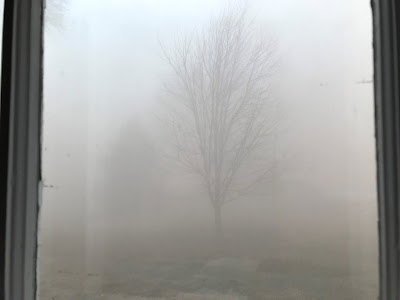
Taken from my dining room window, December 15, 2021. You couldn't see our north driveway.

 This is not a December photo of the wheat field. But it does illustrate some of what happened to our wheat crop this month.

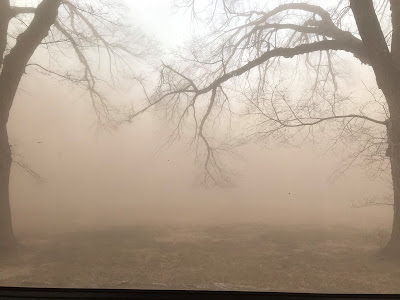
From my front door, December 15, 2021. You couldn't even see the road.

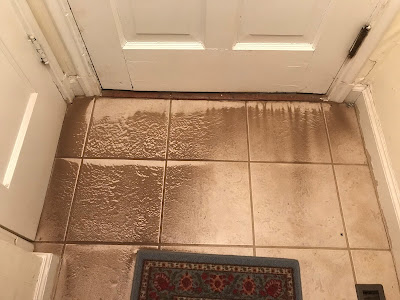
On December 15, we had a terrible windstorm. It turned the landscape into a reenactment of the Dust Bowl Days here on the Central Plains.


This was the dirt that swirled in through my front door. It was everywhere.

Though it was a mess and likely did some damage to the some of the wheat crop, we feel fortunate. Some farmers and ranchers in northwest and north central Kansas had a wind-whipped wildfire. Two people lost their lives. It's estimated that 1,000 head of livestock were lost in the fire. And dozens of homes and outbuildings were lost, along with miles and miles of fencing. 

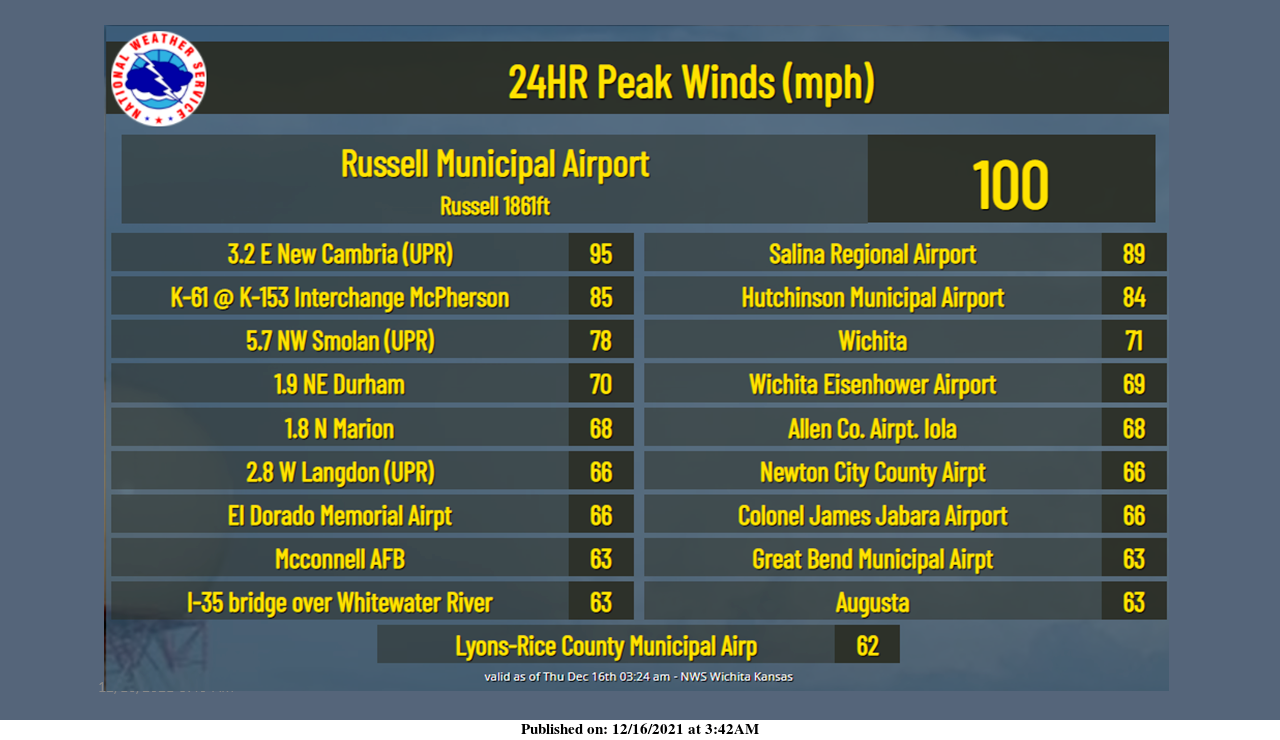
Wind records were smashed for the month of December since 1996 for central and south-central Kansas, according to the National Weather Service. This includes Wichita, Hutchinson, Salina, and Russell. Russell saw winds peak to 100 mph, shattering their old record of 67 mph.

We live in a house surrounded by old trees. As the wind was roaring, I was concerned that a tree or a big branch would topple onto the house. Thankfully, the trees stayed together. 

December 21, 2021

 Our wheat that was better established seems OK.

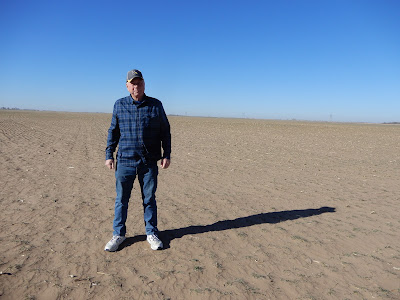
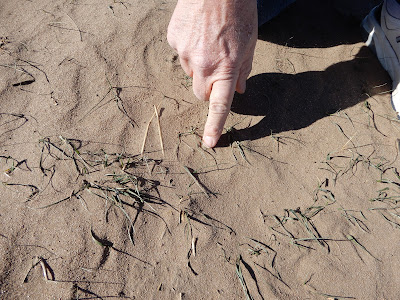
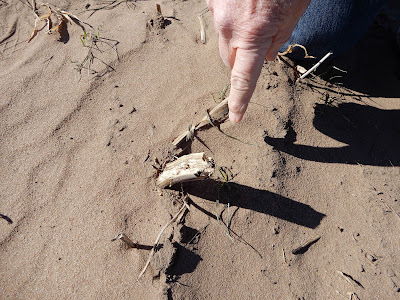
However, we had some later planted wheat (that was also replanted in late October) that blew badly during the windstorm. 

December 21, 2021

It was planted in corn stubble, so there was some residue left in the field, though it's a little hard to tell at the moment.

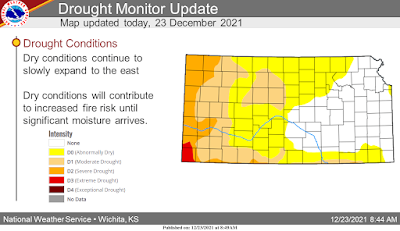
The drought conditions across the state continue to slowly expand as the long stretch of dry weather continues. 


Most areas of western Kansas are in experiences drought conditions, and this area is expected to continue to slowly expand eastward as long and the dry weather continues.Right now, we are in the "abnormally dry" designation. The dry weather will also increase the inherent fire risk until significant moisture arrives in the region.

There is a little glimmer of hope on the horizon. We may get measurable snow on New Year's Day. Time will tell. We haven't had measurable moisture since October when we were trying to plant wheat.

Here's a look back at my monthly wheat updates so far:

October

November

Here's hoping I'll have moisture to report in January!