Showing posts with label binning seed wheat. Show all posts

Thursday, August 26, 2021

The Rest of the Story: Wheat 2022


Harvest time is kind of like a super model. It's gets all the press and the glossy photos. Just like that model, it usually looks good on camera and is the image that wins the accolades.

Harvest 2021 was no exception. I captured a lot of pretty scenes during the three long (very long) weeks from start to finish. 

But, as Paul Harvey always used to claim, here's "the rest of the story." 

Even as we were harvesting our 2021 wheat crop, Randy was looking ahead to Harvest 2022. Interspersed among the multitude of trips hauling wheat to the co-op at Zenith, the guys also binned two varieties of wheat - Bob Dole and Zenda -  in our on-farm storage.


Last week, we took the wheat to Miller Seed Farms to get it cleaned and treated.


It took multiple trips back and forth to deliver it and then pick it back up after it had been cleaned and treated. 

First stop is the scale house, where the trucks are weighed full. After the cleaning, the trucks are reweighed.

As always, Dolores Wagler, office manager, weighed in the trucks and keeps everyone organized.


On our last trip, Randy backed right in to the facility for unloading to begin the cleaning process.

Photo collage from a previous post

After the wheat is cleaned and treated, it comes back to our farm, where we reverse the process and put it back into the on-farm storage until we're ready for wheat planting in late September or early October.  


When we got back to the farm, Randy unrolled the tarp and then backed the truck into position.

After he had it positioned, I shoved a block of wood behind the back tires to keep it from rolling. 

 
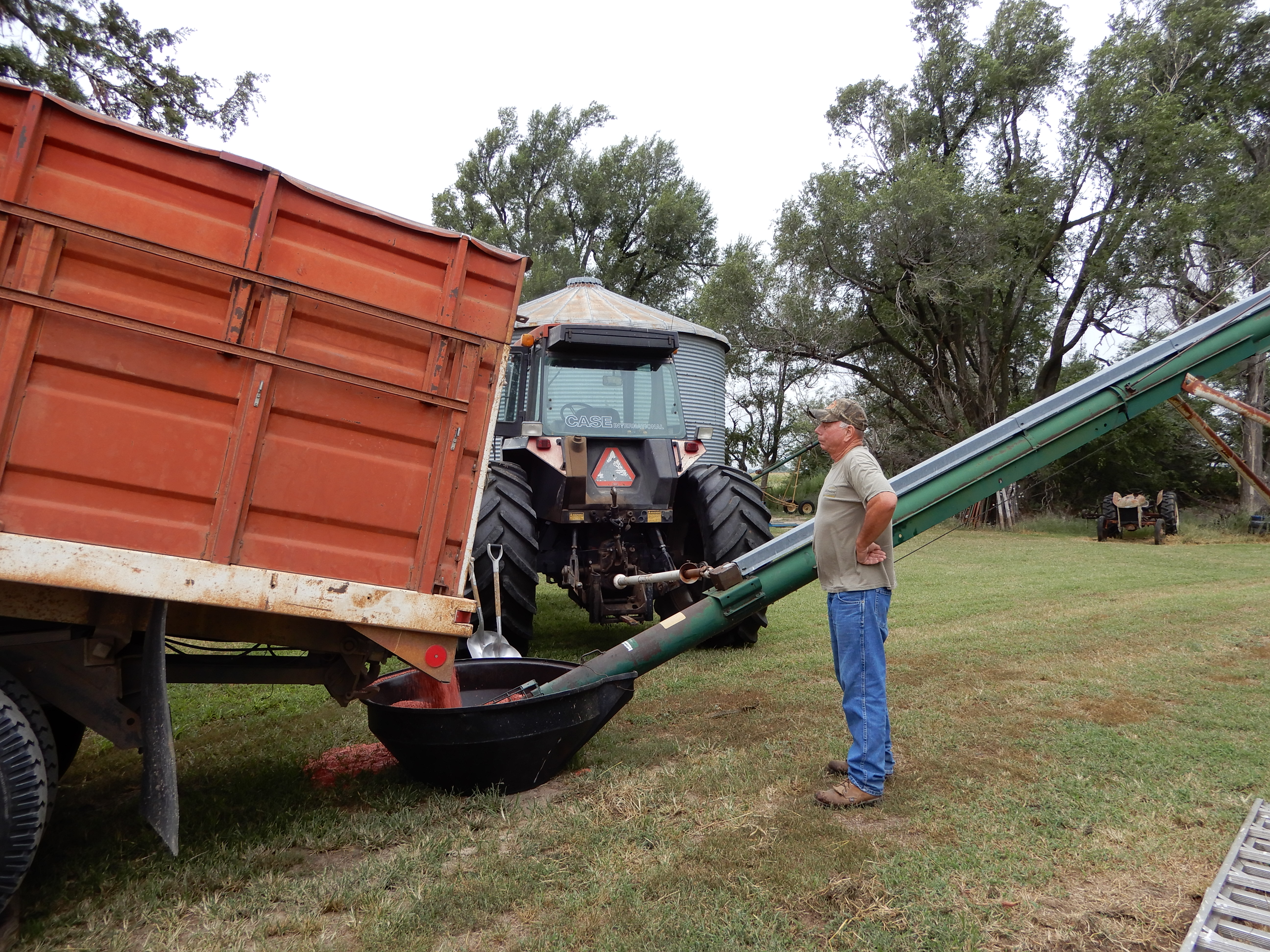
You may be wondering why the wheat isn't golden in color like it was at harvest. After it's cleaned, we have Miller Seed Farm treat it with an insecticide and a herbicide, giving it its rust-colored hue. This is an extra expense, but we believe it will get the 2022 wheat crop off to a good start. Detractors worry about the amount of chemicals that go into the mix. However, only 0.48 ounce per bushel of Cruiser is used, while 1.68 ounce per bushel of the Vibrance product is used. Think about a little bottle of eye drops (usually about 0.5 ounces). Adding slightly more than 2 ounces to a whole bushel of grain is really not much!
 
Randy raises the bed on the tandem truck and tilts it into a tub, where an auger carries it back into the bin. 
 

And from a different angle ...
The white rod in the photo below shows the PTO. It's attached to a tractor, which turns the shaft and powers the auger.

The wheat is augered up from the tub back into the bin.

As the wheat still in the truck dwindled, Randy did his circus performer imitation and used a shovel and a broom to get the truck cleaned out before traveling back to Partridge for a load of another variety.

 
(I didn't get a wider shot of the process this year. Below is a file photo from 2020.)

Here's hoping this behind-the-scenes work will again pay off in "model-worthy" photos next summer for Wheat Harvest 2022. However, there's a lot more behind-the-scenes work to come between now and then.

"The rest of the story" always includes some bloopers.

The blown tire on the semi as we traveled to Miller Seed Farm was just the first of a plethora of tire problems last week. By last Thursday, we were up to eight different tires that either had to be repaired or replaced on different vehicles or implements. (No, that is not an exaggeration.) That Wednesday, I made two separate trips to Kinchloe's at Pratt for disc repairs and picked up a tire at the co-op. Randy made another trip to Kinchloe's on Thursday. We were back again on Monday after more parts arrived. Yes, they know us by name.

This business is not for the faint of heart. Who knows how many tires and multiple trips for repairs will be thrown in before we cross the finish line of Harvest 2022? Maybe I should start a poll ...


Tuesday, August 18, 2020

Normal Stuff in an Abnormal Year: Seed Wheat


Our church service was back online last Sunday after an uptick in Covid-19 cases in our rural county. The back-to-school video posted by our community's elementary teachers required a closer look last week as their enthusiastic faces were covered with masks. Our granddaughters' back-to-school clothes shopping was accomplished through an online order. We made the decision to roll over our 2020 K-State football season tickets and hope for a return to Bill Snyder Family Stadium in 2021 instead.

While I enjoyed the text-message fashion show from the cutest school models I know, it was a depressing week. The news and the constant "us vs. them" attitude that permeates social media? It's enough to raise a white flag and declare, "I surrender!"

So a little "normalcy" in our day-to-day business life last week was welcome. It was seed wheat cleaning time. With the world in constant change this year, having the "same-old, same old" on most of our farming tasks has been refreshing.

There was a sign on the door of Miller Seed Farm, asking customers to wear a mask if they came into the office. But the process of getting ready for wheat planting was as comfortable as slipping into comfy, broken-in shoes.

Because of the cyclical nature of farming, I have written "the same" stories during these past 10+ years of blogging. In the time since I launched my blog in January 2010, we've had 11 wheat harvests. So, behind the scenes, we've planted the wheat crop and managed it every year - from seed wheat to fertilizing to praying for rain or praying the rain quits - and then again sending the golden grain through the combine reel. 

And even though the world itself is different this year with Covid-19 and the attached restrictions, there's still a wheat crop to be planted and a new harvest to anticipate. 

During this summer's harvest, Randy saved two varieties of wheat - Bob Dole and Zenda - to be used for planting our 2021 crop. The two different varieties are stored in two separate bins in on-farm storage until we can get it cleaned.

We made multiple trips back and forth this past week from home to Miller Seed Farm near Partridge. With farmers in the area looking ahead to the 2021 wheat crop, Randy scheduled an appointment to get our seed wheat cleaned, leaving plenty of time before planting time begins in late September or early October.  It ends up looking a little like a farm parking lot as trucks are lined up for their turn at the cleaning process.


Come planting time, we will also purchase some certified seed from Miller's, which we will bin during the 2021 harvest and the process will begin yet again with a march toward the 2022 crop.

And the cycle goes on.


As I watched as our two trucks stopped at the scale house to be weighed at Miller Seed Farm, I looked at the backdrop of a gorgeous August sky. Maybe the Kansas sky was just as dramatic last year. I'm sure I have photos that would either support that notion or prove it false.

But I only "see" those similarities and those contrasts if I take time to look. I need eyes to see it ... and the motivation to go down the road to experience it. And I get to hang out with this cute guy!

You may be wondering why the wheat isn't golden in color like it was at harvest. After it's cleaned, we have Miller Seed Farm treat it with an insecticide and a herbicide, giving it its rust-colored hue. This is an extra expense, but we believe it will get the 2021 wheat crop off to a good start. Detractors worry about the amount of chemicals that go into the mix. However, only 0.48 ounce per bushel of Cruiser is used, while 1.68 ounce per bushel of the Vibrance product is used. Think about a little bottle of eye drops (usually about 0.5 ounces). Adding slightly more than 2 ounces to a whole bushel of grain is really not much!


After the wheat comes back to the farm from cleaning, we (OK, Randy) puts it back in the bin to be stored until we plant it in late September or early October. He raises the bed on the tandem truck and tilts it into a tub, where an auger carries it back into the bin.

The white rod in this photo shows the PTO. It's attached to a tractor, which turns the shaft and powers the auger.

 Here are wider shots of the process.

 And here's a video I shot in 2018:

Seed wheat into storage bin from Kim Fritzemeier on Vimeo.

It'll be wheat planting time before we know it. Oh, if only the rest of the world could have that level of normalcy ...  I can dream, can't I?

Tuesday, July 17, 2018

And So It Begins: Looking to Wheat Harvest 2019

This photo is from a previous year. I didn't get a photo this year. It shows loading out wheat to take to Miller Seed Farms.
Not a seed has been planted. And Wheat Harvest 2019 is likely 11 months away. But Randy has already begun the planning and ground work to make our next wheat harvest a reality, less than a month after we finished the last harvest.
  
During this year's harvest, the guys binned wheat we'll use for seed wheat for our 2019 crop. Before planting this fall, we take the wheat we stored in on-farm bins during harvest time to Miller Seed Farms to get it cleaned and treated.
Once at Miller's Seed Farm, the trucks pull onto a scale to be weighed.
Just like at the co-op elevator, we need to know - and the seed farm needs to know - how much grain was trucked in.
We brought wheat in both the tandem truck and the semi. Farmers may store their own wheat and plant it for their next crop, but only for their own use.
This year, Randy saved two varieties at harvest time, Zenda (a K-State release) and WB 4458 (a WestBred variety) to plant for our 2019 crop.
Photo collage from a previous post
We have our wheat treated with an insecticide - Cruiser - and a fungicide - Vibrance Extreme. This is an extra expense, but we believe it will get the 2019 wheat crop off to a good start. Detractors worry about the amount of chemicals that go into the mix. However, only 0.48 ounce per bushel of Cruiser is used, while 1.68 ounce per bushel of the Vibrance product is used. Think about a little bottle of eye drops (usually about 0.5 ounces). Adding slightly more than 2 ounces to a whole bushel of grain is really not much!

When the wheat arrived at Miller's, it was 60.2 per bushel test weight. After cleaning, it was bumped up to 62 pounds per bushel. The cleaning process gets rid of any chaff and other foreign matter that doesn't get sifted out in the combine. We brought 1,030 bushels to be cleaned and brought back home 910 bushels after the cleaning.
Once back at home, Randy had to transfer the cleaned wheat back into our on-farm storage bin. While we can take the wheat to be cleaned in both the tandem and the semi, we bring it all back to the farm in the smaller truck. He raises the truck bed and the wheat goes into a tub. The auger is turned with a tractor's PTO.

Seed wheat into storage bin from Kim Fritzemeier on Vimeo.

The auger carries the wheat back into the grain bin.
Randy climbed into the truck bed to scoop out the remaining wheat.
We don't want any to go to waste!
Once all the grain was loaded, Randy climbed up to put the lid on the bin.
It will be ready to go in September or October when we begin planting our 2019 crop.
This fall, we'll also pick up some certified seed in sacks. Randy reserved more Zenda and another K-State release, Larry, to plant for the 2020 seed wheat.
He also reserved Double Stop CL+ wheat to try to get rid of some rye and chaff in fields. Double Stop CL+ is a two-gene Clearfield wheat from Oklahoma State University. It has a strong herbicide tolerance for Beyond herbicide and methylated seed oil to control unwanted cheat, goat grass, rye and other "stuff" you don't want in your wheat crop. We'll pick that up in bulk this fall.

Until then ... there's plenty to do. The guys just finished up the second cutting of alfalfa and are about to get through with discing wheat ground for the first time after harvest. That process was slowed by a 2.10" rain Saturday night, but we're sure not complaining about that!

This afternoon, I go to set up for the Stafford County Fair 4-H foods and nutrition judging, which gets underway at 9 on Wednesday morning. I'm starting to think the forecast for slightly cooler temperatures during fair time was only a pipe dream.

Wednesday, August 26, 2015

Back in the Bin

In 1,352 blog posts, I've never written about binning seed wheat. How did that happen? At harvest time, I guess I've been too busy serving as chief go-fer and making and transporting meals to go down to the bins and take photos. Since 2010, there have been five other opportunities to chronicle our seed wheat's journey from on-farm storage bin to Miller Seed Farm for cleaning and back home again to the bins.
But somehow in those millions of words and thousands of photos, I've missed recording it for posterity. Until now.

Farmers may store their own wheat and plant it for their next crop, but only for their own use. During harvest this summer, Randy saved two varieties: 1863 (a K-State Wheat Alliance release) and Cedar (a WestBred wheat variety). Each year, Randy has specific fields from which we harvest the seed wheat. Usually, he plants that wheat fairly close to the farm headquarters, where we have the capacity to store 2,100 bushels in on-farm storage in two different bins.

After the wheat came back from Miller Seed Farms, the guys hoisted the truck bed up and opened a hatch in the center of the truck bed, just raising it enough to let a slow, steady stream fall into the rubber trough.
An aside: Every time I see the back end of our old white truck, I have to smile at the irony of the "I Like Cotton" bumper sticker. The closest we've gotten to cotton production around here is through wearing jeans. But the bumper sticker came attached when we purchased the truck several years ago. So there it stays.
The wheat is that color because it's been treated with Cruiser insecticide and Vibrance Extreme fungicide.
I should have stepped back a little ways to show that the tractor was running the PTO that makes the auger run. (If you use your imagination, you can see a tiny portion of the tractor in the shadow on the lefthand side of the photo above.) The white rod was attached to the tractor and then to the auger, where it provided power for making the auger run.
The auger is used to transport the wheat back into the storage bin, where it will stay until we're ready to plant wheat in late September and early October.

Because Miller Seed Farms gets so busy closer to planting time, we schedule our wheat cleaning early. That way, it's ready to go when we are.
Photo from 2013 wheat planting
Wheat planting is probably about a month away.
And then, we'll again begin the 9-month journey toward harvest.