Showing posts with label Wheat Harvest 2019. Show all posts

Thursday, July 25, 2019

Fini, Finito, Kaput!: Wheat Harvest 2019

Fini.
Finito.
Terminat.
Kaput.
Done!
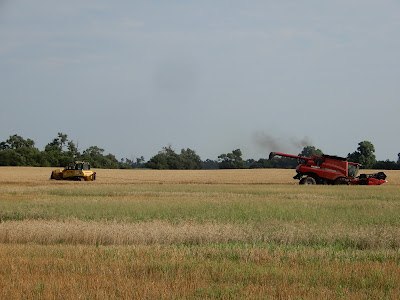
In whatever language, our Wheat Harvest 2019 is finally in the rearview mirror.

We began the odyssey June 26. By June 27, we'd already run out of dry grain and dry ground. It was a series of starts and stops and hiatuses until Randy finally trucked the last load of grain to the Zenith branch of the Kanza Co-op Monday afternoon, July 22.
As I mentioned at the beginning of harvest, this year's start date was later than normal. Here are the stats:
2010:  June 18
2011:  June 10
2012:  May 26 (an anomaly and the earliest harvest, by far, we've ever had)
2013:  June 21
2014:  June 17
2015:  June 20
2016:  June 15
2017:  June 12
2018: June 12
2019: June 26
The finish dates are all over the board in the past 10 years, too:
2010: June 25
2011: June 20
2012: June 9 (an anomaly)
2013: July 6
2014: July 7
2015: July 1
2016: July 13 (another saga of a harvest)
2017: June 28
2018: June 29
2019: July 22
It was the worst harvest we'd had in the 10 years I've been blogging about it. We averaged 23.6 bushels per acre. Our high field (by far) was 45 bushels per acre on one landlord's farm. Nothing else came close. That's what monsoon weather will do for you.

Yield averages in the past few years since I've been blogging have been:

2010: 37.2 bu/acre
2011: 36.7 bu/acre
2012: 45.5 bu/acre
2013: 52 bu/acre
2014: 24.5 bu/acre
2015: 50 bu/acre
2016: 48.5 bu/acre
2017: 50.84 bu/acre
2018: 39.2 bu/acre
2019: 23.6 bu/acre
We began planting on time in late September 2018, and we planted a few days before the deluge of rain fell.

For the first time ever, we weren't able to plant almost one-third of our 2019 wheat crop - about 385 acres. This has never happened since Randy began planting wheat in 1974 as a senior in high school.

The ground was too wet to plant after 14-plus inches in October and 2.5 inches more in November, along with three snows. Because we were unable to get on the ground, we elected to take a prevented planting option in our crop insurance policy. It will pay a percentage of our revenue guarantee. Part has already been paid and more could possibly be paid later, if we don't collect crop insurance on the next crop.

We ended up replanting most of our seed wheat, and thankfully, we had enough to bin for planting the 2020 crop this fall. 
July 2, 2019
It felt like we were the last ones in our area done with cutting. (You know that feeling as a child when you were picked last for the game at recess. Yeah. It felt like that.)
July 2, 2019 - among my prettiest photos from this year's harvest
However, Randy says he saw a neighbor cutting some wheat yesterday afternoon. We evidently weren't totally alone. According to this week's U.S. Wheat Associates Harvest Report, harvest in Kansas was 96 percent finished as of last Sunday.
We are glad to be done, even if we're not thrilled with the results.
Kansas Wheat reported that yields in South Central Kansas were below average. We concur. In southwest Kansas, however, this year's harvest produced some of the best wheat in years, with some people calling it their "best crop ever" or a "once in a lifetime crop," according to Kansas Wheat. We are happy for them.

Certainly, this harvest has been one to remember. Some of it, we'd probably prefer to forget. But that's part of farming. Kind of like the amnesia that new moms experience following labor, we'll put it behind us. And the journey will begin anew in September and October as we plant the 2020 wheat crop. (And let's hope those 100-degree days last week didn't hurt the dryland corn crop too much.)

Tuesday, July 9, 2019

A Sloooooow Slog to the End: Wheat Harvest 2019

It's going to be a sloooooow slog to the end of Wheat Harvest 2019. Same song, 15th verse or so? At this juncture, waking up to the sound of rain on the roof at around 5 this morning is just another day when we say, "Well, I guess we aren't getting any wheat cut today either."
The wheat is kind of a lost cause at this point. The majority of the wheat hasn't been that good and what we have left is even worse. So we might as well be thankful for the rain on our dryland corn, which is tasseling and pollinating. (More on the corn crop on another day.) For the record, it was just another 0.15 to 0.20 of an inch this morning.
 
Monday started with hiring a bulldozer to come and pull out the combine and the 4-wheel-drive tractor that were stuck in a wheat field last Friday night. The oilfield service had initially planned to come and pull it out Saturday morning. Then we got another 1.5 to 2 inches of rain overnight Friday into Saturday. We knew there'd be no cutting with that additional rain, so Monday was soon enough and gave the ground a little more time to dry. 
The field where we had two pieces of equipment buried was one of the fields I featured in a blog post last fall, when we had 14 inches of rain in October (after 8 inches or so in August). At the time, I put together a collage of photos and called it "Quivira South" because of its location on the road which takes visitors to the Quivira National Wildlife Refuge just a mile away. We had plenty of migrating waterfowl taking a break at our "lake" this fall and spring.
 
A wet fall and wet spring have kept that ground soggy, so Randy had initially bypassed it and cut other fields. As he was cutting last Friday, he was already going around mudholes, but the combine just dropped into a soft spot left behind by mudholes and underflow. He'd been able to back out of mud himself other times. And we'd already used the 4-wheel-drive tractor to successfully pull the combine out one other time in the same field.
 
However, this time, the tractor was mired in mud, too.
I was along for the combine ride on my nightly "date" with my farmer after delivering suppers to the field, so I, too, got to hike back to the pickup. I was glad I'd worn my ratty tennis shoes.
I'm always a "Nervous Nellie" when using big ropes and big equipment to pull things out. I just don't want anyone - or anything - to get hurt. However, the dozer pulled both combine and tractor out of the muck. The tractor and combine weren't left with any damage. The field, on the other hand, has deep gouges left behind by grinding tractor and combine tires and dozer tracks.
 
 
I didn't get the video started soon enough, but here's the end of the combine being pulled out.

If we needed any confirmation about the power of a small town "news network," both Randy and I got it yesterday. I was in charge of the Circles meal served at our church last evening. The first question I got asked was, "Did you get your combine pulled out?" Randy said his stops at the co-op, the grocery store, the body shop, the parts store and points in between had several people querying about our stuck combine and tractor. Yes, Stafford and the surrounding metropolitan - or not so metropolitan - area: We got everything pulled out!

I realized I do have some photos of prettier harvest times that I haven't shared yet. On the evening of the 4th of July, I was riding with Randy at sunset and had nature's fireworks in the night sky.
Even in that pretty sunset photo, you can see the remnants of fall and spring rains. Near the sun in the photo, you can see a large green space - a mudhole that stretches from the wheat field into the corn field. I took a few photos of those mudholes in the corn along the mile-long field earlier in the evening.
 
I watched the 4th of July sunset through the front windshield and then in the rearview mirror as we slowly chugged back to the east.
I chose the rearview mirror photo above to feature because I didn't like the weeds in the shot below. And then I realized that having the weeds growing up in the mudholes and in the wheat itself is a more accurate portrayal of Wheat Harvest 2019.
In truth, we'd be happy to see all of wheat harvest in our rearview mirror, but we have several soggy locations left.

Later, as the sun went down and the humidity went up and we we quit harvesting for the evening, we watched fireworks light up the sky over Stafford.

Let's hope the remainder of the wheat cutting doesn't include any fireworks.


Thursday, June 27, 2019

First Day of "School" Jitters: Harvest 2019

Remember that anxious feeling in the pit of your stomach before the school year started each August? There was excitement, but there was also an undercurrent of nervous energy and uncertainty. Would you understand the concepts of Geometry? (Not without sitting at Mr. Bisel's desk for a little one-on-one time.) Would friendship triumph over the girl drama?

There's been a little of that feeling going on at The County Line this June. We finally got started with Harvest 2019 late yesterday afternoon, June 26.  It started better than last year when we sent a raccoon through the combine before ever cutting a swath.

This year, the anxiety was mainly about when we would finally begin. Rain has delayed harvest and caused a later start than we've ever experienced in our 38 years of farming together. I have a record of the start dates since I've been blogging:

2010:  June 18
2011:  June 10
2012:  May 26 (an anomaly and the earliest harvest, by far, we've ever had)
2013:  June 21
2014:  June 17
2015:  June 20
2016:  June 15
2017:  June 12
2018: June 12
2019: June 26
 
Randy thought the ground would be hard to maneuver because of the repeated rains. And while he did go around a lot of mud holes, he didn't have to call for a pullout. Fingers crossed. However, we do have the chain on the big tractor ... just in case.
There's a pond on the ground where we were harvesting last evening. I sent a photo to the landlord, and she didn't recognize it. Her dad had constructed the pond about the time he retired. And she said she'd never seen it look so full. With the old cottonwoods' leaves glistening in the evening sun and the bright blue against the golden wheat, it was undeniably pretty.
(This photo was taken through the window as I was riding with Randy, so it's kind of blurry)
In the background of the photo above, you can also see the water still standing in the field across the road from where we were harvesting. That's not a pond, but it has a lot of water - just like most fields around here.
"Dessert" after bringing dinner to the field last evening was my first combine ride of Harvest 2019 with my favorite farmer. There will be opportunities for plenty more evening "dates." However, we don't have quite as much wheat to harvest as usual, since last October's deluge of rain prevented us from planting nearly 400 planned wheat acres.
Sunset - October 25, 2018
 
Still, my farmer was happy to get the machine rolling. I'm sure there will be more (and better) photos to come! Let's just hope the stories aren't as "exciting" as raccoons and hiring oilfield machinery to pull us out of mud and mire. We could use a happy ending to this saga that began last fall.

Tuesday, April 16, 2019

Oats, Peas, Beans and Barley Grow ... and So Does Wheat

As Randy and I walked into a field last week, I had an old childhood song tumbling around in my head. (By now, it should not come as a surprise to anyone that I have an on-going sound track in my brain):

Oats, peas, beans and barley grow.
Oats, peas, beans and barley grow,
You or I or anyone know how oats, peas, beans and barley grow.

First the farmer plants the seeds,
Stands up tall and takes his ease,
Stamps his feat and claps his hands,
And turns around to view his lands. ...
(For the whole thing and the actions, click here.)

Of course, there's a little more to farming than stamping your feet and clapping your hands. But our oats are growing.

Randy planted oats in an old alfalfa field the third week of March.  In April, the field is looking greener all the time, as the newly-planted oats take hold among the old alfalfa plants.
While the old childhood song doesn't talk about wheat, here in Central Kansas, it's growing, too. Our crop is thinner than it often is by this time of spring. And we don't have as much planted as we usually do. (More on prevented planting here.)
Though wet fields kept us from planting a third of what Randy had planned last fall, the downward trend in wheat acres is not exclusive to us.
This year, the Wheat State is nearing a 100-year low for acres planted to Kansas' most famous crop. Wheat acreage was down significantly in 2017 and 2018. Last year’s 7.7 million wheat acres hit the lowest point in 60 years.
Low prices and a wheat surplus moved farmers away from the Kansas staple. This year, those problems - combined with a delayed fall harvest and unfavorable weather - will push wheat acres to what could be the lowest point in a century.

Abandonment of wheat acres will be higher than the normal 10 percent because many stands, especially in North Central, Central and South Central Kansas, are poor because of wet and cold weather, experts say.

Unplanted acres that were meant for wheat won’t stay that way. Most farmers will plant the fields to corn, soybeans, grain sorghum or other fall harvested crops. We are among those who'll be planting more corn acres than we normally do because rain kept us out of some fields last fall. We got started with corn planting yesterday.
While recent surpluses and low prices have driven Kansas farmers away from wheat, a report from a former Kansas State University Extension wheat marketing specialist outlined that Western Kansas farmers have been losing money on wheat for some time. Bill Tierney, who now works as a market analyst for Ag Resource in Chicago, authored the report using data from Agri Benchmark. Participants in the Agri Benchmark network use standard procedures to best replicate the “standard” farm in their country or region. 

The data used by Tierney compares wheat growers in Western Kansas to those in Australia, Germany, Russia, Ukraine and more. (For the record, we are in Central Kansas.) The study looks at cost of production, yield and prices for the average farm in each country from 2013 to 2016.
The study data shows that while Western Kansas enjoyed one of the highest prices for wheat — at around $5.41 per bushel at the time of the study — it also had one of the highest average costs of production over the four-year period at $5.69 per bushel. 

But with lower average yields and higher costs of production, the report notes that from 2013 to 2016 the average Western Kansas wheat producer lost around 12 cents per acre — before low prices and unfavorable weather hit. (On Monday, the price at Sublette Co-op in western Kansas was $3.85. Yes, the price of wheat has gone down that much since the study. Sad but true. The cost of inputs would not have gone down that much.)
Vance Ehmke,  who sells certified seed in Western Kansas, said he doesn’t expect Kansas farmers to stop growing wheat. As there is less wheat, he expects prices to rise. Those prices could get very interesting in 2019, he said.

"A wise old man once told me that there is a reason why wheat goes to $6," Ehmke said in a news article earlier this year. "You ain't got any!"

Tuesday, July 17, 2018

And So It Begins: Looking to Wheat Harvest 2019

This photo is from a previous year. I didn't get a photo this year. It shows loading out wheat to take to Miller Seed Farms.
Not a seed has been planted. And Wheat Harvest 2019 is likely 11 months away. But Randy has already begun the planning and ground work to make our next wheat harvest a reality, less than a month after we finished the last harvest.
  
During this year's harvest, the guys binned wheat we'll use for seed wheat for our 2019 crop. Before planting this fall, we take the wheat we stored in on-farm bins during harvest time to Miller Seed Farms to get it cleaned and treated.
Once at Miller's Seed Farm, the trucks pull onto a scale to be weighed.
Just like at the co-op elevator, we need to know - and the seed farm needs to know - how much grain was trucked in.
We brought wheat in both the tandem truck and the semi. Farmers may store their own wheat and plant it for their next crop, but only for their own use.
This year, Randy saved two varieties at harvest time, Zenda (a K-State release) and WB 4458 (a WestBred variety) to plant for our 2019 crop.
Photo collage from a previous post
We have our wheat treated with an insecticide - Cruiser - and a fungicide - Vibrance Extreme. This is an extra expense, but we believe it will get the 2019 wheat crop off to a good start. Detractors worry about the amount of chemicals that go into the mix. However, only 0.48 ounce per bushel of Cruiser is used, while 1.68 ounce per bushel of the Vibrance product is used. Think about a little bottle of eye drops (usually about 0.5 ounces). Adding slightly more than 2 ounces to a whole bushel of grain is really not much!

When the wheat arrived at Miller's, it was 60.2 per bushel test weight. After cleaning, it was bumped up to 62 pounds per bushel. The cleaning process gets rid of any chaff and other foreign matter that doesn't get sifted out in the combine. We brought 1,030 bushels to be cleaned and brought back home 910 bushels after the cleaning.
Once back at home, Randy had to transfer the cleaned wheat back into our on-farm storage bin. While we can take the wheat to be cleaned in both the tandem and the semi, we bring it all back to the farm in the smaller truck. He raises the truck bed and the wheat goes into a tub. The auger is turned with a tractor's PTO.

Seed wheat into storage bin from Kim Fritzemeier on Vimeo.

The auger carries the wheat back into the grain bin.
Randy climbed into the truck bed to scoop out the remaining wheat.
We don't want any to go to waste!
Once all the grain was loaded, Randy climbed up to put the lid on the bin.
It will be ready to go in September or October when we begin planting our 2019 crop.
This fall, we'll also pick up some certified seed in sacks. Randy reserved more Zenda and another K-State release, Larry, to plant for the 2020 seed wheat.
He also reserved Double Stop CL+ wheat to try to get rid of some rye and chaff in fields. Double Stop CL+ is a two-gene Clearfield wheat from Oklahoma State University. It has a strong herbicide tolerance for Beyond herbicide and methylated seed oil to control unwanted cheat, goat grass, rye and other "stuff" you don't want in your wheat crop. We'll pick that up in bulk this fall.

Until then ... there's plenty to do. The guys just finished up the second cutting of alfalfa and are about to get through with discing wheat ground for the first time after harvest. That process was slowed by a 2.10" rain Saturday night, but we're sure not complaining about that!

This afternoon, I go to set up for the Stafford County Fair 4-H foods and nutrition judging, which gets underway at 9 on Wednesday morning. I'm starting to think the forecast for slightly cooler temperatures during fair time was only a pipe dream.