Showing posts with label wheat harvest 2022. Show all posts

Thursday, June 23, 2022

From Planting to Harvest: A Review in Photos

June 21, 2022
 

Back in September, during planting, I began documenting our 2022 wheat crop.

September 2021
We began planting wheat on September 21, 2021, so I decided to use the 21st of every month to take a photo at the same location and post it to my blog and Facebook.

I patterned the concept after Hudson Cream Flour's Facebook page. ("Patterned" sounds better than "copied." Thanks for the idea, Tabra!) During the last growing season, Stafford County Flour Mills posted a monthly update on the wheat crop to its Facebook page. The mill - which is located in Hudson, Kansas, in our home county - produces Hudson Cream Flour. (It's the best flour there is, if you need a testimonial. They also have a Hudson Cream Flour Baking page on Facebook. Check it out, too!) They did similar reports in 2022. 

I decided to take my photos on the same day, mainly so I'd remember each month.

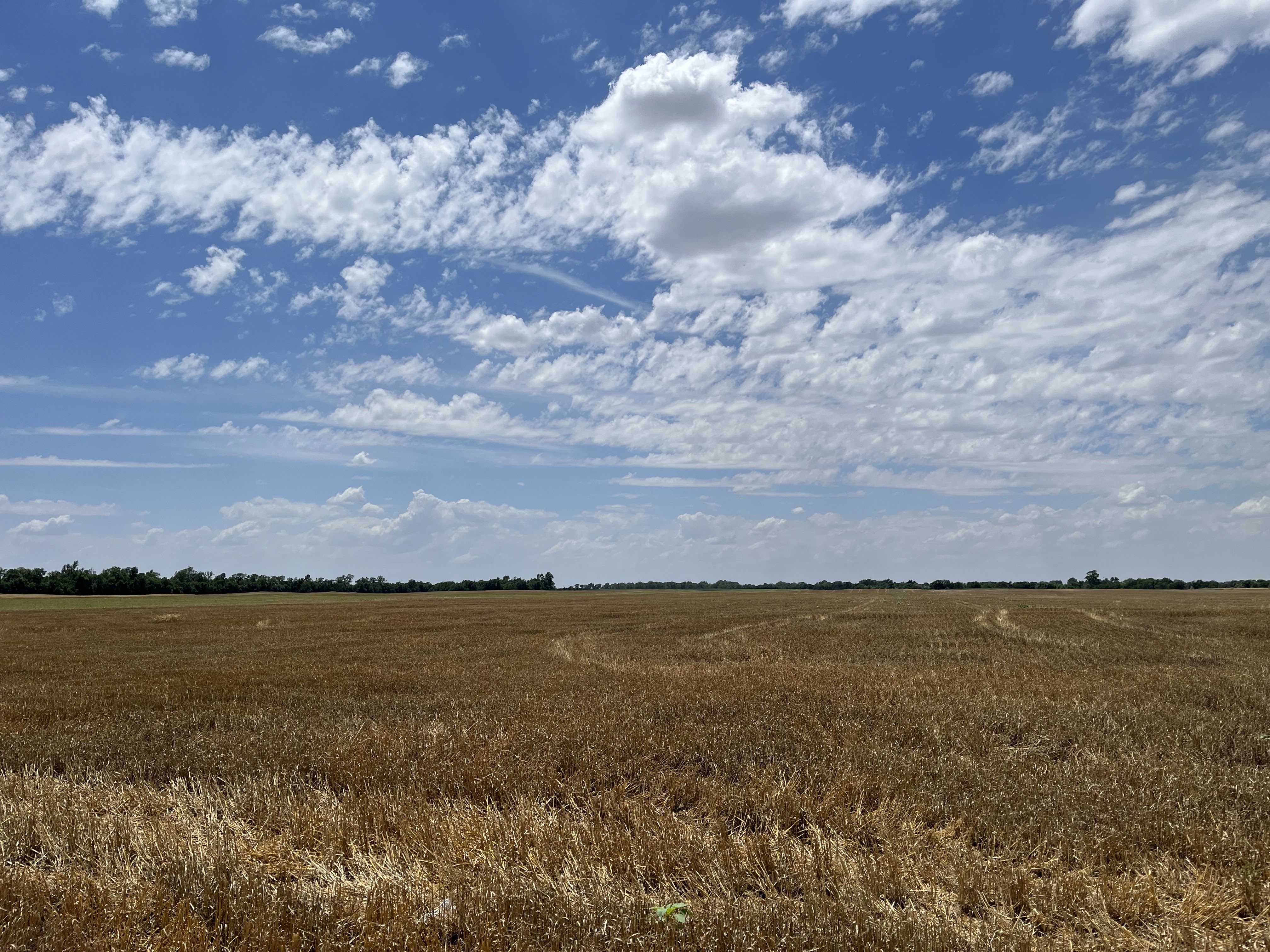
My June 21st shot at the same location revealed a stubble field. We harvested that field during the first week of harvest.


Here's a recap of the photos, without having to go back to each individual blog post. (Click on the photo collage to make it bigger.)

Since I always took the monthly photo on the 21st, it didn't reveal the whole story. Here's one from January 26, when we got a little snow on the crop.

We began our harvest the evening of June 13, and we are about halfway done. We had a stretch of long, hot cutting days but were halted when we got 0.25" of rain Tuesday evening. It didn't dry off during the day yesterday, and we got another 1.10" last night.

During many of those days, we had clear blue skies, with no clouds. But, as an amateur photographer, you always hope for a little drama in the sky to offset that beautiful golden wheat.

Father's Day provided some fluffy clouds for some photogenic shots.

Speaking of photogenic, that storm that rolled through on Tuesday evening provided plenty of drama, including a rope cloud that I captured in a panoramic shot.

The sky provided a free show. A brief shower had moved through about 5:45 PM, dropping a few sprinkles, and then quickly moved on. 

Still, the dramatic blue sky to the east was a startling contrast to the sunshine behind the weather system. It made for pretty photos as I delivered supper to the field.

We thought that was the extent of the weather, but just 30 to 45 minutes later, another system rolled though. 

We watched as the rope cloud developed from the west/southwest.

It constantly evolved as it moved across the plains.


My final panoramic shot was just as the cloud was about to go over me. I made my way back to the car, and then Randy called from the combine to get picked up as the rain began to fall. There was quite a dust storm as I drove a mile over to pick him up.

After more than a week of hot harvest weather, it appears that we'll be dodging raindrops for awhile. We have a custom cutting crew scheduled to come and help us finish. We'll see when we close the chapter on Wheat Harvest 2022.


Tuesday, June 14, 2022

And So Begins the End: Wheat Harvest 2022

Flag Day sunrise, June 14, 2022

And so begins the end.


We began our 2022 Wheat Harvest last evening about 6:15. It won't be a banner year when it comes to wheat yield. That happened last year. But it is a banner year for another reason: It's our final wheat harvest as active farmers. 

Harvest begins, June 13, 2022

I rode along last evening. I'm sure there will be plenty of other rides during this harvest season.

I have a record of our start dates since 2010 because that's when I started blogging:

2010:  June 18
2011:  June 10
2012:  May 26 (an anomaly and the earliest harvest, by far, we've ever had)
2013:  June 21
2014:  June 17
2015:  June 20
2016:  June 15
2017:  June 12
2018: June 12
2019: June 26
2020: June 16
2021: June 17
2022: June 13
 
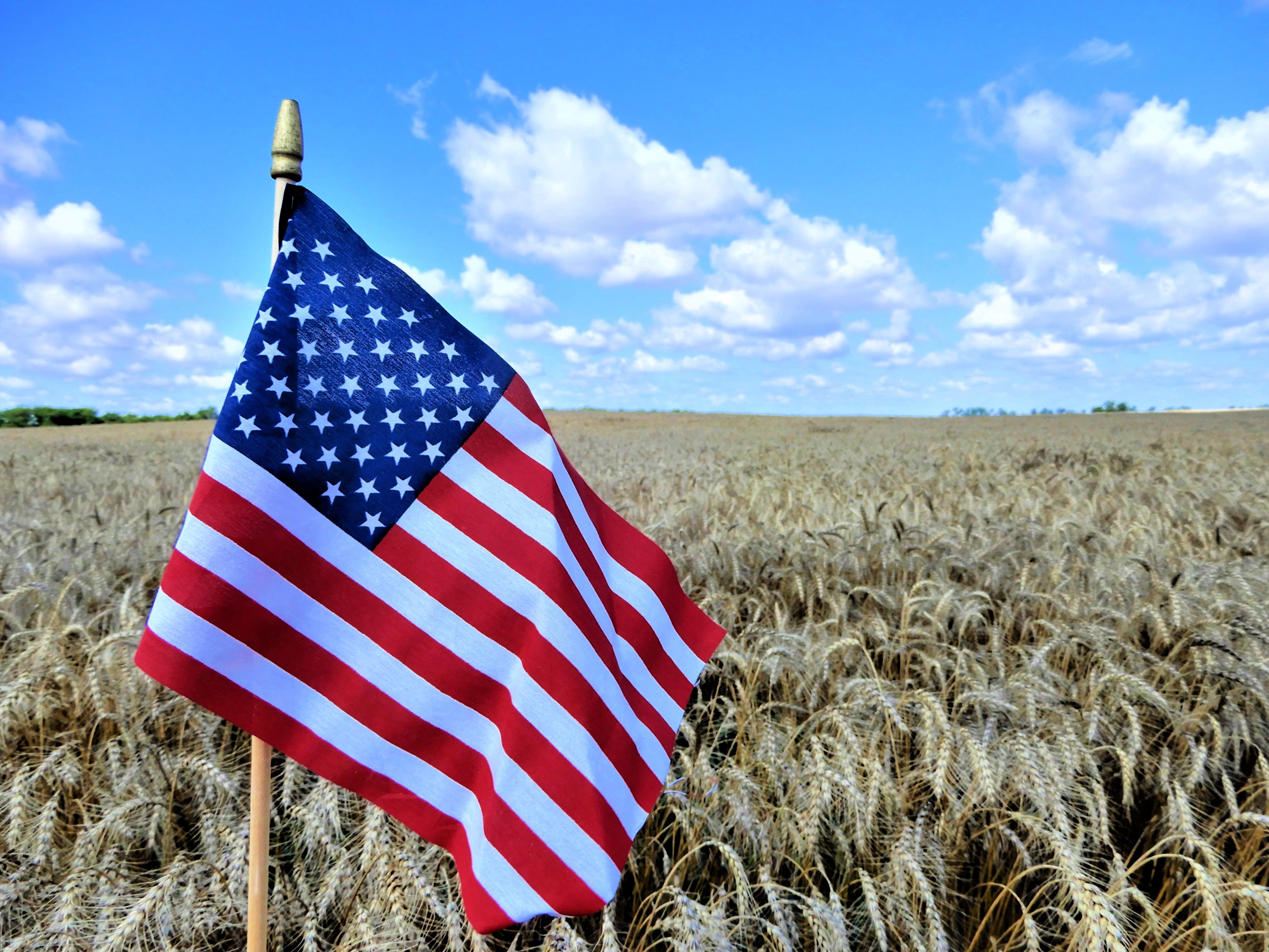
As I came into the house last night, I saw on my family birthday calendar that today (June 14) is Flag Day. So I went to the wheat field to get some shots this morning.


The wind was already gusting mightily at 6:15 in the morning. It's going to be a windy day!


I had trouble keeping the flag flat even when it was lying on the wheat! (I like a rippling flag anyway.) 

I guess I bookended our night and day because I'd taken some sunset photos last night.


I've told a few friends this, but I guess you're my friends, too. But it almost feels like people expect us to apologize or offer explanations for our decision to retire. 

"You're retiring!? Farmers don't retire!" I've heard it from more than one person.

Well, we are. And I can't deny that there are bittersweet feelings about this being our final wheat harvest with "boots on the ground," so to speak. But we are at peace with the decision. Yesterday, Randy found out the truck driver that had said he'd drive won't be coming. This morning, there's a low tire on the semi trailer. (It's taking awhile to fill a truck this year because yields are lower after our dry winter and spring, so I guess there will be fewer truckloads going to the elevator anyway.)

Last evening, as we traveled east to west across the waving wheat field gobbling up yet another header-full of wheat, Randy said, "Well, I won't miss scooping out wheat from the bin to get it cleaned for seed wheat this summer." And I won't miss being up in the tractor cab, running the PTO, hoping he wasn't getting heat stroke inside that hot metal bin.

But, on this Flag Day - and every day - we are proud that we have been part of the American fabric - the American farmer. 

This morning, a Facebook memory came up from five years ago. A friend at church had given me a bookmark that had been produced years ago by the Kansas Wheat Commission. I then put my own photos along the side for an illustration. 

I still feel the same way about wheat. And I probably always will - whether I'm in the truck cab or the combine cab or just viewing the action from my dusty dirt road. 


Tuesday, May 31, 2022

Lipstick on a Pig?: Wheat Harvest Update for May

Photo taken May 12, 2022

Good lighting is everything. A good moisturizer is also critical to that dewy "super model" look. But, look a little closer, and the 2022 wheat crop may look a little more haggard than a touched-up "after" picture.

Yes, some rain and a beautiful sunset made a photo of our 2022 wheat crop look good. But, it was kind of like putting lipstick on a pig, as the saying goes. It didn't reveal the blown-out portions of the field and its short stature.

And I'm getting the feeling that the 2022 Hard Winter Wheat Quality Tour is kind of like that, too. The tour was May 16-19. Tour participants traveled six routes form Manhattan to Colby to Wichita and back to Manhattan. An average yield of 39.7 bushels per acre was calculated from the three-day average yield. 

Randy and I will be thrilled if we come close to that for our final wheat harvest as active farmers. It sure doesn't look like it here, where we are still firmly in the grip of extreme drought. 

Of course, just like meteorologists are prone to do, the Wheat Quality tour powers-that-be give the caveat that there's a lot of time between the end of the tour and the beginning of harvest. 

We did get rain in May, helping make up for the lack of moisture this winter and spring. We got about 1.5 inches during the first week of May. Then, early on May 18, we got about 0.40" more.

The rain gave Randy enough optimism to turn in most of our wheat acres to be sprayed with a fungicide. Crop dusters flew it on on May 16. 

May 16, 2022, Photo by Randy

I had an eye appointment in Hutchinson, so my photography assistant did his best to capture a few snapshots.  

May 16, 2022, Photo by Randy
If we get an extra bushel and a half per acre yield, Randy says it covers the cost of the spraying. Time will tell on that, too.
May 16, 2022, Photo by Randy

The official Wheat Quality Tour projection for total production of wheat to be harvested in Kansas is 261 million bushels. The figure is the average of estimated predictions from tour participants who gathered information from 550 fields across Kansas. 

The tour summary did acknowledge that the Kansas wheat crop is spotty and short.We concur here on the Stafford/Reno County line. 

As I've been doing since October, we took a photo on May 21. (Truth be told, we actually took it the evening before.) 

Evening, May 20, 2022

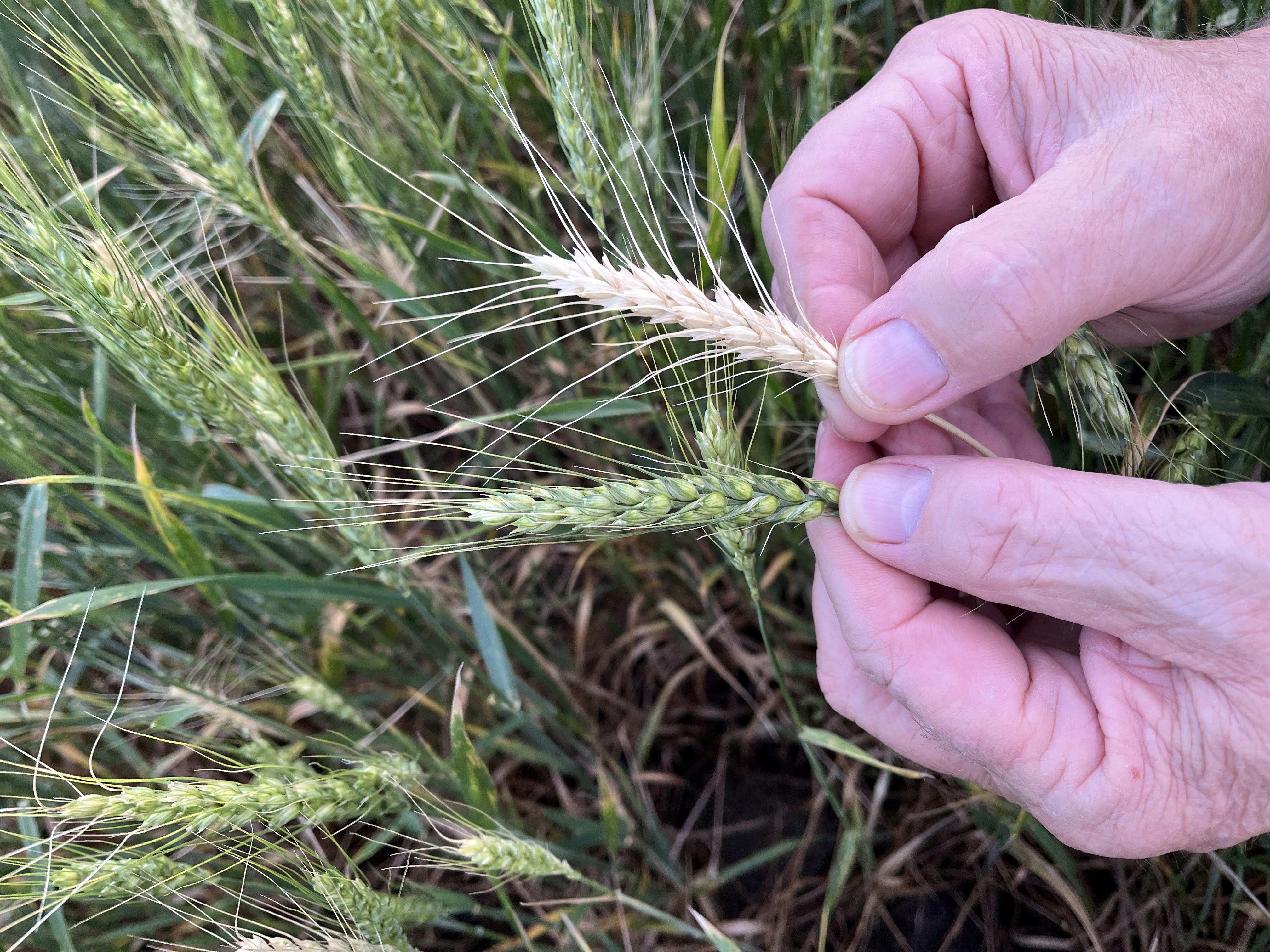
There are some light-colored heads, perhaps due to freeze damage or drought. Those heads don't have kernels.

Other heads look better than we expected, but as the old farmers like to say, "You can't tell for sure until it goes into the bin."

Photo from 2021 wheat harvest

Last week, we ended up with an additional 4.4 inches of soft, soaking rain. It should help the wheat heads fill. Time will tell how much the rain impacts the drought map, but we are thankful. 

Since I posted wedding-related blogs last week, I'm behind on posting my wheat update. So Randy and I went out this morning to take a few photos.

It's amazing to compare the color of the wheat on the evening of May 20 to the morning of May 31. The wheat's color is transitioning to gold. And we were also surprised by the size of some of the heads. The rain last week gave a good boost for filling the heads.

We Kansas farmers aren't the only ones watching and wondering about this year’s wheat harvest. As a Kansas Wheat news release said, the combination of expanding drought conditions and steep input prices in the U.S. and the continued impact of the Russian invasion of Ukraine has the markets — and farmers — on edge. A collection of resources from policy-makers and analysts offers insights into the economic impacts of current geopolitics. 

“Continued disruption in Ukraine through their wheat harvest combined with expanding drought conditions here at home will continue to weigh on the world wheat market. This growing season has the unprecedented combination of geopolitics, weather and some of the highest fertilizer prices and chemical inputs — but farmers here and abroad will remain resilient reminders of the importance of agriculture as a constant in a world full of conflict.” 
Kansas Wheat CEO Justin Gilpin in a news release from Kansas Wheat

The world consumes about 787.4 million metric tons (28.9 billion bushels) of wheat each year. Russia and Ukraine are the world’s top and fifth exporters, respectively, according to the most recent available stats from the Food and Agriculture Organization of the United Nations (FAO). 

Photo from 2021 wheat harvest

Together, Russia and Ukraine make up around one-third of the world’s wheat production. Ukrainian and Kansas wheat farmers follow similar timelines for winter wheat production. The crops planted last fall should be green and growing, marching toward harvest in late June or early July. Following harvest, milling quality wheat from Ukraine is typically exported to the Middle East, Africa and Bangladesh and feed quality wheat to other Asian countries, according to the USDA’s Foreign Agricultural Service (FAS). The impacts of the Russian invasion of Ukraine and disruption of these trading channels are yet to be fully calculated, but will likely extend beyond this year’s harvest. 


Tuesday, April 26, 2022

Praying for Rain


See that blob of red in the middle of the state of Kansas? We farm really close to that red blob. That's an area of extreme drought.

All the color on the map - from yellow to burgundy - means that much of the state desperately needs rain. We certainly do.

So in this pictorial 21st-of-the-month wheat crop update, moisture - or the lack thereof - is the overriding concern.

The wheat isn't very tall. Dry conditions contribute to that.

In a Facebook memory that came up on my news feed last week, I saw that in 2017, the wheat had already headed. (Click HERE for that post.) We aren't that far yet as we work our way toward our summer 2022 harvest.


 But the wheat has jointed. The bearded head of the wheat is in the wheat stalk and will emerge soon.


This chart on wheat development is from Oklahoma State University.

While moisture is the current limiting factor for this year’s harvest, the outlook is more nuanced than measuring the dust or raindrops in the gauge. According to Kansas Crop Progress and Condition report on April 17, issued by USDA’s National Agricultural Statistics Service (NASS), the winter wheat crop's topsoil moisture supplies rated 33 percent very short, 30 percent short, 36 percent adequate and 1 percent slurpus. Subsoil rated 32 percent very short, 34 percent short, 34 percent adequate and 0 percent surplus. 

The field crop report rated the winter wheat crop as 11 percent very poor, 20 percent poor, 36 percent fair, 30 percent good and 3 percent excellent. Winter wheat jointed was 34 percent, behind 47 percent last year and 44 percent for the five-year average. 

A few areas got a little rain overnight on April 22 into April 23. We got less than 0.10 of an inch. 

Here's what it looked like during my first photo session on the 21st of a month - this one from back in October. For that whole blog post, click HERE.

October 2021

There is a chance for rain later this week. Let's hope this round doesn't miss us!


Tuesday, February 22, 2022

LOVE = RAIN or SNOW: February Wheat Update


During this month devoted to love, the 2022 wheat crop hasn't gotten enough of it.

At the moment, LOVE for a Kansas wheat farmer would be spelled with another four-letter word: RAIN ... or even SNOW.

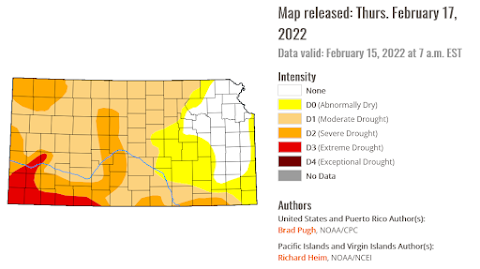
We have gotten a bit of moisture on the Stafford/Reno County Line since my January 21 wheat update. However, the Kansas drought monitor shows worsening conditions - not improvement - in our part of the world. 

On February 8, the drought monitor looked like this, putting us in a region of moderate drought:

 Just a week later, our area worsened to Severe Drought.

We did get some snow February 2 and 3.

It just wasn't enough to make much of an impact.

The above photos were taken on February 4.

But, something is better than nothing. 

 By the time this snow melted down in the rain gauge, it amounted to about 1/2 inch.


Weather forecasters predicted snow for us February 16-17. However, our area received just a dusting.

This month's wheat update photo on February 21 was taken on an unseasonably warm day - hence short sleeves and no jacket for Randy. It was 73 degrees on Monday.

When we got up today, the temperature was 8 degrees, with the wind chill below zero. It's just one other motion on the roller coaster temperature fluctuations that this winter has brought.

Since the wheat crop is still in dormancy, the impact of the swing in temperature won't likely be appreciable, Randy says.

Another issue facing Kansas wheat farmers is the price of fertilizer, which has more than tripled in the past year. Thankfully, we put 60 to 70 pounds of nitrogen per acre on our wheat ground before we planted last fall. Randy chose to put herbicide and another 10 pounds of nitrogen on one field already this winter. It's a field that was replanted last fall. Because it wasn't established as well, it blew badly in the December 15 windstorm. He put the herbicide and fertilizer on after that, hoping to give that field a boost. 

He likely will have the co-op put herbicide and 10 pounds of nitrogen per acre on the remaining acres next month, biting the bullet on the high price of fertilizer with the hopes of bumping yield.

We aren't the only ones contemplating the lack of moisture and the price of fertilizer. At a February meeting of the Kansas Association of Wheat Growers (KAWG), board members reported that wheat fields across Kansas were generally planted into sufficient moisture conditions and went into winter with decent stands. However, more moisture will be needed over the winter and into the spring to kickstart a crop emerging from dormancy and maintain growth. 

According to the USDA’s National Agricultural Statistics Service, Kansas topsoil moisture supplies as of January 23, 2022, were 77 percent very short to short and 23 percent adequate to surplus. Subsoil moisture supplies were 31 percent very short, 41 percent short and 28 percent adequate. In the same report, the Kansas winter wheat crop was rated at 30 percent good to excellent, 39 percent fair and 31 percent very poor to poor. The next crop progress and condition report is scheduled to come out later today.

Perhaps more importantly, KAWG members conveyed the difficult decisions producers are currently making with their fertility programs. This winter application of nitrogen allows the nutrients to move into the root zone with precipitation well before jointing begins to be most efficiently utilized by wheat. Having adequate nitrogen available supports spring tillering and helps ensure good yield potential.

This year, however, fertilizer prices have exploded due to international supply chain disruptions during the COVID-19 pandemic. According to a January 2022 report by Texas A&M University’s Agricultural and Food Policy Center, “Based on current spot markets, it appears as though fertilizer prices will increase in excess of 80 percent for the 2022 planting season (relative to 2021).” KAWG members and their neighbors are feeling this cost crunch, reporting many in their areas are putting off normal topdressing applications to wait for moisture. 

“While we cannot control the weather and its impact on the wheat crop’s yield potential, it is important to note that Kansas farmers are holding off on fertilizer applications due to high prices and availability of supplies,” said Kansas Wheat CEO Justin Gilpin. “Even with welcome winter snow and — fingers crossed — well-timed spring showers, these decisions could affect the final grain yields and quality of this year’s wheat crop.” 

When fertilizer prices will stabilize or decrease is a difficult question, but KWCH Chief Meteorologist Ross Janssen did offer welcome longer-term predictions for weather patterns during Kansas Commodity Classic. Janssen predicted shifting weather patterns could bring near to below normal temperatures and wetter than normal moisture conditions to the western two-thirds of Kansas in the next three months. Overall, he predicted while winter will continue to drag out, Kansas farmers should see near-normal rainfall this spring and are unlikely to have a major drought this summer or a prolonged heatwave. Both predictions are positive for the Kansas wheat crop as wheat plants emerge out of dormancy this spring and continue their growth cycle until this summer’s harvest. 

With a projected 7.3 million acres of wheat planted in Kansas, according to the USDA’s Winter Wheat and Canola Seedings report released on January 12, 2022, Kansas farmers are keeping their eye on the markets and on the sky to make the most of this year’s crop. That includes the farmers on the County Line, who are looking ahead to harvesting our final wheat crop as active farmers.
 
(Thanks to www.kswheat.com for some of the information in this monthly update on the County Line 2022 Wheat Harvest report.)