Showing posts with label wheat update. Show all posts

Tuesday, May 31, 2022

Lipstick on a Pig?: Wheat Harvest Update for May

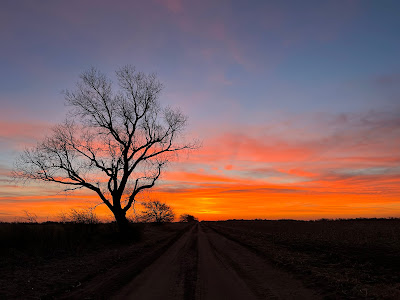
Photo taken May 12, 2022

Good lighting is everything. A good moisturizer is also critical to that dewy "super model" look. But, look a little closer, and the 2022 wheat crop may look a little more haggard than a touched-up "after" picture.

Yes, some rain and a beautiful sunset made a photo of our 2022 wheat crop look good. But, it was kind of like putting lipstick on a pig, as the saying goes. It didn't reveal the blown-out portions of the field and its short stature.

And I'm getting the feeling that the 2022 Hard Winter Wheat Quality Tour is kind of like that, too. The tour was May 16-19. Tour participants traveled six routes form Manhattan to Colby to Wichita and back to Manhattan. An average yield of 39.7 bushels per acre was calculated from the three-day average yield. 

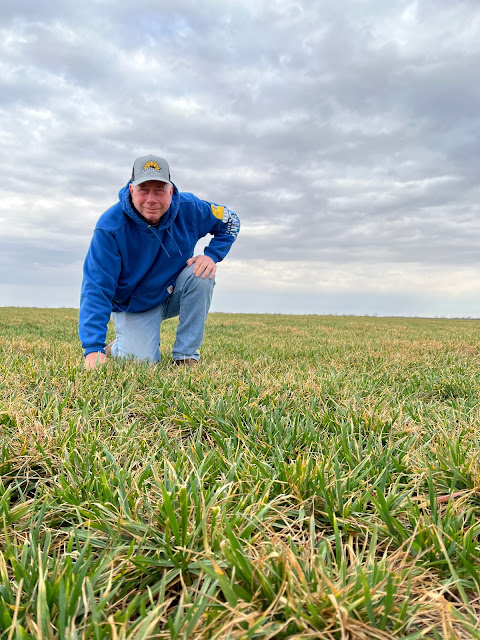
Randy and I will be thrilled if we come close to that for our final wheat harvest as active farmers. It sure doesn't look like it here, where we are still firmly in the grip of extreme drought. 

Of course, just like meteorologists are prone to do, the Wheat Quality tour powers-that-be give the caveat that there's a lot of time between the end of the tour and the beginning of harvest. 

We did get rain in May, helping make up for the lack of moisture this winter and spring. We got about 1.5 inches during the first week of May. Then, early on May 18, we got about 0.40" more.

The rain gave Randy enough optimism to turn in most of our wheat acres to be sprayed with a fungicide. Crop dusters flew it on on May 16. 

May 16, 2022, Photo by Randy

I had an eye appointment in Hutchinson, so my photography assistant did his best to capture a few snapshots.  

May 16, 2022, Photo by Randy
If we get an extra bushel and a half per acre yield, Randy says it covers the cost of the spraying. Time will tell on that, too.
May 16, 2022, Photo by Randy

The official Wheat Quality Tour projection for total production of wheat to be harvested in Kansas is 261 million bushels. The figure is the average of estimated predictions from tour participants who gathered information from 550 fields across Kansas. 

The tour summary did acknowledge that the Kansas wheat crop is spotty and short.We concur here on the Stafford/Reno County line. 

As I've been doing since October, we took a photo on May 21. (Truth be told, we actually took it the evening before.) 

Evening, May 20, 2022

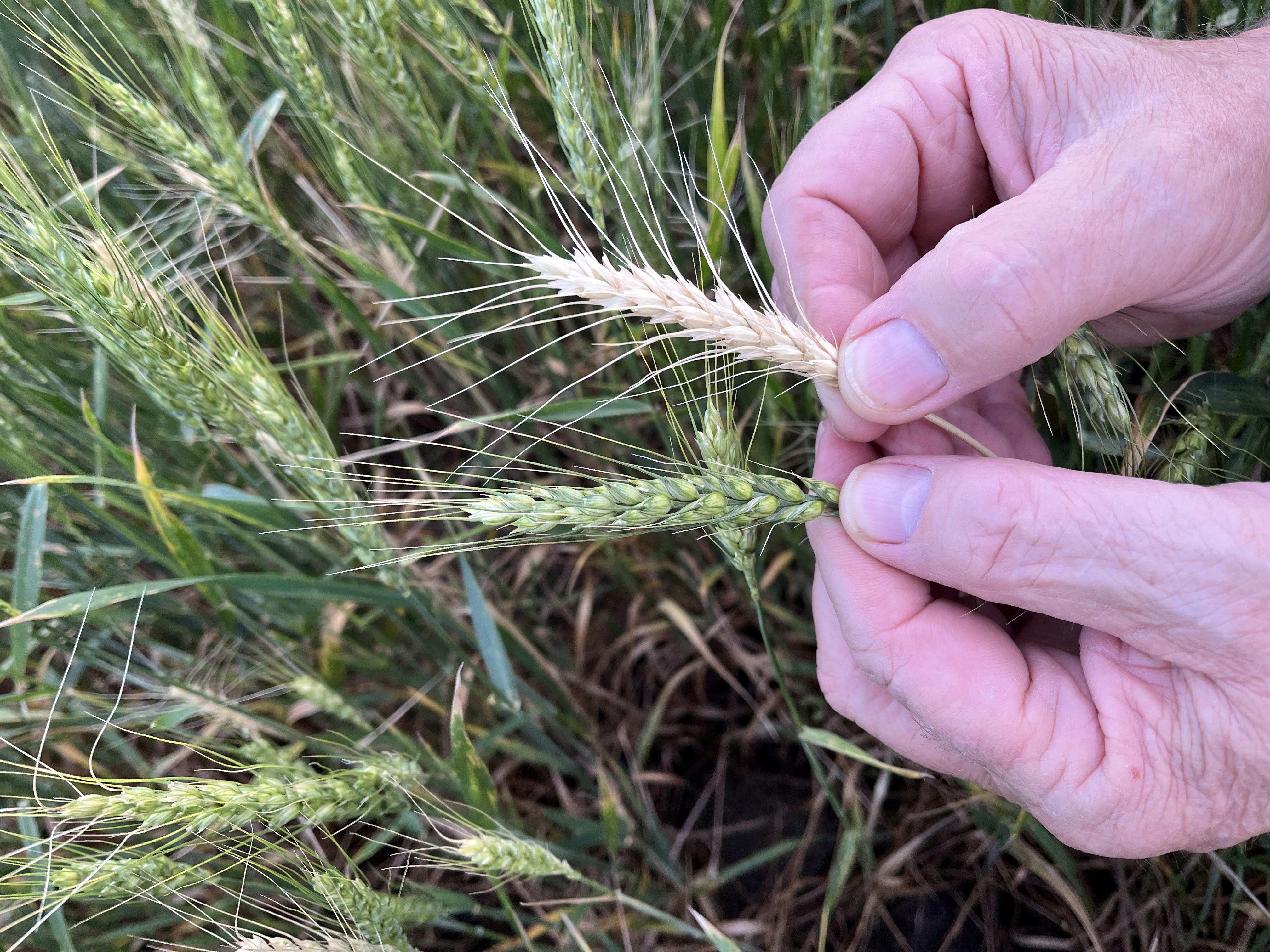
There are some light-colored heads, perhaps due to freeze damage or drought. Those heads don't have kernels.

Other heads look better than we expected, but as the old farmers like to say, "You can't tell for sure until it goes into the bin."

Photo from 2021 wheat harvest

Last week, we ended up with an additional 4.4 inches of soft, soaking rain. It should help the wheat heads fill. Time will tell how much the rain impacts the drought map, but we are thankful. 

Since I posted wedding-related blogs last week, I'm behind on posting my wheat update. So Randy and I went out this morning to take a few photos.

It's amazing to compare the color of the wheat on the evening of May 20 to the morning of May 31. The wheat's color is transitioning to gold. And we were also surprised by the size of some of the heads. The rain last week gave a good boost for filling the heads.

We Kansas farmers aren't the only ones watching and wondering about this year’s wheat harvest. As a Kansas Wheat news release said, the combination of expanding drought conditions and steep input prices in the U.S. and the continued impact of the Russian invasion of Ukraine has the markets — and farmers — on edge. A collection of resources from policy-makers and analysts offers insights into the economic impacts of current geopolitics. 

“Continued disruption in Ukraine through their wheat harvest combined with expanding drought conditions here at home will continue to weigh on the world wheat market. This growing season has the unprecedented combination of geopolitics, weather and some of the highest fertilizer prices and chemical inputs — but farmers here and abroad will remain resilient reminders of the importance of agriculture as a constant in a world full of conflict.” 
Kansas Wheat CEO Justin Gilpin in a news release from Kansas Wheat

The world consumes about 787.4 million metric tons (28.9 billion bushels) of wheat each year. Russia and Ukraine are the world’s top and fifth exporters, respectively, according to the most recent available stats from the Food and Agriculture Organization of the United Nations (FAO). 
Photo from 2021 wheat harvest

Together, Russia and Ukraine make up around one-third of the world’s wheat production. Ukrainian and Kansas wheat farmers follow similar timelines for winter wheat production. The crops planted last fall should be green and growing, marching toward harvest in late June or early July. Following harvest, milling quality wheat from Ukraine is typically exported to the Middle East, Africa and Bangladesh and feed quality wheat to other Asian countries, according to the USDA’s Foreign Agricultural Service (FAS). The impacts of the Russian invasion of Ukraine and disruption of these trading channels are yet to be fully calculated, but will likely extend beyond this year’s harvest. 


Thursday, May 5, 2022

May Flowers Without the April Showers

April showers bring May flowers.

But what happens if you don't get April showers? My lilacs decided to bloom anyway.

While my backyard lilacs have overcome the lack of moisture, our wheat crop is a different story. We did get a half inch of rain on Monday. The weather forecasters were saying that our area could receive 1.5 to 2 inches Wednesday and today. So far, that hasn't happened. 


The little bit of moisture has seemed to prod the wheat to begin to head out. It's a little late this year. For the week ending May 1, Kansas winter wheat jointed was 67%, behind 81% last year and 75% for the five-year average. The wheat headed was 10%, near 11% last year, and behind 17% average, according to USDA/NASS. In our area, I think it's further behind than that, but that's what the survey says.

We'll see what happens. My local correspondent at the Joan's Cafe says that more than one farmer has pulled out his crop insurance contract to see the terms. (Said correspondent has done the same.)

But, in the meantime, I'll enjoy my lilacs. They've been a favorite since childhood.


They're favorites for the bees ...

... and the butterflies, too.

The lilacs and spirea are familiar signs of spring.  

No wonder they are made-to-order for May Day!

I must admit the lack of rain has me worried. Unless we get appreciable rain today, I don't think the drought monitor map is going to improve. We are firmly in the "red" now (extreme drought).

But then I get reminders in things like email devotionals that remind me that God even cares about the flowers that are here today - and gone tomorrow.

Today’s Scripture

Can any one of you by worrying add a single hour to your life? And why do you worry about clothes? See how the flowers of the field grow. They do not labor or spin. Yet I tell you that not even Solomon in all his splendor was dressed like one of these. 
--Matthew 5: 27-29 (NIV)

Prayer for the Week

Thank you, God, for sun and showers.
Thank you for each lovely flower.
Thank you for each stately tree.
Though all these, you speak to me.
A Gardener’s Prayer

(I'm not a gardener, but I like the prayer anyway.)


Tuesday, April 26, 2022

Praying for Rain


See that blob of red in the middle of the state of Kansas? We farm really close to that red blob. That's an area of extreme drought.

All the color on the map - from yellow to burgundy - means that much of the state desperately needs rain. We certainly do.

So in this pictorial 21st-of-the-month wheat crop update, moisture - or the lack thereof - is the overriding concern.

The wheat isn't very tall. Dry conditions contribute to that.

In a Facebook memory that came up on my news feed last week, I saw that in 2017, the wheat had already headed. (Click HERE for that post.) We aren't that far yet as we work our way toward our summer 2022 harvest.


 But the wheat has jointed. The bearded head of the wheat is in the wheat stalk and will emerge soon.


This chart on wheat development is from Oklahoma State University.

While moisture is the current limiting factor for this year’s harvest, the outlook is more nuanced than measuring the dust or raindrops in the gauge. According to Kansas Crop Progress and Condition report on April 17, issued by USDA’s National Agricultural Statistics Service (NASS), the winter wheat crop's topsoil moisture supplies rated 33 percent very short, 30 percent short, 36 percent adequate and 1 percent slurpus. Subsoil rated 32 percent very short, 34 percent short, 34 percent adequate and 0 percent surplus. 

The field crop report rated the winter wheat crop as 11 percent very poor, 20 percent poor, 36 percent fair, 30 percent good and 3 percent excellent. Winter wheat jointed was 34 percent, behind 47 percent last year and 44 percent for the five-year average. 

A few areas got a little rain overnight on April 22 into April 23. We got less than 0.10 of an inch. 

Here's what it looked like during my first photo session on the 21st of a month - this one from back in October. For that whole blog post, click HERE.

October 2021

There is a chance for rain later this week. Let's hope this round doesn't miss us!


Tuesday, March 22, 2022

Then & Now: A Reality Check


Even before Kansas was a state, the sun has been rising and setting on the Kansas plains. Back in the 1880s, our ancestors  saw that same expansive sky stretching across the horizon as the new days dawned on a new state in the Union.

While the view may be similar, it's amazing to consider the changes in agriculture during my lifetime, and even more so during my parents' lifetimes.

Today is Kansas (and national) Ag Day.  It's a day set aside to celebrate agriculture's role in American life.  

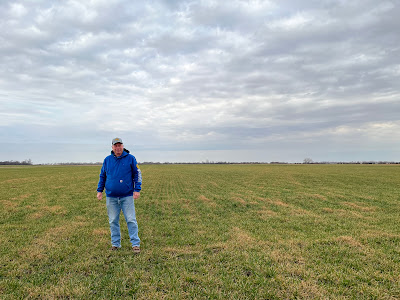
Yesterday was the 21st of the month, and this year, that means a photo update as we march toward summer 2022 and our final wheat crop as active farmers. Just like those sunrises, farmers have been scouting fields to watch the condition of their crops since farmers first began tilling the soil.

The yellow tinge on the wheat is freeze damage on the ends of the leaves and lack of moisture. However, there is green growing underneath. And, as we took the photos yesterday morning, we were hoping the cloudy skies would yield some rain.

We are fortunate: Yesterday and overnight, we got 1.5 inches of rain. Earlier, in this time since my February wheat update, we'd gotten some moisture from a couple of snowfalls, probably totaling 0.75 inches of moisture. 
 
The rain is good news on this Kansas Ag Day 2022. For 12+ years, many of my blog posts have told about our efforts on The County Line to provide food, fuel and fiber for American families and consumers throughout the world. But we're also glad to talk about farming in person, and we got that opportunity a few weeks ago when we spoke with second graders at Stafford Elementary School. I've done this a few times before at the request of second grade teacher Kylie Meyer. But it was great to be back in person, rather than on Zoom, this year.

As with any quality teacher, Mrs. Meyer gave us an assignment. She wanted us to compare the "then and now" of farming. The second graders are learning about comparison and contrast. Mrs. Meyer helps to illustrate the concept by inviting community members with different backgrounds to talk about their professions or interests and compare them, then and now. 

We may not be as interesting as Elroy's Pizza, but we were glad to do it.

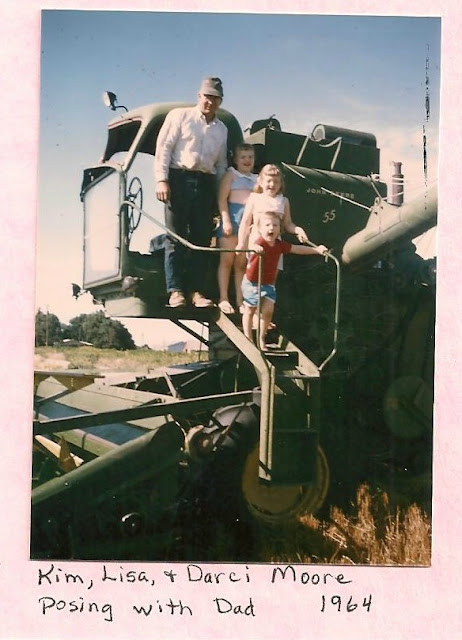
Several years ago, my mom compiled a family scrapbook for each of my kids, as well as her other grandchildren. Both my mom and dad wrote down memories, which were included in the books. In addition, she made copies of photographs. Some of those photos were of family. Others were of farm machinery.


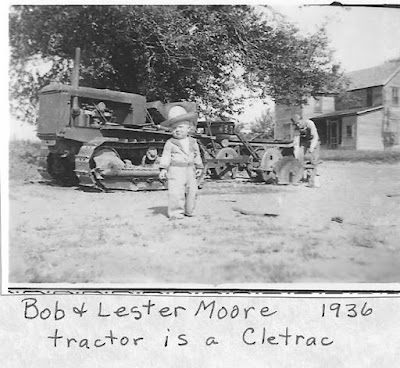
She even included a photo of my dad as a 2-year-old in front of the family's Cletrac tractor.

My mom did a great job through the years of taking photos of equipment as they added it to their farm in Pratt County. 


She had photos of some of the first equipment they purchased after coming back to the farm together in 1956 after their college days at Kansas State University. My parents also kept meticulous records of how much some of that machinery cost. 


The photo below shows that first tractor compared the size of the equipment these days. In 2021, they experienced their 65th harvest of their farming career together. (Thanks to my brother for the photo.)

My family's farming legacy goes back even further.  My dad's great grandfather came to Kansas and started farming in 1877. In 1898, my mom's grandfather came to Kansas and began working for a farmer. After he and his wife married, they began farming on their own early in the 1900s.

During my lifetime, my parents added irrigation to their farm. I also showed the second graders photos related to rural electrification, a cause championed by my maternal grandfather, Shelby Neelly. We talked about the decrease in rural population and what that meant for our rural community.

I have thousands of photos I've taken during our nearly 41 years of marriage and farming. But those old photos and the accompanying history gave me a great head start in preparing the PowerPoint presentation for the second graders, using the "then and now" theme. 


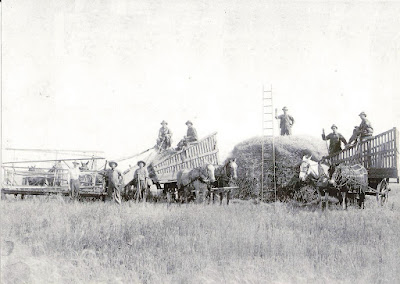
I have a few historic photos of Randy's family farm, but nothing nearly as complete as my Mom compiled. (I know how fortunate I am.) The photo above was in photos from Randy's family, but there was no information about the date it was taken or the people. 

We also showed a video, showing a similar team threshing wheat. Even though it obviously wasn't filmed in Kansas, it still showed a much different picture of harvest then and now.  

Randy's family has a similar history of farming in Kansas. This pasture on the Rattlesnake Creek has been in his family since 1900. 

I did share a few photos from their farm history in the slide show.

Randy's Grandpa Melvin

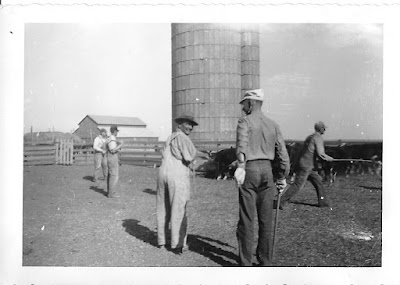
Randy's family on a cattle sorting day

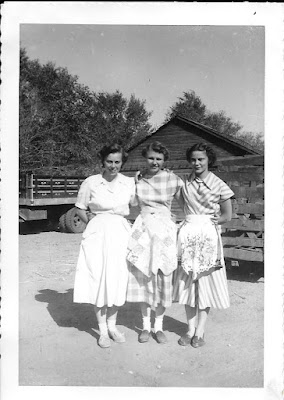
I also pointed out the differences in farm wives today, compared to yesteryear. 


 Of course, we believe agriculture is important. We wouldn't be the fifth generation of farmers in our respective families if we didn't believe in agriculture.
As our society moves away from its agrarian roots, fewer people seem to recognize the value. As organizers of Ag Day say:
We know that food and fiber doesn't just arrive at the grocery or clothing store or magically appear on the dinner table or in our closet. There's an entire industry dedicated to providing plentiful and safe food for consumption.
  • Each American farmer feeds about 165 people. Agriculture is America's No. 1 export.
  • New technology means farmers are more environmentally friendly than ever before. 
Even that tally for feeding has changed: In the 1950s, when my parents were beginning to farm on their own, the American farmer fed 27 people. That's increased 138 people in about 65 years. Pretty amazing, right?

So Happy Agriculture Day - today and every day!

More about the Moore family farming legacy can be found HERE:

 More about the Neelly farming journey can be found HERE.

More about the Fritzemeier farming tradition can be found HERE.