Showing posts with label fall harvest. Show all posts

Thursday, September 23, 2021

Pretty on the Inside?


I think wheat fields are beautiful at pretty much every stage - from bright green sprout to those iconic "amber waves of grain" waving in the Kansas wind. 

However, to me, corn is not a "looker" at harvest time. But we always hope it will be pretty on the inside. (I wrote about ugly corn syndrome in June. Evidently it didn't get a complex because it did OK in the end.) 

Last Friday, we completed our annual quest to discover the "inner beauty" of the crop.

We are relative newcomers to corn and have only had it in our crop rotation since 2013. (Randy has been producing alfalfa for 50 years and wheat for almost that long.) Our 99 bushels/acre 2021 corn crop was almost identical to the verdict last year:

2021 - 99 bu/acre
2020 - 98 bu/acre
2019 - 66.6 bu/acre
2018 - 82 bu/acre 
2017 - 43.6 bu/acre
2016 - 71 bu/acre
2015 - 43.88 bu/acre
2014 - 108 bu/acre
2013 - 57 bu/acre (This was the first year we added corn into the crop rotation).

We began corn harvest on Thursday, September 2. There was an abrupt pause the next day, when it was foggy and humid. Friday night (September 3), we got 3 inches of rain at our house, which stopped corn harvest in its tracks. While the corn was dry earlier, we couldn't get over the ground with the combine again until Wednesday, September 8. We stayed home from the K-State football home opener September 11 to cut corn. We had to be at the state fair on Tuesday, September 14, for Kansas Master Farmer and Farm Homemaker Day. As presidents of our respective branches of the organization, both of us had parts in the meeting and program. Then it rained that evening. 

However, it was pretty from the grandstand as we watched the storm roll in.

We made it through about 45 minutes of the Logan Mize concert before nearby lightning strikes shut down the music for awhile. (We drove home instead of waiting for Sawyer Brown. Looking at radar, we weren't sure the concert would continue, but it did.)

It took until Friday (September 17) for the ground to dry out out enough again for cutting. And we cut the last load of corn for 2021 that afternoon.

This spring, we planted 294 acres to dryland corn. (See the blog post about planting here. The corn was a lot higher than knee high on the 4th of July. And for photos on how it was looking later in July, click here.)

Our acres don't amount to much in the overall statistics of production for Kansas. 

According to the Kansas Corn Commission, a third of our corn stays in Kansas to feed livestock; a third is made into ethanol and dried distillers grain at Kansas ethanol plants; and a third of our corn leaves Kansas to be used in other states or exported overseas, along with corn products. 

Only five states produced more corn than Kansas in 2020. However, since our primary crop here on the County Line is wheat, we don't contribute much to the state's total. For us, corn is one of the crops used in our rotational program to keep soil quality good and weeds down. For my brother and parents in a neighboring county, corn is a primary crop.

Whether it's wheat, corn or milo, Randy still likes being in the combine seat. And I like to go along for the ride.


I think the dry corn cobs look a little like missiles as they get propelled into the header. The corn ears are pulled off the corn stalk and are dragged into the combine with rollers. Inside the combine, the corn kernels are separated from the husks and cobs.


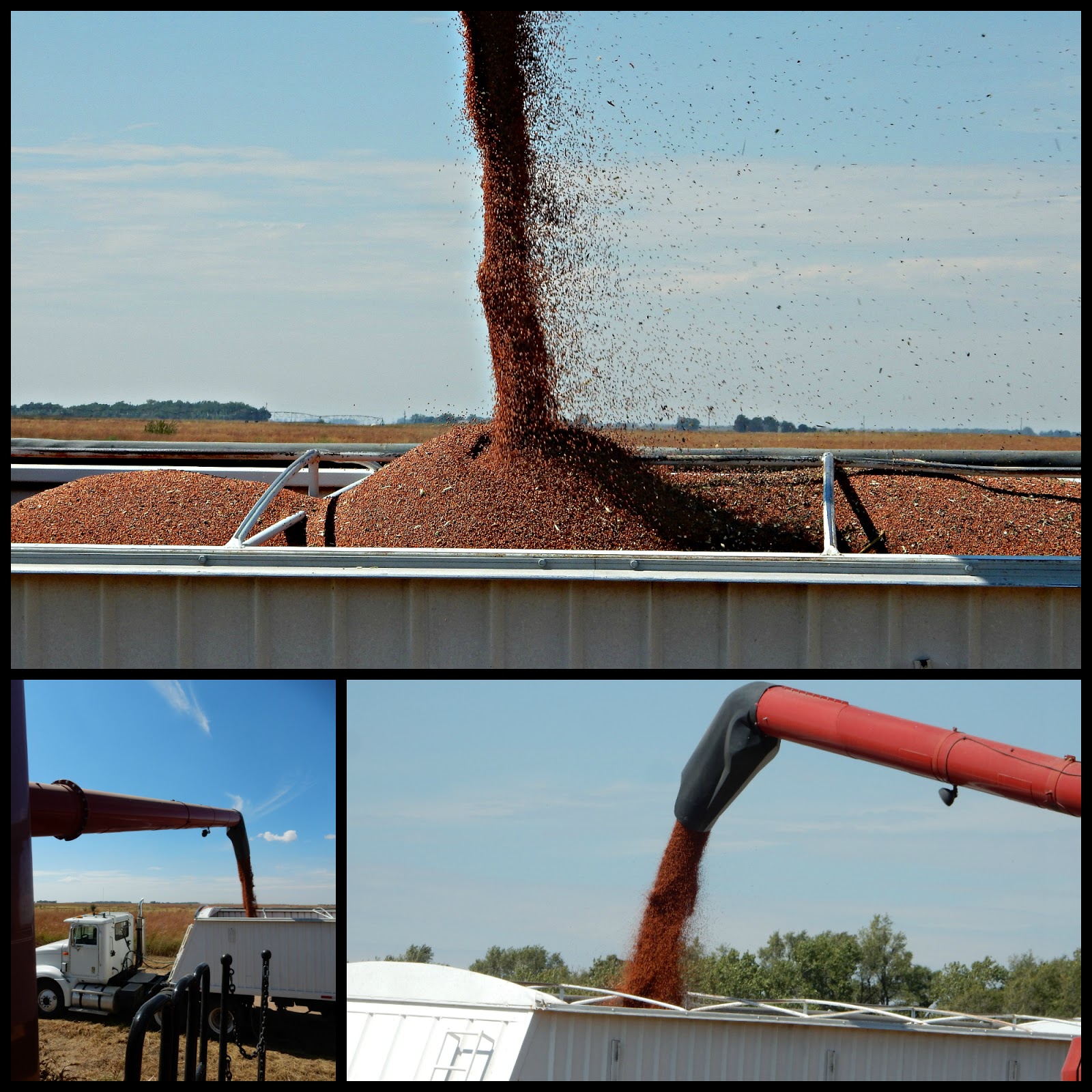
The cobs and debris are dispersed out the back of the combine. And the corn kernels go into the semi for a trip to the co-op elevator.


Many farmers have a grain cart pulled by a tractor to transfer the corn from the combine to the grain cart to the truck. 


But we unload from the combine directly into the truck.


Here's a little video, but the combine cab window is kind of dusty. It's probably not particularly "pretty on the inside."

It's always good to have the sun set on another harvest season.


Unrelated to corn, we discovered that Randy's wheat entry in the Kansas State Fair wheat show had done well. He got second in one of the classes on his Bob Dole wheat variety. And the cycle continues: He began planting our 2022 crop on September 21, the final day of summer (at least, according to the calendar).


Monday, September 26, 2016

Go Big Red: No, Not the Football Team

Kansas grows more sorghum than any other U.S. state. However, here on the County Line, we are not contributing much to the total.
 
Still, it was the first time in four years that we'd had any milo planted.  I, for one, was glad to see it back. I think it's pretty.
August 20, 2016
However, that is not a valid reason for planting a crop (much like choosing a car by color only). This year, Randy planted milo on some poorer ground on which corn had not been productive. It took us less than a day to harvest the 30 acres we'd planted to milo.
August 20, 2016
By the end of the growing time, there was a factor that didn't make it nearly as pretty. The milo fields were invaded by sugarcane aphids. Those are the tiny little white dots on the milo leaves in the photo below.
 
Because the grain on the County Line had mostly turned color by the time the aphids arrived, we didn't spray the milo with an insecticide. (Our silage and sudan also have sugarcane aphids. We did have our silage sprayed by an aerial applicator to try and prevent further damage to it. That field isn't right by our house, so I didn't hear the plane and I missed the opportunity for pictures. Darn!)

When I went to the milo field to take photos of harvest, I noticed all the ladybugs. They were feasting on the aphids.

The tiny aphids migrate on southern winds, pierce the leaves of sorghum plants, suck out the sap and excrete a sticky substance known as honeydew that will gum up harvesting equipment such as combines and ensilage cutters.

As Randy moved through the fields, you could see the sticky residue, making the milo leaves glisten. Thankfully, it didn't gum up the combine for us.

A custom harvester who was eating breakfast in town last week said he'd told his customers that he wouldn't cut aphid-infested fields without them being sprayed because he didn't want to tear up his equipment. It's kind of a Catch-22. Choosing whether or not to spray comes down to a couple of factors: economics and harvestability. It can cost between $15 and $25 an acre to spray the insecticide. Also, there's a four-week withdrawal time before it can be harvested. With milo only at $2.57 a bushel, it's not easy to make a decision to add additional expenses to production of the crop. 
“Right now, with the price of sorghum, you need 90 to 100 bushels just to break even,” said J.P. Michaud, entomologist at the K-State Agricultural Research Center in Hays.
In the photo above, the little dots on the combine windshield are ladybugs. They were taking a ride as Randy went through the field.
One field of our milo made 90 bushels per acre. The other field averaged 60 bushels per acre.
In 2014, Kansas ranked first in grain sorghum production in the U.S. with more than 200 million bushels grown, which equated to more than 40 percent of the country's total production. 

The use of sorghum for human consumption is being developed further in countries where malnutrition and hunger are prevalent. The fall issue of the Kansas State University College of Agriculture Ag Report had an article about sorghum:
In the Mara Region of Tanzania, one of the most starved areas of the world, K-State grain scientist Sajid Alavi is part of a research team working to improve child nutrition and health by providing a sorghum-soybean porridge blend to children younger than 5. ... While the results of the five-month study are yet to be finalized, Alavi said the early indications are that children were more healthy and had average growth rates.
 Even closer to home, Stafford High School students are researching milo. A post to the Stafford High School Greenhouse and Aquaponics page last week showed a photo and explained research being done by students at our small, 1A school. (That makes me really proud of our school!)
From the Stafford High School Greenhouse and Aquaponics Facebook page
Here's what they had to say:
The Ag Research class has begun to investigate sorghum as an alternative to corn production in arid regions of the world. Sorghum isn't nearly as thirsty or hungry as corn, yet produces a grain seed with 95% the nutritional value of corn (lacking vitamin A). We soaked locally grown sorghum in water overnight, next morning brought the container to a rolling boil, then let it simmer for almost 2 hours. The sorghum berries where soft and tender ready to be eaten. Compared to beans, sorghum would save preparation time and save limited resources while providing a nutritious replacement for beans. The sorghum grown in the most of the US is for feed.
Last night, Luke Alpers and his teacher Mike Cargill spoke at a PEO gathering. Luke has been selected to represent the state of Kansas as a delegate to the 2016 Global Youth Institute in Des Moines, Iowa, October 12-15. He'll be part of the conversation with the World Food Organization about world food security. Luke will present his paper on the aquaponic system at Stafford High School.

The SHS students are also doing experiments with mealworms.These insects were able to utilize non-food products - like Styrofoam, cardboard, banana leaves and cut-up plastic milk cartons - and convert the media into a biological food source. The worms could provide another protein source for malnourished countries and could also have implications at landfills. It is fascinating stuff! Want to know more about what our SHS students are doing? "Like" the Stafford High School Greenhouse and Aquaponics on Facebook for periodic updates on what's going on in the greenhouse and in the Ag Research class. 

Friday, September 4, 2015

Harvest Kernels

We've been finding corn kernels on the bedroom floor. Hmmm ... I wonder who is responsible?
This moisture test came out 14.0, which is dry enough to cut.
Of course, if I tried to climb in and out of the combine bin to check moisture on the corn, I'm afraid I would break my neck. (See Randy doing his acrobatic act without a net in the upper lefthand photo in the collage above. It's kind of blurry, but you get the idea.) So if I have to sweep up a little corn, it's a small price to pay.
Corn harvest 2015 on the County Line started August 27. We were able to cut for a few days before we ran out of dry grain.
After Randy put corn in the grain moisture tester (see photos in the collage) and got a 16.6 reading, we waited a few days until the corn could dry out more.
We got started again on Wednesday, September 2. It was my second attempt at getting some photos I was happy with. Maybe I'm a wheat farmer at heart. I think wheat harvest is inherently prettier. The dried up corn and crepe-paper-like crinkly husks don't have the natural charm of wheat, in my humble opinion.

This year, we also have a lot of weeds, which doesn't make farmers OR photographers very happy. (I got some ideas for corn shots after seeing posts from fellow ag-vocate and Facebook/blog friend Jenny Burgess, Sterling, of Farmwife Transparency. Thanks, Jen!)
We don't have yield totals yet. However, this third year of corn production on the County Line is not a bin buster.
Photo through the dirty combine window, but you can see the corn cobs coming into the combine.
Yes, modern corn varieties have some drought-tolerant properties bred into them. However, that just keeps the "window" open a little longer for ear development. It's still important to get a good rain during that time frame. This year, we didn't.
Because we are totally dryland on our farm, wheat continues to be the primary crop for us. And that isn't likely to change.
When I saw the corn cobs left behind, I kept thinking about Frosty the Snowman's corn cob pipe. I would take more "frosty" temperatures after the blast furnace heat and wind of the past few days!
 
The adventure continues ...

Wednesday, September 11, 2013

View From the Combine Cab

"Thumping" is not usually a sound a Kansas wheat farmer wants to hear in the combine cab. Too often, it signals a malfunction of the mammoth machine that will likely result in costly repairs and downtime.

But, we Kansas wheat farmers on the County Line are discovering that corn harvest is a bit different. The thump, thump, thump as corn cobs enter the machine is just business as usual.
The quality of this photo isn't the best. It's not easy to take a photo of moving parts. Still, maybe it can give you the idea of what's happening!
This is the first time we've raised corn in our 32 years of farming together. In recent years, there has been some dryland corn planted in our area, but wheat is still the dominate crop around here. For most in this immediate area, irrigation is not an option. Our proximity to Quivira National Wildlife Refuge and its salt marshes is not ideal for quality ground water for irrigation.

This year, instead of planting milo as our row crop, we planted corn. There's a potential for higher yields, and there is more drought tolerance built into dryland corn seeds than previously available.  Additionally, corn is Round-Up ready, and milo is not. We have been having trouble controlling weeds in milo. If there are weeds and grasses in the corn, we can spray with Round-Up without harming the growing plants. 

Generous summer rains have helped us find some measure of success in our maiden voyage as corn farmers. However, extreme heat during pollination has reduced yields in some fields.
There is a learning curve for we new corn farmers. Randy is getting used to running our new corn head, which looks kind of like it has eight missiles attached to the front. He runs each missile-shaped attachment between the rows. The combine strips the corn cobs from the corn stalk, then the cobs are run through the machine.
Randy's reflection in the back window of the combine cab, with corn being deposited in the grain bin on the combine.
The cobs and stalks end up behind the machine. And the golden corn is augered up into the bin.
 Then, Randy offloads it into the grain truck, so that it can be hauled to market.
 
That's the process - theoretically, anyway. However, cutting a different crop means some tinkering with the combine to make sure the grain is getting separated from the stalk and cob, so Randy checks what's left behind the combine and makes adjustments as needed.
Last week, we cut higher moisture corn to take to the Haw Ranch Feedlot near Turon. They want the corn with a moisture percentage between 24 to 32 percent. They then grind the corn into cattle feed. (More on that process tomorrow.)
 
Our local cooperative elevator wanted moisture percentages at 16 or lower.  We hauled several loads to the Turon feed lot Tuesday and Wednesday. However, last Wednesday afternoon, Randy sat in a line of more than 30 trucks, waiting to dump. Since we don't have a semi truck for hauling, he decided that it was no longer worth the time or money to haul 20 miles away and have that much downtime.

On Monday, it had dried down enough to haul to Zenith, so Randy & Jake are back in business and cutting corn. 
Tomorrow - Hauling corn to the feedlot - a new adventure!