Thursday, July 12, 2018

Fresh Cut Hay Candles: Yes, It Is a Thing

Yankee Candle company has scents like "midsummer's night" or "sun and sand," but I didn't find a "hay field" scent.

However, Grey Horse Candle Co. has entered the market on this summertime fragrance. Here's what they had to say about their Fresh Cut Hay candle:

It's an obsession that only other horse people understand, the fresh aroma of this season's first cutting, baled into a big bundle of happiness. Experience the sensation of a warm breeze blowing through freshly cut hay fields. (Your horse will love it, too!)
Our Fresh Cut Hay fragrance is infused with natural orange essential oil, and captures the essence of summer florals and the fresh aroma of freshly cut grass. And with a hint of orange and sandalwood, it’s a natural scent you’ll love any time of the year!

I wonder if it's a big seller.  (They also have Wash Rack, Give a Horse a Carrot and Sweet Feed, to name a few. Hmmm ... interesting.)

We haven't needed a candle to capture the scent of freshly-cut alfalfa here on the County Line lately.
The purple blossoms add decorative flair to the subtle aroma. The butterflies like them, too, though on a summer evening, their traffic pattern seemed to have more take-offs and landings than a busy airport. It wasn't ideal for capturing their portraits. Ah well!
The guys have been working on our second cutting of alfalfa.
This has not been a good alfalfa hay year. Our first cutting yielded only 200 bales - half of our normal 400-bale yield.
 
Our lack of springtime and summer moisture has stunted the crop's growth. Our second cutting will be even smaller, though a few rain showers have generated enough growth to make a second cutting possible - even if it's thin.
The guys are still in the process of raking and baling the second cutting.
We use the alfalfa to feed our cattle. Usually, we raise more than we can use and sell the rest.
We'll have to see how the rest of the summer goes to see if we'll have any excess hay to sell.
Randy hopes to supplement alfalfa with sudan, pearl millet and silage for feeding our cattle. While last week's rains helped boost those crops, this week's 90+ temperatures are not helping those crops flourish either.
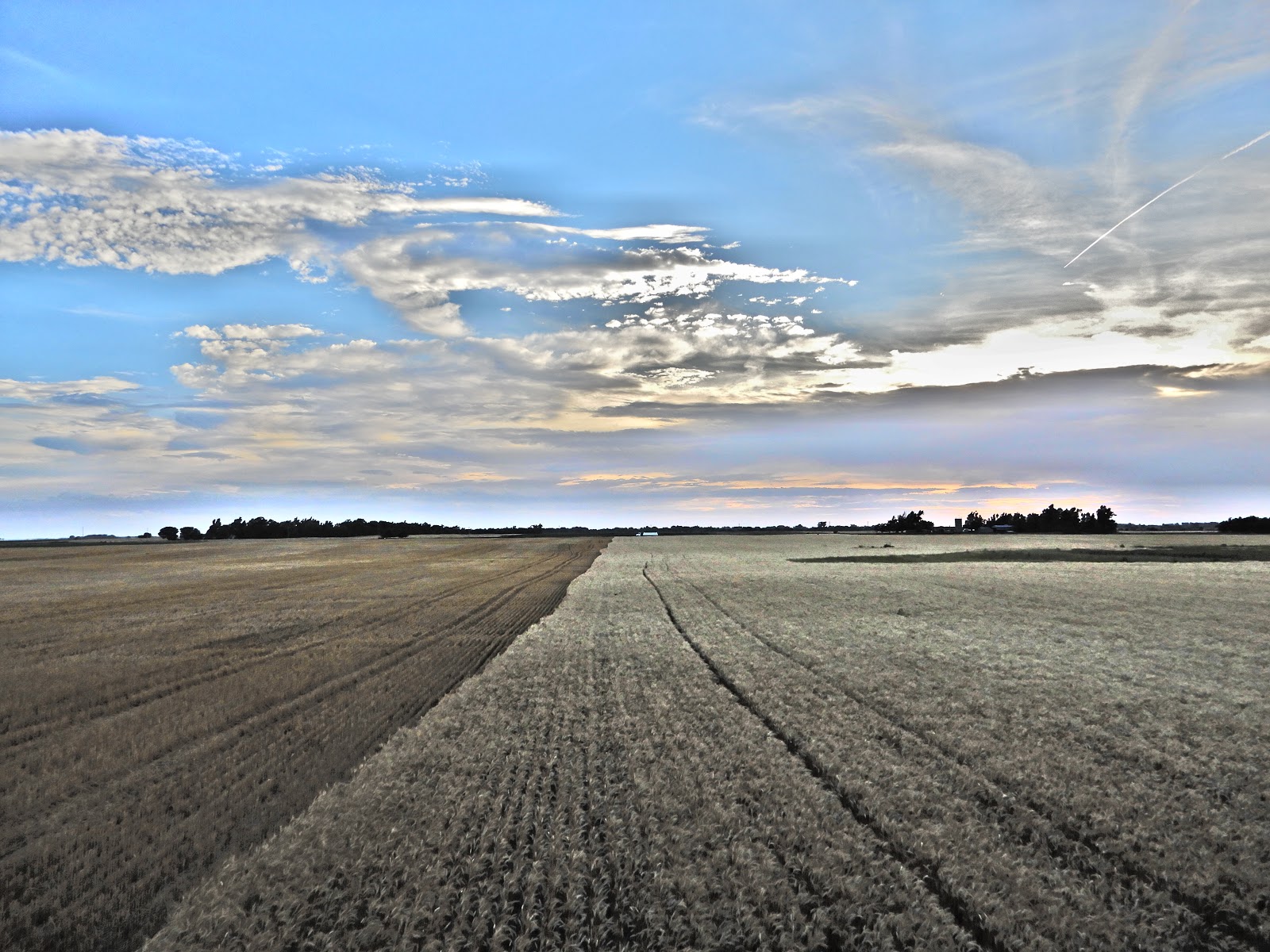
As with most things in farming, we'll have to take a wait-and-see position. The waiting is made a little nicer with scenes like this though. I just wish those clouds had some rain in them.

Tuesday, July 10, 2018

Cottonwoods: Wtiness Trees

One of Reno County's largest cottonwood trees. Can you see Randy?
I have a lifetime love of cottonwoods.  At my childhood home, an old cottonwood stood near the south driveway, the first thing visitors saw as they approached the farmstead and one of the last things silhouetted by a sunset sky at night. 
Cottonwood at my childhood home, Pratt County
Every spring, the cotton from the tree covered the ground.
My sisters and I used both the cotton and the green unopened pods to decorate mud pies.
In this photo dated April 1963, I was 5, Lisa was 4 and Darci was 18 months. I have fond memories of adding just the right amount of water to dirt and then pouring it into pie tins and buckets. The fluffy white cotton and the green pods were the decorative touch. It was all about presentation, even back before knowing anything about garnishing via the Food Network chefs.

But, sadly, that old cottonwood succumbed to old age, and it no longer stands sentinel at my parents' home.

On Sunday, July 8, CBS Sunday Morning featured a story on Witness Trees. These trees "witnessed" the battle at Gettysburg. Across 6,000 acres of Gettysburg National Military Park, rangers have documented at least a dozen "witness trees" that were alive during the battle - living links that help tell the story of the battle, according to park rangers.

Cottonwoods live from 60 to 200 years. A few of them that still survive today likely co-existed with the bison herds that roamed the Great Plains long ago. (Great Plains Nature Center, 2006).

Cottonwoods help tell my story, too, and they have "witnessed" important passages in my life. 
It just seemed right that a cottonwood tree guarded the mailbox at the home where we've lived since 1985. (Click on the link to see our tree in every season.) Just a few weeks after we moved into this home, that cottonwood witnessed us bringing home our first baby, Jill. It was a quiet sentinel two and three-quarters years later when we brought Brent home. It witnessed their wobbly attempts to ride bikes on dirt roads, their first bus rides to school and "saw" more than one 4-H calf halter broke. It waved goodbye as they left for college and greets them when they come back home. It is our "witness" tree on the County Line.

 However, it, too, is struggling to survive these days, with some branches never greening up this spring.
The road patrol driver asked about cutting it down. While there's still green to be seen, we're not ready to let it go.
Mighty cottonwoods form a canopy down many a country road in rural Kansas. One of my favorite cottonwood "tunnels" is along 4th Avenue near Huntville.
 
Though tree trimming and age have made that tunnel effect less dramatic in recent years, it's still a favorite landmark on the drive to and from Hutchinson.
June 2018
One of Reno County's largest cottonwood trees is on a road just east of that old cottonwood tunnel.  On a recent return trip from Hutchinson, Randy detoured down the road to visit. 
It's so big you can't get the whole thing in a single snapshot. Randy tried to demonstrate the massive trunk with his outstretched hands.

"It's a darn big tree," Jim Smith, former director at Dillon Nature Center in Hutchinson, said in an article in The Hutchinson News. I'm glad he did the measuring because we didn't come prepared, even to measure the trunk and certainly not to scale its height. It measures more than 28 feet around, 96 feet tall and has a spread of about 110 feet.
Early Kansas settlers found the native trees as they arrived from the eastern U.S. The wide Kansas prairie was often foreign and intimidating to settlers moving west from the Ohio Valley, the Appalachian Mountains or New England. The landscapes they had left back home were covered with trees that provided wood for building homes, fuel for cooking, fuel to warm the hearth during a harsh winter and shade to protect them from a hot summer sun. Following the Oregon and Santa Fe trails west, trees were in very short supply.

4th Street cottonwoods, September 2015
When a cottonwood tree was spotted, thoughts of shade, water, wood and back home filled the minds of weary travelers. The cottonwood gave those traveling through the state a respite from the summer sun and the courage to continue west.

When the Kansas Legislature chose the cottonwood (Populus deltoides) as the state tree in 1937, the proclamation read:
"Whereas, if the full truth were known, it might honestly be said that the successful growth of the cottonwood grove on the homestead was often the determining factor in the decision of the homesteader to 'stick it out until he could prove up on his claim'; and Whereas, The cottonwood tree can rightfully be called 'the pioneer tree of Kansas.' "
4th Street cottonwoods in winter
They are like the old family patriarch - tall, stately, but maybe a little rough around the edges after years of standing through the changing seasons. Many a country road is lined with these big old trees, which seem to wave a friendly greeting in the Kansas breeze. On early morning or late evening trips to check cattle, the cottonwood's leaves rustle and birds serenade from their branches.

Their attire changes with the seasons - whether clothed in green for summer or in yellow finery for fall or stark and drab in winter's solemnity.
July 2013
For years, the road to the Big Pasture was lined with cottonwoods. It's just not the same after they were cut down last year.
The Palmer Pasture cottonwood in better times.
A cottonwood near our Palmer Pasture came crashing down two summers ago. I still miss it when we pull into the southwest gate of the pasture.
I always appreciate the fall colors on the cottonwood trees as we leave the Ninnescah Pasture to bring the cattle home each November.
And a grove of old cottonwoods frame our secret garden of iris each May along the Zenith Road and the glimmer of the shiny leaves at golden hour make it even more picturesque.

Long may these witness trees live!

Thursday, July 5, 2018

Independence Day

Independence Day came a day early for some feathered guests.

This year, a pair of barn swallows chose an unused porch on the south side of our house for their nest-building site.
I don't know whether they liked it better or not, but I've liked their new southerly address this year.
2017
Last year, they took up residence at our back door, the one we go in and out of several times a day. They were the epitome of messy house guests, leaving their "calling cards" all over our back steps.

Out of sight, out of mind this year.
I'd see the parent swallows hanging out on the same backyard wire. But they weren't dive bombing me as I used the door.

Randy told me the birds were about to outgrow the nest, so I decided to venture closer for a photo op the evening of July 3rd. If you look closely, I think you can see five. I got one photo snapped before they flew the coop -literally.
Independence Day came a day early. And, no, I did not get video of them flying away. Randy, who was swathing hay at the time, asked if I'd captured their departure. I'm not that quick. With a rush of wings, they were gone. I couldn't even see where they'd flown. Sorry Mama and Papa Barn Swallow. I didn't intend to give your babies a push out of the nest.

Their sudden departure made my heart beat a little faster - kind of like a surprise boom tossed into a colorful show of aerial fireworks. That's as close as we got to real fireworks this year. We watched the New York City and Washington, D.C., shows on television so Randy could be up early today to rake hay.
But, let's not hang that "Vacancy" sign out quite yet. Last evening at dusk, Randy noticed that a barn swallow was hanging out at the nest. We're not sure whether it was one of the parents, wanting to know where their babies had gone? But we think it was a juvenile ... kind of like that college student who wants to be independent but still likes mama's home-cooked meals and laundry service.

It wasn't there this morning, so we'll see if it's time to send in the housekeeping crew and get the "bird motel" cleaned up for good. 

Tuesday, July 3, 2018

Wheat Harvest: Now That's a Wrap!

Wheat Harvest 2018 is now in the rear view mirror.

We finished up June 29 after starting on June 12. Well, we tried to start on June 12 and would have, except for the raccoon going through the combine. That delayed the start to June 14. We then limped along with repeated visits from the Case repair guy because of an engine power problem, unrelated to the raccoon. We finally started making headway on June 17, a good Father's Day gift for my farmer.

This year's start date was consistent with recent history. (I have good records since 2010 because I've been blogging that long). Our start dates are:

2010:  June 18
2011:  June 10
2012:  May 26 (an anomaly and the earliest harvest, by far, we've ever had)
2013:  June 21
2014:  June 17
2015:  June 20
2016:  June 15
2017:  June 12
2018: June 12 (sort of)
Because of the rough start to harvest, we opted to have a custom cutter harvest 290 acres of our 1,321 acres this year. Even though it's an added expense we'd prefer not to have, we're glad we did it now, after having several days of rain. And, no, we aren't complaining about the rain or cooler temperatures that arrived June 22-26. The rains were beneficial to corn, feed, alfalfa and pastures.
But, back to wheat harvest. Yield averages in the past few years have been:

2010: 37.2 bu/acre
2011: 36.7 bu/acre
2012: 45.5 bu/acre
2013: 52 bu/acre
2014: 24.5 bu/acre
2015: 50 bu/acre
2016: 48.5 bu/acre
2017: 50.84 bu/acre
2018: 39.2 bu/acre
Our 2018 average was 39.2 bu/acre. We had a low average of 11 bushels an acre and a high of 56 bushels per acre. Most of it was in the 35 to 45 bushels per acre range. The 11 bushels an acre was on ground the landlord bought primarily for hunting, so it's less productive ground. Because of our dry fall and winter, much of it didn't come up until the spring. That put green heads among the dry heads, which was one reason for the delay in cutting and the poor quality.
Used the "painting" setting on the camera for a different look
After being in an exceptional drought category for much of the winter and spring, Randy was pleased with the yield totals. Some late spring rains came at just the right time for the filling of the wheat heads, and we are thankful!
Randy is always thankful for harvest pie, too. He doesn't get dessert all the time. Blueberry pie with crumb topping makes harvest a little more palatable and was my Father's Day gift to him. (Here's a two-crust version at this link.)
Photo taken June 22, 2017 - Wheat Harvest 2017
Wheat Harvest 2018 isn't just about cutting wheat in June. It actually started with Wheat Harvest 2017. (Notice how I capitalize Wheat Harvest. It's a "Big Deal" to our farm. By far, wheat is our biggest crop.) Each year, we plant some certified seed, which we use for seed wheat for the following year. Randy binned KanMark (a K-State release) and WB 4458 (a WestBred variety) to plant for seed wheat for our 2018 crop. During the 2017 harvest, we binned the seed wheat in on-farm storage.
Then, last July, we took the wheat to be cleaned to Miller Seed Farms. (See blog post: A Kernel of the Process: Cleaning Seed Wheat.)
In October 2017, we planted the 2018 wheat crop. (Read more about it here: Planting Wheat, Harvesting the Sky.)
 
The lack of moisture was a concern during the winter and spring. In fact,  November 2017 to January 2018 ranked as the driest (lowest precipitation) on record for Kansas, receiving less than 25 percent of normal precipitation for that time period.  (Read more about it here: Precipitation Woes.)
 
Our first measurable precipitation on the 2018 wheat crop after planting came in late March. (Read more here: Million Dollar Rain?)
Because of cooler temperatures and slow growing in April, a freeze didn't nip the growing point in our fields. (Read more here: Rain, Rain, Come Again Another Day.)
 
The wheat was heading by early May. (Read more here: April Showers.)
And then the main event came in June. Cutting wheat is usually Randy's favorite time of the year.
You sure can't beat the scenery seen from the elevated vantage point of a combine cab. (The poem in the photo above was written by a Kansas poet who lived for a time in Belpre, a town in the county to our west. Fittingly, her husband ran the grain elevator there.)
However, this year's harvest wasn't all beautiful scenery, as evidenced by Randy shaking out the air filter ... yet again. But there was plenty of good, too.
The last of that combine bin trickles out as the last bit of light fades from the sky.
And that, as they say in show business, is a wrap.

THE END ... until a new beginning for Wheat 2019.