Thursday, March 24, 2022

President's Project: To Make the Best Better!


I think I've dotted all my Is and crossed all my Ts now. On March 11, I installed my friend, Millie, as the next president of the Kansas Master Farm Homemakers Guild. And with that installation, I finished five years serving as an officer in the organization. (Randy finished up five years as an officer with Kansas Master Farmers.) Last week, I completed paperwork and wrote letters and thank you notes to end my term.

On the women's side, tradition has it that the outgoing president gets to choose a President's Project. Members - and others - are invited to contribute to a project of her choosing. 

I contacted Kansas 4-H Foundation Director Jake Worcester prior to the meeting for some ideas. I told him that 4-H foods and nutrition, as well as photography, were among my passions. After talking with Kansas 4-H state leaders, he suggested a project to help honor foods and nutrition exhibitors at the Kansas State Fair.

Foods and nutrition 4-H members have their food exhibits judged early on at the fair. There's only room for a few of those exhibits. And even those exhibits don't look too tasty by the end of the 10-day fair. 

The digital display board will be something similar to this.

My President's Project will help provide a digital display board in Centennial Hall on the Kansas State Fairgrounds where photos of the 4-Hers and their foods can be displayed during the duration of the state fair. It's a pilot project. If this display board works well, Kansas 4-H may add similar displays to honor other projects at the fair. 

Several of my fellow Kansas Master Farm Homemakers contributed to the digital display board. I know there are others of my friends whose roots in the 4-H program go just as deep as mine. If you'd like to contribute to the KMFHG President's Project, you may send a check made out to the Kansas 4-H Foundation with your contribution to:
 
Kansas 4-H Foundation
1680 Charles Pl., Suite 100
Manhattan, KS 66502

Please make a note that it should go toward the KMFHG President's Project.

The project was the perfect choice for me. 


I was a foods and nutrition member back in the 1960s & '70s in Pratt County.


 From the very first year of Jill's 4-H career, foods and nutrition was a favorite project.

Jill's first food demonstration on making a Raggedy Ann Salad

Foods demonstrations and exhibits were central to Jill's 4-H experience.  Jill and her friend, Holly, made dozens of pretzels one year. They made dozens of dinner rolls another. And they earned the right to take both those demonstrations to regional club day and the state fair.

Jill's friend, Holly, & Jill making pretzels for a demonstration
 

By the time she was veteran 4-Her, Jill was teaching others, and serving as a foods superintendent at the county fair.

She was the state award winner in the 4-H Foods and Nutrition Project her senior year.  

Last year, Kinley had her first experience as a foods and nutrition exhibitor at the Shawnee County Fair. She also gave her first foods talk for county club day, though it was a different experience having to do it on Zoom.


But this winter, she got to give her first in-person foods demonstration, making Energy Bites. She got a blue ribbon.

Brooke just began her 4-H journey last fall. But her very first Show and Tell at county club day was on foods and nutrition and My Plate.

The girls are the fourth generation in our family to be involved in the Kansas 4-H program. My parents were members back in the 1940s in Pratt County. Both were members of the Lincoln Bluebirds 4-H Club in Pratt County, the club that my siblings and I later joined. (During my time in the club, we consolidated with another club and became the Lincoln Climbers.)

Bob & Janis Moore - Pratt County Fair service award recipients in 2011      

All four of their children and all seven of their grandchildren were part of the 4-H program, two in Pratt County in the same club their grandparents attended, two in Stafford County and three in Clay County. Now that continues for five of their 10 great-grandchildren in Clay and Shawnee Counties.

Randy's parents were leaders in the Stafford County 4-H program, too, though we're not sure they were 4-H members themselves. For a dozen years, Randy & I were community leaders of the Corn Valley 4-H Club, the same club Randy was a part of back when he took his first cow to the fair. I'm still the 4-H foods superintendent at the Stafford County Fair.

In 2006, we celebrated 100 years of Kansas 4-H. The youth program has been part of the national landscape since 1902.

The 4-H website says:

The 4-H idea is simple: help young people and their families gain the skills they need to be proactive forces in their communities and develop ideas for a more innovative economy. That idea was the catalyst to begin the 4-H movement, and those values continue today.

The 4-H program continues to MAKE THE BEST BETTER!

I'm thankful that it's been all that and more for my family ... and will continue to be.

Kinley & Eric before their shift at the pancake feed. As Uncle Brent says, 4-H t-shirts haven't evolved a lot from the '90s.

***
A little more history: The Kansas Master Farmer award was started in 1927, by then-Kansas Farmer publisher Sen. Arthur Capper. A year later, The Farmer’s Wife magazine, which is no longer in print, started the Master Farm Homemaker Guild, with help from Kansas State University. More than 400 farm couples have been recognized and have become members of the Kansas Master Farmer Association and the Kansas Master Farm Homemakers Guild. The goal was to publicly honor excellence in farming, homemaking, farm living and rural citizenship. In 1953, Kansas State University Cooperative Extension Service took on the duty of the selection process and coordination of the annual honor banquet. Today, K-State Research and Extension and Kansas Farmer magazine co-sponsor the program, with financial support from Kansas Farm Bureau, Frontier Farm Credit and American AgCredit.

Tuesday, March 22, 2022

Then & Now: A Reality Check


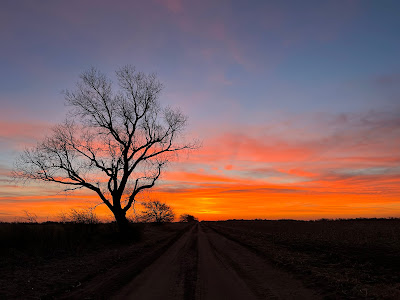
Even before Kansas was a state, the sun has been rising and setting on the Kansas plains. Back in the 1880s, our ancestors  saw that same expansive sky stretching across the horizon as the new days dawned on a new state in the Union.

While the view may be similar, it's amazing to consider the changes in agriculture during my lifetime, and even more so during my parents' lifetimes.

Today is Kansas (and national) Ag Day.  It's a day set aside to celebrate agriculture's role in American life.  

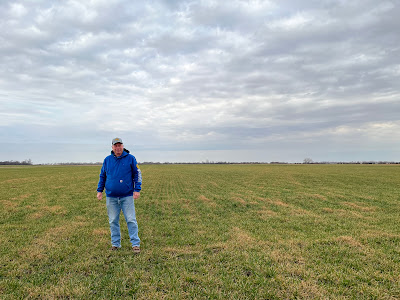
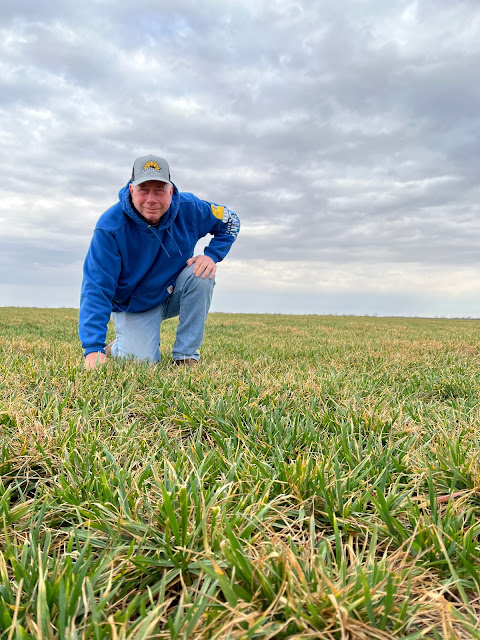
Yesterday was the 21st of the month, and this year, that means a photo update as we march toward summer 2022 and our final wheat crop as active farmers. Just like those sunrises, farmers have been scouting fields to watch the condition of their crops since farmers first began tilling the soil.

The yellow tinge on the wheat is freeze damage on the ends of the leaves and lack of moisture. However, there is green growing underneath. And, as we took the photos yesterday morning, we were hoping the cloudy skies would yield some rain.

We are fortunate: Yesterday and overnight, we got 1.5 inches of rain. Earlier, in this time since my February wheat update, we'd gotten some moisture from a couple of snowfalls, probably totaling 0.75 inches of moisture. 
 
The rain is good news on this Kansas Ag Day 2022. For 12+ years, many of my blog posts have told about our efforts on The County Line to provide food, fuel and fiber for American families and consumers throughout the world. But we're also glad to talk about farming in person, and we got that opportunity a few weeks ago when we spoke with second graders at Stafford Elementary School. I've done this a few times before at the request of second grade teacher Kylie Meyer. But it was great to be back in person, rather than on Zoom, this year.

As with any quality teacher, Mrs. Meyer gave us an assignment. She wanted us to compare the "then and now" of farming. The second graders are learning about comparison and contrast. Mrs. Meyer helps to illustrate the concept by inviting community members with different backgrounds to talk about their professions or interests and compare them, then and now. 

We may not be as interesting as Elroy's Pizza, but we were glad to do it.

Several years ago, my mom compiled a family scrapbook for each of my kids, as well as her other grandchildren. Both my mom and dad wrote down memories, which were included in the books. In addition, she made copies of photographs. Some of those photos were of family. Others were of farm machinery.


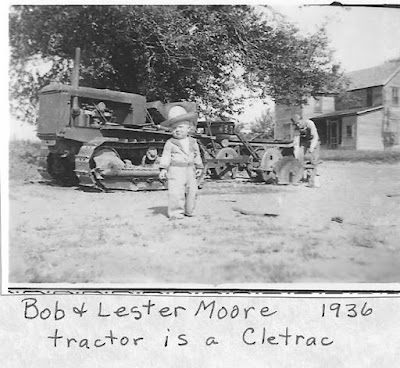
She even included a photo of my dad as a 2-year-old in front of the family's Cletrac tractor.

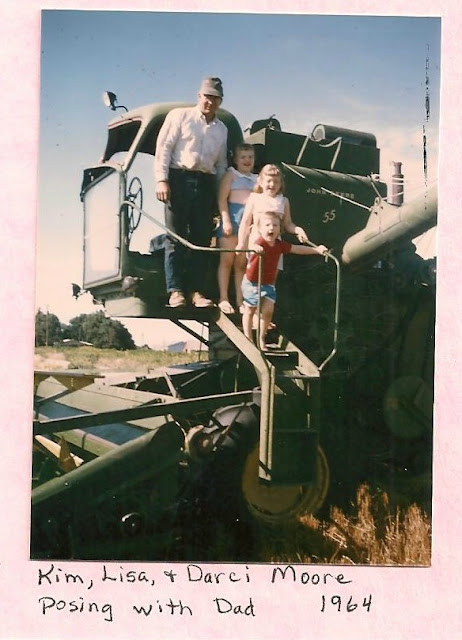
My mom did a great job through the years of taking photos of equipment as they added it to their farm in Pratt County. 


She had photos of some of the first equipment they purchased after coming back to the farm together in 1956 after their college days at Kansas State University. My parents also kept meticulous records of how much some of that machinery cost. 


The photo below shows that first tractor compared the size of the equipment these days. In 2021, they experienced their 65th harvest of their farming career together. (Thanks to my brother for the photo.)

My family's farming legacy goes back even further.  My dad's great grandfather came to Kansas and started farming in 1877. In 1898, my mom's grandfather came to Kansas and began working for a farmer. After he and his wife married, they began farming on their own early in the 1900s.

During my lifetime, my parents added irrigation to their farm. I also showed the second graders photos related to rural electrification, a cause championed by my maternal grandfather, Shelby Neelly. We talked about the decrease in rural population and what that meant for our rural community.

I have thousands of photos I've taken during our nearly 41 years of marriage and farming. But those old photos and the accompanying history gave me a great head start in preparing the PowerPoint presentation for the second graders, using the "then and now" theme. 


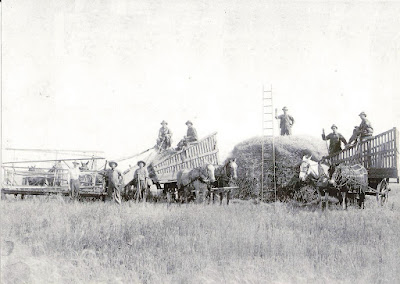
I have a few historic photos of Randy's family farm, but nothing nearly as complete as my Mom compiled. (I know how fortunate I am.) The photo above was in photos from Randy's family, but there was no information about the date it was taken or the people. 

We also showed a video, showing a similar team threshing wheat. Even though it obviously wasn't filmed in Kansas, it still showed a much different picture of harvest then and now.  

Randy's family has a similar history of farming in Kansas. This pasture on the Rattlesnake Creek has been in his family since 1900. 

I did share a few photos from their farm history in the slide show.

Randy's Grandpa Melvin

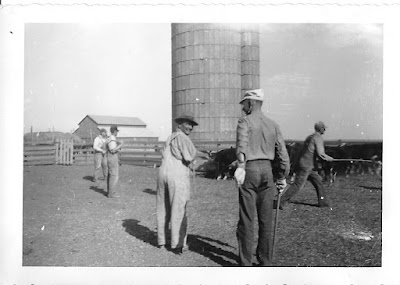
Randy's family on a cattle sorting day

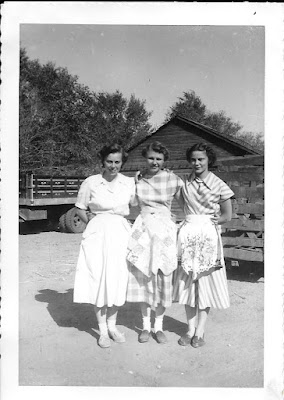
I also pointed out the differences in farm wives today, compared to yesteryear. 


 Of course, we believe agriculture is important. We wouldn't be the fifth generation of farmers in our respective families if we didn't believe in agriculture.
As our society moves away from its agrarian roots, fewer people seem to recognize the value. As organizers of Ag Day say:
We know that food and fiber doesn't just arrive at the grocery or clothing store or magically appear on the dinner table or in our closet. There's an entire industry dedicated to providing plentiful and safe food for consumption.
  • Each American farmer feeds about 165 people. Agriculture is America's No. 1 export.
  • New technology means farmers are more environmentally friendly than ever before. 
Even that tally for feeding has changed: In the 1950s, when my parents were beginning to farm on their own, the American farmer fed 27 people. That's increased 138 people in about 65 years. Pretty amazing, right?

So Happy Agriculture Day - today and every day!

More about the Moore family farming legacy can be found HERE:

 More about the Neelly farming journey can be found HERE.

More about the Fritzemeier farming tradition can be found HERE.

Thursday, March 17, 2022

Top O' the Mornin'


Top o' the mornin' to you! This is your friendly reminder that today is St. Patrick's Day. A lot of elementary school students will avoid the inevitable pinch for forgetting their green today, since many are on spring break this week.

My childhood breakfast table was usually the site of my first pinch of the day, back in my elementary school days. Unless I searched my pajama wardrobe or underwear drawer for a hint of green among floral prints as I went to bed on March 16, I could usually count on one of my siblings to provide the first pinch of the day as we consumed our bowl of Lucky Charms. (It may have been Frosted Flakes or Sugar Smacks or Apple Jacks cereal, but those don't sound as leprechaun-inspired, do they?)

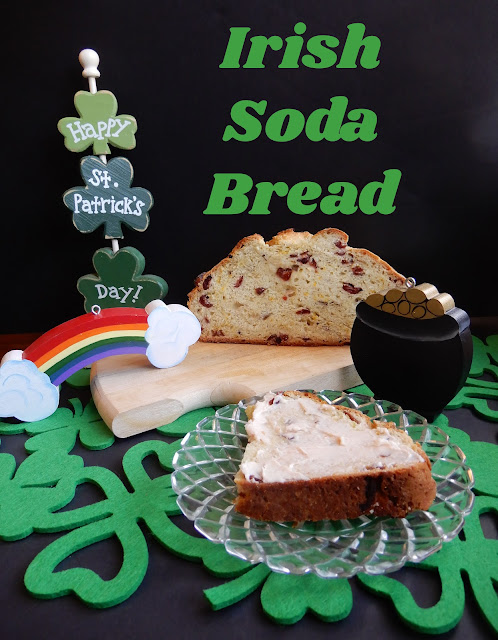
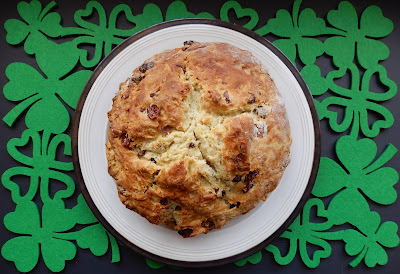
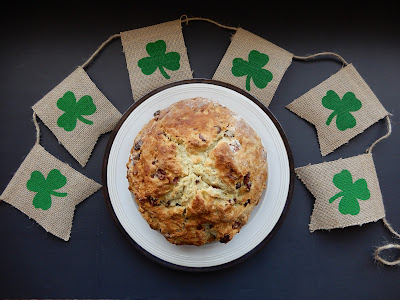
Today's recipe calls for a "pinch" of a different kind - or, more accurately - a measured amount of baking soda. Irish Bread is one of the hallmarks from the Emerald Isle. It's a quick bread that uses soda, rather than yeast, for leavening.

However, the website www.myrecipes.com says that the Irish bakers weren't the first cooks to use soda to leaven bread. American Indians first used pearl ash—a natural form of soda created from the ashes of wood—to leaven their breads without the presence of yeast. However, it wasn’t until this process was later discovered and replicated by the Irish that it earned a reputation worldwide. 

Irish Soda Bread was first created in the late 1830s, when the first iteration of baking soda—or bicarbonate soda—was introduced to the United Kingdom. The first versions were created out of necessity. Irish cooks were having trouble finding quality flour, since Ireland's climate raises a lower-gluten variety of wheat than we're known for here in the heart of Kansas. The soda was added to other basic ingredients, like the “soft” wheat flour,  salt, and soured milk.

At the time, many lower-class and farmhouse kitchens lacked ovens, so the bread was cooked in iron pots or on griddles over open hearths. This cooking method resulted in the signature dense texture, hard crust, and slight sourness that's characteristic for soda bread. The unique texture of this bread is the result of a reaction between acid and baking soda that results in the formation of small bubbles of carbon dioxide within the dough. Sour milk was most commonly used in the early days of the bread’s history, thanks to its high acidity levels, but now buttermilk is typically used in its place.

The bread traditionally has a cross cut into the top before baking. 

Other fun St. Patrick Day ideas, especially for kids:

  • Take 2 refrigerated biscuits per child and tear each in half. Place three of the pieces together to form a shamrock and use the other one to roll into a stem. Sprinkle with green sugar and bake.
  • Another easy green treat: Combine equal parts cream cheese and marshmallow cream. Tint green and serve as dip for green apples.
  • Gold Cookies (for the pot of gold at the end of the rainbow!): Take two Ritz crackers. Put peanut butter between them. Dip them in melted butterscotch chips. Place on waxed paper until set up.
  • Substitute Lucky Charms for some (or all) of the cereal in your Rice Krispie treats.
Here's hoping you find some St. Patrick's Day "Luck o' the Irish" at the end of your rainbow ... or in your kitchen. (There are some more ideas and links after the Irish Soda Bread recipe.)
 
I used a recipe from Sally's Baking Addiction for this version of Irish Soda Bread. (Sally's is one of my and Jill's go-to baking blogs.) However, after perusing several other recipes, I made some adjustments. Her recipe said raisins were optional. Another recipe developer used whiskey-soaked raisins or craisins. A couple of them suggested orange zest. (I'm guessing that 1800s-era Irish cooks didn't have access to oranges or orange zest.) Did they have dried fruit? I don't know.
 
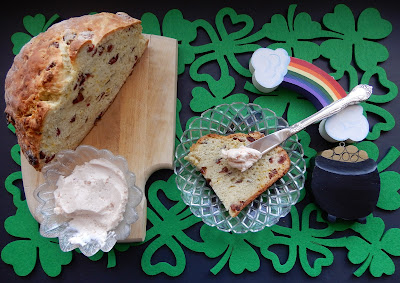
But soaking dried fruit in orange juice and adding orange zest do provide a nice bit of flavor. And, of course, you have to drain the fruit before using it in the bread. However, one recipe used the reserved liquid - whether whiskey or orange juice or a combination - to combine with softened butter for a spread for the bread. I also added that for an extra treat.

Grandma's Irish Soda Bread
Adapted from Sally's Baking Addiction
 
1 3/4 cups buttermilk
1 large egg
4 1/4 cups all-purpose flour
3 tbsp. sugar
1 tsp. baking soda
1 tsp. salt
5 tbsp. butter (cold and cubed)
1 cup raisins, currants or craisins (opt.)
2 tsp. orange zest (opt.) 

Butter Spread (optional)
1/2 cup room temperature butter
Liquid (whiskey, orange juice or combination) retained after plumping the dried fruit
 
IF DESIRED: Rehydrate dried fruit of your choice in 1/2 cup Irish whiskey, orange juice or a combination of the two. To do this quickly, you may add the fruit and liquid to a glass measuring cup. Microwave for 2 minutes. Set aside to cool and to rehydrate for an hour or so.
 
Preheat oven to 400 degrees. Prepare a baking pan. I used a 9-inch cake pan, lined with parchment paper. Other options are using a seasoned cast iron skillet or a 5-quart Dutch oven without the lid. Another option is to use only a baking sheet lined with parchment paper, though the bread spreads out a little more.
 
Whisk the buttermilk and egg together. (If you don't have buttermilk available, you can make a substitution by putting 1 tablespoon of vinegar in a glass measuring cup and then adding milk to make 1 3/4 cups. Stir together, and let sit for 5 minutes before adding egg and using.)
 
Combine flour, sugar, baking soda and salt in a large mixing bowl. Cut in cold butter with a pastry blender. There's a lot of flour compared to the amount of butter, but keep working to break the butter down into pea-sized crumbs. Stir in orange zest, if desired.

Drain the fruit well, if you have chosen to plump the fruit in advance. Reserve the liquid if you plan to make the butter spread. 

Stir fruit into the flour mixture and stir to distribute. Pour in the buttermilk/egg mixture. Gently fold together until the dough it too stiff to stir. Pour crumbly dough onto a lightly-floured work surface. With floured hands, work the dough into a ball as well as you can, then knead for about 30 seconds or until the flour is moistened. If the dough is too sticky, add a little more flour. (You will likely have to do this if you've plumped your fruit in liquid.)

Transfer the dough to the prepared pan. Using a very sharp knife, score an X into the top. Bake for 20 minutes, then put a piece of foil on top to prevent overbrowning. Bake for another 20-25 minutes until the bread is golden brown and center appears cooked through. 

Remove from oven and allow bread to cool for 10 minutes, then transfer to a wire rack. Serve warm, at room temperature or toasted. Serve with whipped butter spread, if desired.

Butter Spread
Whip softened-to-room-temperature butter with a stand or hand mixer until light and fluffy. Add in about 2 tablespoons of the reserved liquid, whipping together until it's well blended. Add more, if desired. Serve with warm bread. (Because I used craisins, it gave the butter a slight pink tinge since some of the color leached out when the fruit was soaking.)

***

And, if you're looking for other lucky treats, here are some other St. Patty's Day foods I've shared here in the past:

Good As Gold Snack Mix

Kinley and Brooke helped me make these Mint Chocolate Chip Cookies when they were visiting a couple years ago:

For a main dish with an Irish twist, try Reuben Crescent Bake. (Well, at least, it's got corned beef and cabbage. I don't think it's very Irish.)

For cabbage minus the corned beef, try this slaw recipe:

Slaw Salad 

May your troubles be less and your blessings be more
And nothing but happiness come through your door.

Tuesday, March 8, 2022

Salt of the Earth

If there's a salt shortage in Topeka, you can blame Jill and other mamas with fourth graders at Jay Shideler Elementary.

Randy & I made a stop in Topeka Friday evening before Susan's first bridal shower in Kansas City on Saturday. While Grandpa and Eric took Kinley to volleyball practice, Jill and I stayed behind in the "salt mines" ... so to speak.

The salt dough is being used to construct 4th grade volcanoes this week. 

Other parents had already signed up for the easier stuff - like detergent and other needed supplies. So Jill volunteered to make a a dozen recipes of salt dough for Kinley's fourth grade class project. 

By Friday night, no one else had signed up to bring the rest of the dough. Since Jill and I already had our system down, she texted Kinley's teacher and asked if she wanted her to make all the dough.

"Extremely grateful" was the gist of the return text. 

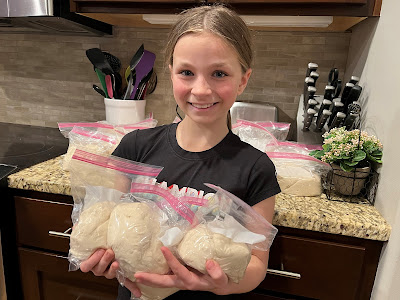
I measured out the salt and the flour. Jill added the water with the mixer. And we used teamwork to maneuver the completed dough into the quart-sized plastic bags. With the additional recipes, we had to wait on a salt delivery from Eric. Otherwise, we would have gotten it accomplished in an hour. 

As I was taking a photo of the supplies, Jill said that Hudson Cream Flour isn't available at her Hy-Vee Grocery Store, where she purchased everything. Hudson Cream Flour is made at Stafford County Flour Mill, our home county. We are both part of a Hudson Cream Flour baking group on Facebook, and if she needs it for her home baking projects, she gets it at Dillon's. 

I told her that Hudson Cream Flour was too valuable to use for an inedible recipe anyway.

After we got all 22 bags complete, we decided that Kinley was going to need help getting it to her classroom.


She was convinced she could do it ... until she about pulled her arm sockets out with the two grocery bags of dough. Jill dropped it off at the school with the teacher ahead of time.

I wish I was a fly on the wall so I could see the 4th graders using the dough for their volcanoes. Kinley says they built the volcanoes yesterday. She told Jill that she "did a good job" making the dough. Today, they are supposed to paint their masterpieces, and tomorrow is eruption day.

Hopefully, I'll get to see a photo of the finished product.


Salt Dough
2 cups all-purpose bleached flour
1 cup salt
1/2 cup to 1 cup warm water

In a mixing bowl or stand mixer, stir together flour and salt. Mix in water, 1/4 cup at a time. Add water until it forms a doughy consistency, similar to Playdough.

Do not overmix! Overmixing will make it too stringy and hard to form into shapes.

***

That was just first stop on a fun and activity-filled weekend. I shared photos from Susan's & Brent's first bridal shower on Facebook. But there are some blog readers who don't see my Facebook page, so I'm including some here, too.

Brent wasn't there for most of the shower, but he came at the end to help load and transport the gifts home. It was fun for me to get to meet some of their friends.

Jill, Brooke and Kinley also were there to take in the festivities.


 Susan's friend, Mallory, added lots of special touches for the brunch.


The moms were both glad to be there!


I can't wait to do it again in a few weeks! Shower No. 2 is coming up then!

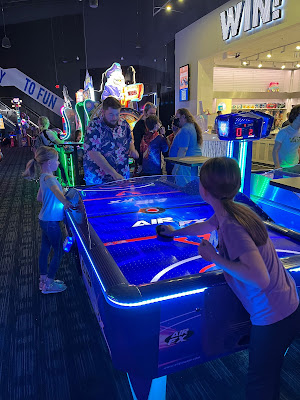
But we weren't done with the fun. We also went to Dave & Buster's. 


And just in case we hadn't done enough for the day, we ended the day at Kinley's tennis tournament.

A good time was had by all. (That was the tagline on social news in weekly newspapers like The Stafford Courier back in the day.)