Showing posts with label farm history. Show all posts

Tuesday, June 28, 2022

This Is Us: An Overhead Glimpse of Harvest 2022

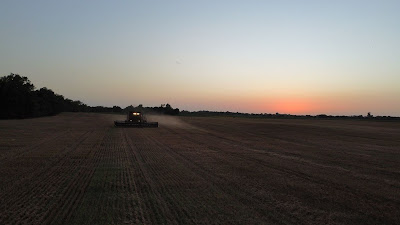
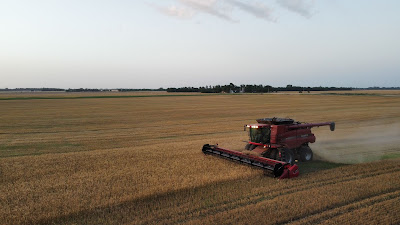
Thanks to our neighbor, Mark Pike, for these drone images and his permission to share them. What a gift!

***

Just like 6.4 million other people, I watched the series finale of a family television drama called "This Is Us" at the end of May. Just by watching my Facebook feed, I know I'm not the only viewer who had a Kleenex box nearby as I watched the finale episode about a family we all got to know and care about during six seasons of Tuesday nights.

I'm not sure how many people then scoured the internet to find quotes from the episode. But there was at least one. (That was easier than starting and stopping the DVR for me to take notes. And since I found a compilation of "This Is Us" quotes, I'm fairly confident that I'm not the only one.)

In it, the mom, Rebecca, is traveling on the metaphorical train toward death after suffering from dementia for several years. And I was struck by the words from her "conductor," William:

"The way I see it, if something makes you sad when it ends, it must have been pretty wonderful when it was happening. Truth be told, I always felt it a bit lazy to just think of the world as sad, because so much of it is. Because everything ends. Everything dies. But if you step back, if you step back and look at the whole picture, if you're brave enough to allow yourself the gift of a really wide perspective, if you do that, you'll see that the end is not sad, Rebecca. It's just the start of the next incredibly beautiful thing." 
William to Rebecca, This Is Us, series finale

I saved the quote (and a few others). And I thought about it again when our neighbor, Mark Pike, sent some drone photos he'd taken of our harvest - our final one as active producers.


Undoubtedly, the drone gives that wide perspective - a little bigger picture than I'm able to see with my normal "boots-on-the-ground" view through my camera lens.


For some reason, the drone pictures - and that different look at harvest - had me pulling out the Kleenex box again.


Through the years, I've tried to document harvest to the best of my ability. Since I began Kim's County Line in 2010, I've made an even more concentrated effort, but the efforts to photographically show and tell the journey of wheat - beginning to end- have been part of my DNA for long before then.

I've taken some spectacular shots - and a whole lot that weren't noteworthy at all. But, for some reason, these photos taken from a bird's eye view were particularly poignant. 


"The way I see it, if something makes you sad when it ends, it must have been pretty wonderful when it was happening."
 
That bears repeating, I suppose. But I also know this process is a little like childbirth. The mom develops a bit of amnesia about the rigors of the birth process itself. Otherwise, the whole world would be single children - or so the joke goes.
 
So, as I look back on 41+ years of farming with Randy (and a lifetime for both of us before that), I have a tendency to remember the good - the rides in the buddy seat on the combine, my book in my hand after the conversation was exhausted. ... The wildlife making a hasty retreat as the mighty machine takes another swath of field ... The vibrant green peeking through brown soil, a yearly miracle. ... The dewy raindrops caught on green wheat. ...The sound of wheat, rustling in the Kansas breeze. God's masterpiece sunsets sinking into the western horizon as the combine rumbles toward it and seems to gobble up the light. And so much more.

You don't wax nostalgic about yet another trip to the parts counter or the third flat tire in a week or your legs sticking to the plastic seat of the truck or the buckets of sweat. You realize that you're not bounding up the steps of the combine like you did when you were that teenaged truck driver. You aren't thrilled with the rash you develop during harvest or the pesky cheat that gets stuck in your socks. You don't fondly remember those phone calls to hire a Caterpillar to come pull both the combine and the tractor out of mud - and the accompanying bill. While Harvest 2022 was pretty smooth sailing the first week, perhaps I needed a reality check - and got one. We had a rain delay, and, when we got up and running again after a day and a half, I got the call that I needed to come help get the truck pulled out. (Plus, since we hadn't used the tractor for awhile, it had to be jumped before it could do its job. Mission accomplished - but it was a circuitous route.)
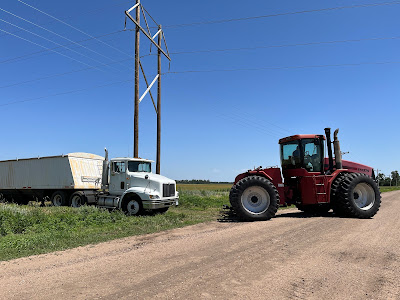
But those moments of aggravation don't take away from the life and lifestyle that we've lived and loved. It's not for everyone. We didn't do it perfectly. I'd change some things.
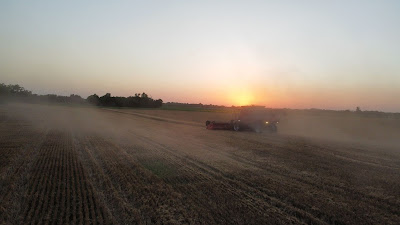

But, a bird's eye view helps me remember that it was - and is - a beautiful life. 
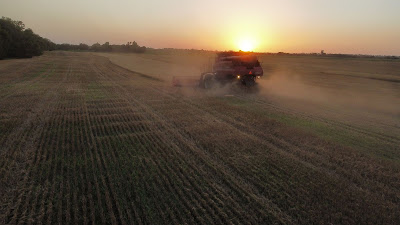
Toward the truck, that field finished
 
In another quote from "This Is Us," Dad Jack tells his kids:

“That’s what we’re doing, just collecting these little moments. We don’t recognize them when we’re in them because we’re too busy looking forward. But then we spend the rest of our lives looking back trying to remember them, trying to be back inside them.” 
 

So I find myself doing a bit of that. I think it's natural, as we change directions.

Mark also included a drone photo of Randy's folks' house. It sold on June 4, and a new family will begin building a life and making memories there, beginning in mid-August.
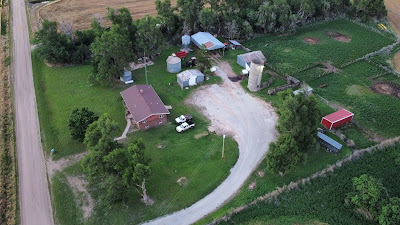
 

I just hope they'll look back - years from now - and have those moments to collect and remember, too. 

And, as for us, we may get done with wheat harvest today, after getting rained out yesterday again. Then it will be time to get things ready for the farm sale coming August 13. 

And, hopefully, just like William told Rebecca: "It's just the start of the next incredibly beautiful thing." 

***

Mark shot drone footage two harvests ago. He didn't send any video from this harvest, but here are some repeats of 2020 videos


.  


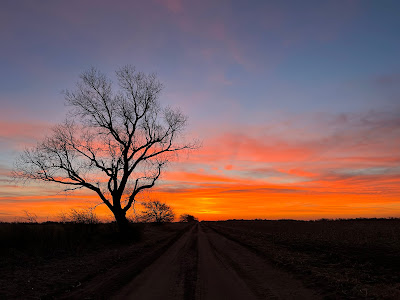
I actually got a pretty awesome still shot from that 2020 harvest night, too. The sky was breathtaking. I enlarged this one to canvas size.
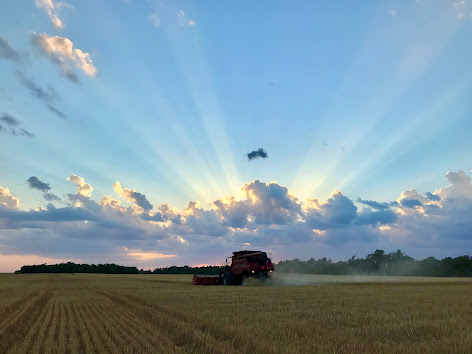
Harvest 2020

A shot I got Saturday night, June 25, reminded me of that one. 
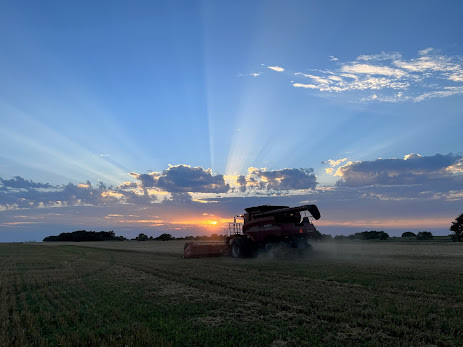
Harvest 2022

For more from the post about the 2020 harvest, click HERE. And, thanks again to Mark!

Tuesday, March 22, 2022

Then & Now: A Reality Check


Even before Kansas was a state, the sun has been rising and setting on the Kansas plains. Back in the 1880s, our ancestors  saw that same expansive sky stretching across the horizon as the new days dawned on a new state in the Union.

While the view may be similar, it's amazing to consider the changes in agriculture during my lifetime, and even more so during my parents' lifetimes.

Today is Kansas (and national) Ag Day.  It's a day set aside to celebrate agriculture's role in American life.  

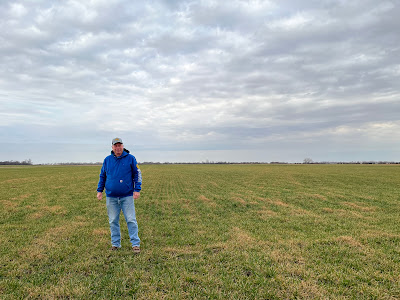
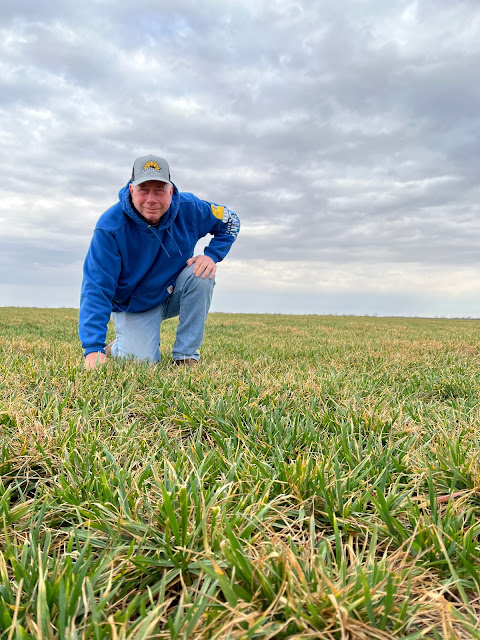
Yesterday was the 21st of the month, and this year, that means a photo update as we march toward summer 2022 and our final wheat crop as active farmers. Just like those sunrises, farmers have been scouting fields to watch the condition of their crops since farmers first began tilling the soil.

The yellow tinge on the wheat is freeze damage on the ends of the leaves and lack of moisture. However, there is green growing underneath. And, as we took the photos yesterday morning, we were hoping the cloudy skies would yield some rain.

We are fortunate: Yesterday and overnight, we got 1.5 inches of rain. Earlier, in this time since my February wheat update, we'd gotten some moisture from a couple of snowfalls, probably totaling 0.75 inches of moisture. 
 
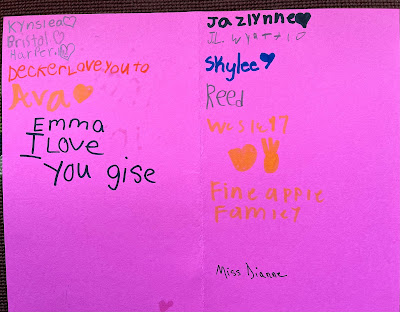
The rain is good news on this Kansas Ag Day 2022. For 12+ years, many of my blog posts have told about our efforts on The County Line to provide food, fuel and fiber for American families and consumers throughout the world. But we're also glad to talk about farming in person, and we got that opportunity a few weeks ago when we spoke with second graders at Stafford Elementary School. I've done this a few times before at the request of second grade teacher Kylie Meyer. But it was great to be back in person, rather than on Zoom, this year.

As with any quality teacher, Mrs. Meyer gave us an assignment. She wanted us to compare the "then and now" of farming. The second graders are learning about comparison and contrast. Mrs. Meyer helps to illustrate the concept by inviting community members with different backgrounds to talk about their professions or interests and compare them, then and now. 

We may not be as interesting as Elroy's Pizza, but we were glad to do it.

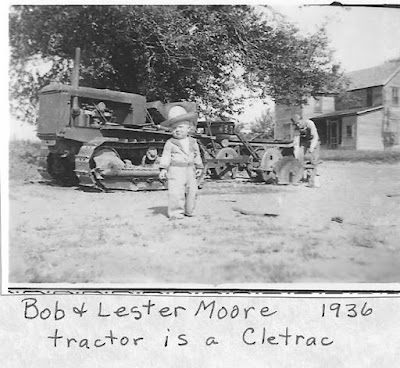
Several years ago, my mom compiled a family scrapbook for each of my kids, as well as her other grandchildren. Both my mom and dad wrote down memories, which were included in the books. In addition, she made copies of photographs. Some of those photos were of family. Others were of farm machinery.


She even included a photo of my dad as a 2-year-old in front of the family's Cletrac tractor.

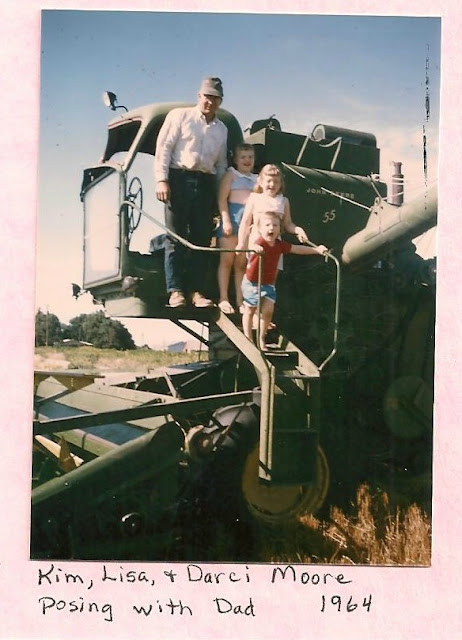
My mom did a great job through the years of taking photos of equipment as they added it to their farm in Pratt County. 


She had photos of some of the first equipment they purchased after coming back to the farm together in 1956 after their college days at Kansas State University. My parents also kept meticulous records of how much some of that machinery cost. 


The photo below shows that first tractor compared the size of the equipment these days. In 2021, they experienced their 65th harvest of their farming career together. (Thanks to my brother for the photo.)

My family's farming legacy goes back even further.  My dad's great grandfather came to Kansas and started farming in 1877. In 1898, my mom's grandfather came to Kansas and began working for a farmer. After he and his wife married, they began farming on their own early in the 1900s.

During my lifetime, my parents added irrigation to their farm. I also showed the second graders photos related to rural electrification, a cause championed by my maternal grandfather, Shelby Neelly. We talked about the decrease in rural population and what that meant for our rural community.

I have thousands of photos I've taken during our nearly 41 years of marriage and farming. But those old photos and the accompanying history gave me a great head start in preparing the PowerPoint presentation for the second graders, using the "then and now" theme. 


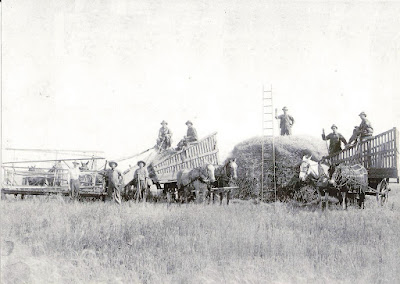
I have a few historic photos of Randy's family farm, but nothing nearly as complete as my Mom compiled. (I know how fortunate I am.) The photo above was in photos from Randy's family, but there was no information about the date it was taken or the people. 

We also showed a video, showing a similar team threshing wheat. Even though it obviously wasn't filmed in Kansas, it still showed a much different picture of harvest then and now.  

Randy's family has a similar history of farming in Kansas. This pasture on the Rattlesnake Creek has been in his family since 1900. 

I did share a few photos from their farm history in the slide show.

Randy's Grandpa Melvin

Randy's family on a cattle sorting day

I also pointed out the differences in farm wives today, compared to yesteryear. 


 Of course, we believe agriculture is important. We wouldn't be the fifth generation of farmers in our respective families if we didn't believe in agriculture.
As our society moves away from its agrarian roots, fewer people seem to recognize the value. As organizers of Ag Day say:
We know that food and fiber doesn't just arrive at the grocery or clothing store or magically appear on the dinner table or in our closet. There's an entire industry dedicated to providing plentiful and safe food for consumption.
  • Each American farmer feeds about 165 people. Agriculture is America's No. 1 export.
  • New technology means farmers are more environmentally friendly than ever before. 
Even that tally for feeding has changed: In the 1950s, when my parents were beginning to farm on their own, the American farmer fed 27 people. That's increased 138 people in about 65 years. Pretty amazing, right?

So Happy Agriculture Day - today and every day!

More about the Moore family farming legacy can be found HERE:

 More about the Neelly farming journey can be found HERE.

More about the Fritzemeier farming tradition can be found HERE.

Tuesday, March 24, 2020

Just A Box of Crayons: Ag Month 2020

I gave a memorial service earlier this month for the Kansas Master Farm Homemakers Guild annual meeting. I used some missing crayons to illustrate the "holes" left behind by the unique members who've joined Chapter Eternal during this past year. Just like all the crayons in the box, each one had his or her own job to do. They leave a little less "color" in our world in their absence.

Anyway, our gathering in Manhattan happened just as the U.S. response to Covid-19 - or the coronavirus - was beginning. There was some talk of postponing the meeting, but several of our members were already on the road driving to Manhattan about the time the Big 12 canceled the rest of its tournament. While there, the NCAA sidelined the Big Dance. Governor Laura Kelly's request to limit group gatherings to 50 or less didn't come until after we'd all packed our bags to come home. And the 10-person limit was a week-and-a-half down the road at that point. The crowd was a little fewer than planned, but, for the most part, the Kansas Master Farmers/Farm Homemakers showed up to honor the six new couples who joined our ranks.

Since the 1920s, Kansas Farmer magazine began to publicly recognize excellence in farming, homemaking, farm living and rural citizenship. In 1953, K-State Extension got involved, handling the details of selecting Master Farm couples and planning the March recognition banquet. Local extension councils and districts submit nominations, and a committee picks one couple from each extension area, plus two couples at large. 

The farm families are all different. Some have a lot of acres. Some don't. Some are primarily livestock operations. Others focus more on grain production. But all have figured out how to combine their livelihood with community service - though that looks different from couple to couple and from community to community, too.
The month of March has been proclaimed Kansas Agriculture Month, and today - March 24 - has been declared Kansas Agriculture Day. Farmers and ranchers make up less than 2 percent of the population, and that number drops each year.  We also run businesses that are highly technical, are not very well understood and operate on razor-thin margins.
Not terribly long ago, a new acquaintance asked what I did. I explained that my husband and I are both fifth-generation farmers in our respective families. His response floored me when he said, we had "quite a racket sitting back and collecting government payments."
I was so stunned that I didn't respond quickly enough and the moment passed. It bothered me for two weeks before I wrote an old-fashioned letter to him to try and explain why he had the wrong idea about farmers and farming. He has since apologized, and I hope I made a difference by opening one person's eyes.
 
It's what I try to do all the time. Every day is Ag Day for me, whether I'm helping with cattle tasks (like Saturday and yesterday) ...
 
... or delivering meals to the field during busy times ...
 ... or visiting the Case parts counter ...
... or writing some children's books about farm life ...
... or contributing to my rural community.

It could be via  my KFRM Central Kansas reports and through blog posts via Kim's County Line, where I offer a glimpse at one Kansas farm family by featuring farming, family, faith, food and photography.
 
Every day is Ag Day for Randy, who works to provide food, fuel and fiber through crops and livestock.
As our society moves away from its agrarian roots, fewer people seem to recognize the value. As organizers of Ag Day say:
We know that food and fiber doesn't just arrive at the grocery or clothing store or magically appear on the dinner table or in our closet. There's an entire industry dedicated to providing plentiful and safe food for consumption.
  • Each American farmer feeds about 165 people. Agriculture is America's No. 1 export.
  • New technology means farmers are more environmentally friendly than ever before. 
With the coronavirus outbreak, the Department of Homeland Security has labeled agriculture a critical industry, allowing businesses to continue operating as usual amid current and potential restrictions created to stem the spread of the virus. Farm groups had been concerned about the potential for movement restrictions put in place to limit exposure of the virus, including the potential for halted shipment of inputs needed for the upcoming planting season.

Still, farm businesses are doing their part to prevent the spread, too. At our local co-op, visitors need to go through the office to arrange for services. Some of the extraneous interactions have been curtailed for the time being - whether that's getting together for a cup of coffee to talk rainfall or commodity prices while they wait for a tire repair or that bunch of retired farmers playing dominoes in the farm store.
At the Master Farm Homemakers Guild meeting, we sang "The Sunflower Song," penned by one of our Kansas members, Rachel Imthurn. The words of the second verse seemed meant for the moment:

We celebrate this nation with roots deep in the sod.
Our hearts are with our children.
Our souls reach up to God.
Our joys grow in sharing the sunshine and the rain.
And when those hard times come along 
Friends help to ease the pain.

Farmers will still plant their spring crops, as long as they can get the inputs needed. Farmers and ranchers like us will continue to sort and work baby calves like we've done since our families settled as Kansas pioneers - and just like we did on Saturday and again on Monday. (More on that later.)

Just like other industries right now, there are plenty of "what ifs" and "what about that?s" that are being contemplated, whether that's supply and demand, the tottering economy and seasonal labor concerns.

The world is different today than it was a month ago. But we all need to figure out how to work together and live in the "same box."
***
And, by the way, I didn't mention it in my memorial service, but some crayons have a farm connection. Soybean oil can be substituted for paraffin wax in some brands of crayons. In fact, the Wisconsin Soybean Association estimates that one acre of soybeans can produce about 82,368 crayons. Prang Crayons are made with 85 percent soybean oil.

Happy Agriculture Day!

Tuesday, May 1, 2018

My, How Times Have Changed? Or Have They?

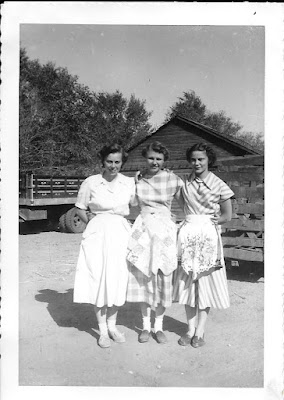
My mother-in-law Marie, Jean Newell Fritzemeyer & Marjorie Giedinghagen
In an old scrapbook, this photo was labeled "3 cooks for cattle round up day."

I didn't wear my apron or my crisp cotton dress for our latest cattle round up day. I may have been the cook, too, but I was breathing in more than soup from the slow cooker ...

Like dust from an old barn's alleyway ...
... and eau de toilette (I know lots of consumers are into "organic" these days. This was organic all right! That's what happens when you're trying to push baby calves into the trailer!
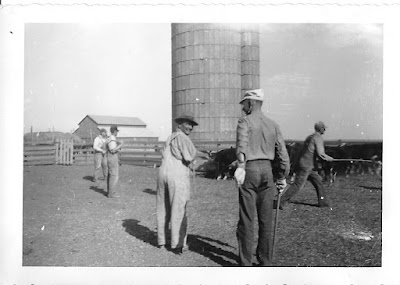
While the trio of cooks from the 1950s were busy putting together a meal, the fellas were rounding up and sorting the cattle.
L to R: Clarence Fritzemeier (Randy's Grandpa) Milton Giedinghagen, Ben Fritzemeyer, Melvin Fritzemeier (my father-in-law) & Harve Fritzemeier. Yes there are two different spellings on Fritzemeier - it's not a typo!
My, how times have changed!

I'm certainly not denigrating the role my mother and mother-in-law fulfilled as farm wives and partners back in the 1950s during the early days of their marriage. The times were different. And I've had reminders of that as I've been reading the final book in my book challenge - a book written in my birth year - 1957. (I'll talk more about the book challenge in another post, but just to name a few differences - making phone calls in a phone booth and a $90 weekly salary as a secretary.)

But even though gender roles during the cattle sorting, working and moving process may be different in 2018 than they were in 1958, for example, some things never change.


Mamas protest from Kim Fritzemeier on Vimeo.

Mama cows still protest being separated from their babies ...

... even if it's only for a short time and even if it's for their baby's own good!
Back when Melvin and Marie were first starting out, they raised horned Herefords.

Today, we still have Hereford blood in our herd, but it's provided by two polled Hereford bulls.
And we've added Angus genetics to our crossbred herd as well.
We still sort the baby calves from the mamas, but it's no longer a men's club doing the separating ... hence the organic matter on my jeans!
Some mamas form "picket lines" and protest when their babies leave for their doctor's appointments.
Mother and calf, 1952
They were just as glad to be reunited then ...
... as now.

 A woman may be the person handing the ear tagger and syringes to the chief cattle "worker" these days. But at many farms, it's probably the woman doing it all herself.
But some things on our Kansas farm haven't changed during the five different generations that have been living and working along the Stafford/Reno County line.
 
And that's the desire to do our job to the best of our abilities and to make a difference in our community - man OR woman!

***
And, this morning, it's time for more of that hands-on cattle work. We're moving heifers and bulls. Wish me luck! And Happy May Day!