Wednesday, May 11, 2011

Dust in the Wind

As the strong southerly wind blew away more than a hundred years of dust, I was thankful the memories couldn't be swept away as easily.

On April 29, my Grandma and Grandpa Neelly's house came tumbling down. It had stood for more than 100 years in Pratt County, though we're not exactly sure when it was built. My grandparents, Shelby and Lela Neelly, moved into the house in May 1942 with their two small girls - 6-year-old Janis and 4-year-old Merlene.

(This photo was taken in 1943 at the house, a year after they moved in)

It was the house where they spent their growing up years, the years before they became wives and mothers and grandmas themselves.

On April 29, my mom, Janis, was the only one of the four to witness the end of the era.

Janis Neelly Moore, April 29, 2011

Grandma died in 1989, really before either of my kids could know her. Grandpa celebrated his 100th birthday in 2004 and then died the next spring in 2005. Merlene died unexpectedly in 2007. To be sure, we all carried their memories in our hearts and minds that morning.

After people had removed doors and other salvagable items, it was definitely a little worse for the wear. The "bones" still looked like my home away from home, a place where my sisters and my brother had built memories with my grandparents, who lived only 7 miles away from our house.

The house had stood empty since 2004. At age 100, my Grandpa still lived in the old farm house. A few months after we celebrated his personal centennial, pneumonia finally forced him to move to a nursing home.

The great-grandkids and Grandpa at his 100th birthday party, July 2004

The excavator made quick work of the demolition job. The demolition man arrived at 8 AM and dug a huge hole in the backyard. It was where my Grandma's irises once blossomed. I never see iris without thinking of her backyard.

My brother Kent and Dad watching the progress of the hole

By 9:30, the machine made the first "chomp" with its massive jaws and the walls began tumbling down. The garage had been added when I was a kid. It went down much more quickly than it went up.

It was a morning of mixed emotions. No one had lived in the house since Grandpa moved out. It wasn't a practical candidate for renovation. It was poorly insulated (though Grandpa insisted otherwise). It would have cost far more to renovate than it would to start from scratch.

With the propensity for old farmhouses to become havens to meth labs and other criminal activity, my parents felt fortunate that the house escaped that fate.

So it was time ...

... time to say goodbye to a house whose very rooms were stuffed to the brim with memories, even though the people and the things that made it a home were long gone.

It took little more than an hour for the entire structure to look more like the pick-up sticks we used to play with as kids.

And not long after that, many of the remnants of the old two-story house were pushed into the hole.

By 2:20, all that was left was broken up concrete. The cement was from the slab by their garage, where my folks would park during our visits and we kids would run through the garage and through Grandma and Grandpa's back door.

The brooder house also ended up in the cavernous hole. Grandpa, a K-State fan through and through, painted it and many other outbuildings purple after Grandma died.

That little brooder house was the first home for each spring's arrival of chicks. We didn't have chickens at home, so it was an adventure at Grandma's and Grandpa's house. We'd run out and watch the fluffy yellow chicks grow and change as they got stronger under the glow of heat lamps.

We grew and changed, too, at Grandma and Grandpa's house. Tomorrow: What makes a house a home? Memories live on ...

Tuesday, May 10, 2011

Mom Guilt


I'm feeling a bit guilty today. My boy is turning 23, and I didn't even send him a box of treats. And I'm not sure when or if I'll get to talk with him today.

Before anyone goes and reports me as the Worst Mother of the Year, it's not like I forgot his special day. I've already texted him this morning. (Who would have predicted that form of communication back in 1988? Not me!)

Believe me, I haven't forgotten what I was doing on a Tuesday morning 23 years ago.

It's certainly not the first time that we've spent his birthday apart. For the past four years, I've mailed him a batch of Scotcheroos with sprinkles on top. Brent hasn't been so thrilled that his birthday falls during finals week at college. Somehow, we missed that little conflict with our family planning. His box of birthday treats also doubled as study snacks to share with his buddies.

But this year, as a graduate student at the University of South Carolina, he got done with finals last week. Yesterday, he started an intercession class which includes a trip down the South Carolina coast. (Yes, it sounds like an intensive, arduous class, doesn't it?)

I told him I'd mail him a box of Scotcheroos to share on the bus. But he said I didn't need to do it. Now I'm wishing I had anyway.

Brent will be back in Kansas next week to attend a friend's wedding and to spend a few days at home before his summer classes begin. He said we'd just celebrate his birthday then.

And I know he's not a little boy anymore. But I still wish I'd sent those treats.

So Happy Birthday to my fun-loving son! No matter how many miles separate us, you're still my little boy.

And if you want to celebrate Brent's birthday for him, eat a Scotcheroo in his honor. He's not a big fan of cake.

Scotcheroos
1 cup sugar
1 cup corn syrup
1 cup peanut butter
6 cups Rice Krispies
1 cup semi-sweet chocolate chips
1 cup butterscotch chips

Mix sugar and corn syrup together and bring to a boil in microwave or on top of stove. Add peanut butter and stir in well. Add cereal; mix well. Put mixture into a buttered 9- by 13-inch pan.

Melt the chocolate and butterscotch chips together in the microwave, stirring frequently to prevent burning. When melted, spread over cereal bars. If desired, cover with candy sprinkles while the chocolate mixture is still wet. Cool and cut into bars.

Monday, May 9, 2011

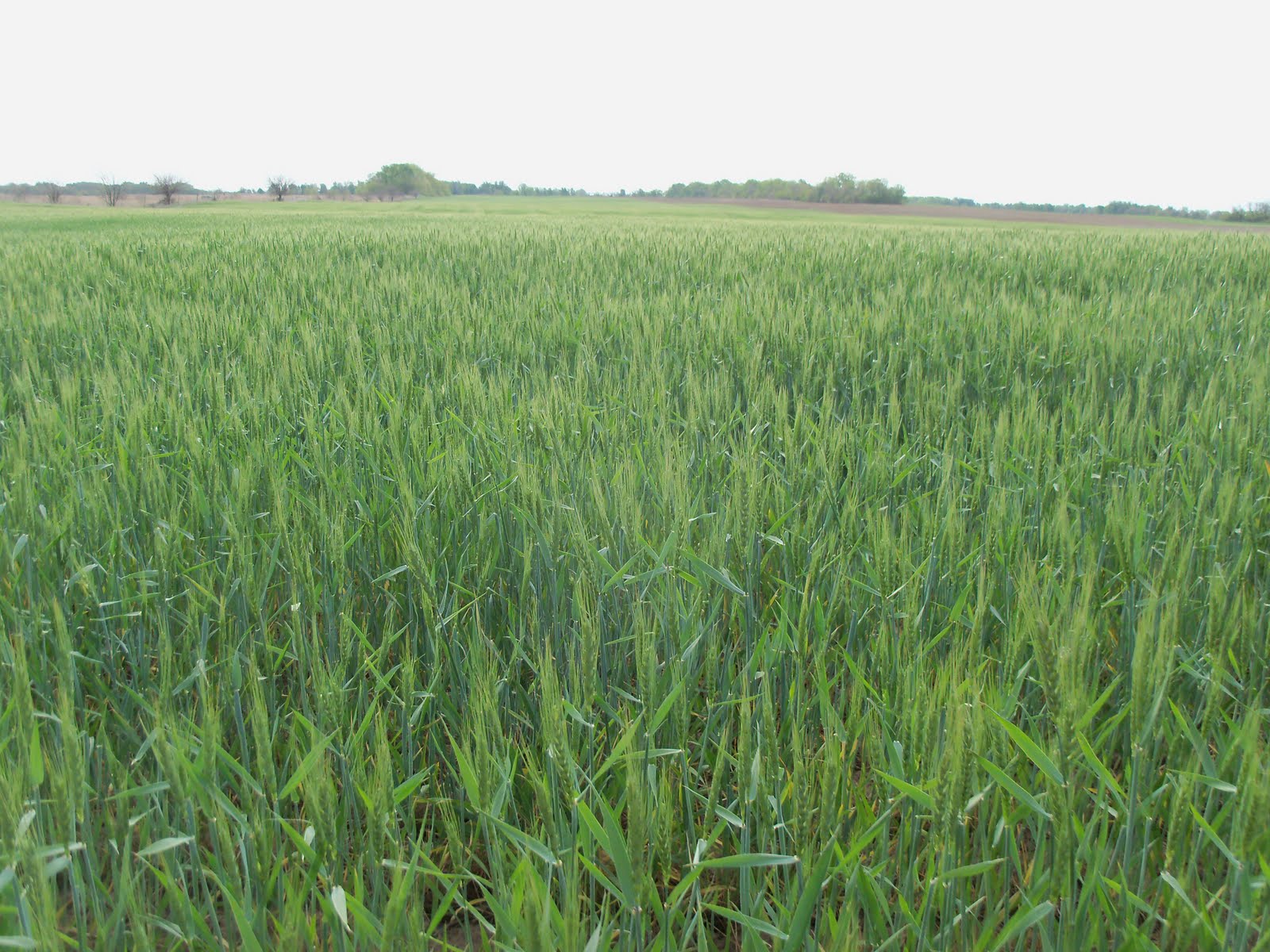
"Heading" Toward Harvest

Photo taken on the Stafford/Reno County Line, May 2, 2011

When the wheat begins to head, it usually signals a time for producers to look forward to the upcoming harvest.

My farmer is a known optimist, a good quality to have for someone whose livelihood depends on weather and a myriad of other uncontrollable factors. But even he is backpedaling on predictions for the 2011 wheat crop.

Simply put? The crop needs rain. In Central Kansas, a good soaking rain as the wheat head fills could still give us a good crop, though not a bin buster by any means.

But for many in Western Kansas, it's too late for this crop. Still, nobody would turn down a rain to help bolster spring-planted crops and create lush grasslands for summer pastures.

When weather forecasters start using terms like "Dust Bowl," it's not good for farm country. Three weeks ago, AccuWeather reported:

"Following what has been the driest four-month period since before the 1930s Dust Bowl, hope is dwindling, if not already lost, for wheat farmers of Oklahoma and Texas who desperately need rain. The forecast is not looking promising."

The news isn't any better from western Kansas.

The image above is from DTN reporter Katie Micik, who was on the Wheat Quality Council's annual Hard Red Winter Wheat Tour May 2-5. The photo is from a wheat field near Sublette in Haskell County.

While our wheat crop here in Central Kansas is much better than that found in Western Kansas, it's definitely gone backwards in the past three weeks. Three weeks ago, Randy used a formula to determine our crop's potential at 40 to 50 bushels per acre.

But, with no rain on the crop, it stunted the growth. Now, he estimates the yields at half that amount. The wheat plants are fairly short, which will make it more difficult to harvest.

And if we don't get a rain as the heads fill, the wheat will shrivel in the head, lowering both yield and test weight.

As the Wheat Quality Council tour came to an end last week, participants estimated the 2011 Kansas wheat crop to have an average yield of 37.4 bushels per acre.

The average of participants' crop estimates puts Kansas wheat production at 256.7 million bushels. The tour's estimate is lower than last year, when the state produced 360 million bushels, with an average yield of 45 bushels per acre, according to the U.S. Department of Agriculture.

But there's still a lot of days between now and harvest in mid- to late June. And the seven-day weather forecast doesn't look promising for this part of the world. I know some of our friends to the east in the Corn Belt would gladly share the rain that is flooding fields and preventing their spring planting.

Here's praying for the rain we need and for dry, blue skies for the producers who wish they could turn off the spigot. We're not picky, are we?

Friday, May 6, 2011

A Bouquet for Moms

My mom and me, 1957

And so our mothers and grandmothers have, more often than not anonymously, handed on the creative spark, the seed of the flower they themselves never hoped to see - or like a sealed letter they could not plainly read.

Alice Walker


On this Mother's Day weekend, I'd like to share a visual bouquet for all the moms and grandmas out there. A few weeks ago, Randy & I spent a couple of hours at Botanica in Wichita.

The day before we were there, the wind had blown 50 mph. While there was a blanket of petals in some of the flower beds, I was amazed at the resiliency of the flowers. They held their ground and survived, despite less-than-ideal conditions.

And aren't mothers kind of like that? In the face of obstacles and gale force "winds," moms help us survive the storms of life.


They feed and water and care for us in all sorts of ways and help mold us into the totally unique beings we were created to be.


Sometimes they hide in the shadows and let us shine.

They provide that window on the world and perspective that helps guide our decisions ...


and directs our paths.


Your family and your love must be cultivated like a garden. Time, effort, and imagination must be summoned constantly to keep any relationship flourishing and growing.
Jim Rohn

So, on this Mother's Day weekend, appreciate the beauty of your mom, your grandmas and all the women in your life who helped make you into you.

A garden is a thing of beauty and a job forever.
Richard Briers

If that's the case, I guess a garden is kind of like being a mom.

Brent and Jill, 1988

August 2009

Happy Mother's Day weekend to all the Moms, Grandmas and special women in our lives!


Thursday, May 5, 2011

A Cinco de Mayo Dessert

The only thing Mexican about this dessert is its name: Sopapilla Cheesecake. But on this Cinco de Mayo, that's what this Kansas farm wife of English and Scottish descent has to offer. There's not much in the way of authentic Mexican fare around here, though we do enjoy eating tamer versions of spicy entrees.

But I've made this dessert for three different occasions lately, and Cinco de Mayo seemed the perfect day to celebrate sopapillas and this recipe. Surely it's easier than making the actual thing, though I can't say I've ever tried making the authentic Hispanic dessert.

I served this cheesecake variation for a Nu Lambda meeting at my house, then made it for dessert for a joint meeting of Stafford and St. John's Beta Sigma Phi groups. Then I made two more for our family Easter celebration.

So Happy Cinco de Mayo! Or happy any occasion when you need a simple, yet tasty, dessert. Enjoy!

Sopapilla Cheesecake

2 cans crescent rolls
2 (8 oz.) pkg. cream cheese
2 cups sugar (divided)
1 tsp. vanilla
1 tsp. cinnamon
1/2 cup butter (no substitutes)

Press 1 can of crescent rolls into bottom of a prepared 13- by 9-inch pan. Mix cream cheese, 1 cup sugar and vanilla until creamy. Spread over rolls in pan. Cover with other can of rolls. Melt butter and stir in the rest of the sugar and cinnamon. Pour over top. Bake at 350 degrees for 30 minutes. Cut into pieces and serve. I topped each with a dollop of whipped cream, then decorated with a fresh strawberry.

This is from the cookbook, Journey Toward Excellence, a celebration of Skyline Schools' 40th anniversary.

And here's the step-by-step pictorial version of the recipe.

Step-By-Step Sopapilla Cheesecake

Press 1 can of crescent rolls into bottom of a prepared 13- by 9-inch pan. (I didn't get a photo before I started putting the cream cheese mixture on. Sorry!)

Mix cream cheese, 1 cup sugar and vanilla until creamy. Spread over rolls in pan. As I've said before, I don't know how I got along before without this little metal spatula. I use it all the time to get fillings even and smooth.

Cover with other can of rolls. I found it worked better to get the rolls out of the tube and put them on a piece of waxed paper. Then I topped with another piece of waxed paper and used a rolling pin to try to get the crescent separations to stick together and to roll it out to the 13- by 9-inch size.

The hardest part is definitely getting the top crust on. I took off one of the waxed paper layers and placed that side down on the cream cheese filling. But it's still tough to get it on without it coming apart at the seams, so to speak. After you have it in position, peel off the other layer of waxed paper.

Then just use your fingers to piece the rolls back together and stretch it to cover the entire surface.

Melt butter and stir in the rest of the sugar and cinnamon. Pour over top.

Bake at 350 degrees for 30 minutes. Let cool. Put in the refrigerator until ready to serve. Refrigerate any leftovers.

For a salsa recipe on this Cinco de Mayo, check out my sister's blog post from last year at Bauer Banter. And though my daughter isn't actively blogging anymore, check out her recipe for Chimichangas at Ladditude and Longitude. (Maybe she'll start blogging again ... hint hint!)

Wednesday, May 4, 2011

The County Line Moving Co.

Injury update: Yes, indeed, I have a broken big toe. It has now been confirmed by an orthopedist, who said it will take at least six weeks to heal. I am now wearing a rigid-soled black shoe on my left foot after my encounter with the gate. After people see it, I'm sure the doctor's office will be flooded with requests for this stylish new footwear for spring. Though it is a pain - both literally and figuratively - I am thankful it wasn't worse. Thanks to everyone for your concerns. I feel loved!

So, after a momentary delay, here's the rest of the story:

The mama cows and babies have spent the winter closer to home. In Central Kansas, there's no vegetation in pastures during the winter, so they had "catered" meals pretty much every day as the guys fed them silage and hay. Plus, the guys are better able to check on the "maternity ward" when the cows and heifers are close by.

But during the past week or so, we've been gathering the cows and calves from various winter locations and transporting them to summer pastures.

The process varies by location. At the location we call the roundtop, we herd mamas and babies into a corral.

First, we had to sort off a couple of cows who didn't have babies and were going to another location.

Then we separate the mamas and the babies. We do this because it's safer to transport the babies in a separate trailer so they aren't trampled by the moms.

But the cows and calves don't know that we're doing it for their own good. The mamas are very verbal in their displeasure that their babies are on the other side of the fence.

The calves don't seem nearly as concerned. Of course, if it was lunchtime, they might protest a little more. They do seem curious about why they are on one side of the gate and their own personal milk machines are on the other.

After the calves are in the trailers, Randy applies a fly deterrent to the babies. Again, it's to keep them more comfortable during the summer season. And yes, I asked why the mamas don't get the same four-star treatment (We mamas have to stick together, you know.) But as the calves nurse, the mamas have some of the mixture rub off onto them. As you can see, he follows a highly scientific process to assure that each calf gets the same amount of fly ointment ... or not.

Sometimes, we have to add a step to the process and drive the pairs to the farmstead, so we have a place to sort and load the cattle.

After a trailer ride, the pairs are reunited in the pastures. It takes several trips to get all the moms and babies transported.

And there's a great mother and child reunion.

We need some rain to assure plenty of vegetation for summertime snacking. I wouldn't want anyone to go hungry. Not even F91, 397 or No Name.